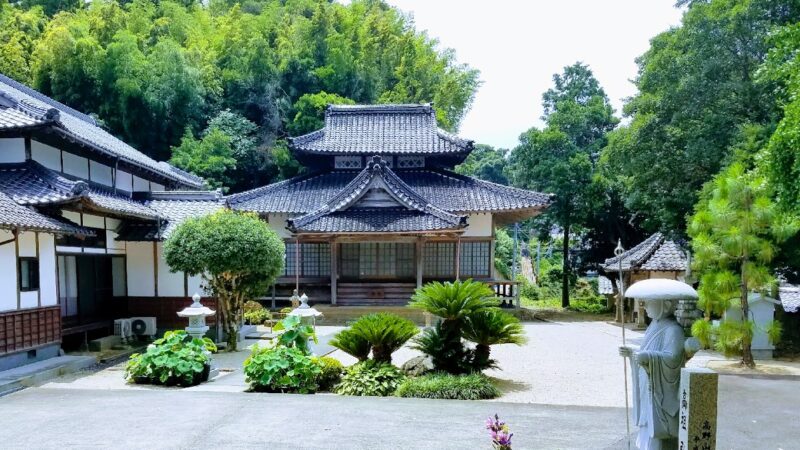
Reikanji Temple (Matsue City, Shimane Prefecture) | Complete Guide to History, Principal Image, Shimane Kannon Pilgrimage, and Access
Reikanji Temple, located in Nishikawazu-cho, Matsue City, Shimane Prefecture, is a historic temple established during the Edo period as a place of prayer for the Matsudaira family, the lords of the Matsue domain. It enshrines the Taizokai Dainichi Nyorai as a special part of the Izumo Province Thirteen Buddha Pilgrimage and is also known as a pilgrimage site for the Shimane Kannon Pilgrimage. This article provides a thorough explanation of Reikanji Temple’s detailed history, the characteristics of its principal image, the significance of pilgrimage to the temple, and information for visitors.
Overview of Reikanji Temple
Reikanji Temple is a Buddhist temple located in Nishikawazu-cho, Matsue City, Shimane Prefecture, and has a long history as a center of local faith. Currently, it operates as an independent temple, welcoming visitors in a tranquil environment.
The temple’s name, “Reikan,” means a miraculous response, indicating that it has answered the prayers of many people since ancient times. Deeply intertwined with the history of Matsue Castle town, this temple holds an important position as a regional cultural heritage site.
History and Transformations of Reikanji Temple
History of the Kannonji Era and Relocation
The history of Reikanji Temple dates back to the time when it was originally called “Kannonji Temple.” Originally located in the Tomita Castle town, it was relocated to the depths of Rakuzan Mountain during the Keicho era (1596-1615) with the construction of Matsue Castle. This period was a transitional period from the Sengoku period to the Edo period, a time when the layout of temples changed significantly along with the formation of Matsue’s castle town.
Reconstruction by Matsudaira Tsunataka
In 1661, when Matsudaira Tsunataka, the third lord of the Matsue domain, built a mountain villa on Rakuzan Mountain, Kannonji Temple was forced to relocate again. Lord Tsunataka moved the temple to its current location at the foot of the mountain, rebuilt it, and designated it as his personal place of prayer.
Matsudaira Tsunataka was a grandson of Tokugawa Ieyasu and is known for his efforts in promoting culture in the Matsue Domain. The establishment of Reikanji Temple was an important measure to strengthen the lord’s faith and the religious base of the region.
Renaming to Reikanji Temple and Abbot Gakuyu
In 1666 (Kanbun 6), Lord Tsunataka invited Abbot Gakuyu to be the founding abbot and changed the temple’s name from “Kannonji” to “Reikanji.” This renaming is thought to have reflected a new beginning for the temple and a desire for greater spiritual efficacy.
Under Abbot Gakuyu, Reikanji Temple was developed as an important religious facility of the Matsue Domain and came to function as a place of prayer for the lord. It continued to develop throughout the Edo period, maintaining a deep connection with the domain.
Characteristics of the Principal Image and Buddha Statue
Holy Kannon Bodhisattva
The principal image of Reikanji Temple is the Holy Kannon Bodhisattva. While Kannon Bodhisattva is widely worshipped as a symbol of compassion, the Holy Kannon statue at Reikanji Temple has a particularly noteworthy characteristic.
Generally, Holy Kannon statues are often standing figures, typically depicted holding a lotus flower in the right hand and lowering the left. However, the Holy Kannon statue at Reikanji Temple is unusual in that it is a seated figure making the Jōin mudra. The Jōin mudra is a hand gesture where both hands are clasped on the knees with the thumbs touching, primarily symbolizing meditation. This mudra is usually made by Amida Buddha or Shakyamuni Buddha, and it is extremely rare for Kannon Bodhisattva to make this gesture.
This unique form indicates that the principal image of Reikanji Temple was a special object of worship, making it a valuable Buddha statue from an art historical perspective.
Special Enshrinement: Taizo Dainichi Nyorai
Reikanji Temple enshrines Taizo Dainichi Nyorai as a special enshrinement of the Izumo Thirteen Buddhas Pilgrimage.
Dainichi Nyorai is the highest Buddha in Esoteric Buddhism and is considered to embody the very truth of the universe. The Dainichi Nyorai of the Taizokai (Womb Realm) represents the compassionate aspect that nurtures all life, and is depicted with the Dharma Realm Dharma Mudra (Dharma Realm Dharma Mudra).
The Thirteen Buddhas faith involves visiting thirteen Buddhas who preside over memorial services for the deceased, from the seventh day after death to the thirty-third anniversary. Reikanji Temple’s enshrinement of Dainichi Nyorai as a special enshrinement holds special significance in this pilgrimage and makes it an important place of worship for pilgrims.
The Principal Images of Entsudo and Shōrakudō
The main hall of Reikanji Temple also houses the principal images of Entsudo and Shōrakudō, which were once separate halls.
Entsudo is the ninth temple on the Shimane Kannon Pilgrimage, and its principal image is Nyoirin Kannon. Nyoirin Kannon is depicted with six arms, holding a wish-granting jewel and a Dharma wheel, and is worshipped as a Kannon that fulfills wishes.
Shōrakudō is the tenth temple on the pilgrimage, and its principal image is Byakue Kannon. Byakue Kannon is a graceful Kannon clad in white robes, and has particularly attracted the devotion of women.
Currently, only the ruins of these halls remain, but both principal images are carefully enshrined in the main hall of Reikanji Temple and continue to receive the faith of worshippers.
Shimane Fuda Kannon Pilgrimage and Pilgrimage
What is the Shimane Fuda Thirty-Three Kannon Pilgrimage?
In the Edo period, in Shimane County, Izumo Province (present-day Matsue City, north of Lake Shinji and Lake Nakaumi, and east of the Sata River), there was a Kannon pilgrimage known as “Shimane Fuda.” This pilgrimage route visited thirty-three Kannon halls and was central to the religious life of the local people.
The number thirty-three is based on the teaching of the Lotus Sutra that Kannon Bodhisattva transforms into thirty-three forms to save sentient beings. Thirty-three Kannon pilgrimages were formed throughout Japan, including the Saigoku Thirty-Three Kannon Pilgrimage, and the Shimane Fuda was one of them.
The Role of Reikanji Temple
Reikanji Temple, as the eighth temple of the Shimane Fuda Kannon Pilgrimage, has welcomed many pilgrims. During the Edo period, pilgrimages to Kannon temples were popular among common people, and visiting sacred sites was an important cultural activity that combined faith and entertainment.
Currently, many of the temples on the Shimane Kannon Pilgrimage have been abolished or consolidated, but Reikanji Temple has inherited the principal images of the ninth temple, Entsudo, and the tenth temple, Shorakudo, and continues to preserve the Kannon faith of all three locations. This can be considered an important role in preventing the extinction of local faith.
Izumo Province Thirteen Buddha Pilgrimage
Reikanji Temple is not only a temple on the Shimane Kannon Pilgrimage, but also a temple on the Izumo Province Thirteen Buddha Pilgrimage. The Thirteen Buddha Pilgrimage is a pilgrimage route where people pray for the repose of the deceased and seek peace of mind for their bereaved families.
The Thirteen Buddhas refer to Fudo Myoo (7th day after death), Shakyamuni Buddha (27th day), Manjushri Bodhisattva (31st day), Samantabhadra Bodhisattva (41st day), Jizo Bodhisattva (5th day), Maitreya Bodhisattva (61st day), Bhaisajyaguru Buddha (7th and 49th days), Kannon Bodhisattva (100th day), Seishi Bodhisattva (1st anniversary), Amida Buddha (3rd anniversary), Akshobhya Buddha (7th anniversary), Dainichi Nyorai (13th anniversary), and Kokuzo Bodhisattva (33rd anniversary).
Reikanji Temple specially enshrines Dainichi Nyorai, giving it a special place in this pilgrimage.
Cultural Assets and Highlights of Reikanji Temple
Main Hall Architecture
The main hall of Reikanji Temple is a valuable building that preserves the architectural style of the Edo period. Since its construction by Lord Matsudaira Tsunataka, the temple has undergone several restorations, yet retains its original appearance.
Inside the main hall, the principal image, the Holy Kannon Bodhisattva, is enshrined, along with the Nyoirin Kannon in the Entsu-do Hall, the Byakue Kannon in the Shōraku-do Hall, and the Taizō Dainichi Nyorai, creating a solemn atmosphere.
Temple Grounds Environment
Located in a quiet residential area of Nishikawazu-cho, Matsue City, Reikanji Temple maintains a tranquil atmosphere despite its urban location. The temple grounds are well-maintained, providing an environment where visitors can offer prayers in peace.
The surrounding area is close to Lake Shinji, offering a chance to experience Matsue’s nature and history. The temple grounds, which show different expressions with each season, provide solace to visitors.
Access Information
Location
Address: 1321 Nishikawazu-cho, Matsue City, Shimane Prefecture 690-0823
Transportation Access
By Public Transportation:
- Approximately 15 minutes by car from JR Matsue Station
- Approximately 5 minutes on foot from the Ichibata Bus “Nishikawazu” bus stop
By Car:
- Approximately 10 minutes from the San’in Expressway “Matsue Nishi IC”
- Approximately 15 minutes from Matsue city center via National Route 9
- Please inquire with the temple in advance regarding parking.
Visiting Hours and Precautions
Reikanji Temple is generally open for daytime visits, but visits may be restricted during memorial services and events. Especially if you wish to view the interior of the main hall, it is recommended that you contact the temple in advance.
When visiting, please maintain silence and be considerate of other visitors. Regarding photography, please note that permission may be required for photographing Buddha statues and the interior of the main hall.
Nearby Tourist Attractions
Matsue Castle
Matsue Castle, deeply intertwined with the history of Reikanji Temple, is one of the few remaining castle keeps designated as a National Treasure. Located approximately 10 minutes by car from Reikanji Temple, it is a central hub for Matsue tourism.
Lake Shinji
Lake Shinji, the seventh largest lake in Japan, is known for its beautiful sunsets. It’s just a few minutes’ drive from Reikanji Temple to the shores of Lake Shinji.
Matsue History Museum
This facility allows visitors to learn about the history and culture of Matsue, with exhibits on the Matsudaira family and the history of the castle town. It helps in gaining a deeper understanding of the historical background of Reikanji Temple.
Recommendation for Pilgrimage
Izumo Province Thirteen Buddhist Pilgrimage
The Izumo Province Thirteen Buddhist Pilgrimage, including Reikanji Temple, is a pilgrimage route visiting temples scattered throughout the Izumo region. By visiting these temples and receiving a Goshuin (temple stamp), one can deepen their peace of mind and honor their ancestors.
You don’t need to visit all the temples at once; you can proceed at your own pace, little by little. It’s important to respectfully pray at each temple and focus your heart on the respective Buddha.
About Goshuin (Temple Seals)
At Reikanji Temple, you can receive a Goshuin as proof of your visit (please note that this may not be possible depending on the circumstances; prior confirmation is recommended). A Goshuin is not merely a commemorative stamp, but proof of your connection with the Buddha, so please treat it with respect.
It is considered good manners to bring your Goshuincho (stamp book) and respectfully request one after your visit.
Summary
Reikanji Temple in Matsue City, Shimane Prefecture, is a historical temple built during the Edo period by Matsudaira Tsunataka. It enshrines a rare Kannon Bodhisattva with a meditation mudra as its principal image, and also houses the Taizokai Dainichi Nyorai as a special temple of the Izumo Thirteen Buddha Pilgrimage.
As the eighth temple on the Shimane Kannon Pilgrimage, and as the temple protecting the principal images of Entsudo (the ninth temple) and Shorakudo (the tenth temple), it has played a central role in the region’s Kannon faith. It is an important temple that conveys the history and culture of Matsue, and a place where one can pray in a peaceful environment.
When sightseeing in Matsue, why not visit this historic Reikanji Temple along with Matsue Castle and Lake Shinji, and feel the spirit of faith that has continued since the Edo period? For those interested in pilgrimage, it is a temple worth visiting as one of the thirteen Buddhist pilgrimage sites of Izumo Province.