Complete Guide to Abeno Shrine | A Thorough Explanation of Deities, Goshuin (Shrine Seals), History, and Shrine Grounds Highlights
Abeno Shrine, located in Kitabatake, Abeno Ward, Osaka City, is a historical shrine dedicated to Kitabatake Akiie and Kitabatake Chikafusa, loyal retainers of the Nanboku-cho period. As one of the fifteen shrines of the Kenmu Restoration and a former special government-supported shrine, this shrine enjoys high status and is beloved by locals while also attracting attention from history enthusiasts and visitors collecting shrine seals. This article provides a detailed explanation of Abeno Shrine, from its history and shrine grounds to information on shrine seals and access.
What is Abeno Shrine?
Although Abeno Shrine is a relatively new shrine, founded during the Meiji era, its background is rooted in the stories of heroes from the Nanboku-cho period, a crucial era in Japanese history. Currently designated as a special shrine by the Association of Shinto Shrines, it is known as a shrine of high historical value within Osaka City.
Basic Information
- Location: 3-7-20 Kitabatake, Abeno-ku, Osaka City, Osaka Prefecture
- Former Shrine Rank: Special Imperial Shrine
- Current Shrine Rank: Special Shrine
- Deities Enshrined: Kitabatake Chikafusa, Kitabatake Akiie
- Founded: Meiji 15 (1882)
- Shrine Building Completion: Meiji 20 (1887)
- Current Shrine Building: Rebuilt Showa 43 (1968)
About the Deities Enshrined
The two deities enshrined at Abeno Shrine are both important figures of the Kitabatake family who played an active role on the Southern Court side during the Nanboku-cho period.
Kitabatake Akiie
Kitabatake Akiie (1318-1338) was a renowned court official and military commander during the Nanboku-cho period, known as the “Flower General”—a handsome and brilliant warrior. Appointed Governor of Mutsu Province at the young age of 16, he governed Oshu and fought in various battles as a central figure for the Southern Court.
He supported Emperor Go-Daigo during the Kenmu Restoration and achieved numerous military successes in battles against Ashikaga Takauji. However, in 1338, at the young age of 21, he died in battle at Ishizu in Izumi Province (present-day Sakai City). His tomb still remains in Kitabatake Park near Abeno Shrine.
Kitabatake Chikafusa
Kitabatake Chikafusa (1293-1354) was the father of Akiie and a court noble who played an active role in both politics and military affairs as a senior retainer of the Southern Court. He supported the Kenmu Restoration as a close confidant of Emperor Go-Daigo and is also known as the author of the *Jinnō Shōtōki* (Chronicle of the Legitimate Succession of the Divine Emperors).
Even after his son Akiie’s death in battle, Chikafusa remained loyal to the Southern Court and continued to assert its legitimacy. His scholarship and loyalty were highly valued in later generations, and with the rise of reverence for the Emperor during the Meiji era, he was enshrined as a deity alongside Akiie.
History of Abeno Shrine
Circumstances of its Founding
The founding of Abeno Shrine is deeply connected to the rise of reverence for the Emperor after the Meiji Restoration. The Meiji government pursued a policy of honoring historical figures who demonstrated loyalty to the Imperial Family, and as part of this, the construction of a shrine dedicated to Kitabatake Akiie and his son Chikafusa was decided.
In 1882 (Meiji 15), the construction of Abeno Shrine was decided by imperial decree of Emperor Meiji, and the shrine grounds were set up at the current location, near where Kitabatake Akiie died in battle. In 1884 (Meiji 17), it was ranked as a special government-supported shrine, and the shrine building was completed in 1887 (Meiji 20).
War Damage and Reconstruction
The Abeno Shrine building was completely destroyed by fire during the Great Osaka Air Raid, which took place from March 13th to 14th, 1945 (Showa 20). This air raid caused immense damage to the city of Osaka, and many cultural properties and historical buildings were lost.
After the war, reconstruction progressed thanks to the enthusiasm and efforts of the local people, and the current shrine building was rebuilt in 1968. While constructed of modern reinforced concrete, it incorporates traditional shrine architectural styles, resulting in a magnificent structure.
Relationship with the Fifteen Shrines of the Kenmu Restoration
Abeno Shrine is counted as one of the “Fifteen Shrines of the Kenmu Restoration.” The Fifteen Shrines of the Kenmu Restoration are a collective term for 15 shrines dedicated to individuals who contributed to the Kenmu Restoration, designated during the Meiji era. These shrines were founded or designated to honor the loyal retainers who supported Emperor Go-Daigo’s Kenmu Restoration.
Other shrines in the Fifteen Shrines of the Kenmu Restoration include Minatogawa Shrine (Hyogo Prefecture), dedicated to Kusunoki Masashige, and Fujishima Shrine (Fukui Prefecture), dedicated to Nitta Yoshisada. Among these, Abeno Shrine is positioned as a representative shrine of Osaka.
Highlights of the Shrine Grounds
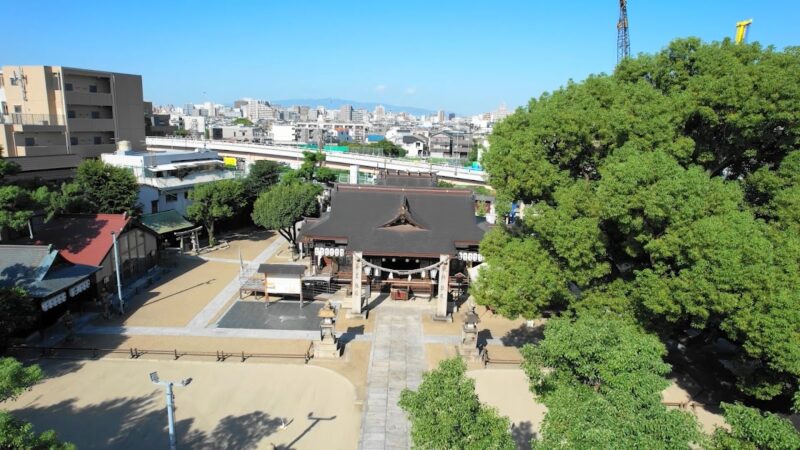
The grounds of Abeno Shrine offer many points of interest, including historically valuable facilities and beautiful gardens.
Main Hall and Worship Hall
Rebuilt in 1968, the main hall and worship hall follow traditional shrine architectural styles while incorporating modern construction methods. The contrast between the vermilion pillars and white walls is beautiful, creating a solemn atmosphere.
Nakai-matei Garden
Within the shrine grounds is a tea house called “Nakai-matei,” surrounded by a beautiful tea garden. While usually closed to the public, it is open to visitors on the first and third Sundays of each month, offering a space of tranquility and beauty.
The tea garden incorporates traditional Japanese garden styles while maximizing the use of the limited space within the urban shrine grounds, allowing visitors to enjoy the beauty of each season.
Mausoleum of Lord Kitabatake Akiie
Near Abeno Shrine, within Kitabatake Park, lies the mausoleum of Lord Kitabatake Akiie. This is said to be the place where Akiie was buried after his death in the Battle of Ishizu in Izumi Province.
Every year, on the day of the main festival of Abeno Shrine’s summer festival (mid-July), a procession is held from the shrine to the mausoleum in Kitabatake Park, and a Shinto ritual is performed to comfort the spirit of Lord Akiie.
Shrine Precincts
In addition to the main shrine, there are several subsidiary shrines within the grounds, each with its own unique characteristics. These shrines enshrine various deities, including local guardian deities, gods of business prosperity, and gods of academic success, catering to the diverse wishes of visitors.
About Goshuin (Shrine Seals)
Abeno Shrine offers Goshuin as proof of worship. Goshuin (temple/shrine stamps) can be obtained at the shrine office, and the offering fee is usually around 300 to 500 yen.
Features of Goshuin
The goshuin at Abeno Shrine features the shrine’s name and date of visit written in ink, along with the shrine’s seal. The calligraphy is strong and dignified, befitting a historical shrine.
Special seasonal goshuin are sometimes offered, making them popular among visitors who collect goshuin as a hobby. Especially during special periods such as summer festivals and New Year’s, goshuin with different designs than usual are sometimes available.
Goshuincho (Goshuin Notebook)
Abeno Shrine also offers original goshuincho. Several types are available, including designs related to Kitabatake Akiie and those featuring the shrine’s crest, making them valuable souvenirs.
Annual Events and Festivals
Abeno Shrine holds various festivals and events throughout the year.
Annual Grand Festival (Summer Festival)
The summer festival, held annually in mid-July, is the most important festival of Abeno Shrine. On the day of the main festival, the “Procession Ceremony” takes place, in which the portable shrine leaves the shrine grounds and proceeds to the tomb of Lord Akiie in Kitabatake Park.
This festival is an important annual event for the local people, and it is a lively gathering of many worshippers and local residents. At night, the light of lanterns illuminates the shrine grounds, creating a magical atmosphere.
New Year’s Events
From New Year’s Day to the third day of the year, the shrine grounds are bustling with worshippers making their first shrine visit of the year. Many people visit to pray for happiness in the new year, and lucky charms such as hama-ya (demon-repelling arrows) and kumade (rakes) are given out.
Other Events
- Setsubun Festival: On Setsubun in February, bean-throwing ceremonies are held, and worshippers visit to pray for protection against evil.
- Shichi-Go-San: In November, Shichi-Go-San prayers are held to pray for the healthy growth of children.
- Monthly Festival: Monthly festivals are held regularly each month, where daily gratitude and prayers are offered.
Divine Virtues and Blessings
The deities enshrined at Abeno Shrine, Kitabatake Chikafusa and Akiie, were accomplished figures in both learning and martial prowess, and are therefore believed to bestow various divine virtues.
Academic Achievement and Passing Exams
Chikafusa is known as a scholar who authored the “Jinno Shotoki” (Chronicle of the Legitimate Succession of the Divine Emperors), and Akiie was also a talented individual who acquired high levels of education at a young age. Therefore, many worshippers visit the shrine to pray for academic success and passing exams.
Victory and Guaranteed Succession
Akiie was a renowned general known as the “Flower General,” and achieved military success in numerous battles. Therefore, he attracts worshippers seeking victory in sports, competitions, and business. ### Loyalty and Integrity
Both Lord Chikafusa and Lord Akiie were figures who maintained unwavering loyalty to the Southern Court. Therefore, they are revered by those who wish to cultivate a heart that values sincerity and loyalty.
Pilgrimage Route of Shinto and Buddhism
Abeno Shrine is designated as the 44th stop (Osaka 3rd) of the “Pilgrimage Route of Shinto and Buddhism.” The Pilgrimage Route of Shinto and Buddhism is a pilgrimage route visiting shrines and temples in the Kinki region, consisting of 150 sacred sites in total.
This pilgrimage route inherits the tradition of syncretism of Shinto and Buddhism, aiming to attain deeper faith and peace of mind by visiting both shrines and temples. Many pilgrims visit Abeno Shrine, and special stamp books and pilgrimage supplies are available.
The Song “Ah, Kitabatake”
During the Meiji era, a song was created to praise the loyalty of Kitabatake Akiie. This song was sung in schools and played a role in widely disseminating the achievements of Lord Akiie.
The lyrics express the courage and loyalty of Lord Akiie, who sacrificed his life for his country at a young age, and it held an important position as part of the Meiji era’s imperial loyalist ideology and patriotic education. Even today, it is sometimes sung at festivals such as those held at Abeno Shrine.
Access and Transportation Information
Public transportation is the most convenient way to access Abeno Shrine.
Access by Train
Hankai Electric Railway (Hankai Tramway)
- Get off at Tenjin-no-mori Station on the Hankai Line, approximately 6 minutes on foot southeast.
- Get off at Kitabatake Station on the Hankai Line, approximately 3 minutes on foot (nearest station).
Nankai Electric Railway
- Get off at Kishisato-Tamade Station on the Nankai Main Line/Koya Line, approximately 5 minutes on foot east.
Osaka Metro (Subway)
- Get off at Nishitanabe Station on the Midosuji Line, approximately 10 minutes on foot west.
- Get off at Showacho Station on the Midosuji Line, approximately 15 minutes on foot southwest.
Access by Car
Approximately 5 minutes from the Fuminosato Exit of the Hanshin Expressway Route 14 Matsubara Line. However, while there is a parking lot for visitors on the temple grounds, the number of spaces is limited, so the use of public transportation is recommended during New Year’s visits and festivals.
Landmarks in the Area
Abeno Shrine is located in a residential area, but as the place name “Kitabatake” is derived from the shrine, it is a landmark in the area. Nearby is Kitabatake Park, where the tomb of Lord Kitabatake Akiie is located.
Manners and Time Required for Visiting the Shrine
Etiquette for Visiting the Shrine
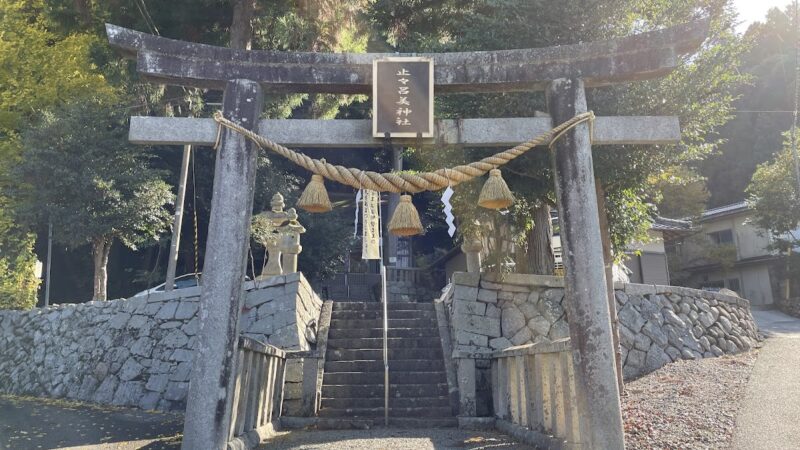
- Bow before passing through the torii gate: Before entering the sacred area, bow before the torii gate.
- Purify at the water basin: Purify your hands and mouth at the water basin.
- Walk along the edge of the path: The center of the path is considered the path of the gods, so walk along the edge.
- Two bows, two claps, one bow: In front of the main hall, bow twice, clap twice, and finally bow once.
Estimated Time Required
For a normal visit, allow about 30 minutes. If you wish to leisurely explore the grounds, allow about an hour. If you visit on a day when the Nakai-tei Garden is open to the public, it is recommended to allow an additional 30 minutes to an hour.
Nearby Tourist Attractions
Kitabatake Park
Located a few minutes’ walk from Abeno Shrine, this park contains the tomb of Lord Kitabatake Akiie. It is an important location, serving as the destination for the procession during the summer festival.
Abeno Harukas
Approximately 2km north of Abeno Shrine lies Abeno Harukas, Japan’s tallest skyscraper. From the observation deck, you can enjoy panoramic views of Osaka city, as well as shopping and dining.
Sumiyoshi Taisha Shrine
Approximately 2km southwest of Abeno Shrine lies Sumiyoshi Taisha Shrine, one of Osaka’s most representative ancient shrines. It is the head shrine of all Sumiyoshi shrines nationwide, and over 2 million people visit annually for Hatsumode (first shrine visit of the year).
About Weddings and Prayers
Abeno Shrine offers Shinto wedding ceremonies and various prayers.
Shinto Wedding Ceremonies
You can have a traditional Shinto wedding ceremony. A ceremony at this historic shrine will take place in a solemn and dignified atmosphere, creating a lifelong memory. Please inquire with the shrine office in advance regarding the offering fee and other details.
Various Prayers
- Prayer for safe childbirth
- First shrine visit (Omiyamairi)
- Shichi-Go-San (7-5-3) ceremony
- Protection from evil
- Traffic safety
- Business prosperity
- Prayer for success in examinations
You can receive prayers for various milestones in life and for different wishes.
Summary
Abeno Shrine is a historic and prestigious shrine dedicated to Kitabatake Akiie and Kitabatake Chikafusa, heroes of the Nanboku-cho period. As one of the fifteen shrines of the Kenmu Restoration and a pilgrimage site on the Shinto-Buddhist pilgrimage route, it is beloved by many worshippers.
Despite being located in the urban area of Osaka City, the shrine grounds offer a tranquil space and are filled with an atmosphere that evokes a sense of history. It is believed to grant various blessings, including academic success and good fortune, attracting the faith of local residents, as well as history enthusiasts and those collecting Goshuin (shrine stamps).
When visiting Osaka, why not take a visit to Abeno Shrine and quietly pray while reflecting on the heroes of the Nanboku-cho period? Visiting on a day when the Nakai-tei Garden is open will allow you to appreciate the shrine’s charm even more deeply.