Meiseki-ji Temple Complete Guide | History, Highlights, and Visiting Information for the 43rd Temple of the Shikoku 88 Temple Pilgrimage
About Meiseki-ji Temple
Meiseki-ji Temple is a Tendai Jimon sect temple located in Akashi, Uwacho, Seiyo City, Ehime Prefecture. Its formal names are Genkozan and Enshuin, and it enshrines a Thousand-Armed Kannon Bodhisattva as its principal image. As the 43rd temple of the Shikoku 88 Temple Pilgrimage, it has long been cherished by many pilgrims.
Locally, it is affectionately known as “Ageishi-san” and is recognized as a representative ancient temple of the Nanyo region. The temple grounds are surrounded by giant cedar and cypress trees, creating a tranquil atmosphere for worship.
History of Akashi-dera Temple
Founding and Ancient History
The origins of Akashi-dera Temple date back to the first half of the 6th century, during the reign of Emperor Kinmei (532-571). It is said that, at the request of Emperor Kinmei, a Buddhist ascetic named Enshuin Shōchō built a seven-building temple complex to enshrine a statue of the Thousand-Armed Kannon Bodhisattva, a Buddhist image brought from Tang China, and founded the temple.
In 734 (Tenpyō 6), the ascetic Jūgen invited the Twelve Shrines of Kumano from Kishū, further strengthening the temple’s religious foundation. This connection to Kumano faith can still be seen in the Kumano Shrine that remains on the temple grounds today.
Restoration by Kōbō Daishi
In 822 (Kōnin 13), Kōbō Daishi (Kūkai), who was traveling around Shikoku, visited this area and restored the dilapidated Akashi-dera Temple. It is said that Kobo Daishi himself carved a statue of the Thousand-Armed Kannon and enshrined it as the principal image. This restoration solidified Akashi-dera’s position as one of the sacred sites of the Shikoku Pilgrimage.
It is said that Kobo Daishi performed rituals at this temple and demonstrated many miraculous powers, and thereafter, it came to play an important role as a training ground for Shingon Esoteric Buddhism.
Medieval Development and the Involvement of Minamoto no Yoritomo
Records show that Minamoto no Yoritomo carried out repairs to this temple during the Kamakura period. Yoritomo implemented a policy of protecting famous temples throughout the country, and Akashi-dera was one of the temples that benefited from this. These repairs restored the temple complex, and the temple’s influence greatly increased.
In the Muromachi period, it came under the patronage of the Saionji clan, the shugo daimyo (provincial governor) of Iyo Province. The Saionji clan designated this temple as their family’s place of prayer, donating temple lands and repairing the temple buildings. During this period, Akashi-dera flourished as a center of Buddhist culture in the Nanyo region. ### From the Edo Period to the Modern Era
During the Edo period, Akashi-ji Temple served as a place of prayer for the Date family, the lords of the Uwajima Domain, and received generous protection from the domain. The Date family consistently valued Akashi-ji Temple and made numerous donations. During this period, the temple’s management was stable, and it also functioned as a training ground for many monks.
Despite the impact of the anti-Buddhist movement of the Meiji era, it survived, supported by the strong faith of the local community. The current main hall was constructed between 1882 (Meiji 15) and 1890 (Meiji 23), completed by the Ikata master carpenters, Kamei Chiyoji and Utsunomiya Umetaro.
Origin of the Temple and Mountain Names
The mountain name of Akashi-ji Temple, “Genkozan,” embodies the meaning that the compassionate light of Senju Kannon (Thousand-Armed Kannon) shines as a source, illuminating all sentient beings. The temple’s sub-temple name, “Enshuin,” represents the perfect salvation of all sentient beings by the thousand hands of Senju Kannon.
There are several theories regarding the origin of the temple’s name, “Akashi.” One theory suggests it derives from a large rock (Akashi) located within the temple grounds, which has been revered as a sacred stone since ancient times. The local name, “Ageishi,” is thought to be a corrupted form of “Akashi.”
Highlights of the Temple Grounds
Main Hall
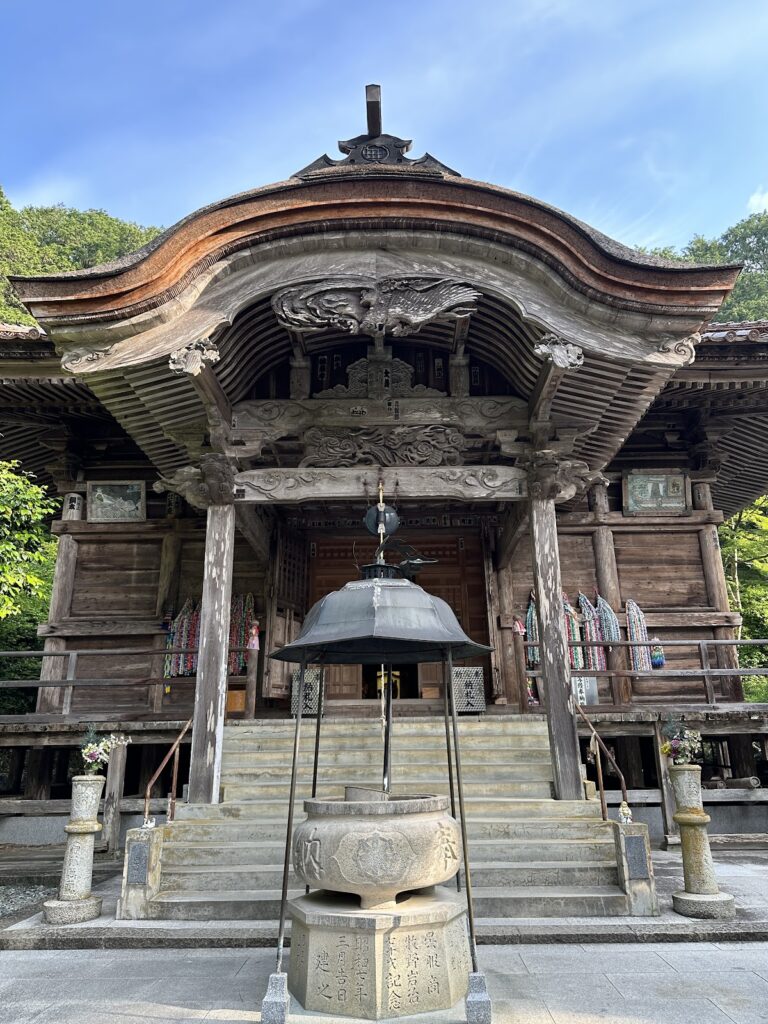
The main hall of Akashi-ji Temple is a magnificent building measuring five bays on each side, characterized by its distinctive hipped roof covered in red Sekishu tiles. Constructed between 1882 and 1890, this main hall was designated a National Registered Tangible Cultural Property in 2007.
The inner sanctuary houses the principal image, the Thousand-Armed Kannon Bodhisattva, flanked by Fudo Myoo and Bishamonten. The interior decoration, while simple, is dignified and well-preserved, reflecting the characteristics of temple architecture from the late Edo period to the Meiji era.
Daishido Hall
Located to the right of the main hall, the Daishido Hall houses a statue of Kobo Daishi. Pilgrims always pay their respects at this hall after visiting the main hall. The Daishido Hall was registered as a National Registered Tangible Cultural Property in 2007 and boasts a beautiful architectural style that harmonizes with the main hall.
Every morning, monks perform religious services inside the hall, offering gratitude and appreciation to the Daishi.
Niomon Gate
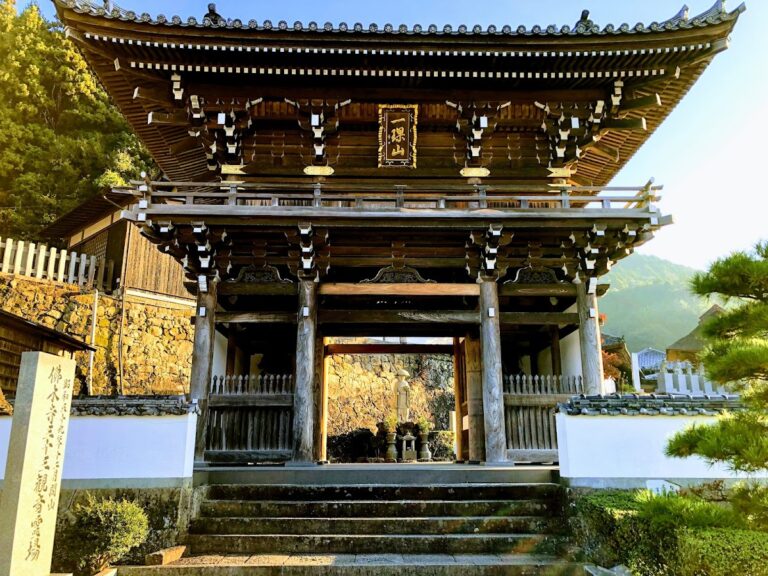
The Niomon Gate, standing at the entrance to the temple grounds, is an important structure that first welcomes visitors. Kongo Rikishi statues (Nio statues) are enshrined on either side of the gate, protecting the sacred area from evil. This Niomon Gate is also a Registered Tangible Cultural Property and a masterpiece showcasing the finest architectural techniques of the Meiji period.
Bell Tower
In a corner of the temple grounds stands the bell tower, where a temple bell hangs to announce the time in the morning and evening. The sound of this bell resonates throughout the surrounding settlements, becoming an integral part of the lives of the local residents. Visitors are also welcome to ring the bell, and its sound is said to purify the soul.
Kumano Shrine
At the back of the temple grounds lies the Kumano Shrine, dedicated to the Twelve Kumano Shrines, which were established in 734 AD by the ascetic Jūgen. It is an important historical site demonstrating the deep connection between Akashi-dera Temple and Kumano faith.
This shrine, which retains strong traces of the syncretism of Shinto and Buddhism, was worshipped as an integral part of Akashi-dera Temple until the Edo period. Even today, it attracts fervent devotion from the local people, and a temple fair is held every year on August 9th, drawing many visitors.
Giant Trees on the Temple Grounds
The grounds of Akashi-dera Temple are surrounded by giant cedar and cypress trees estimated to be several hundred years old. These giant trees are living witnesses to the temple’s long history, creating a solemn atmosphere within the grounds. The giant cedar trees behind the main hall are particularly impressive and have garnered attention as a power spot.
Cultural Properties
Nationally Registered Tangible Cultural Properties
In 2007, nine buildings at Akashi-ji Temple, including the main hall, Daishi Hall, Niomon Gate, bell tower, priest’s quarters, and guest hall, were registered as Nationally Registered Tangible Cultural Properties. These buildings retain many characteristics of Meiji-era temple architecture and possess high historical value.
In particular, the red Sekishu tiles on the main hall are a rare architectural style even within Ehime Prefecture and are considered important historical materials in architectural history.
National Historic Site Designation
In 2019, the “Iyo Pilgrimage Route: Akashi-ji Temple Grounds and Daiho-ji Temple Route” was designated a National Historic Site. This recognizes the historical value of the Shikoku Pilgrimage Route, and the route from the 42nd temple, Butsumoku-ji, through Akashi-ji, to the 44th temple, Daiho-ji, is designated for preservation.
This designation elevated Akashi-dera Temple beyond mere temple status to a significant cultural heritage site that preserves the culture of the Shikoku Pilgrimage.
Temple Treasures
Akashi-dera Temple possesses numerous temple treasures, including ancient documents, Buddhist statues, and Buddhist paintings. In particular, the medieval documents are attracting attention from researchers as valuable historical materials illustrating its relationship with the Saionji and Date families.
In 2009, a special exhibition, “Akashi-dera Temple and the Shikoku Pilgrimage,” was held at the Ehime Prefectural Museum of History and Culture, where these temple treasures were publicly displayed.
Inner Sanctuary
The inner sanctuary of Akashi-dera Temple is located in the mountains, approximately 2 kilometers from the main temple. It is a sacred site that has been used as a place of ascetic practice since ancient times and remains an object of worship today.
The inner sanctuary can be reached by walking along a mountain path, with various sacred sites and stones scattered along the way. Pilgrims seeking a deeper spiritual experience visit this tranquil place surrounded by deep forest.
Surrounding Extra Sacred Sites and Pilgrimage Routes
Around Akashi-ji Temple, there are several extra sacred sites that are not included in the Shikoku 88 Temple Pilgrimage, but are visited by pilgrims. These temples, like Akashi-ji Temple, have a long history and are revered by local faith.
Daihoji Road
The pilgrimage route from Akashi-ji Temple to the next temple, the 44th temple, Daihoji Temple, is called the “Daihoji Road” and is designated a national historical site. This route is approximately 10 kilometers long and passes through mountainous areas, retaining a strong atmosphere of traditional pilgrimage routes.
Along the route, there are distance markers (mileposts) and rest areas, allowing you to experience the history of pilgrimage culture firsthand.
Hanaga Pass
On the way from Akashi-ji Temple to Daihoji Temple, there is a difficult pass called Hanaga Pass. This pass has a significant elevation difference and has been considered a test for pilgrims. A Jizo Bodhisattva statue is enshrined at the mountain pass, making it a place where people pray for safe travels.
Visiting Information
Basic Information
- Official Name: Genkozan Enshuin Akashi-ji Temple
- Sect: Tendai Jimon Sect
- Principal Image: Thousand-Armed Kannon Bodhisattva
- Pilgrimage Site: 43rd temple of the Shikoku 88 Temple Pilgrimage
- Founder: Enshuin Shocho
- Address: 201 Akashi, Uwa-cho, Seiyo City, Ehime Prefecture
- Phone: 0894-62-0032
- Temple Hours: 7:00~17:00 (may vary depending on the season)
- Parking: 30 regular cars, 5 large buses (free)
Access Method
Access by Car
- Approximately 10 minutes from the Seiyo-Uwa IC on the Matsuyama Expressway
- Via Prefectural Road 29 from National Route 56
- Approximately 10 kilometers from the previous temple, Butsumokuji, about 20 minutes by car.
- Approximately 10 kilometers from the next temple, Daihoji, about 25 minutes by car.
Access by Public Transportation
- Approximately 40 minutes on foot or 10 minutes by taxi from JR Yosan Line “Unomachi Station”.
- Get off at the “Akashiji-mae” bus stop on the Uwajima Bus, about 5 minutes on foot.
For Pilgrims on Foot
- Approximately 10 kilometers from the previous temple, Butsumokuji, about 3 hours on foot.
- Approximately 10 kilometers from the next temple, Daihoji, about 3 hours 30 minutes on foot (crossing the Hanaga Pass).
Etiquette for Worship
Worship at Akashiji Temple follows the general etiquette of the Shikoku Pilgrimage.
- Bow before passing through the Niomon Gate
- Cleanse your hands and mouth at the water basin
- Ring the bell at the bell tower (only before praying)
- Chant sutras, offer votive slips and coins at the main hall
- Chant sutras, offer votive slips and coins at the Daishi Hall
- Receive a Goshuin (temple stamp) at the sutra copying office
General visitors other than pilgrims can pray using the same etiquette. It is important to pray quietly and with a sincere heart.
Temple Lodgings and Rest Facilities
Akashi-ji Temple does not have temple lodgings, but there are pilgrim lodgings and guesthouses scattered around the area. There is also a rest area on the temple grounds that visitors can use freely.
There are also several hotels and inns in the town of Uwacho, Seiyo City, where you can stay overnight.
Annual Events
Temple Fair (August 9th)
Every year on August 9th, the Kumano Shrine’s temple fair is held. On this day, many worshippers visit, and the temple grounds are bustling with stalls. It is an important annual event for the local people.
Mini Shikoku 88 Temples
Within the temple grounds, there is a “Mini Shikoku 88 Temples” area, allowing visitors to pay homage to the principal images of all 88 temples of the Shikoku pilgrimage. Even those who find the full Shikoku pilgrimage difficult due to age or health reasons can accumulate the merit of the 88-temple pilgrimage here.
Akashi-ji Temple and Shikoku Pilgrimage Culture
Akashi-ji Temple is one of the temples among the 88 sacred sites of Shikoku that actively works to preserve and pass on the pilgrimage culture. It continues to protect the traditions of the Shikoku pilgrimage in cooperation with the local community, through activities such as preserving the pilgrimage route, which has been designated a national historical site, and passing on the culture of hospitality to pilgrims.
In recent years, the number of foreign pilgrims has also increased, and the temple is focusing on installing multilingual signage and promoting international pilgrimage culture.
Nearby Tourist Attractions
Unomachi Townscape
Located approximately 3 kilometers from Akashi-ji Temple, Unomachi is a designated Important Preservation District for Groups of Traditional Buildings, preserving the townscape from the Edo to Meiji periods. The rows of white-walled merchant houses and samurai residences create an atmosphere that feels like stepping back in time.
Kaimei School
Kaimei School, located in Unomachi, is a pseudo-Western style elementary school built in 1882 (Meiji 15). It is now open to the public as an educational museum. It is a valuable facility for learning about education during the Meiji period.
Uwa Folk Tools Museum
This folk tools museum exhibits approximately 6,000 items, allowing visitors to learn about the lifestyle and culture of the Iyo region. A diverse range of folk tools, including farming tools, daily necessities, and festival implements, are systematically displayed.
Summary
Akashi-ji Temple, the 43rd temple on the Shikoku 88 Temple Pilgrimage, boasts a history of over 1400 years and has welcomed countless pilgrims. Its history—founded by imperial decree of Emperor Kinmei, restored by Kobo Daishi, and patronized by powerful figures such as Minamoto no Yoritomo, the Saionji clan, and the Date family—speaks to the temple’s importance.
The group of buildings designated as a National Registered Tangible Cultural Property, the pilgrimage route designated as a National Historic Site, and the forest of giant trees surrounding the temple grounds evoke a profound sense of spirituality and historical weight in visitors.
Akashi-ji Temple is a place worth visiting not only for those undertaking the Shikoku pilgrimage, but also for those interested in history and culture, and those seeking peace of mind. When visiting the Nanyo region of Ehime Prefecture, be sure to visit this ancient temple and experience the spirit of faith that has continued for over a thousand years.