Complete Guide to Yusuhara Hachimangu Shrine | A Thorough Explanation of the History, Important Cultural Properties, and Power Spot of Bungo Province’s Ichinomiya
What is Yusuhara Hachimangu Shrine?
Yusuhara Hachimangu Shrine is a shrine located in Kami-Hachiman, Oita City, Oita Prefecture. It is a historically significant shrine that has long been revered as the Ichinomiya (first-ranked shrine) of Bungo Province. It is also read as “Isuhara” or “Yusubaru,” and is sometimes written as Yuhara Hachimangu.
Its former shrine rank was a National Shrine of the Lower Rank, and it is currently designated as a Special Shrine by the Association of Shinto Shrines. Within the grounds, surrounded by a deep cedar forest, stand 10 shrine buildings, including the main hall, prayer hall, worship hall, and gate tower, all designated as important national cultural properties. Its unique layout, modeled after Usa Jingu Shrine, is a distinctive feature.
Despite its convenient location, approximately 15 minutes by car from Oita city center, it possesses a solemn atmosphere enveloped in an ancient forest, and in recent years has attracted attention as a power spot.
History and Origins of Isohara Hachimangu Shrine
Founding History
The founding of Isohara Hachimangu Shrine dates back to the early Heian period. In 827 (Tenchō 4), during a thousand-day retreat at Usa Hachimangu Shrine, the renowned monk Konki Wajō of Enryaku-ji Temple received a divine oracle stating that “Hachiman-sama will manifest in Buzen Province on the 3rd day of the 3rd month of the 7th year of Tenchō (830).”
On July 7th, 830 (Tenchō 7), a miraculous event occurred in which a white banner flew over Kaku-go, Ōita County, and Konki Wajō reported this to the imperial court. In 836 (Jōwa 3), by imperial decree of Emperor Ninmyō, Ōe no Uku, the governor of Bungo Province, constructed a shrine on Isohara Mountain and enshrined a divided spirit of Usa Hachimangu Shrine, which is considered the origin of this shrine.
Status as the Ichinomiya (First Shrine) of Bungo Province
Since its founding, Isohara Hachimangu Shrine has been revered as the Ichinomiya of Bungo Province, attracting the deep devotion of provincial governors and samurai families. In particular, during the medieval period, it received the fervent faith of the Otomo clan, who ruled Bungo Province, and was also protected by successive lords of the Funai Domain.
During the Edo period, it played an important role as a place of prayer for the Funai Domain lords, and the construction and repair of the shrine buildings were carried out with the support of the domain.
Developments Since the Modern Era
In the shrine ranking system established after the Meiji Restoration, Isohara Hachimangu Shrine was initially ranked as a prefectural shrine, but in 1916 (Taisho 5), it was promoted to a national shrine of the lower rank, establishing its position as a representative shrine of Bungo Province.
Many shrine buildings were destroyed in a great fire in 1749 (Kanei 2), but they were subsequently rebuilt, resulting in the magnificent complex of shrine buildings seen today. The main hall was completed in 1850 (Kaei 3) and is a masterpiece that embodies the finest architectural techniques of the late Edo period.
Nationally Designated Important Cultural Property: Shrine Architecture
Characteristics and Value of the Main Hall
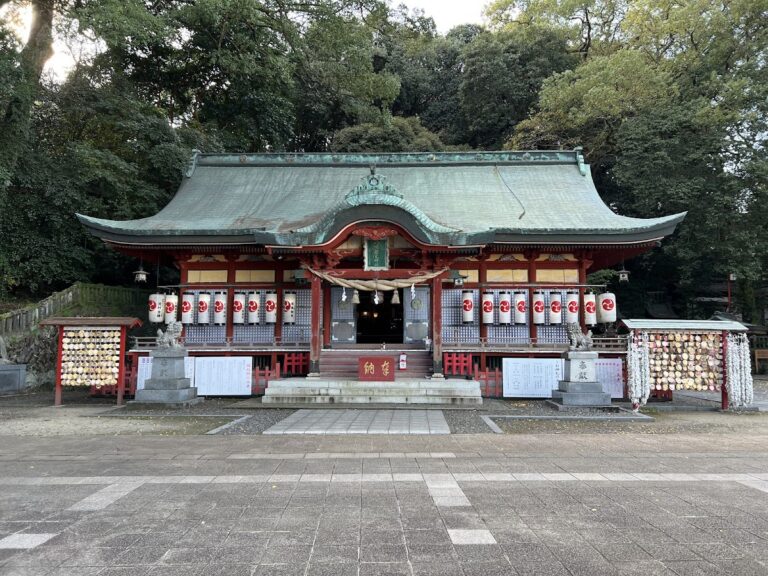
The main hall of Isohara Hachimangu Shrine is a Hachiman-style shrine building consisting of a rear hall and a front hall, each with five bays in length. It was completed in 1850 (Kaei 3). The interior is divided into an inner sanctuary and an outer sanctuary, while the exterior is magnificently decorated with colors and other embellishments.
Hachiman-style architecture is a unique form that integrates two buildings, front and back, and is a rare architectural style with few examples nationwide. The main hall of Isohara Hachimangu Shrine possesses a unique main hall form and shrine layout modeled after Usa Jingu Shrine, making it of extremely important value in architectural history.
Notably, it features a small building called a “Hanado” (flower hall) on the veranda. This is a unique form not seen in other Hachiman-style main halls, demonstrating a distinctive regional characteristic.
The Sculpture of the Tower Gate (South Gate) “Higurashi-mon”
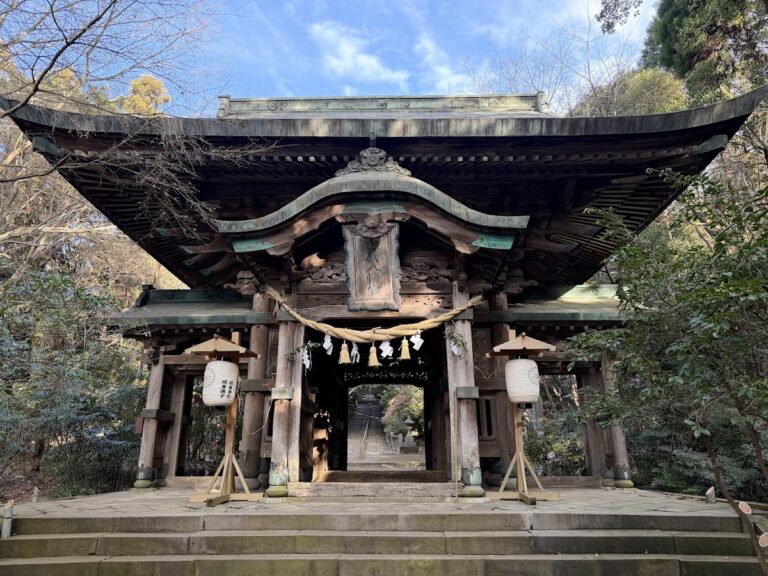
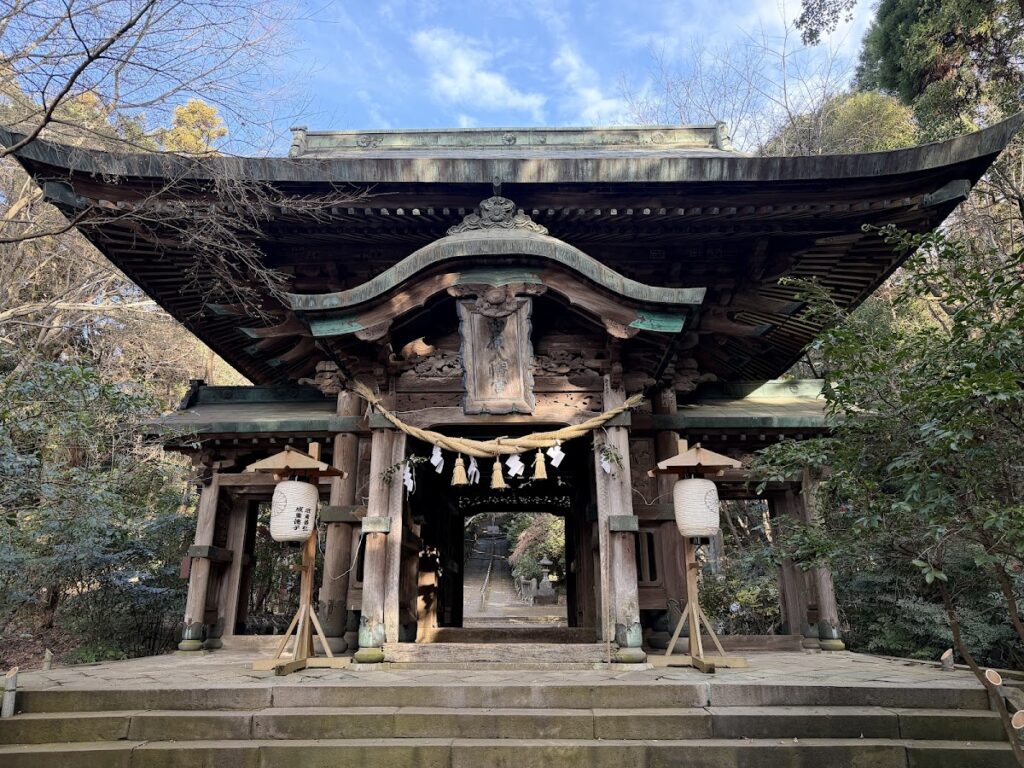
The tower gate of Isuhara Hachimangu Shrine, also known as the “South Gate” or “Higurashi-mon,” is renowned for its magnificent and opulent carvings.
It features a unique form with a curved gable roof on the lower level, and is adorned with delicate carvings of dragons, flowers, birds, and saints. Its exquisite carvings have earned it the name “Higurashi-mon” (meaning “Sunset Gate”), signifying that one could gaze upon it all day without getting bored, and it continues to captivate visitors.
It is highly regarded from both architectural and art history perspectives as a masterpiece representing the pinnacle of late Edo period carving techniques.
Arrangement of the Shinden and Haiden
A distinctive feature of the Isuhara Hachimangu Shrine’s layout is its unique configuration, with the tower gate, Shinden, and main hall aligned along an axis. This arrangement is modeled after Usa Jingu Shrine and reflects its status as the Ichinomiya (first-ranked shrine) of Bungo Province.
The Shinden (offering hall) is an important building connecting the main shrine and the worship hall, and functions as a place for offering sacred food during rituals. Along with the worship hall, it is a valuable surviving structure that exemplifies the typical architecture of shrine buildings from the late Edo period.
Other Important Cultural Properties
In addition to the main shrine, Shinden, worship hall, and gate tower, a total of 10 buildings, including the treasure hall, east corridor, and west corridor, are designated as important cultural properties of Japan. These were rebuilt sequentially from the late Edo period to the end of the Edo period after a fire in 1749, forming a unified group of shrine buildings.
The corridors are arranged to surround the main shrine, serving to separate the sacred area from the secular world, while also creating a beautiful architectural landscape.
Isohara Hachimangu Shrine as a Power Spot
3000-Year-Old Sacred Tree
Within the shrine grounds stands a giant camphor tree, estimated to be approximately 3000 years old, and is known as a representative power spot of Isohara Hachimangu Shrine.
This sacred tree is a symbol of the ancient forest, and many visitors say they feel a strong energy emanating from its overwhelming presence and vitality. With a trunk circumference exceeding 10 meters, it boasts a towering height, making it a precious place to experience the mystery of nature and the weight of history.
The Fan-Shaped Stone of Happiness
Within the shrine grounds is a special stone called the “Fan-Shaped Stone of Happiness,” which has long been said to grant wishes to those who step on it.
This fan-shaped stone is believed to bring happiness to visitors who step on it while making a wish, and it has become a popular power spot for fulfilling various wishes, such as finding love, business prosperity, and academic success.
The Sacred Atmosphere of the Ancient Forest
The greatest charm of Isohara Hachimangu Shrine lies in its sacred atmosphere, enveloped in a deep cedar forest. Stepping onto the grounds, one is enveloped in silence and pure air, far removed from the hustle and bustle of the city, and feels a sense of purification of mind and body.
The ancient forest, revered as a dwelling place of gods, embodies the origins of nature worship. Combined with the benefits of forest bathing, it is a beloved place for healing and rejuvenation.
Deities and Divine Virtues
Main Deities
The main deities of Isohara Hachimangu Shrine are the three Hachiman gods, centered around Hachiman Okami (Emperor Ojin). Specifically, the following three deities are enshrined:
- Emperor Ōjin: The 15th Emperor, revered as a god of war and victory.
- Hime-no-Ōkami: A collective name for the three Munakata goddesses, deities of maritime safety and traffic safety.
- Empress Jingū: Mother of Emperor Ōjin, deity of safe childbirth and child-rearing.
Divine Virtues
Hachiman is known as a god of war and is believed to possess a wide range of divine virtues, including good fortune in competitions, protection from evil, family safety, business prosperity, and academic success.
Especially as the Ichinomiya (first-ranked shrine) of Bungo Province, it has played a role as a guardian deity of the region and has held an important position as a place of prayer for national peace and abundant harvests.
Annual Events and Festivals
Major Festivals
Various festivals are held throughout the year at Isohara Hachiman Shrine.
The Annual Grand Festival is the most important festival, celebrated grandly every year. Traditional Shinto rituals, such as the portable shrine procession and the dedication of Kagura (sacred dance), are performed, attracting many worshippers.
For the New Year’s visit, many worshippers visit the shrine, which is the Ichinomiya (first-ranked shrine) of Bungo Province, to pray for peace and prosperity in the new year.
Other Annual Events
- Saitansai (January 1st): A festival celebrating the New Year
- Setsubunsai (February): Prayers for protection from evil and for good fortune
- Natsugoshi no Oharae (June 30th): A Shinto ritual to purify sins and impurities accumulated over the past six months
- Shichi-Go-San Pilgrimage (November): A prayer for the growth of children
- Toshikoshi no Oharae (December 31st): A Shinto ritual to purify sins and impurities accumulated over the past year
Through these events, we deepen our ties with the local community and strive to pass on traditional culture.
Information for Visitors
Access
Access by Train and Bus
- Take the Oita Bus bound for “Yasuhara Hachimangu-mae” from JR Oita Station and get off at the last stop (approximately 25 minutes).
- Approximately 15 minutes by taxi from JR Oita Station.
Access by Car
- Approximately 20 minutes from the Oita IC on the Oita Expressway.
- Approximately 15 minutes from Oita city center via Prefectural Road 21.
- Parking: Free parking available (approximately 100 regular cars).
Visiting Hours and Admission Fee
- Visiting Hours: Grounds are freely accessible (Shrine office is open from 9:00 AM to approximately 5:00 PM).
- Admission Fee: Free.
- Goshuin (Shrine Stamp): Available at the shrine office (offering fee approximately 300 yen).
Manners and Points for Visiting
When visiting Yusuhara Hachimangu Shrine, please keep the following points in mind.
- Bow before passing through the torii gate: A courtesy when entering the sacred area.
- Purify yourself at the water basin: Purify your left hand, then your right hand, then your mouth.
- Walk along the edge of the path: The center is considered the path of the gods.
- Two bows, two claps, one bow: Basic worship etiquette.
- Visit the sacred tree and fan-shaped stone: Popular as a power spot.
- Admire the carvings on the South Gate: Take your time to observe the details.
Nearby Attractions
Tourist Spots in Oita City
When visiting Isohara Hachimangu Shrine, we recommend visiting other tourist spots in Oita City as well.
Oita Funai Castle Ruins was the residence of the Funai Domain during the Edo period and is now a park. It has a deep historical connection to Isohara Hachimangu Shrine, and visiting both together will deepen your understanding of Bungo’s history.
The Oita City Museum of Art features exhibits on local history and culture, allowing visitors to deepen their understanding of the cultural properties of Isohara Hachimangu Shrine.
Gourmet Information
Oita Prefecture is known not only as the “Onsen Prefecture” (hot spring prefecture) but also for its rich food culture. After visiting the shrine, we recommend enjoying Oita’s local cuisine, such as toriten (chicken tempura), Seki aji (horse mackerel) and Seki saba (mackerel), and dango-jiru (dumpling soup).
Cultural Value of Isohara Hachimangu Shrine
Significance in Architectural History
The shrine buildings of Isohara Hachimangu Shrine are valuable historical remains that strongly retain the characteristics of late Edo period shrine architecture. In particular, the Hachiman-zukuri style main hall is rare nationwide and, due to its unique form modeled after Usa Jingu Shrine, occupies an important position in architectural history research.
Architectural elements that clearly demonstrate local characteristics, such as the main hall with a flower hall and the gate tower with a curved gable roof, are valuable materials that show the uniqueness of the architectural culture of the Bungo region.
Position in the History of Religion
As the Ichinomiya (first-ranked shrine) of Bungo Province, Isohara Hachimangu Shrine has played a crucial role as the center of local faith from ancient times to the modern era. The circumstances surrounding the enshrinement of a divided spirit from Usa Hachimangu Shrine are noteworthy in religious history research as a concrete example of the spread of Hachiman faith.
Its history of attracting reverence from a wide range of social classes, from provincial governors and samurai to feudal lords and commoners, clearly illustrates the characteristics of Japanese shrine faith.
Connection to Local Culture
Isohara Hachimangu Shrine has greatly contributed to the formation of regional identity as a symbol of Oita’s history and culture. Festivals and annual events serve as opportunities to strengthen community ties and function as a place for the transmission of traditional culture.
In recent years, from the perspective of cultural property protection, the preservation and repair of the shrine buildings and the maintenance of the grounds have been systematically carried out, and efforts are being made to pass on the culture to future generations.
To fully enjoy the charm of Isohara Hachimangu Shrine
Recommended time to visit
Isohara Hachimangu Shrine is beautiful in every season, but there are particularly recommended times to visit.
Spring (March-May) is a season when the fresh greenery is beautiful and you can feel the vitality of the forest.
Autumn (October-November) is a season when the autumn leaves are magnificent and you can enjoy the scenery in harmony with the shrine buildings and nature.
New Year’s visit (January) and the Grand Festival offer a valuable opportunity to experience traditional events. However, crowds are expected, so it is recommended to visit with plenty of time to spare.
Photography tips
Isohara Hachimangu Shrine is also a popular photography spot. There is no shortage of subjects to photograph, from the carvings on the South Gate and the impressive sacred trees to the view of the shrine buildings from the approach.
Especially in the early morning when the light shines in, a mystical atmosphere prevails, making for wonderful photographs. However, please note that tripod use is restricted in some areas to avoid disturbing other visitors, so check beforehand.
Take Your Time to Visit
To fully appreciate the charm of Isohara Hachimangu Shrine, we recommend allocating at least an hour. Taking the time to admire the details of the shrine buildings, spending quiet time in front of the sacred tree, and breathing in the forest air will refresh your mind and body.
Summary
Isohara Hachimangu Shrine, with a history of over 1200 years since its founding in the Heian period, is the Ichinomiya (first-ranked shrine) of Bungo Province and a representative shrine of Oita Prefecture. The 10 shrine buildings, designated as important national cultural properties, are masterpieces showcasing the finest architectural techniques of the late Edo period. The Hachiman-style main hall and the beautifully carved South Gate (Higurashi Gate) are particularly must-sees.
The 3000-year-old sacred tree, the Happiness Fan Stone, and other power spots, along with the sacred atmosphere of the ancient forest, provide healing and energy to visitors.
Located just a 15-minute drive from downtown Oita, Isohara Hachimangu Shrine offers a tranquil escape from the hustle and bustle of city life. A special place where history, architecture, nature, and faith harmonize, it’s a shrine you should definitely visit when in Oita.
While maintaining the prestige and traditions of Bungo Province’s Ichinomiya (first-ranked shrine), Isohara Hachimangu Shrine continues to be beloved by many in modern times. Its charm cannot be fully described in a single visit. We encourage you to visit the shrine grounds, which display different expressions throughout the seasons, multiple times to experience its profound depth.