Complete Guide to Gandenji Temple | History and Highlights of Zushi’s Hydrangea Temple and the 2nd Temple of the Bando Thirty-Three Kannon Pilgrimage
Gandenji Temple, nestled on a small hill in a quiet residential area of Zushi City, Kanagawa Prefecture, is an ancient temple boasting a history of over 1300 years. Known as the 2nd temple of the Bando Thirty-Three Kannon Pilgrimage, it is affectionately known as “Gandenji Kannon.” Appearing in the works of Minamoto no Yoritomo’s uprising and Izumi Kyoka’s literature, this temple is also famous for its hydrangeas and is counted as one of the Eight Scenic Views of Zushi.
This article provides a detailed explanation of everything you need to know before visiting Gandenji Temple, from its history to its highlights and visiting information.
What is Gandenji Temple? | An Overview of Zushi’s Representative Ancient Temple
Gandenji Temple is a Soto Zen Buddhist temple located in Kuki, Zushi City, Kanagawa Prefecture. The temple’s mountain name is Kaiunzan, its principal image is the Eleven-Faced Kannon Bodhisattva, and it is said to have been founded in 721 AD.
It is unique in that it is the only Soto Zen temple among the 33 Kannon pilgrimage sites of Bando, and it is also the 89th temple on the Kanto 108 Jizo pilgrimage route. Located along an ancient road connecting present-day Omachi in Kamakura City and Kotsubo and Kuki in Zushi City, it has attracted worshippers since ancient times.
The temple grounds spread across a small hill, and the Kannon Hall and main hall stand at the top of a stone staircase. The tranquil grounds exude a peaceful atmosphere that makes one forget the hustle and bustle of the city.
Basic Information about Iwadono-ji Temple
- Official Name: Kaiunzan Iwadono-ji Temple
- Sect: Soto Zen Buddhism
- Principal Image: Eleven-faced Kannon Bodhisattva
- Founded: 721 AD (Yoro 5)
- Founder: Tokudo Shonin and Gyoki Bodhisattva
- Pilgrimage Site: 2nd of the Bando Thirty-Three Kannon Pilgrimage, 89th of the Kanto One Hundred and Eight Jizo Pilgrimage
- Common Name: Iwadono Kannon
- Address: 5-7-11 Kuki, Zushi City, Kanagawa Prefecture
- Phone Number: 046-871-2777
History of Iwadono-ji Temple | A Path of Faith Continuing from the Nara Period
Founding and Founder
According to temple tradition, Iwadono-ji Temple was founded in 721 AD (Yoro 5) by Tokudo Shonin. It is said that when the monk Tokudo visited this area, he encountered an old man, an incarnation of Kumano Gongen, and learned that this place was a sacred site.
Several years later, Gyoki Bodhisattva, a renowned high priest of the Nara period, visited the area and erected and enshrined a stone statue of the Eleven-Faced Kannon, marking the official founding of the temple. This Eleven-Faced Kannon statue is still enshrined as the principal image today.
Minamoto no Yoritomo and Iwadono-ji Temple
At the end of the Heian period, when Minamoto no Yoritomo raised an army to overthrow the Taira clan, an anecdote remains that the Eleven-Faced Kannon of Iwadono-ji Temple assisted him. Because of this legend, Iwadono-ji Temple became known as a temple with deep ties to the Minamoto clan.
Even after the establishment of the Kamakura Shogunate, it continued to attract the faith of samurai, and due to its important location connecting Kamakura and the Miura Peninsula, it is believed that many samurai visited the temple.
Prosperity in the Edo Period
During the Edo period, Iwadono-ji Temple was developed as the second temple on the Bandō Thirty-Three Kannon Pilgrimage, attracting many pilgrims. During this time, the foundations of the current temple complex were laid, and the Kannon Hall and main hall were constructed.
According to Edo period records, the temple grounds were home to numerous buildings, and its land holdings were extensive. It enjoyed strong popular faith, particularly in the Eleven-Faced Kannon, which was widely practiced.
Iwadono-ji Temple in the Modern Era
Despite the impact of the anti-Buddhist movement of the Meiji era, Iwadono-ji Temple continued to thrive as a center of local faith. During the Taisho era, the renowned author Izumi Kyōka frequently visited Iwadono-ji Temple while staying in Zushi, reflecting its atmosphere in his works.
Even today, it continues to welcome many visitors as a pilgrimage site on the Bandō Thirty-Three Kannon Pilgrimage and as a spiritual haven for the local people.
Iwadono-ji Temple Grounds | Highlights and Cultural Assets
Kannon-do Hall (Main Hall)
Located in the center of the temple grounds, the Kannon-do Hall is the core building of Iwadono-ji Temple, housing the principal image, the Eleven-Faced Kannon Bodhisattva. The current building, constructed during the Edo period, boasts a simple yet dignified design characteristic of Soto Zen temples.
In front of the Kannon-do Hall is a stage-like structure offering expansive views. From here, one can see the townscape of Zushi and Sagami Bay, and it has long been known as a scenic spot.
Inside the hall, in addition to the principal image of the Eleven-Faced Kannon, various Buddhist statues and cultural assets from throughout history are enshrined. The principal image, the Eleven-Faced Kannon, is a stone statue said to have been created by Gyoki Bodhisattva and is deeply revered.
Eleven-Faced Kannon Statue and Buddhist Statues
The Eleven-Faced Kannon statue, the principal image of Iwadono-ji Temple, is a stone statue said to have been created by Gyoki Bodhisattva. The Eleven-Faced Kannon is a manifestation of Kannon Bodhisattva, said to save all sentient beings in all directions, due to its eleven faces.
Besides the main deity, various Buddhist statues from different eras are enshrined within the temple grounds. These statues are valuable cultural assets that tell the long history of Iwadono-ji Temple, each conveying its own unique beliefs and stories.
Stone Steps and Approach
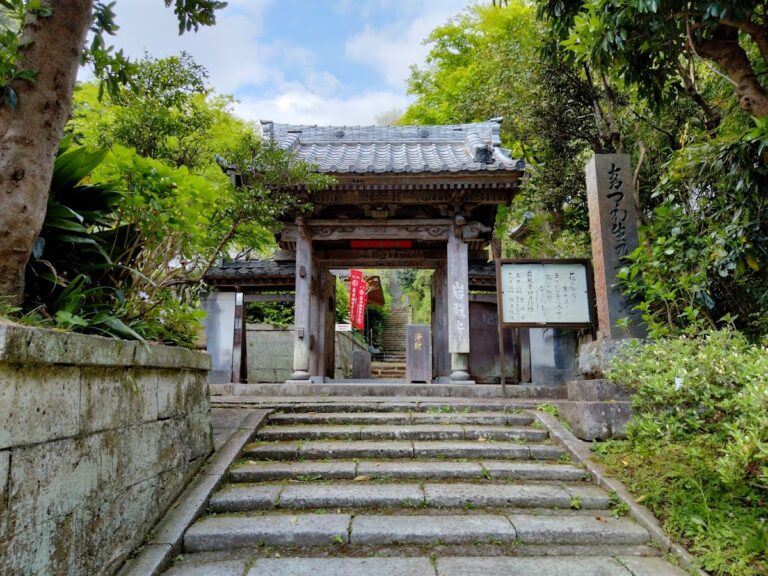
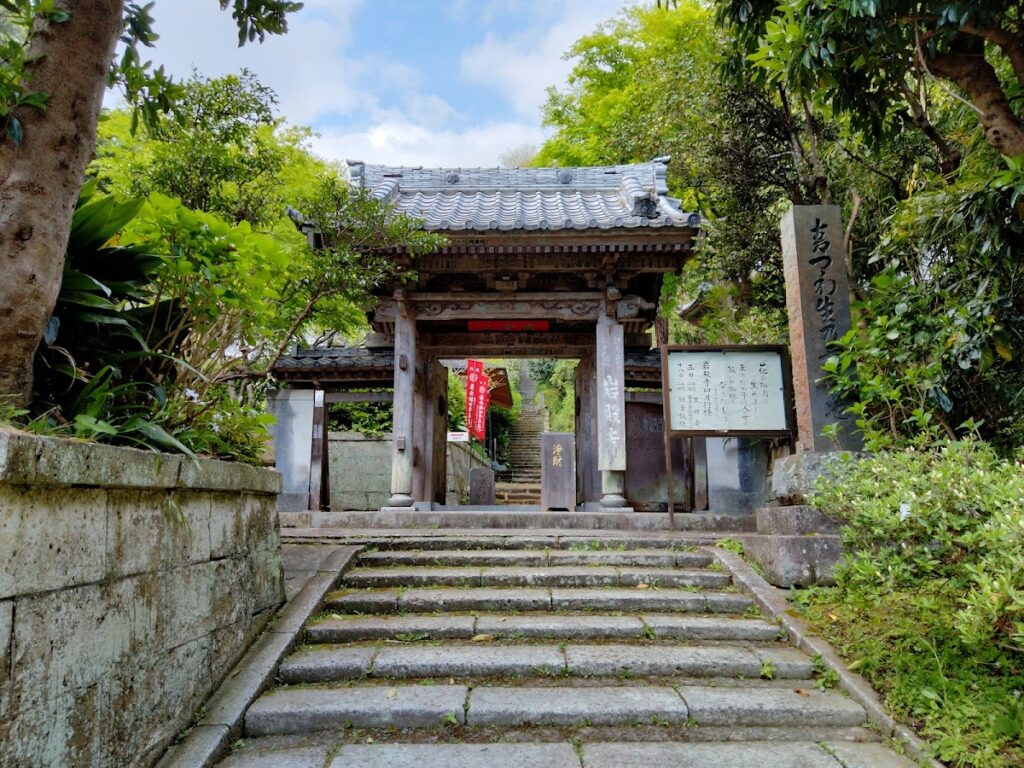
The approach to Iwadono-ji Temple begins in a narrow alleyway in a residential area. Passing through the temple gate, moss-covered stone steps continue, flanked by ancient trees. Climbing these steps is an important part of the pilgrimage, transitioning from everyday life to a sacred space.
Along the steps, Jizo Bodhisattva statues and stone Buddhas are scattered, watching over pilgrims. As it is also a pilgrimage site for the Kanto 108 Jizo Pilgrimage, traces of Jizo worship remain strong.
Bell Tower and Bell
A bell tower stands within the temple grounds, and a temple bell hangs from it. The sound of this bell has long been a constant reminder of time in the surrounding area, deeply intertwined with people’s lives. Even today, the bell is rung during morning and evening services, its quiet tone resonating through the mountains.
Gardens and Natural Environment
The grounds of Iwadono-ji Temple are designed to take advantage of the natural environment of the hilly terrain. Visitors can enjoy seasonal flowers and plants, with the cherry blossoms in spring, the hydrangeas in early summer, and the autumn foliage being particularly magnificent.
The stone arrangements and plantings throughout the grounds reflect the simple aesthetic sensibilities characteristic of Zen Buddhist temples. The atmosphere of the grounds, harmoniously integrated with nature, provides visitors with a deep sense of peace.
Iwadono-ji Temple: A Famous Hydrangea Spot | Zushi’s Hydrangea Temple
Iwadono-ji Temple is widely known as “Zushi’s Hydrangea Temple.” Every June, approximately 2,000 hydrangea bushes bloom in the temple grounds, attracting many tourists and photography enthusiasts.
Hydrangea Blooming Season and Varieties
The best time to see hydrangeas is usually from early June to early July. During the rainy season, the hydrangeas, glistening with rain, become even more beautiful.
Various varieties of hydrangeas, including lacecap hydrangeas and European hydrangeas, are planted on the temple grounds. The colorful blue, purple, pink, and white flowers adorn the stone steps and the approach to the temple.
Hydrangea Viewing Tips
Looking up at the hydrangeas as you climb the stone steps is like walking through a tunnel of flowers. The sea of hydrangeas viewed from the stage of the Kannon Hall is also magnificent.
The combination of old stone Buddha statues, stone steps, and hydrangeas makes for an excellent photo spot that evokes the beauty of traditional Japan. However, please remember that the temple grounds are a place of worship, and be mindful of proper etiquette while viewing the flowers.
Flowers of the Four Seasons Other Than Hydrangeas
In spring, cherry blossoms bloom, and in autumn, the temple grounds are adorned with colorful autumn leaves. You can also enjoy various flowers throughout the year, such as camellias and sasanquas. Iwadono-ji Temple shows a different face in each of the four seasons, offering new discoveries with every visit.
Iwadono-ji Temple as the 2nd Temple of the Bando Thirty-Three Kannon Pilgrimage
What is the Bando Thirty-Three Kannon Pilgrimage?
The Bando Thirty-Three Kannon Pilgrimage is a pilgrimage route that visits 33 Kannon temples scattered throughout the Kanto region (Bando). Along with the Saigoku Thirty-Three and Chichibu Thirty-Four Kannon Pilgrimages, it is one of Japan’s three major Kannon pilgrimage routes, and has attracted many pilgrims since ancient times.
It is said to have been established by Minamoto no Yoritomo during the Kamakura period, modeled after the Saigoku Thirty-Three, and is deeply connected to the faith of Kanto samurai. Following the first temple, Sugimoto-dera (Kamakura City), Iwadono-ji Temple is the second temple on the pilgrimage route.
Characteristics of Iwadono-ji Temple as a Pilgrimage Site
Iwadono-ji Temple is the only Soto Zen Buddhist temple among the 33 Kannon pilgrimage sites of Bando. Considering that many of the other temples belong to the Shingon or Tendai sects, this makes it a very unique existence.
The temple’s hymn is “Approaching, pushing open the Heavenly Rock Cave, relying on the Buddha, how joyful is this life,” which evokes the myth of Amaterasu Omikami hiding in the rock cave. This is deeply related to the temple’s name, “Iwadono” (rock cave).
Sutra Copying and Temple Seal
At Iwadono-ji Temple, you can receive the sutra copying and temple seal for the 33 Kannon pilgrimage sites of Bando. The temple seal includes calligraphy such as “Eleven-faced Great Compassion Hall” and the temple’s seal.
Pilgrims receive the temple seal in their sutra copying notebooks or hanging scrolls as proof of their pilgrimage. In recent years, the popularity of collecting temple stamps (Goshuin) has led to a large influx of visitors, but it’s important to understand the true meaning of pilgrimage before visiting.
Temples Associated with Izumi Kyoka | Literature and Iwadono-ji Temple
Izumi Kyoka and Zushi
Izumi Kyoka, a literary giant active from the Meiji to Taisho periods, stayed in Zushi for a time. Kyoka loved Zushi’s nature and tranquility, and wrote many of his works there.
During his stay in Zushi, Kyoka frequently visited Iwadono-ji Temple, showing deep interest in the atmosphere and history of the temple grounds. The temple’s mystical atmosphere likely resonated with Kyoka’s fantastical literary world.
Iwadono-ji Temple Appearing in Kyoka’s Works
Kyoka’s works feature descriptions that evoke Iwadono-ji Temple and its surrounding landscape. In particular, the ethereal atmosphere of the ancient temple and the stories of Kannon worship are thought to have influenced Kyoka’s literary world.
Even today, literature enthusiasts sometimes visit Iwadono-ji Temple, tracing the footsteps of Kyoka Izumi. Walking through the temple grounds and reflecting on the scenery Izumi saw is one of the pleasures of visiting Iwadono-ji.
Crossroads of Literature and Faith
Iwadono-ji Temple is both a place of worship and a stage for literature. Many writers and artists have visited since ancient times, leaving their beauty and history in their works.
The narrative and artistic qualities of the temple give Iwadono-ji Temple a cultural value that transcends mere tourist attraction.
89th Temple of the Kanto 108 Jizo Pilgrimage
Iwadono-ji Temple is not only part of the Bando 33 Kannon Pilgrimage, but also the 89th temple of the Kanto 108 Jizo Pilgrimage.
What is the Kanto 108 Jizo Pilgrimage?
The Kanto 108 Jizo Pilgrimage is a pilgrimage route visiting 108 sacred sites dedicated to Jizo Bodhisattva scattered throughout the Kanto region. The number 108 is based on the number of worldly desires, reflecting the widespread worship of Jizo Bodhisattva.
Jizo Bodhisattva, revered as a bodhisattva who saves all sentient beings in all six realms of existence, has been particularly popular among ordinary people in Japan.
Jizo Worship at Iwadono-ji Temple
Besides the principal image, the Eleven-Faced Kannon, Jizo Bodhisattva is also enshrined on the temple grounds. Small stone Jizo statues are scattered along the stone steps of the approach to the temple, watching over pilgrims.
Iwadono-ji Temple, which embraces both Kannon and Jizo worship, can be described as a temple with a broad and accepting nature that embraces diverse faiths.
Access and Visiting Information for Iwadono-ji Temple
Access by Train
From JR Yokosuka Line “Zushi Station”
- Walking: Approximately 30 minutes (uphill)
- Bus: Take the Keikyu Bus “Kamegaoka Danchi Loop” or “Midorioka Iriguchi” bound bus and get off at “Kamegaoka Danchi Kita” bus stop, then walk for approximately 7 minutes.
From Keikyu “Shin-Zushi Station”
- Walking: Approximately 30 minutes
- Bus: Take the Keikyu Bus and get off at “Kamegaoka Danchi Kita” bus stop, then walk for approximately 7 minutes.
Access by Car
Approximately 15 minutes from the Yokohama-Yokosuka Expressway “Zushi IC”. However, there is no dedicated parking lot on the temple grounds, so it is recommended to use nearby coin parking or public transportation.
As the route involves driving through narrow residential streets, it is advisable to avoid visiting in large vehicles.
Visiting Hours and Admission Fee
- Visiting Hours: Grounds are freely accessible (visiting during reasonable hours is recommended)
- Admission Fee: Free (Donations welcome)
- Temple Office: Usually open, but may be unattended at times
Points to Note When Visiting
- Stone Steps: You will need to climb stone steps to reach the temple grounds. Comfortable walking shoes are recommended.
- Residential Area: The area around the temple is a residential area. Please be mindful of noise and street parking.
- Photography: Photography is permitted on the temple grounds, but please respect the privacy of other visitors.
- Hydrangea Season: June is expected to be crowded. Visiting early in the morning or on weekdays is recommended.
Attractions Around Iwadono-ji Temple
Hiroyama Park
Hiroyama Park, within walking distance of Iwadono-ji Temple, is a scenic spot offering panoramic views of Sagami Bay. On a clear day, you can see as far as Mount Fuji and the Izu Peninsula.
Zushi Beach
Zushi Beach, a representative tourist spot in Zushi, is bustling with many beachgoers in the summer. You can enjoy a stroll along the beach in conjunction with a visit to Iwadono-ji Temple.
Temples and Shrines in the Kamakura Area
If you extend your trip from Iwadono-ji Temple towards Kamakura, you can visit many ancient temples, including Sugimoto-ji Temple, the first temple of the Bando Thirty-Three Kannon Pilgrimage.
Kotsubo Fishing Port
Kotsubo Fishing Port, where you can enjoy fresh seafood, is also nearby. Enjoying local seafood dishes after your visit is highly recommended.
Annual Events at Iwadono-ji Temple
New Year’s Visit
Many worshippers visit the temple for their first shrine visit of the new year. You can offer your prayers for the new year in the peaceful temple grounds.
Hydrangea Festival
During the hydrangea season in June, many people visit the temple grounds unofficially, creating a vibrant atmosphere.
Kannon Festival
The 18th of each month is considered the festival day for Kannon (Goddess of Mercy), and special religious services are sometimes held.
Cultural Assets and Importance of Iwadono-ji Temple
Historical Value
With a history of over 1300 years, Iwadono-ji Temple is an indispensable part of the history of the Zushi region. From its founding in the Nara period to the present day, it conveys the forms of faith of each era.
Architectural Value
The Kannon Hall, built during the Edo period, is a valuable example of Soto Zen temple architecture. Its simple yet dignified construction clearly represents the characteristics of Zen Buddhist architecture.
Faithful Value
As the second temple on the Bando Thirty-Three Kannon Pilgrimage and a temple on the Kanto One Hundred and Eight Jizo Pilgrimage, it remains a living place of faith visited by many pilgrims.
A Recommendation for Visiting Iwadono-ji Temple | Seeking Peace of Mind
For those seeking to escape the hustle and bustle of modern society and enjoy a quiet time, Iwadono-ji Temple is the perfect place. As you climb the stone steps and step into the temple grounds, a sense of calm will mysteriously wash over you.
Praying to the Eleven-Faced Kannon is also a time for self-reflection. In this place where countless people have offered prayers for over 1300 years, why not listen to the voice of your own heart?
Iwadono-ji Temple offers the beauty of flowers during hydrangea season, and a sense of tranquility and history in other seasons. It’s a temple where you’ll discover something new with every visit, throughout the seasons.
Experience the charm of Iwadono-ji Temple, where Minamoto no Yoritomo prayed and Izumi Kyoka loved, for yourself. Whether as part of a pilgrimage to the 33 Kannon temples of Bando or as a day trip, Iwadono-ji Temple warmly welcomes all visitors.
Summary | Reaffirming the Charm of Iwadono-ji Temple
Iwadono-ji Temple is a historic temple founded in 828 AD (Yōrō 5), and is known as the second temple on the Bandō Thirty-Three Kannon Pilgrimage. With an eleven-faced Kannon as its principal image, and connections to Minamoto no Yoritomo and Izumi Kyōka, this temple is also famous as “Zushi’s Hydrangea Temple.”
The temple grounds feature a Kannon Hall built during the Edo period, historical Buddhist statues, and a beautiful garden, allowing visitors to enjoy nature throughout the seasons. Especially during the hydrangea season in June, approximately 2,000 hydrangea bushes bloom, attracting many visitors.
It is accessible on foot or by bus from JR Zushi Station, and can be visited in conjunction with nearby tourist attractions such as Kamakura and Zushi Beach. Iwadono-ji Temple, where history, culture, nature, and faith harmonize, is a precious place where modern people can find peace of mind.
I recommend visiting Iwadono-ji Temple not only to pilgrims of the Bando Thirty-Three Kannon Pilgrimage, but also to anyone who wants to admire hydrangeas, is interested in history and literature, or simply wants to spend some quiet time.