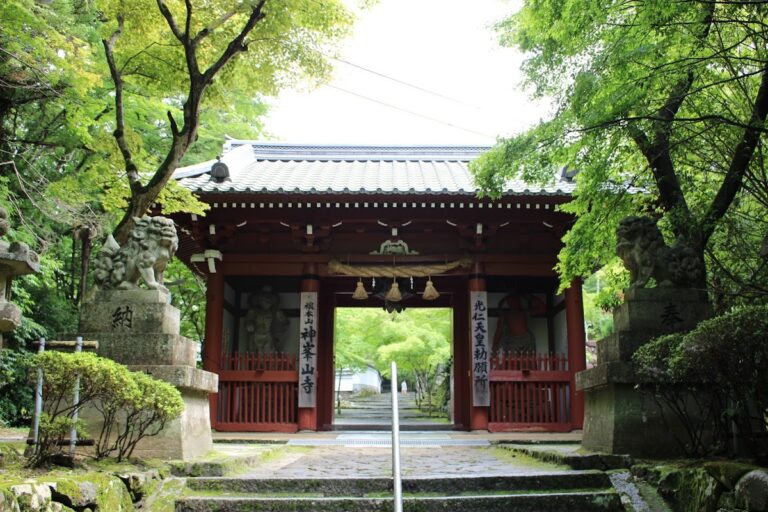
Complete Guide to Kabusanji Temple: History and Highlights of Japan’s First Bishamonten Sacred Site
About Kabusanji Temple
Kabusanji Temple is a Tendai sect mountain temple located in Hara, Takatsuki City, Osaka Prefecture. Its mountain name is Konponzan, and it is known as the first sacred site in Japan where Bishamonten was enshrined. It was founded in 697 (Hakuhō 5) by En no Gyōja (En no Ozunu) and restored as a Buddhist temple in 774 (Hōki 5) by Prince Kaisei.
This ancient temple, with a history of over 1300 years, was once counted as one of the “Seven High Mountains” alongside Mount Hiei and Mount Katsuragi, and flourished as a prestigious temple under imperial decree. Even today, it attracts many visitors with its daily Goma prayer ceremonies and as a famous spot for autumn foliage.
History of Kamine-sanji Temple
Legend of its Founding and Construction
Kamine-sanji Temple was founded in 697 by En no Ozunu, known as the founder of Shugendo (mountain asceticism). According to tradition, En no Ozunu visited the temple after seeing the sparkling spray of the Kuzuryu Waterfall on Mount Kamine from Mount Katsuragi in Nara.
The Kuzuryu Waterfall remains a sacred site within the temple grounds and has served as a training ground for Shugendo practitioners, a central point of mountain worship. The existence of this waterfall formed the foundation for Kamine-sanji Temple’s development as a sacred site of mountain Buddhism.
Restoration by Prince Kaijo
In 774 (Hoki 5), Prince Kaijo, son of Emperor Konin, restored Kamine-sanji Temple as a Buddhist temple. Prince Kaisei, in order to spread the teachings of the Tendai sect, established a full-fledged temple complex in this area and enshrined Bishamonten as the principal deity.
From this period onward, Kamine-sanji Temple deepened its ties with the imperial family and came to occupy an important position as a temple of imperial prayer. Prince Kaisei’s name remains at the temple today in the form of the “Kaisei-in Cemetery.”
The Golden Age
From the Heian period to the Kamakura period, Kamine-sanji Temple reached its peak. During this time, it is recorded that there were 21 monks’ quarters and the temple’s land holdings amounted to 1,300 koku. It was counted as one of the “Seven High Mountains,” alongside Enryaku-ji Temple on Mount Hiei, Mount Katsuragi, and Mount Omine, and flourished greatly as a sacred site of Buddhism.
As the center of Tendai sect temples in Takatsuki, many monks devoted themselves to their training, and it became a center of learning and faith. The tradition of mountain asceticism established during this period has been passed down continuously to the present day.
Relationship with the Samurai Class
From the Kamakura period to the Sengoku period, Kamine-sanji Temple deepened its relationship with the samurai class. Because Bishamonten was worshipped as a god of war, it received protection from powerful warlords such as the Ashikaga, Toyotomi, and Tokugawa families.
In particular, Bishamonten attracted the fervent faith of samurai as a god of victory in battle, and it is said that many warlords visited Kamine-sanji Temple before battle. This relationship with samurai and wealthy merchants became an important factor in supporting the maintenance and development of the temple.
Principal Deities: Three Bishamonten Statues
Japan’s First Bishamonten Sacred Site
The most distinctive feature of Kamine-sanji Temple is that it is the first sacred site in Japan to enshrine Bishamonten. Three Bishamonten statues are enshrined as principal deities, each with a different form and origin.
Tobatsu Bishamonten is a unique form of Bishamonten standing atop two demons, the Earth Goddess and the Niramba. This form originated in Central Asia and is considered particularly powerful for protecting the nation.
Sojin Bishamonten is a Bishamonten in a married couple form, accompanied by Kichijoten, and is believed to bring wealth and family harmony.
Regular Bishamonten is the common form, standing alone, and is known for its blessings of protection against evil and good fortune in competitions.
Characteristics of Bishamonten Worship
Bishamonten is another name for Tamonten, one of the Four Heavenly Kings, and is worshipped as a warrior god who protects Buddhist law. At Kamine-sanji Temple, this Bishamonten worship has been fused with elements of mountain worship and Shugendo, forming a unique form of faith.
It is believed to offer a wide range of blessings, including protection from evil, warding off misfortune, business prosperity, good fortune in competitions, and family safety, and even today, many worshippers visit the temple. Especially on the Day of the Tiger, special prayers are offered as it is the auspicious day of Bishamonten.
Important Cultural Properties and Temple Treasures
Nationally Designated Important Cultural Properties
Kamimine-sanji Temple houses several Buddhist statues designated as National Important Cultural Properties.
The Seated Amida Buddha Statue, enshrined in the main hall, is a late Heian period work characterized by its elegant mudra (hand gesture). It is highly valued in art history as a valuable cultural asset demonstrating the spread of Amida worship.
There are two Holy Kannon Bodhisattva Statues, both believed to be from the Heian period. One of them is the principal image of the 14th temple of the New Saigoku Thirty-Three Kannon Pilgrimage, and is an object of Kannon worship.
These Buddhist statues tell the story of Kamimine-sanji Temple, which was not merely a temple dedicated to the worship of Bishamonten, but a comprehensive place of worship encompassing Amida and Kannon as well.
Other Temple Treasures
Many other valuable cultural artifacts are preserved within the temple grounds. The ancient documents include those that reveal the temple’s relationship with the imperial family and samurai families, making them important resources for studying the history of Kamimine-sanji Temple.
Highlights of the Temple Grounds
Main Hall
The main hall, the heart of Kamimine-sanji Temple, is a magnificent building housing three statues of Bishamonten. The inner sanctuary also enshrines a seated statue of Amida Buddha and a statue of Sho Kannon Bodhisattva, both designated as Important Cultural Properties, allowing visitors to offer their prayers in a solemn atmosphere.
Regular religious services are held in the main hall, and it is particularly bustling with many visitors during the New Year’s pilgrimage and the spring and autumn equinoxes.
Kajōin Temple and the Bishamonten Fudo Goma Ritual
At Kajōin Temple, one of the temples within the mountain grounds, the continuous Goma ritual, “Bishamonten Fudo Goma,” is performed daily without fail. This ritual is the spiritual pillar of Kamine-sanji Temple and continues a tradition of prayer that has lasted for over 1300 years.
The flames of the Goma ritual are believed to burn away worldly desires and deliver wishes to heaven. Prayers are offered for protection from misfortune, recovery from illness, and business prosperity. General visitors can also participate in the Goma prayer, making it a popular and unique spiritual experience.
Kuzuryū Falls
Kuzuryū Falls, which was the catalyst for the temple’s founding by En no Gyōja, is still carefully preserved as a sacred site within the temple grounds. The waterfall’s water is believed to possess purifying power and is used as a place for Shugendō practitioners to perform waterfall asceticism.
This waterfall, also associated with dragon deity worship, symbolizes the origins of Kamine-sanji Temple’s mountain worship.
Reihōin and Ekōdō
The temple grounds also include affiliated facilities such as Reihōin and Ekōdō, each functioning as a place of specific faith and memorial service. Ancestor memorial services and annual memorial services are held at Ekōdō, which also serves as a base for perpetual memorial services.
A Famous Spot for Autumn Foliage
A Spectacular Autumn Scenery
Kamimine-sanji Temple is known as one of the leading spots for autumn foliage in Osaka Prefecture. Every year from mid- to late November, the temple grounds are enveloped in fiery red leaves.
The temple grounds, spread across the mountainside, are home to a variety of trees including maple, ginkgo, and other trees that change color, creating a landscape like a brocade painting from the approach to the main hall and each of the other buildings. The autumn foliage around the main hall is particularly magnificent, attracting many photography enthusiasts.
The Season of Fresh Greenery
In addition to the autumn foliage, the fresh greenery from spring to early summer is also beautiful and captivates visitors. The sight of the mountains covered in the vibrant green of young leaves is full of life, allowing visitors to feel refreshed and invigorated during their visit.
Enjoying the changing seasons is another major attraction of Kamine-sanji Temple, a mountain temple.
Prayer and Training Experiences
Various Prayers
Kamine-sanji Temple accepts various prayers. The main types of prayers are as follows:
- Prayers for protection against misfortune
- Prayers for good health and recovery from illness
- Prayers for business prosperity
- Prayers for family safety and traffic safety
- Prayers for passing exams and academic success
- Prayers for finding a good partner
During the daily Goma prayer ceremony, wooden prayer sticks inscribed with individual wishes are burned, and prayers are offered along with chanting by monks.
Special Training Experiences
Kamine-sanji Temple also offers special Buddha worship and Goma experience programs in areas not open to the public. These programs are popular because they offer valuable experiences such as visiting the inner sanctuary, which is normally inaccessible, and participating in the Goma ritual.
These programs, which allow you to experience the traditions of mountain asceticism, provide modern people with an opportunity for spiritual purification and self-reflection.
New Saigoku Thirty-Three Kannon Pilgrimage
The main hall of Kamine-sanji Temple is designated as the 14th temple of the New Saigoku Thirty-Three Kannon Pilgrimage. The principal image of the temple is the Holy Kannon Bodhisattva, and many pilgrims visit it as part of their Kannon pilgrimage.
Goshuin (temple stamps) are given out at the main hall and are an important memento for pilgrims. Kamine-sanji Temple has a unique charm as a sacred site where Kannon worship and Bishamonten worship coexist.
Kamine-sanji Kaisei-in Cemetery
Kamine-sanji Temple operates the “Kamine-sanji Kaisei-in Cemetery” as a perpetual memorial cemetery. This cemetery, a historic temple with a 1300-year history, provides a tranquil setting for the perpetual memorial service of your ancestors.
Regular memorial services, including Higan (equinox) services, annual memorial services, and ancestral rites, are held, ensuring respectful and heartfelt care. Located in a lush, natural mountain setting, the cemetery offers a peaceful and serene environment for eternal rest.
Access and Visiting Information
Location
Address: 3301-1 Hara, Takatsuki City, Osaka Prefecture
Transportation Access
By Train/Bus:
- Take the city bus bound for “Hara Ohashi” from JR Takatsuki Station or Hankyu Takatsuki-shi Station.
- Get off at the last stop, “Hara Ohashi,” then walk for approximately 40 minutes (mountain path).
- Taxis are also available (approximately 20 minutes from the station).
By Car:
- Approximately 30 minutes from the Meishin Expressway “Ibaraki IC.”
- Approximately 25 minutes from the Shin-Meishin Expressway “Takatsuki IC.”
- Parking is available on the temple grounds (free).
Due to its mountainous location, the roads are narrow and winding. Please drive with caution.
Visiting Hours and Admission Fees
Visiting Hours: 9:00 AM – 4:00 PM (may vary depending on the season)
Admission Fee: Free entry to the grounds (special viewings require a separate fee)
Holidays: Generally open every day
Contact Information
Phone: 072-688-0788
Official Website: https://kabusan.or.jp/
For prayer reservations and special viewings, we recommend contacting us by phone in advance.
Annual Events
Kabusan-ji Temple holds various events throughout the year.
Main Annual Events
January
- First Shrine Visit of the Year / New Year’s Prayers
- Shusho-e Ceremony
Spring
- Spring Equinox Ceremony
- Flower Festival (April 8th)
Autumn
- Autumn Equinox Ceremony
- Special Viewing during the Autumn Foliage Season (November)
December
- New Year’s Eve Bell Ringing
Daily
- Bishamonten Fudo Goma Ritual (Kajoin Temple)
Especially during the first shrine visit of the year and the autumn foliage season, the temple is crowded with many visitors, so we recommend visiting with plenty of time to spare.
Souvenirs and Amulets
Kamineyama-ji Temple offers a variety of souvenirs and amulets.
Main Items Offered
- Bishamonten Amulet (Protection from Evil, Good Luck in Competitions)
- Traffic Safety Amulet
- Health Prayer Amulet
- Academic Success Amulet
- Goshuin (New Saigoku Thirty-Three Kannon Pilgrimage)
- Goma Talisman
The Bishamonten amulet, in particular, is popular for its unique blessings, stemming from its location as Japan’s first Bishamonten pilgrimage site.
Some items and amulets can also be purchased from the official online store (https://kabusanji.stores.jp/), allowing those from afar to receive the blessings of Kabusanji Temple.
Nearby Attractions
Takatsuki City, where Kabusanji Temple is located, has many other historical attractions.
Takatsuki Castle Ruins
The ruins of Takatsuki Castle, which existed from the Sengoku period to the Edo period. It is now maintained as a park.
Imashirozuka Kofun (ancient burial mound)
A massive keyhole-shaped burial mound believed to be the true tomb of Emperor Keitai. It is open to visitors as a historical park.
Settsukyo Gorge
A lush, natural gorge popular for hiking and autumn leaf viewing.
Enjoy the history and nature of Takatsuki in conjunction with a visit to Kamine-sanji Temple.
Summary
Kamine-sanji Temple, with a history of over 1300 years since its founding in 697, is Japan’s first Bishamonten sacred site. Its history, from its founding by En no Gyoja, to its restoration by Prince Kaisei, and its prosperity as one of the Seven High Mountains, forms an important chapter in Japanese mountain Buddhism.
With three Bishamonten statues as its principal deities, and housing a seated Amida Buddha statue and a statue of Sho Kannon Bodhisattva, both designated as important national cultural properties, Kamine-sanji Temple is not only a place of worship but also a treasure trove of cultural assets. The daily Goma prayer rituals, performed without fail, are a precious practice that carries on a 1300-year-old tradition of prayer into the modern age.
With its seasonal natural beauty, from the vibrant autumn foliage to the fresh greenery of spring, it is a beloved scenic spot in Osaka Prefecture. Its unique form of faith, a fusion of mountain worship, Shugendo (mountain asceticism), and Tendai Buddhism, remains a spiritual anchor for modern people.
Kamineyama-ji Temple attracts visitors for a variety of purposes, including those seeking protection from misfortune, good health, and business prosperity, tourists enjoying the beauty of the autumn leaves, and those seeking spiritual experiences. This ancient temple, quietly nestled in the mountains of Takatsuki, Osaka, will undoubtedly continue to provide a place of prayer and solace to many people.