Complete Guide to Yoshimine-dera Temple | History, Highlights, and Seasonal Flowers of the 20th Temple of the Saigoku Kannon Pilgrimage
Yoshimine-dera Temple, nestled on the slopes of Nishiyama in Nishikyo Ward, Kyoto City, is an ancient Tendai sect temple boasting a vast 30,000-tsubo (approximately 100,000 square meters) precinct. Known as the 20th temple of the Saigoku Kannon Pilgrimage, it is a renowned temple with numerous attractions, including breathtaking panoramic views of Kyoto city and Mount Hiei, seasonal flowers, and the “Yuryu no Matsu” (Dragon-Playing Pine), a designated natural monument. It attracts many worshippers and tourists throughout the year.
This article will introduce the charms of Yoshimine-dera Temple in detail, from its history and various buildings to seasonal highlights and access information.
History and Origins of Zenpoji Temple
Founded by Gensan Shonin
Zenpoji Temple was founded in the mid-Heian period, in the second year of Chogen (1029), by Gensan Shonin. Gensan Shonin was a high-ranking monk who studied under Eshin Sozu (Genshin) of Yokawa on Mount Hiei. At the age of 47, he entered the mountains of Shakagatake in the western mountains and built a small hermitage. It is said that the beginning of Zenpoji Temple was when he enshrined a statue of the Thousand-Armed Kannon, which he had carved himself, as the principal image.
At the age of 61, Gensan Shonin climbed Mount Oshio and established Shoren-in Temple. He continued his ascetic training, and in the third year of Chokyu (1042), Emperor Go-Ichijo bestowed upon him the temple name “Ryohoji.” Furthermore, in the early Kamakura period, it became an imperial prayer temple of Emperor Go-Toba and was renamed “Zenpoji.”
Glory, War, and Reconstruction
During the Muromachi period, the temple complex was renovated by order of Emperor Go-Hanazono, and at its peak, it flourished as a large temple with 52 monks’ quarters. However, many of the buildings were destroyed by fire during the Onin War (1467-1477).
Reconstruction progressed slowly, but a major turning point came in the Edo period. Keishoin, the mother of Tokugawa Tsunayoshi, the 5th shogun, was deeply devoted to Zenpoji Temple, and in 1692, the Kannon Hall was rebuilt. With Keishoin’s continued support, buildings such as the pagoda and sutra hall were rebuilt one after another, forming the foundation of the current temple complex.
Deep Connection with Keishoin
Keishoin is said to have been from Nishiyama in Kyoto, and her connection to Zenpoji Temple was particularly deep. Thanks to her support, Zenpoji Temple was restored and became known throughout the Edo period as the foremost temple in the Nishiyama region. Items associated with Keishoin and buildings she donated still remain on the temple grounds, making them indispensable to understanding the history of Zenpoji Temple.
Zenpoji Temple’s Faith and Principal Image
Eleven-Faced Thousand-Armed Kannon Bodhisattva
The principal image of Zenpoji Temple is the Eleven-Faced Thousand-Armed Kannon Bodhisattva. In fact, there are two principal images: one is a hidden Buddha said to have been carved by the monk Gensan himself, and the other is a Kannon statue from the late Heian period. The Thousand-Armed Kannon is revered as a Bodhisattva of great compassion and mercy, said to save all sentient beings with its thousand arms and thousand eyes.
As the 20th temple of the Saigoku Thirty-Three Kannon Pilgrimage, it has long been visited by many pilgrims and has become a center of Kannon worship. The temple’s hymn reads: “The rainy sky, passing through the fields and heading towards the mountain path, is clearer than the moon over Yoshimine on this night.”
Yakushi Nyorai and Shakyamuni Buddha
Besides the Thousand-Armed Kannon, Yakushi Nyorai and Shakyamuni Buddha are also important objects of worship at Zenpoji Temple. Yakushi Nyorai is revered as the Buddha of healing illnesses and longevity, while Shakyamuni Buddha is worshipped as the founder of Buddhism. The rare and powerful belief in the miraculous powers of these three deities is one of Zenpoji Temple’s distinguishing features.
Guide to the Temple Grounds
Zenpoji Temple’s grounds cover a vast area of approximately 30,000 tsubo (about 100,000 square meters), with numerous temple buildings scattered throughout. It is recommended to take your time and stroll through the buildings, which are arranged along the mountain slope.
Temple Gate (Nio Gate)
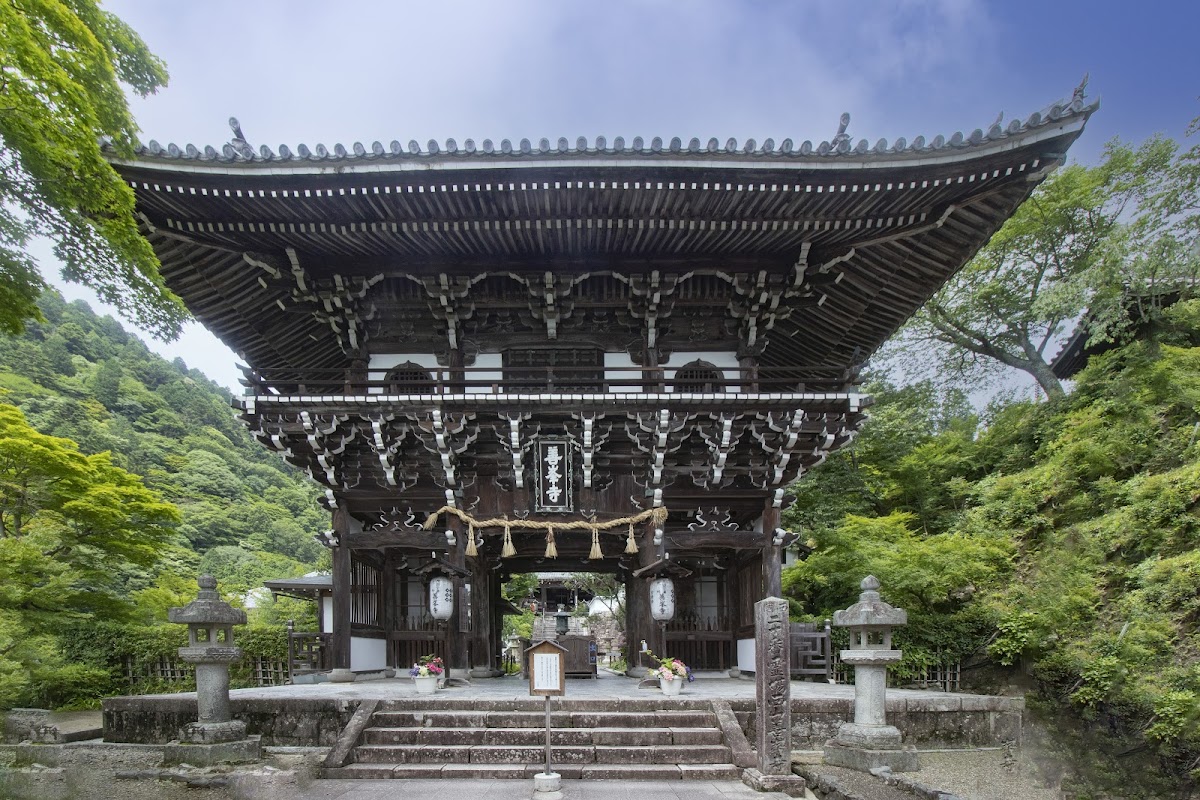
The temple gate, welcoming visitors, is a magnificent gate with Nio statues on either side. From here, a stone staircase leads to the temple grounds, where visitors are greeted by the changing seasons.
Kannon-do Hall (Main Hall)
Rebuilt in 1692 (Genroku 5) through a donation from Keishoin, the Kannon-do Hall is the central building of Zenpoji Temple. Inside, the principal image, the Eleven-Faced Thousand-Armed Kannon Bodhisattva, is enshrined. Visitors can receive sutra copying and temple stamps as it is one of the 33 pilgrimage sites of the Saigoku Kannon Pilgrimage. The hall is enveloped in a solemn atmosphere, and visitors can be seen quietly offering their prayers.
Tahōtō Pagoda
Built in 1694 (Genroku 7) by Keishoin, the Tahōtō Pagoda is designated as a National Important Cultural Property. This beautiful vermilion-painted pagoda, standing on the mountainside of Shakagatake, is one of Zenpoji Temple’s representative landscapes. Adorned with cherry blossoms in spring and autumn leaves in fall, it displays different expressions throughout the seasons.
Shakado Hall
The Shakado Hall, with Shakyamuni Buddha as its principal image, is a building that preserves the architectural style of the Edo period. Inside, in addition to the Shakyamuni Buddha statue, statues of Manjushri Bodhisattva and Samantabhadra Bodhisattva are also enshrined.
Keido Hall (Sutra Hall)
The Keido Hall, donated by Keishoin, houses the complete Buddhist canon. It is believed that rotating the revolving sutra repository once grants the same merit as reciting the entire canon.
Kaisando Hall (Founder’s Hall)
The Kaisando Hall, dedicated to Gensan Shonin, the founder of Zenpoji Temple, stands in a tranquil setting. Many worshippers visit to commemorate the virtuous legacy of the saint.
Goma Hall (Fire Ritual Hall)
The Goma Hall, where Goma prayers are performed, accepts various prayers. Goma wood, imbued with people’s wishes for family safety, business prosperity, recovery from illness, and more, is burned.
Bell Tower and Temple Bell
Within the temple grounds stands a magnificent bell tower, and the sound of the temple bell, ringing out on New Year’s Eve and throughout the day, resonates across the Nishiyama mountain.
Natural Monument “Yuryu no Matsu” (Playing Dragon Pine)
Visitors to Zenpoji Temple are sure to see the “Yuryu no Matsu,” a nationally designated natural monument. This five-needle pine, estimated to be over 600 years old, is relatively short at about 2 meters in height, but its trunk extends an astonishing 37 meters horizontally.
Its appearance resembles a dragon crawling along the ground, hence its name, “Yuryu no Matsu” (Playing Dragon Pine). It is said to have once been over 50 meters long, but a typhoon in 1953 damaged part of it, resulting in its current length. Even so, its unique form continues to fascinate visitors.
The pine’s branches, supported by props, spread horizontally along the slope, conveying the beauty of nature’s form and the strength of its life force. The temple grounds are particularly beautiful during the fresh green season and in winter when they are covered in snow, making them a popular photography spot for many photographers.
Flowers and Nature Through the Seasons
Yoshimine-dera Temple is also known as the “Temple of Flowers,” and visitors can enjoy a variety of flowers throughout the year in its vast 30,000-tsubo (approximately 100,000 square meter) grounds.
Spring Cherry Blossoms (Late March to Mid-April)
Yoshimine-dera Temple is famous as a cherry blossom viewing spot in spring. Approximately 500 cherry trees, including Somei Yoshino, mountain cherry, and weeping cherry trees, adorn the temple grounds. The cherry blossoms around the pagoda are especially magnificent, creating a beautiful contrast between the vermilion pagoda and the blossoms.
Due to its high altitude, the blossoms bloom about a week later than in Kyoto city, and it’s sometimes possible to enjoy the cherry blossoms until mid-April. Furthermore, the view of the Kyoto Basin seen through the cherry blossoms is called the “Cherry Blossom Garden in the Sky,” attracting many visitors.
Early Summer Azaleas and Satsuki Rhododendrons (Late April to May)
After the cherry blossoms fade, azaleas and satsuki rhododendrons begin to bloom throughout the temple grounds. The azaleas around the Kannon Hall are particularly impressive, their vibrant colors harmonizing beautifully with the fresh greenery.
Rainy Season Hydrangeas (Mid-June to Early July)
Yoshimine-dera Temple is known as one of Kyoto’s premier hydrangea viewing spots. Approximately 8,000 hydrangea plants are planted on the temple grounds, and during the rainy season, hydrangeas of various colors—blue, purple, pink, white, and more—bloom all at once.
The area known as the “Hydrangea Garden” is especially breathtaking, with a sea of hydrangeas covering the entire slope, captivating visitors. The beauty of hydrangeas glistening with rain is exceptional, making it a classic spot for sightseeing in Kyoto during the rainy season.
Autumn Foliage (Mid-November to Early December)
In autumn, Yoshimine-dera Temple is a popular spot for viewing autumn leaves, attracting many tourists. Various trees, including maple, cherry, and other species, change color, dyeing the entire temple grounds in red and yellow. The view of the sea of autumn leaves from the Kannon Hall, and the contrast between the pagoda and the foliage, are particularly magnificent.
Due to its high altitude, the leaves begin to change color slightly earlier than in Kyoto city, with the best viewing period being from mid-November to early December. The view of Kyoto city through the autumn leaves is also superb, making it one of the highlights of autumn sightseeing in Kyoto.
Winter Serenity and Snowscape (December to February)
Winter at Yoshimine-dera Temple is quiet, with fewer tourists, making it a peaceful season for worship. When it snows, the temple grounds become a silver world, and the snow-covered Yuryu Pine is particularly breathtakingly beautiful. On New Year’s Day, the temple is bustling with worshippers making their first shrine visit of the year, and visiting in the refreshing air of the new year is a truly special experience.
Scenic Viewpoints
One of the greatest attractions of Zenpoji Temple is the magnificent view it offers, taking advantage of its location on the slopes of Nishiyama Mountain. From several points within the temple grounds, you can enjoy panoramic views of Kyoto city, the Kyoto Basin, and even Mount Hiei and the Higashiyama mountain range in the distance.
The views from around the Kannon Hall and the observation point with the Yuryu Pine are particularly spectacular, and on clear days, you can even see as far as Osaka. The ability to enjoy seasonal flowers and the Kyoto cityscape simultaneously is a unique charm of Zenpoji Temple.
In spring, you can enjoy cherry blossoms and the Kyoto cityscape; in summer, fresh greenery and a blue sky; in autumn, autumn leaves and city lights; and in winter, snowscapes and distant views in the crisp air—each season offers a different breathtaking view to enjoy.
Annual Events and Special Viewings
Zenpoji Temple holds various events throughout the year.
Main Annual Events
- January 1st-3rd: Shushō-e (New Year’s Buddhist service)
- February 3rd: Setsubun-e (Bean-throwing festival)
- Spring Equinox: Spring Equinox Service
- April 8th: Hana Matsuri (Buddha’s Birthday Celebration)
- August 9th: Sennichi-e (Day of 46,000 Days of Merit)
- Autumn Equinox: Autumn Equinox Service
- December 31st: New Year’s Eve Bell Ringing
During these events, special Buddhist services and ceremonies are held, attracting many worshippers.
Visiting Information
Visiting Hours and Admission Fees
- Visiting Hours: Weekdays 8:00 AM – 5:00 PM (Last entry at 4:45 PM) *Hours may vary depending on the season
- Admission Fee: Adults 500 yen, High school students 300 yen, Elementary and junior high school students 200 yen
- Estimated Time Required: Due to the vast grounds, a leisurely visit will take approximately 1 hour 30 minutes to 2 hours.
Parking
- Capacity: Approximately 150 cars
- Parking Fee: Regular cars 500 yen, Buses 1,000 yen
- Notes: You can drive up to near the main gate.
Access Method
Yoshimine-dera Temple is located on the slopes of Nishiyama, away from Kyoto city center. Access takes some time, but this allows for a peaceful visit.
Using Public Transportation
Using JR/Hankyu Railway
- Get off at JR Mukomachi Station or Hankyu Higashi-Mukomachi Station
- Take Hankyu Bus No. 66 (bound for Zenpoji Temple) (approximately 30 minutes)
- Get off at the “Zenpoji Temple” bus stop and walk for approximately 8 minutes (uphill)
*Since the number of buses is limited, we recommend checking the timetable in advance. It can get particularly crowded during the autumn foliage season and on holidays.
Using a Taxi
It takes approximately 20-30 minutes by taxi from JR Mukomachi Station, Hankyu Higashi-Mukomachi Station, or Hankyu Nagaoka-Tenjin Station. The fare is approximately 3,000-4,000 yen. If you are visiting in a group, it is worth considering taking a taxi.
By Private Car
From Kyoto
- Head west on National Route 9 towards Oharano
- Take Prefectural Road 208 (Yoshimine-dera Road) towards the mountains for approximately 10 minutes
From Osaka
- Approximately 30 minutes from the Meishin Expressway “Oyamazaki IC”
- Or approximately 25 minutes from the Kyoto Jukan Expressway “Nagaokakyo IC”
Please drive carefully as you will be driving up a mountain road. Especially in winter, there is a possibility of icy roads, so we recommend checking weather information.
Nearby Tourist Spots
When visiting Yoshimine-dera Temple, we recommend also visiting the tourist spots in the surrounding Nishiyama area.
Komyoji Temple
The head temple of the Nishiyama Jodo sect, known as a famous spot for autumn foliage. The “Maple Leaf Path” is one of Kyoto’s top autumn foliage spots.
Yanagiya Kannon (Yōkoku-ji Temple)
An ancient temple revered for its Kannon (Goddess of Mercy) that heals eye diseases. In recent years, it has also gained popularity for its “flower water basin.”
Ōharano Shrine
An ancient shrine revered as the guardian deity of western Kyoto. A famous spot for autumn foliage, it offers a peaceful place for worship.
Shōji-ji Temple (Temple of Flowers)
A temple associated with the monk Saigyo, known for its cherry blossoms. The “Saigyo Cherry Blossoms” are particularly famous.
These temples and shrines are part of a sightseeing route called “Nishiyama Sanzan” or “Nishiyama Ancient Temple Pilgrimage,” allowing you to leisurely visit them over the course of a day.
Points to Note and Recommendations for Visiting
Clothing and Items to Bring
- Comfortable Shoes: The temple grounds are large, with many slopes and stone steps, so comfortable walking shoes such as sneakers are recommended.
- Seasonal Clothing: Located on the mountainside, the temperature is lower than in the city. Especially in spring and autumn, we recommend bringing a jacket.
- Parasol/Hat: The sun is strong in summer, so take precautions against the sun.
- Rain gear: The weather can change quickly, so it’s a good idea to have a folding umbrella.
Photography Tips
- Yuryu Pine Tree: You can take photos from various angles. The morning light is beautiful.
- Tahōtō Pagoda: The combination with cherry blossoms and autumn leaves creates a spectacular view.
- Observation Deck: You can take photos with Kyoto city in the background.
- Hydrangea Garden: During the rainy season, the slopes covered in hydrangeas are breathtaking.
Best Season
While Zenpōji Temple is beautiful throughout the four seasons, the best times to visit are:
- Early to Mid-April: Cherry blossom season
- Mid-June to Early July: Hydrangea season
- Mid-November to Late November: Autumn leaves season
These times are crowded, but the beauty is well worth it. Weekday mornings are relatively less crowded.
Estimated Time Required
- Minimum Visit: 30-40 minutes
- Visiting Major Sights: 1-1.5 hours
- A Relaxed Stroll Through the Entire Grounds: 2-2.5 hours
Due to the vast grounds, we recommend allowing ample time for your visit.
To Fully Enjoy the Charms of Zenpoji Temple
Zenpoji Temple is located a little distance from Kyoto city center, which allows for a peaceful visit and the enjoyment of magnificent nature. Take your time strolling through the 30,000-tsubo (approximately 100,000 square meters) grounds and fully appreciate the seasonal flowers, historic temple buildings, and the breathtaking panoramic views of Kyoto.
For pilgrims of the Saigoku Kannon Pilgrimage, it is an important sacred site as the 20th temple on the pilgrimage route, and for tourists, it is a hidden gem in Kyoto, making it a temple worth visiting for various purposes. Especially during the cherry blossom, hydrangea, and autumn foliage seasons, you can enjoy a landscape distinctly different from other famous Kyoto spots.
With its natural monument, the Yuryu no Matsu (Dragon-Playing Pine), its history intertwined with Keishoin’s legacy, and its tranquil grounds nestled amidst the natural beauty of Nishiyama, Zenpoji Temple offers a peaceful escape from the hustle and bustle of modern life. When visiting Kyoto, be sure to extend your trip and experience the charm of Zenpoji Temple.
Summary
Zenpoji Temple, founded in 1029, boasts a history of nearly a thousand years and is the 20th temple on the Saigoku Thirty-Three Kannon Pilgrimage. The temple buildings, destroyed during the Onin War, were rebuilt during the Edo period with the support of Keishoin, resulting in its current form.
Within its vast 30,000-tsubo (approximately 100,000 square meters) grounds, there are numerous points of interest, including the Tahoto Pagoda (a nationally important cultural property) and the Yuryu no Matsu (Dragon-Playing Pine), a natural monument. It continues to be loved by many as a “flower temple,” displaying different expressions throughout the seasons—cherry blossoms in spring, azaleas in early summer, hydrangeas in the rainy season, and autumn leaves—and as a scenic spot offering panoramic views of Kyoto city.
While it takes a little time to get there, this magnificent temple is well worth the effort. Please do visit Zenpoji Temple, where you can feel the spirit of history, nature, and Kannon worship in a tranquil setting.