Complete Guide to Kogakuji Temple | The Charm of Komoro’s Ancient Temple and Ashigara Gate, Commemorating Tokugawa Ieyasu’s Mother
Kogakuji Temple, nestled in the castle town of Komoro City, Nagano Prefecture, is a historic Jodo sect temple built to commemorate Oda-no-kata, the birth mother of Tokugawa Ieyasu. Its magnificent main gate, a relocated Ashigara Gate from Komoro Castle, the deep history conveyed by its three family crests, and its cultural heritage thriving in the castle town of Shinshu continue to fascinate many visitors and history enthusiasts.
History and Origins of Kogakuji Temple
Established to Commemorate Oda-no-kata
The founding of Kogakuji Temple has a deep connection to Oda-no-kata (Dentsuin-dono), the birth mother of Tokugawa Ieyasu. Known as Ieyasu’s mother, after her death, temples were built throughout the country to commemorate her.
Kogakuji Temple in Komoro was founded by Matsudaira Noriyoshi, the then lord of Komoro Castle and a great-grandson of Oda-no-kata. Its official name, Tenkizan Dentsuin Kogakuji, suggests a deep connection to Dentsuin Temple in Edo. Dentsuin Temple derives its name from Oda-no-kata’s posthumous Buddhist name, and Kogakuji Temple is positioned as an important temple in that lineage.
A Family Temple Inherited from the Matsudaira to the Makino Family
The historical value of Kogakuji Temple lies in its function as a family temple for multiple daimyo families. After its founding by Matsudaira Noriyoshi, when the lord of Komoro Domain changed to the Makino family, they also chose Kogakuji Temple as their family temple.
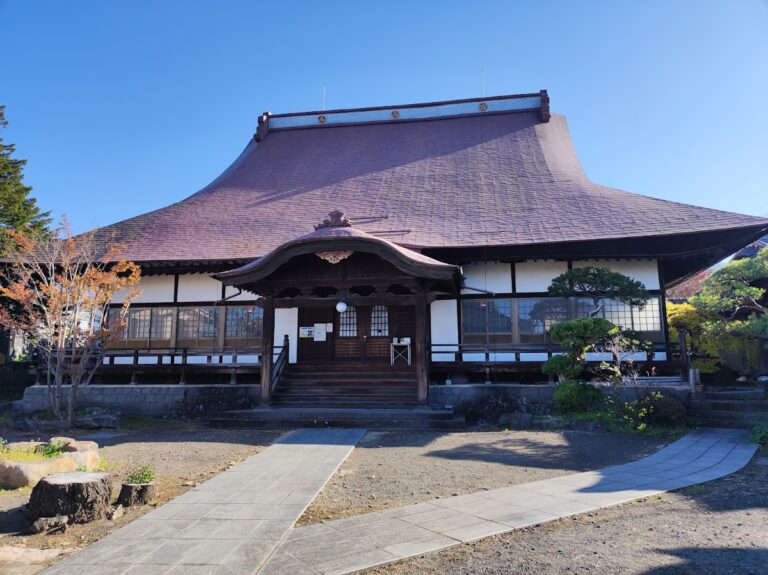
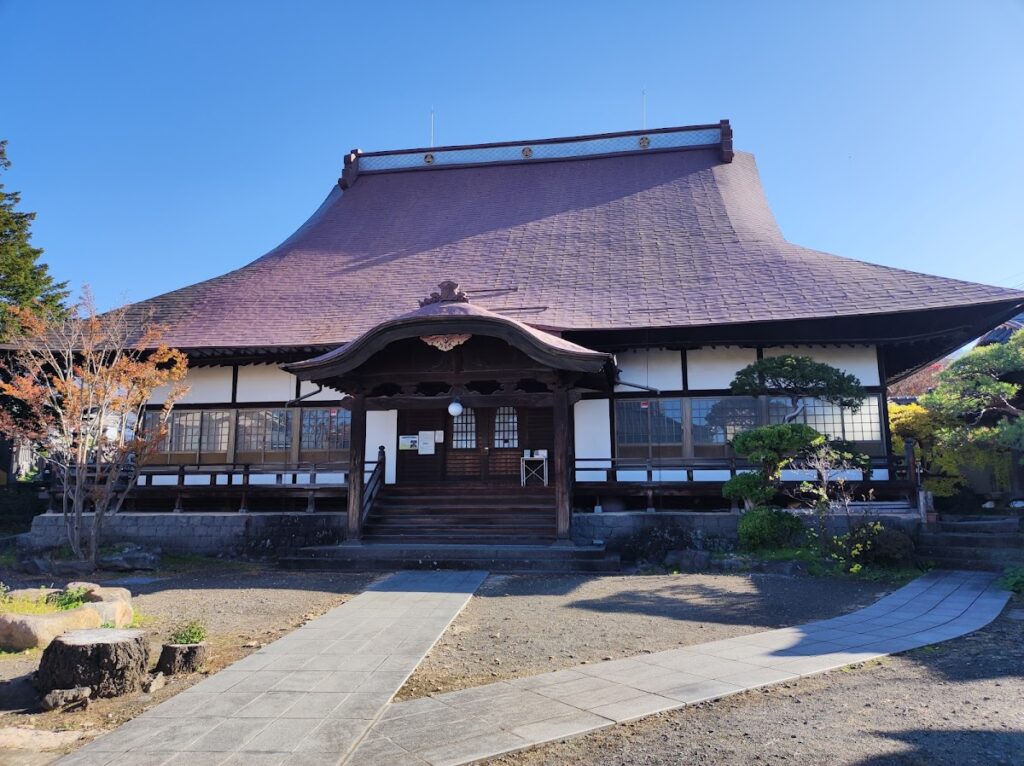
This historical background is symbolized by the three family crests displayed on the roof of the main hall. The sight of the three family crests—the Tokugawa Aoi crest, the Matsudaira Hoshi Umebachi crest, and the Makino Mitsugashira crest—standing side by side is evidence of the reverence Kōgaku-ji Temple has received from multiple daimyo families, and it is a valuable cultural heritage that tells the history of Komoro Castle Town.
An Ancient Jōdo Sect Temple with a History Since the Edo Period
As a Jōdo sect temple, Kōgaku-ji Temple enshrines Amida Buddha as its principal image. Throughout the Edo period, it functioned as the center of faith in Komoro Castle Town, attracting the devotion of not only the castle lord but also many samurai and townspeople.
Located in Aramachi, Komoro City, Nagano Prefecture, close to the former center of the castle town and situated along a major road, it is said that many travelers and merchants visited the temple. As an ancient temple indispensable to the history of Shinshu Komoro, it is still cherished by the local people today.
Highlights and Architectural Features of Kōgaku-ji Temple
The Magnificent Temple Gate, Relocated from Komoro Castle’s Ashigara Gate
The first thing visitors to Kōgaku-ji Temple see is the temple gate, which was relocated from the Ashigara Gate, once part of Komoro Castle. This two-story gatehouse serves as a landmark along the main road, visible from Honmachi Street, and is a valuable structure that conveys the historical landscape of Komoro Castle town.
The Ashigara Gate functioned as part of Komoro Castle’s defensive facilities and retains many characteristics of castle architecture. While there are various theories about its relocation, it was moved to Kōgaku-ji Temple during the Meiji era after the castle’s abandonment, and took on a new role as the main gate. The construction, exhibiting the architectural style of the mid-Edo period, is magnificent, and the craftsmanship in every detail can still be appreciated today.
On the path from Honmachi Street to Kōgaku-ji Temple, the Ashigara Gate, visible straight ahead, serves as a visual landmark, guiding visitors into the temple grounds. This placement is intentional, creating a unique Komoro landscape where the urban planning of the castle town and the temple architecture are integrated. ### The Main Hall and Three Family Crests
The main hall of Kōgaku-ji Temple is a magnificent building befitting a Jōdo sect temple. Its most distinctive feature is the three family crests displayed on the roof: the Tokugawa Aoi, the Matsudaira Hoshi Umebachi, and the Makino Mitsugashira.
These crests are not merely decorative; they represent the history of Kōgaku-ji Temple itself. Beginning as a temple to mourn the mother of Tokugawa Ieyasu, and protected by successive lords of Komoro Castle—the Matsudaira and Makino families—this history is visualized through these three crests.
Inside the main hall, an Amida Buddha statue is enshrined, creating a solemn space based on the teachings of the Jōdo sect. Visitors can feel the weight of history and the depth of faith in this tranquil atmosphere.
Highlights of the Temple Grounds
Besides the main hall and the temple gate, there are other noteworthy buildings and cultural assets scattered throughout the grounds of Kōgaku-ji Temple. There is a Naritasan hall on the grounds, showing a connection to the worship of Fudo Myoo. This is an interesting element that demonstrates the spread of popular faith during the Edo period.
The temple houses Buddhist statues such as the Shakyamuni Triad and the Sixteen Arhats, making it a temple of high value from the perspective of Buddhist art. These statues are valuable cultural assets that convey the sculpting techniques of the Edo period, attracting the attention of researchers and art lovers.
The layout of the temple grounds follows the typical style of Edo period temple architecture, and the spatial composition of the approach from the main gate to the main hall is calculated to bring a sense of spiritual uplift to worshippers.
Relationship between Kōgaku-ji Temple and Komoro Castle Town
As the Center of Faith in the Castle Town
Kōgaku-ji Temple is not merely a temple; it has held an important position in the urban structure of Komoro Castle Town. It was the family temple of the castle lord, and at the same time, a place of faith for the samurai and townspeople living in the castle town.
Komoro Castle Town also flourished as a post town on the Nakasendō road, a place where many travelers passed through. Located along a major road, Kōgaku-ji Temple likely attracted many visitors praying for safe travels. In Komoro, situated in the mountainous region of Shinshu, Kōgaku-ji Temple was closely intertwined with the local community.
Cultural Heritage Preserving Komoro’s History
In present-day Komoro City, Kōgaku-ji Temple plays a significant role as a historical building. Its structures, including the Ashigara Gate, enhance the city’s cultural value as remnants of Komoro Castle.
The landscape leading from Honmachi Street, which retains the atmosphere of a castle town, to Kōgaku-ji Temple is an important element of Komoro’s historical streetscape and is attracting attention as a tourist resource. Local residents take pride in Kōgaku-ji Temple and strive for its preservation and utilization.
Access and Visiting Information for Kōgaku-ji Temple
Location and Transportation Access
Kōgaku-ji Temple is located at 1-3-4 Aramachi, Komoro City, Nagano Prefecture. It is within walking distance of Komoro Station and can be visited as part of a stroll through the castle town.
Access by Train
Approximately 10 minutes on foot from Komoro Station on the JR Koumi Line and Shinano Railway. Walking from the station via Honmachi Street towards Ashigara Gate will prevent you from getting lost.
Access by Car
Approximately 10 minutes from Komoro Interchange on the Joshinetsu Expressway. While there are paid parking lots nearby, dedicated parking spaces for the temple are limited, so using public transportation is recommended.
Visiting Hours and Admission Fees
Kogakuji Temple is generally open to visitors, but if you wish to view the interior of the main hall or participate in special events, it is recommended to inquire in advance.
Contact Information
Phone: 0267-22-0981
General strolling through the temple grounds and viewing the main gate are free, but please be mindful of photography and visiting etiquette to protect cultural properties.
Nearby Tourist Attractions
When visiting Kōgakuji Temple, we recommend also visiting nearby historical sites such as Komoro Castle Ruins Kaikoen Park and Komoro-juku Honjin (a former inn). You can enjoy the history and culture of Komoro, Shinshu, while strolling through the streets that retain the atmosphere of a castle town.
There are many other temples and shrines in Komoro City, and by planning a historical exploration route, you can discover the charm of Komoro more deeply.
Annual Events and Temple Activities at Kōgakuji Temple
Main Annual Events
As a Jōdo-shū (Pure Land) Buddhist temple, Kōgakuji Temple holds various Buddhist services and events throughout the year. Traditional Buddhist events such as the Spring Equinox service, the Obon (Buddhist festival) service, and the Autumn Equinox service are held together with the local community.
These events may be open to general visitors as well as temple parishioners and local residents. For detailed dates and participation methods, we recommend contacting the temple directly.
Connection with the Community
Kōgakuji Temple is not merely a tourist spot; it is a living temple deeply intertwined with the faith and lives of the local people. It plays a role in passing on the region’s history and culture to future generations, and cooperates with Komoro City’s cultural property preservation activities and history education.
It is also utilized as a place for history learning in collaboration with local schools, providing children with a valuable opportunity to learn about local history.
Points to Note When Visiting Kōgakuji Temple
Charm as a Photo Spot
Kōgakuji Temple is not only valuable as a historical building, but also an attractive photo gallery. The Ashigara Gate, in particular, offers a beautiful view from Honmachi Street, attracting many photography enthusiasts.
The three family crests displayed on the roof of the main hall are also a unique photo spot at Kōgakuji Temple. The temple grounds change with the seasons, allowing visitors to enjoy the beauty of each season, from the fresh greenery of spring to the vibrant autumn leaves.
Manners for Visiting
Kōgakuji Temple is an active temple and a place of worship. Please observe the following manners when visiting.
- Please behave quietly within the temple grounds and be considerate of other visitors.
- Please obtain permission before taking photographs inside the main hall.
- Do not touch any buildings or cultural artifacts.
- Please take all your trash with you.
- Please minimize your use of the parking lot and be considerate of nearby residents.
Recommended Time to Visit
While Kōgakuji Temple is open year-round, there are particularly recommended times to visit.
Spring (April-May)
The fresh greenery is beautiful, and the mild weather makes it ideal for a stroll. Visiting in conjunction with the cherry blossoms at Komoro Castle Ruins Kaikoen Park is also recommended.
Autumn (October-November)
During the autumn foliage season, the temple grounds are ablaze with color, creating a beautiful landscape in harmony with the historical buildings.
Winter (December-February)
The snow-covered Ashigara Gate has a special charm, allowing for peaceful worship in the tranquil atmosphere of the temple grounds.
Cultural Value of Kōgaku-ji Temple
Position in Architectural History
The buildings of Kōgaku-ji Temple, particularly the relocated Ashigara Gate, hold high architectural historical value as a valuable example of the fusion of Edo-period castle architecture and temple architecture. Its two-story gate structure is unique, combining defensive function with religious grandeur.
The architectural style of the main hall also well preserves the characteristics of Jōdo-shū temple architecture from the mid-Edo period, making it important material for studying the architectural techniques and designs of the time.
Value as Historical Materials
The ancient documents and records remaining at Kōgaku-ji Temple are valuable historical materials for studying the history of the Komoro Domain and the social structure of the castle town. Documents showing the relationship between daimyo families such as the Matsudaira and Makino families and the temple, and furthermore, the connection with the Tokugawa family, provide clues to understanding the relationship between daimyo and religion during the Edo period.
Summary: Kogakuji Temple’s Message to Komoro’s History and Culture
Kogakuji Temple boasts a multi-layered history, including its origins as a memorial to Oda-no-kata, the mother of Tokugawa Ieyasu; its magnificent main gate, a relocated Ashigara Gate from Komoro Castle; and its deep connections to daimyo families, as indicated by its three family crests.
Located in Aramachi, Komoro City, Nagano Prefecture, this ancient temple is not merely a tourist spot, but a living cultural heritage site that conveys the castle town culture of Shinshu Komoro. While maintaining its religious functions as a Jodo sect temple, it also contributes to local history education and cultural preservation.
The Ashigara Gate, a landmark visible from Honmachi Street, the Shakyamuni Triad and Sixteen Arhats statues enshrined within the temple grounds, and the three family crests displayed on the roof of the main hall—all of these tell the story of the history that Komoro has walked.
When you visit Komoro, be sure to stop by Kōgaku-ji Temple and experience the atmosphere of this place of worship that has continued since the Edo period. Feel the weight of history that has been preserved and passed down by the Tokugawa, Matsudaira, and Makino families. Kōgaku-ji Temple is a place where the past and present intersect, and it will bring deep emotion and new discoveries to those who visit.