Complete Guide to Oyama Afuri Shrine | A Thorough Explanation of History, Access, Worship Methods, and Scenic Spots
Oyama Afuri Shrine, located on the sacred mountain Oyama in Isehara City, Kanagawa Prefecture, is one of the leading power spots in the Kanto region, boasting a history of approximately 2,200 years. During the Edo period, it attracted as many as 200,000 worshippers annually as part of the “Oyama Pilgrimage,” and it remains a popular place of worship today. This article provides a detailed explanation of Oyama Afuri Shrine’s history, enshrined deities, worship methods, access information, and even its scenic spots, which have earned it two stars in the Michelin Green Guide Japan.
What is Oyama Afuri Shrine?
Oyama Afuri Shrine (Oyama Afuri Jinja) is a shrine located on Mount Oyama (elevation 1,251.7m) in Isehara City, Kanagawa Prefecture, and is also known as “Afuriyama” (Rain-Falling Mountain). Oyama Afuri Shrine is one of the thirteen Engishiki-listed shrines in Sagami Province, as described in the Engishiki Jinmyocho (a list of shrines compiled in 927 AD), and has long been revered as a highly prestigious shrine.
Mount Oyama is located at the southwestern edge of the Kanto Plain and has been worshipped as a sacred mountain since ancient times. Due to its beautiful shape, it is affectionately known as “Sagami Oyama” or “Amefuri-yama” (Rain-Falling Mountain), and has a history of developing as a sacred site for mountain worship.
Structure of Oyama Afuri Shrine
Oyama Afuri Shrine has a unique structure with three shrine buildings on the mountaintop.
- Main Shrine (Summit): Located at the summit of Mt. Oyama, at an altitude of 1,251.7m
- Lower Shrine (Mid-slope): Located on the mid-slope at an altitude of 696m, accessible by the Oyama Cable Car
- Subsidiary Shrines (Mae-sha and Oku-sha): Located near the summit
Each shrine enshrines a different deity, allowing worshippers to visit according to their religious purpose and wishes.
History of Oyama Afuri Shrine
Founding and Ancient Beliefs
Oyama Afuri Shrine is said to have been founded approximately 2200 years ago during the reign of Emperor Sujin (around 97 BC to 30 BC). It is an ancient shrine listed in the “Engishiki Jinmyocho” (a list of shrines compiled in the Heian period) and has been positioned as an important center of faith in Sagami Province.
Since ancient times, Mt. Oyama has been revered as a sacred mountain for praying for rain and abundant harvests, and its alternative name, “Afuriyama” (Rain-Falling Mountain), originates from this belief. In agricultural societies, rain was a lifeline, and Oyama Afuri Shrine was widely worshipped as the god of water and rain.
The Era of Shinto-Buddhist Syncretism
From the medieval to the early modern period, Oyama Afuri Shrine was influenced by the syncretism of Shinto and Buddhism and was worshipped as “Oyama Sekison Daigongen.” It also flourished as a sacred site for Shugendo (mountain asceticism), and many ascetics visited it as a place for mountain training.
During the era of Ryobu Shinto, the two subsidiary shrines were called “Great Tengu” and “Little Tengu” as the sacred bodies of the main shrine, and were revered as a sacred site of the land, enshrined in the rocky depths and revered as a sacred place of the realm, with its roofs reaching high into Takamagahara (the High Plain of Heaven).
The “Oyama Pilgrimage” Boom in the Edo Period
During the Edo period, pilgrimages to Oyama Afuri Shrine became extremely popular among common people as “Oyama Pilgrimage.” It was particularly popular among the townspeople of Edo, and every summer, pilgrimage groups called “Oyama-ko” were organized, with records indicating that as many as 200,000 people visited annually.
“Oyama-mairi” was not merely an act of faith, but a major event encompassing elements of leisure and tourism. Pilgrims, clad in white robes, ascended the mountain while chanting “Rokkon Shojo” (purification of the six senses). At the foot of Mount Oyama, lodgings and tea houses lined the streets, creating a bustling temple town.
Changes after the Meiji Era
Due to the Meiji-era separation of Shinto and Buddhism, Oyama Afuri Shrine adopted a purely Shinto form, eliminating its Buddhist elements. However, the essence of its faith remained unchanged, and it continues to attract many pilgrims to this day.
In 2016, “Oyama Pilgrimage,” including the “Pilgrimage to Oyama,” was designated a Japan Heritage site as a place of faith and recreation for the common people of Edo, featuring the “Oyama Pilgrimage” with giant wooden swords, and its cultural value has been re-evaluated.
Deities and Benefits
Oyama Afuri Shrine enshrines three deities.
Deities Enshrined at the Main Shrine
Oyamatsumi-no-Okami
This deity is revered as the god of mountains and water. An important deity in Japanese mythology, appearing in the Kojiki and Nihon Shoki, this deity is worshipped as the god who governs mountains and protects agriculture and fishing.
Benefits:
- Abundant harvest
- Industrial development
- Family safety
- Business prosperity
- Protection from evil
- Good fortune and happiness
Deity enshrined at the inner shrine
Oikazuchi-no-kami
A god who controls thunder and is also revered as an agricultural god who brings rain. In ancient times, he was also called “O-Tengu” (Great Tengu).
Deity enshrined at the front shrine
Takaokami-no-kami
A dragon god who controls water and is worshipped as a guardian deity of rain and water sources. In ancient times, he was also called “Ko-Tengu” (Little Tengu).
Oyama Afuri Shrine as a power spot
Oyama Afuri Shrine is known as one of the leading power spots in the Kanto region. A sacred site of mountain worship, it attracts many visitors as a place filled with natural energy.
The view from the lower shrine, in particular, is breathtaking, offering panoramic views of Sagami Bay, the Boso Peninsula, the Izu Islands, and even Mount Fuji. It is believed to have a purifying effect on both mind and body. Furthermore, the sacred water “Oyama Meisui” has long been cherished as “the water of longevity” and is offered free of charge to visitors.
Access Methods
Access by Train and Bus
Nearest Station:
- Odakyu Line “Isehara Station” (North Exit)
Bus:
Take a Kanagawa Chuo Kotsu bus from platform 4 at the north exit of Isehara Station
- Take the bus bound for “Oyama Cable” for approximately 25 minutes and get off at the last stop, “Oyama Cable”
- Bus service varies depending on the time of day, so it is recommended to check in advance.
Walking:
Approximately 15 minutes on foot from the “Oyama Cable” bus stop to the Oyama Cable Car “Oyama Cable Station” (via Komado).
Access by Car
Expressway:
- Approximately 30 minutes from Tomei Expressway “Atsugi IC”
- Approximately 20 minutes from Odawara-Atsugi Road “Isehara IC”
Parking:
There are several municipal and private parking lots around Oyama. It gets crowded on holidays and during peak seasons, so early arrival is recommended.
Oyama Cable Car
The Oyama Cable Car is the most convenient way to access the lower shrine.
Operating Section:
- Oyama Cable Station to Afuri Shrine Station (Lower Shrine): Approximately 6 minutes
- Afuri Shrine Station to Oyama Summit Station: Approximately 3 minutes (If heading to the main shrine, hike from Oyama Summit Station)
Fare (One-way):
- Oyama Cable Station to Afuri Shrine Station: Adult 640 yen, Child 320 yen
- Round-trip discount available
Operating Hours:
- Weekdays: 9:00 AM – 5:00 PM (Varies by season)
- Weekends and Holidays: 9:00 AM – 5:30 PM (Varies by season)
- Extended hours during peak season
Hiking Route
It is also possible to hike to the lower shrine without using the cable car.
Men’s Slope:
- A traditional approach path with steep stone steps.
- Estimated time: Approximately 50 minutes to 1 hour.
- Recommended for those confident in their physical fitness.
Women’s Slope:
- A gentler route than the Men’s Slope.
- Estimated time: Approximately 60 minutes to 1 hour 20 minutes.
- Recommended for beginners or those unsure of their physical fitness.
Visiting the Shrine Guide
Visiting the Lower Shrine
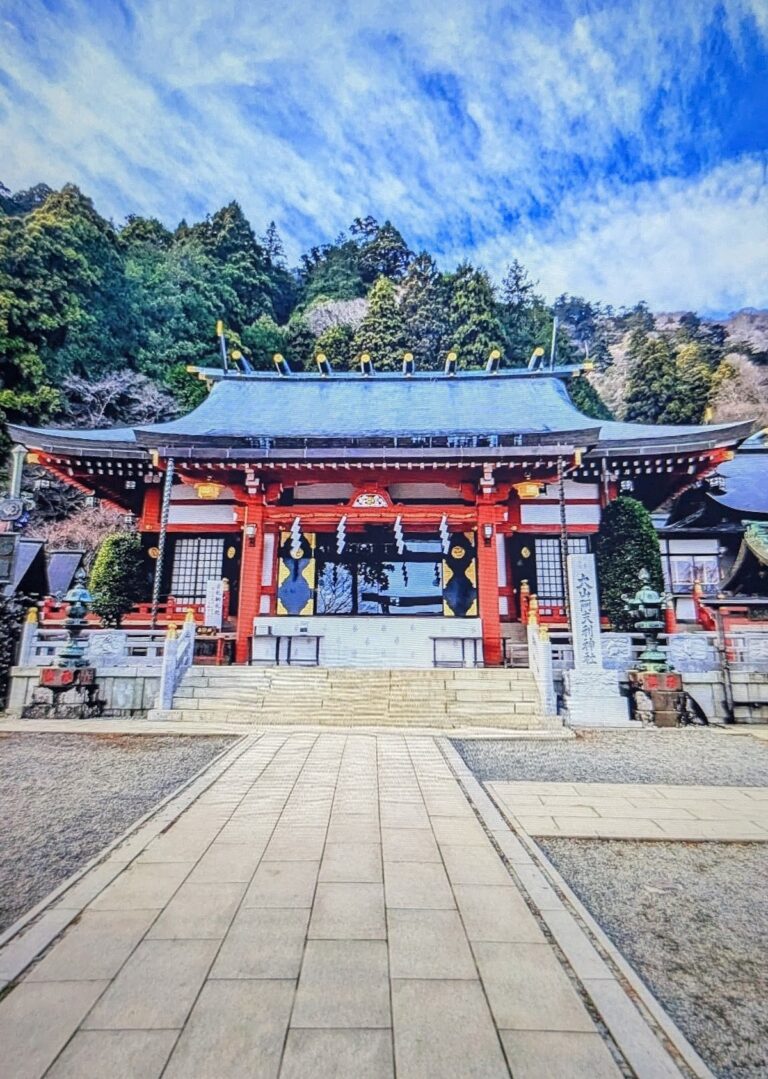
Getting off at Afuri Shrine Station on the Oyama Cable Car will take you to the Lower Shrine at an altitude of 696m.
Walking Procedure:
- Pass through the torii gate and purify your body and mind at the water basin.
- Worship in front of the main hall using the two bows, two claps, and one bow ritual.
- Enjoy the spectacular view from the observation point within the shrine grounds.
- Take a break at the tea house “Saryo Sekison” (check opening hours).
- Obtain a goshuin (shrine stamp) and amulet at the shrine office.
Highlights of the Lower Shrine:
- Main Hall: A magnificent shrine building enveloped in a solemn atmosphere.
- Observation Deck: A scenic spot that has received two Michelin stars.
- Sacred Water “Oyama Meisui”: Sacred water available free of charge.
- Saryo Sekison: A tea house where you can relax while enjoying the scenery.
Hiking to the Main Shrine (Summit)
Those wishing for a more authentic worship experience can aim for the main shrine at the summit from the lower shrine.
Hiking Route:
- From the lower shrine to the summit: Approximately 1 hour 30 minutes to 2 hours
- The trail is steep, so hiking equipment is necessary.
- Elevation difference: Approximately 550m
Hiking Precautions:
- Wear hiking boots or athletic shoes.
- Prepare water and snacks.
- Check the weather (it can be slippery in rainy weather).
- Aim to descend before sunset.
- There is a possibility of snow and ice in winter.
Summit Shrine:
The main shrine, located at the summit of the mountain at an altitude of 1,251.7m, is a sacred place where Oyamatsumi-no-Okami is enshrined. The view from the summit is a 360-degree panorama, and on clear days you can see Mt. Fuji, the Tanzawa mountain range, Sagami Bay, and even central Tokyo.
Visiting Hours
Lower Shrine:
- Open year-round
- Office for offerings: 9:00 AM – 4:30 PM (Hours may vary seasonally)
Main Shrine (Summit):
- Open year-round
- May be difficult to climb in winter due to snow.
A Michelin Two-Star View
The view from the Lower Shrine of Oyama Afuri Shrine received two stars in the 6th revised edition of the Michelin Green Guide Japan, published in France in 2015.
Scenic Spots
Shimosha Observatory:
- Magnificent views of Sagami Bay
- Enoshima, Miura Peninsula, Boso Peninsula
- Izu Islands (Oshima Island visible on clear days)
- Mount Fuji (on clear winter days)
View from the Summit:
- 360-degree panoramic view
- Tanzawa Mountain Range
- Kanto Plain
- Tokyo Skytree and the skyscrapers of central Tokyo (on clear days)
50 Scenic Spots of Kanagawa:
The summit of Mt. Oyama has been selected as one of “50 Scenic Spots of Kanagawa,” and is recognized as a representative scenic spot of Kanagawa Prefecture.
Best Season to Enjoy the Spectacular Scenery
- Spring (March-May): Soft scenery of fresh greenery and spring mist
- Summer (June-August): The contrast between lush green mountains and the blue sea
- Autumn (September-November): Autumn leaves and clear air allow for excellent long-distance views
- Winter (December-February): The season when Mt. Fuji looks its most beautiful; the air is clear and you can see far into the distance.
Early mornings and evenings are especially beautiful, and many visitors come to witness the sunrise and sunset.
Goshuin (Shrine Seal) and Amulet Information
Goshuin (Shrine Seal)
At Oyama Afuri Shrine, you can receive multiple types of goshuin.
Lower Shrine Goshuin (Stamp):
- Regular Goshuin
- Seasonal Goshuin (Available for a limited time)
- Offering Fee: Approximately 500 yen
Main Shrine (Summit) Goshuin (Stamp):
- A stamp as proof of having climbed to the summit
- May only be available during the climbing season
Goshuincho (Stamp Book):
Oyama Afuri Shrine also offers original Goshuincho. Several designs are available, featuring motifs of Oyama’s nature and the shrine buildings.
Amulets
Popular Amulets:
- Exorcism Amulet: Protection from misfortune
- Good Fortune Amulet: Brings good fortune and happiness
- Traffic Safety Amulet: Prayers for safe traffic travel
- Matchmaking Amulet: For successful relationships
- Academic Success Amulet: For passing exams and academic improvement
- Health Amulet: For recovery from illness and longevity
Oyama Meisui Related Goods:
Special containers for the sacred water “Oyama Meisui” are also available.
Annual Events and Festivals
Oyama Afuri Shrine holds various Shinto rituals and events throughout the year.
Main Annual Events
January:
- New Year’s Day Festival: A Shinto ritual celebrating the New Year
- Tsutsugayu Shinji (Rice Porridge Ritual): A traditional Shinto ritual predicting the abundance or scarcity of the year’s harvest
February:
- Setsubun Festival: Bean-throwing and prayers for warding off evil
April:
- Spring Grand Festival: The grand spring festival
July-August:
- Summer Mountain Opening: Prayers for safety during the mountain climbing season
- Oyama Lantern Festival: A fantastical event where lanterns line the approach to the shrine (a recreation of the Oyama pilgrimage)
August 27th & 28th:
- Grand Festival: The most important annual event
October:
- Autumn Grand Festival: The grand autumn festival
December:
- Great Purification Ceremony: A Shinto ritual to purify oneself of the impurities accumulated over the year.
Special Events
Oyama Pilgrimage Related Events:
Events recreating the Edo-period “Oyama Pilgrimage” are sometimes held, mainly during the summer. These events offer a valuable opportunity to experience history, including climbing the mountain in white robes and participating in traditional ceremonies along the Koma Sando (pilgrimage route).
Light-Up Events:
For a limited time, the mountain is illuminated at night. Visiting the mountain in this magical atmosphere offers a different charm than during the daytime.
Sightseeing Around Oyama
Koma Sando
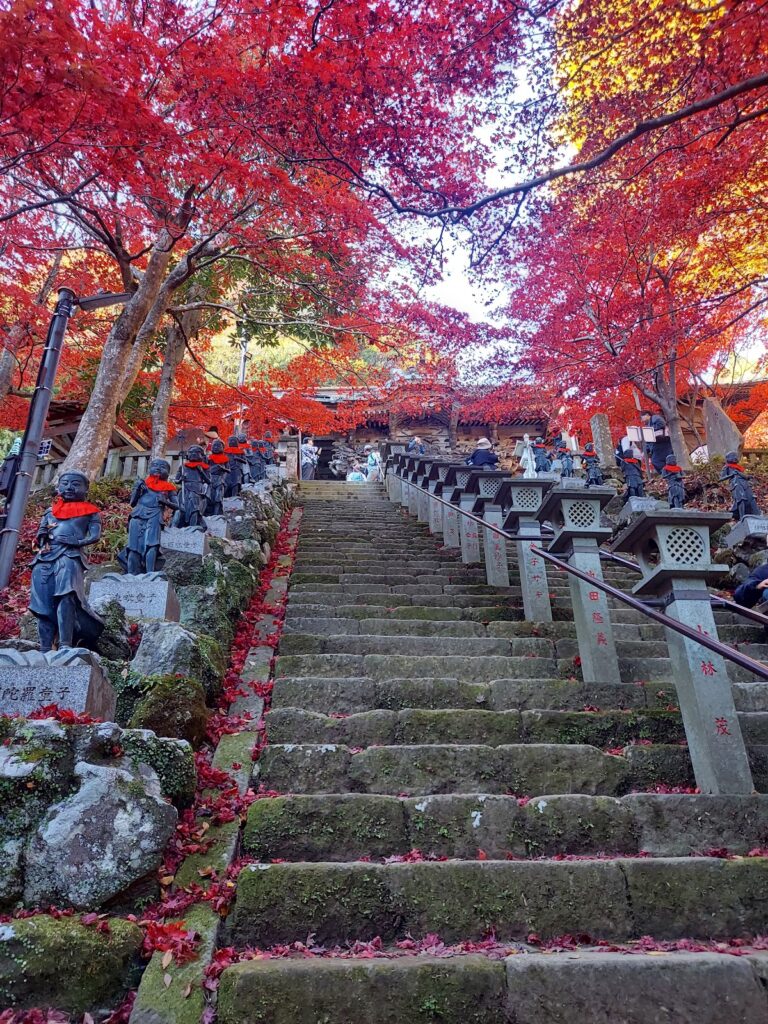
This is a stone staircase leading to the “Oyama Cable Car Station.” Souvenir shops and restaurants line both sides, selling Oyama specialties such as “Koma” (a type of spinning top) and “Oyama Tofu.”
Local Specialties:
- Oyama Tofu: A rich and flavorful tofu dish
- Tofu Soft Serve Ice Cream: A healthy soft serve ice cream made with tofu
- Oyama Spinning Top: A traditional wooden spinning top
Oyama-dera Temple
An ancient Shingon Buddhist temple located near Oyama Afuri Shrine. Known as a famous spot for autumn foliage, it attracts many tourists in the fall.
Hinata Yakushi Temple
An ancient temple in Isehara City, housing a statue of Yakushi Nyorai (Medicine Buddha) designated as a National Important Cultural Property. A popular tourist spot, often visited in conjunction with Oyama.
Nature of Oyama
Oyama is part of the Tanzawa-Oyama Quasi-National Park and is blessed with abundant nature.
Nature Through the Seasons
Spring:
- A beautiful season of fresh greenery
- Wildflowers begin to bloom
Summer:
- Mountains enveloped in deep green
- Popular as a summer resort
Autumn:
- A famous spot for autumn foliage
- Maple and other trees change color
Winter:
- Snowscapes (when there is snow)
- Clear air and panoramic views
Flora and Fauna
Mt. Daisen is home to a diverse array of flora and fauna. Along the hiking trails, you can enjoy the songs of wild birds and seasonal flowers. If you’re lucky, you might even encounter wild animals such as squirrels and raccoons.
Guidelines and Precautions for Visiting the Shrine
Attire
- Visiting the Lower Shrine Only: Casual attire is acceptable (comfortable walking shoes recommended)
- Climbing to the Summit: Hiking equipment is required (hiking boots, comfortable clothing, rain gear, etc.)
Items to Bring
- Drinking water
- Towel
- Rain gear (in case of weather changes)
- Camera (for capturing scenic views)
- Goshuincho (stamp book) (if you wish to receive a Goshuin stamp)
Manners
- Remember that this is a sacred place and worship in silence
- Take your trash with you
- Respect nature
- Be considerate of other visitors
Safety Measures
- If hiking, plan with ample time and energy
- If the weather deteriorates, do not push yourself and turn back
- Avoid hiking alone and hike in a group whenever possible
- Submit a hiking plan (for serious hiking)
Summary
Oyama Afuri Shrine is a representative ancient shrine of the Kanto region, situated on the sacred mountain Oyama, which boasts a 2200-year history. During the Edo period, it attracted the faith of ordinary people as part of the “Oyama Pilgrimage,” and even today, it is visited by many as a power spot.
The breathtaking views from the lower shrine, which has earned two Michelin stars, the climb to the main shrine at the summit, the abundant nature, and the solemn atmosphere of the sacred grounds deeply move visitors.
For first-time visitors, we recommend starting with a visit to the lower shrine via the Oyama Cable Car to experience the spectacular views and sacred atmosphere. Those confident in their physical abilities should definitely climb to the main shrine at the summit to enjoy the 360-degree panoramic view and the sense of accomplishment.
With its seasonal natural beauty, historical rituals, and soul-cleansing pilgrimage experience, Oyama Afuri Shrine is a special place where you can discover and be moved by something new every time you visit. It’s easily accessible from the Kanto region, making it perfect for a weekend getaway or day trip.
I highly recommend visiting Oyama Afuri Shrine at least once to experience its charm for yourself.