Complete Guide to Oyama-dera Temple | History, Goshuin (Temple Seals), and Access Information for Sacred Sites in Kanagawa and Tottori
Oyama-dera is a prestigious temple with several locations throughout Japan, with the most famous being “Amefuri-san Oyama-dera” in Isehara City, Kanagawa Prefecture, and “Kakuiwa-san Oyama-dera” in Oyama Town, Tottori Prefecture. Each possesses its own unique history and cultural assets, and remains a popular sacred site attracting many visitors. This article provides a comprehensive explanation of both temples, including their detailed history, cultural assets, visiting information, and access methods.
Oyama-dera is a historical and venerable temple with multiple locations throughout Japan. ## Table of Contents
- Oyama-dera Temple, Isehara City, Kanagawa Prefecture
- Oyama-dera Temple, Oyama Town, Tottori Prefecture
- Comparison and Characteristics of Both Temples
- Points to Note When Visiting
Oyama-dera Temple (Amaburi-san Oyama-dera) in Isehara City, Kanagawa Prefecture
History and Founding
Oyama-dera Temple, located in Oyama, Isehara City, Kanagawa Prefecture, is a temple belonging to the Daikaku-ji branch of the Shingon sect and is affectionately known as “Oyama Fudo” or “Oyama no Ofudo-san.” Its mountain name is Amaburi-san, and its principal image is Fudo Myoo.
It is said to have been founded in 755 (Tenpyo Shoho 7) by the monk Ryoben, who founded Todai-ji Temple in Nara. Following the founding by monk Ryoben, the second abbot of Oyama-dera Temple was the monk Kozo, a senior disciple of Gyoki Bodhisattva, who opened the entire Oyama area and built various halls on the mountainside. Later, at the invitation of Tokuichi Bodhisattva, Kobo Daishi (Kukai) became the third head priest of Oyama-dera Temple, and numerous sacred sites were established.
In the late Kamakura period, the Shingon monk Gangyo Shonin restored the temple, and during the Bun’ei era, he cast the principal image, an iron statue of Fudo Myoo and two attendant figures. These statues are now designated as important national cultural properties.
During the Edo period, the Oyama pilgrimage spread throughout the Kanto region, and it became a popular tourist destination near Edo. It was such a well-known sacred site among ordinary people that it was even featured in the rakugo (traditional Japanese comic storytelling) performance “Oyama Mairi” (Pilgrimage to Oyama).
Cultural Properties
Oyama-dera Temple in Isehara houses an iron seated statue of Fudo Myoo and two attendant figures, designated as important national cultural properties. These were cast by Gangyo Shonin during the Bun’ei era (1264-1275) and are extremely valuable cultural assets as iron Buddhist statues.
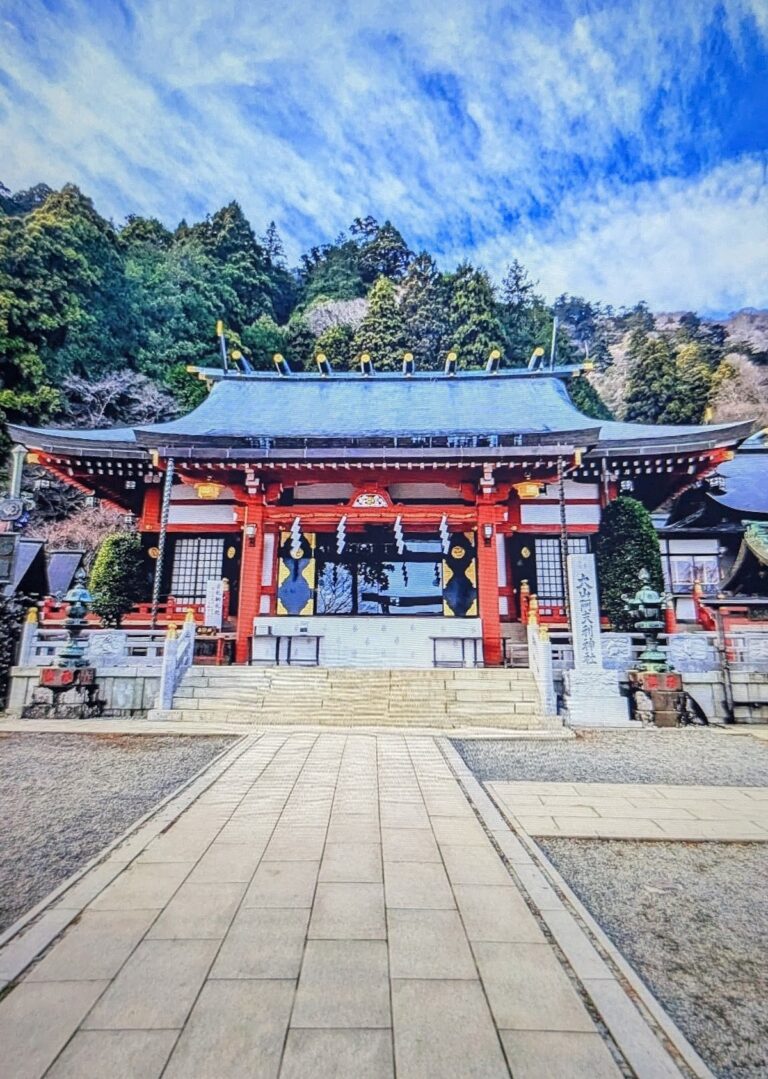
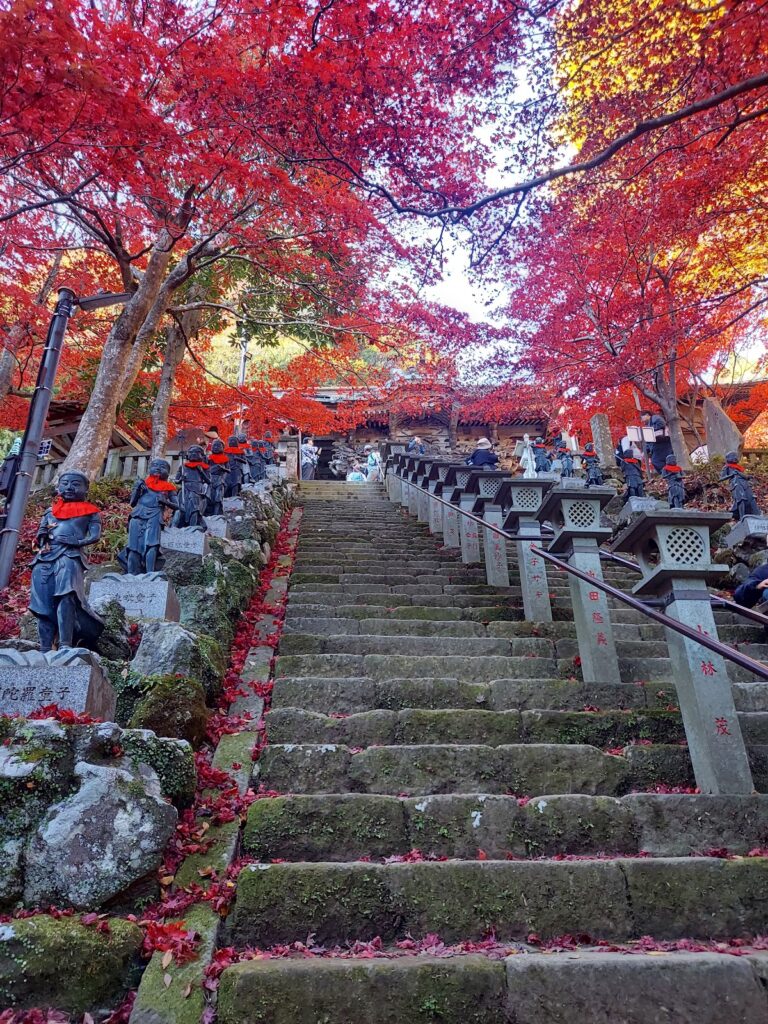
The main hall was rebuilt during the Edo period and still retains a strong atmosphere of a sacred site for Shugendo (mountain asceticism). It is also known as a famous spot for autumn foliage, attracting many tourists.
Pilgrimage, etc.
Oyama-dera Temple is counted as one of the three major Fudo temples in the Kanto region, and along with Takahata-san Kongo-ji Temple (Hino City, Tokyo) and Narita-san Shinsho-ji Temple (Narita City, Chiba Prefecture), it is a representative Fudo Myoo pilgrimage site in Kanto. It is also known as the first of the 36 Fudo temples of Kanto.
The principal image, a statue of Fudo Myoo, is usually a hidden Buddha and is only unveiled on special occasions. When it is unveiled, many devotees visit to pay their respects, conveying the dignity of this sacred site to this day.
Location and Access
Location: 724 Oyama, Isehara City, Kanagawa Prefecture
Access:
- From the north exit of Isehara Station on the Odakyu Odawara Line, take the Kanagawa Chuo Kotsu bus bound for Oyama Cable Car for approximately 25 minutes and get off at the last stop, Oyama Cable Car.
- From the bus stop, it’s approximately a 15-minute walk to the cable car station.
- Get off at Oyama-dera Station on the Oyama Cable Car and walk for approximately 2 minutes.
- Alternatively, it’s approximately a 30-minute walk from Oyama Cable Car Station (climbing stairs).
Parking: Several paid parking lots are available around Oyama (public transportation is recommended during peak seasons due to congestion).
Visiting Hours: Grounds are freely accessible (please check for entry to the main hall).
Admission Fee: Grounds are free.
Relationship with Oyama Afuri Shrine
Oyama-dera Temple has a close relationship with Oyama Afuri Shrine. Before the Meiji-era separation of Shinto and Buddhism, it was worshipped in a form of syncretism of Shinto and Buddhism. Even today, along with Oyama Afuri Shrine, it remains a central point of Oyama worship, attracting many visitors.
Using the Oyama Cable Car provides access to both Oyama-dera Station and Afuri Shrine Station, making it common for people to visit both.
Oyama-dera Temple (Kakubanzan Oyama-dera) in Oyama-cho, Tottori Prefecture
History and Founding
Oyama-dera Temple, located on the slopes of Mt. Hoki-Daisen in Oyama-cho, Saihaku-gun, Tottori Prefecture, is a Tendai sect temple with a special status. Its mountain name is Kakubanzan, and its principal image is Jizo Bodhisattva. It is also the 29th temple on the Chugoku Thirty-Three Kannon Pilgrimage.
It is believed to have been founded in 718 AD by Toshikata (Kinren Shonin), and the origins of Oyama worship date back over 1300 years. Initially a Shingon sect temple, it converted to the Tendai sect during the Heian period as Tendai sect temples were successively built.
From the Heian period through the Kamakura and Muromachi periods, Daisen-ji Temple flourished, boasting over 100 temples and more than 3,000 warrior monks at its peak, rivaling the power of Enryaku-ji Temple on Mount Hiei (Shiga Prefecture), Kongobu-ji Temple on Mount Koya (Wakayama Prefecture), and Yoshino-san (Nara Prefecture). It became a major training ground for asceticism, known as “Daisen-ji with 3,000 warrior monks,” and a religious center of the Chugoku region.
During the Sengoku period, it attracted the reverence of various warlords in the Chugoku region and played an important role as a sacred site for the protection of the nation. However, it suffered numerous fires throughout history, with many buildings being destroyed. The current main hall was rebuilt after the Edo period.
Cultural Properties
Daisen-ji Temple in Tottori Prefecture preserves the Amida Hall and the Amida Triad, which are important cultural properties. The Amida Hall is a valuable structure that retains medieval architectural style and is an important cultural property for understanding the history of Buddhist architecture in the San’in region.
In addition, many treasures remain in the ten temples within the mountain, preserving the history of this renowned temple in the San’in region.
Main Hall and Temple Grounds
The current main hall was rebuilt after a past fire and exudes a solemn atmosphere. From the temple grounds, one can see Mount Daisen (1729 meters above sea level), the highest peak in the Chugoku region, and feel the atmosphere of a sacred site where nature and faith are intertwined.
Daisen-ji Temple is revered by people throughout the Chugoku region as “a temple where one can meet their ancestors,” and many worshippers still visit it today.
Relationship with Ogamiyama Shrine Inner Sanctuary
The Ogamiyama Shrine Inner Sanctuary is located very close to Daisen-ji Temple. The Daisen faith in Tottori also has a form of syncretism of Shinto and Buddhism, and both Daisen-ji Temple and Ogamiyama Shrine developed as centers of Daisen faith.
Although the two were separated by the Meiji-era Shinto-Buddhism Separation Order, many people who visit Daisen still visit both. The inner sanctuary of Ogamiyama Shrine boasts one of the largest Gongen-zukuri style shrine buildings in Japan and is designated as a National Important Cultural Property.
Location and Access
Location: 9 Oyama, Oyama-cho, Saihaku-gun, Tottori Prefecture
Access:
- Approximately 50 minutes by Nihon Kotsu bus bound for Oyama-ji Temple from JR San’in Main Line “Yonago Station,” then a 5-minute walk from “Oyama-ji” bus stop.
- Approximately 15 minutes by car from Yonago Expressway “Mizoguchi IC.”
- Approximately 25 minutes by car from Yonago Expressway “Yonago IC.”
Parking: Multiple parking lots available around Oyama-ji Temple (be aware of road conditions in winter).
Visiting Hours: Grounds are freely accessible (please check for entry to the main hall).
Admission Fee: Free entry to the grounds.
Daisen-Oki National Park
Oyama-ji Temple is located within Daisen-Oki National Park and is surrounded by abundant nature. With its fresh greenery in spring, mountain climbing in summer, vibrant autumn foliage, and skiing in winter, it’s a major tourist destination attracting many visitors throughout the year.
Comparison and Characteristics of the Two Temples
Differences in Sects
- Oyama-dera Temple in Isehara: Shingon-shu Daikaku-ji School
- Oyama-dera Temple in Tottori: Tendai-shu Special Head Temple
Although their founding sects differ, both temples have deep connections to Kobo Daishi and the Tendai sect, occupying important positions in the history of Japanese Buddhism.
Differences in Principal Deities
- Oyama-dera Temple in Isehara: Fudo Myoo (Iron, Important Cultural Property)
- Oyama-dera Temple in Tottori: Jizo Bodhisattva
The difference in principal deities reflects the differences in the forms of worship at each temple. Oyama-dera Temple in Isehara, as a sacred site of Shugendo, centers on Fudo Myoo worship, while Oyama-dera Temple in Tottori focuses on Jizo worship and ancestor worship.
Status as a Sacred Site
- Oyama-dera Temple in Isehara: One of the three major Fudo temples in the Kanto region, and the first temple on the Kanto Thirty-Six Fudo pilgrimage route.
- Oyama-dera Temple in Tottori: The 29th temple on the Chugoku Thirty-Three Kannon pilgrimage route, a sacred site for national protection.
Both temples function as important pilgrimage sites in their respective regions.
Historical Scale
Oyama-dera Temple in Tottori was a major religious force with 3,000 warrior monks at its peak, while Oyama-dera Temple in Isehara developed as a more accessible sacred site attracting the faith of the common people of Edo. Although differing in scale, both have played important roles as centers of faith in their respective regions.
Points to Note When Visiting
Clothing and Preparation
Since both temples are located in the mountains, comfortable clothing and shoes are recommended. Isehara’s Oyama-dera Temple has many stairs, and Tottori’s Oyama-dera Temple experiences snowfall in winter, so seasonal preparations are necessary.
Visiting Hours
While you can generally visit the temple grounds freely, there may be time restrictions for viewing the main hall or obtaining a Goshuin (temple stamp). We recommend checking the latest information on each temple’s official website beforehand.
Photography
Photography is generally permitted on the temple grounds, but there may be restrictions on photographing the main hall or cultural artifacts. When taking photos, please follow the signs and be considerate of other visitors.
Goshuin (Temple Stamps)
Both temples offer Goshuin. Please bring your Goshuincho (stamp book) and visit during the reception hours. Limited edition Goshuin may be available during special events.
Nearby Tourist Attractions
Around Oyama-dera Temple in Isehara
- Oyama Afuri Shrine: An ancient shrine located near the summit of Mt. Oyama
- Oyama Cable Car: A convenient mode of transportation that allows you to enjoy the scenery while traveling
- Oyama Tofu: Shops serving Oyama’s famous tofu dishes line the approach to the temple
- Oyama Koma Sando: An approach lined with souvenir shops and restaurants
Around Oyama-dera Temple in Tottori
- Ogamiyama Shrine Okumiya: One of the largest Gongen-zukuri style shrine buildings in Japan
- Oyama Makiba Milk Village: A tourist facility where you can enjoy the nature of Mt. Oyama
- Oyama Masumizu Plateau: A resort area where you can enjoy the nature of the four seasons
- Shoji Ueda Photography Museum: A museum exhibiting the works of a world-renowned photographer
Current Status of Oyama-dera Temple
Both temples continue to engage in active religious activities, with regular memorial services and events being held. At Oyama-dera Temple in Isehara, events such as Setsubun (bean-throwing festival) and autumn foliage illuminations are held, while at Oyama-dera Temple in Tottori, traditional events such as the Oyama Summer Mountain Opening Festival are held.
Detailed event schedules and the latest information can be found on each temple’s official website. It is recommended to check the information in advance when planning a visit.
Summary
The two temples bearing the name Oyama-dera, while each possessing different histories and characteristics, continue to attract many worshippers as important sacred sites in Japanese Buddhist culture. Oyama-dera Temple in Isehara City, Kanagawa Prefecture, is one of the three major Fudo temples in the Kanto region, and Oyama-dera Temple in Oyama Town, Tottori Prefecture, is a renowned temple in the San’in region, each functioning as a center of spiritual culture in their respective areas.
Visiting both temples will allow you to experience the diversity of Japanese Buddhist history and the depth of faith rooted in the local communities. With its historical cultural assets, beautiful nature, and vibrant faith, Oyama-dera Temple is a sacred site well worth visiting.