Complete Guide to Ryushoin Temple (Namegawa Kannon) | History and Cultural Assets of the 28th Temple of the Bando Thirty-Three Kannon Pilgrimage
About Ryushoin Temple
Ryushoin Temple is a Tendai sect temple located in Namegawa, Narita City, Chiba Prefecture. Its mountain name is Namegawa-san, and its principal image is the Eleven-Faced Kannon Bodhisattva. It is known as the 28th temple of the Bando Thirty-Three Kannon Pilgrimage. Locally, it is affectionately known as “Namegawa Kannon,” and is a place of worship visited by many as a guardian deity for longevity, safe childbirth, and child-rearing.
Founded in 838 AD by Jikaku Daishi Ennin, Ryushoin Temple is an ancient temple with a history of over 1200 years. Throughout its long history, it has preserved numerous valuable cultural assets, including nationally designated important cultural properties and Chiba Prefecture designated tangible cultural properties.
History of Ryushoin Temple
Origin of its Founding and Jikaku Daishi
Ryushoin Temple’s founding dates back to the early Heian period, specifically to the 5th year of the Jōwa era (838 AD). It is said to have been founded by Jikaku Daishi Ennin, a high-ranking priest of the Tendai sect, at the behest of Oda Masaharu, the lord of Namekawa Castle.
According to legend, Oda Masaharu encountered an old monk on the banks of the Oda River, and received a statue of Kannon from him, which became the impetus for the temple’s construction. This Kannon statue is the current principal image, the Eleven-Faced Kannon Bodhisattva. Although a small statue, approximately 3.6 cm tall, it is housed within a larger Kannon statue created later.
Jikaku Daishi Ennin was a high-ranking priest known as the third head of the Tendai sect, and is known for founding many temples from the Tohoku region to the Kanto region. Ryushoin Temple is one of them, and has functioned as an important base for spreading the teachings of the Tendai sect.
Changes from the Medieval to the Early Modern Period
Since its founding, Ryushoin Temple developed as an important Tendai sect temple in Shimosa Province. As the 28th temple on the Bando Thirty-Three Kannon Pilgrimage, it established itself as a sacred site visited by many pilgrims.
During the Bunki era (1501-1504) at the end of the Muromachi period, the Niomon Gate, now a nationally designated Important Cultural Property, was constructed. This suggests that Ryushoin Temple received support from local influential figures and believers during this period, leading to the development of its temple complex.
In the Edo period, the main hall was rebuilt during the Genroku era (1688-1704), further enhancing the temple’s appearance. This reconstruction formed the basic structure of the current main hall.
Ryushoin Temple in the Modern Era
Despite the impact of the Meiji-era separation of Shinto and Buddhism, Ryushoin Temple continued to exist as a center of local faith. In 1916 (Taisho 5), the Niomon Gate was designated a National Important Cultural Property, officially recognizing its historical and architectural value.
Even as times changed from Showa to Heisei and Reiwa, Ryushoin Temple has continued to attract devoted followers rooted in the region as a pilgrimage site for the Bando Thirty-Three Kannon Pilgrimage and as the Namekawa Kannon. Currently, it balances the preservation of cultural properties with its role as a place of worship, welcoming many worshippers and tourists.
Ryushoin Temple Complex
Niomon Gate (National Important Cultural Property)
The Niomon Gate, a nationally designated Important Cultural Property, is a symbol of Ryushoin Temple. Built during the Bunki era at the end of the Muromachi period, this gate is a three-bay, single-entrance, eight-legged gate with a hipped roof and copper plate roofing (originally thatched).
The Niomon Gate, as its name suggests, houses Nio statues (Kongo Rikishi statues) on both sides, serving to protect the temple grounds. While its architectural style is primarily Japanese, influences from Zen Buddhism can also be seen in its details, making it a valuable historical structure that conveys the high level of architectural technology of the Muromachi period.
Since being designated a National Important Cultural Property on May 24, 1916 (Taisho 5), it has undergone proper preservation and management, and still largely retains its original appearance. The Niomon Gate’s powerful structure and elegant roof lines leave a deep impression on visitors.
Main Hall (Chiba Prefecture Designated Tangible Cultural Property)
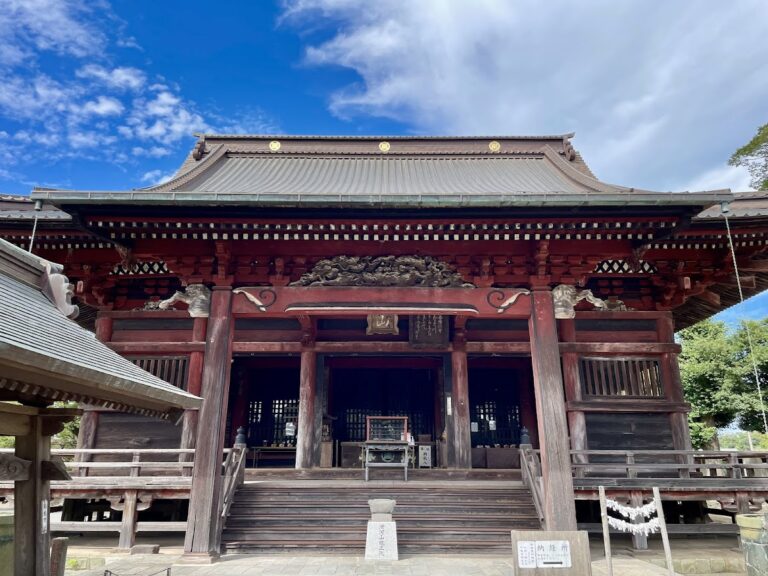
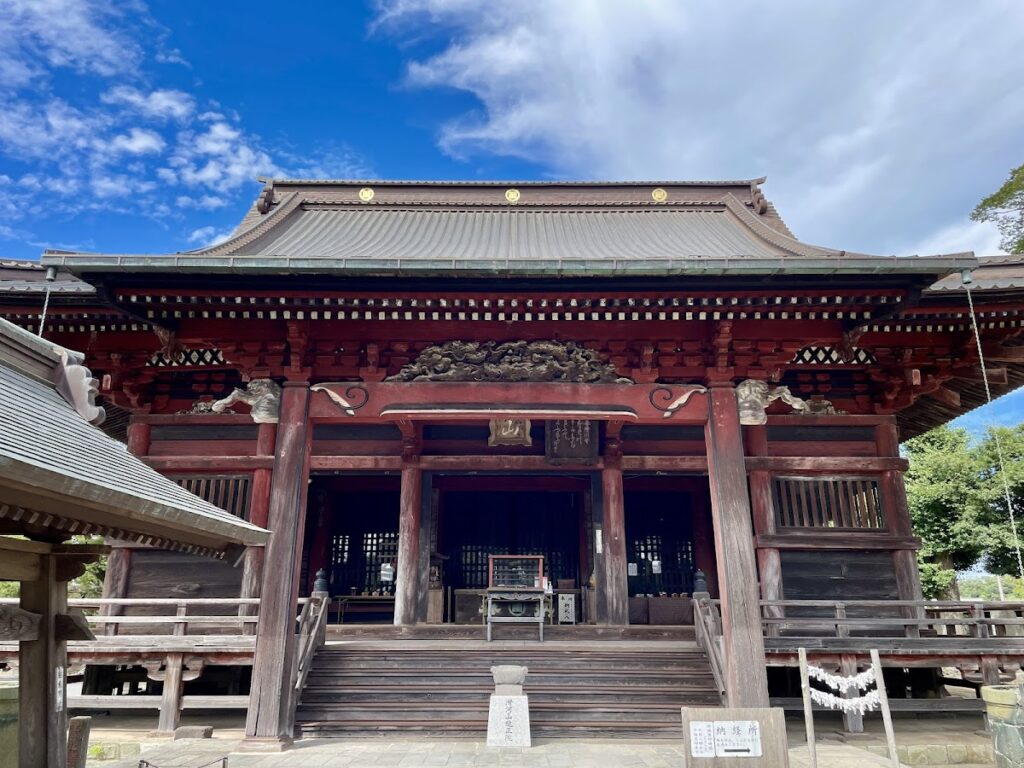
The main hall of Ryushoin Temple is a building rebuilt during the Genroku era and is a Chiba Prefecture Designated Tangible Cultural Property. It boasts a magnificent hip-and-gable roof structure, and houses the principal image, the Eleven-Faced Kannon Bodhisattva.
The architectural style of the main hall clearly exhibits characteristics of the mid-Edo period, and its construction reflects the formality of a Tendai sect temple. The interior of the hall exudes a solemn atmosphere, serving as a space for worshippers to offer prayers to Kannon.
The principal image, the Eleven-Faced Kannon Bodhisattva, is a small statue, approximately 3.6 cm tall, as mentioned earlier. However, it is housed within a larger Kannon statue created later and is carefully preserved as a hidden Buddha. Worshippers can directly worship this larger Kannon statue, and many believers visit seeking blessings for longevity, safe childbirth, and successful child-rearing.
Other Halls and Grounds
In addition to the main hall and Niomon gate, several other halls are located within the grounds of Ryushoin Temple. Centered around the main hall, which functions as a Kannon hall, the temple’s living quarters and bell tower are neatly arranged, forming a typical Tendai sect temple layout.
The grounds are of a moderate size, providing ample space for worshippers to leisurely explore. The natural beauty of the grounds, which changes with the seasons, is another of Ryushoin Temple’s charms. Especially during the cherry blossom season in spring and the autumn foliage season, many visitors come to the temple to spend time in quiet prayer.
Cultural Properties of Ryushoin Temple
Nationally Designated Important Cultural Property
Ryushoin Niomon Gate
As mentioned above, the most important cultural property of Ryushoin Temple is the Niomon Gate. Designated as a Nationally Important Cultural Property on May 24, 1916 (Taisho 5), this building is a valuable relic that conveys the architectural techniques of the late Muromachi period.
Owned by Ryushoin Temple, it is still open to the public, and visitors can freely view it. Regular preservation and repair work is carried out, ensuring that its value as a cultural property is preserved and passed down to the present day.
Chiba Prefecture Designated Tangible Cultural Property
Ryushoin Main Hall
The Ryushoin Main Hall is a Chiba Prefecture Designated Tangible Cultural Property, receiving protection at the prefectural level. With a clear history of reconstruction during the Genroku era, it is valued as a building that clearly exhibits the characteristics of temple architecture from the mid-Edo period.
The architectural style, structure, and decorations of the main hall are important historical documents for understanding the architectural techniques and religious practices of the time, and it holds a significant position in Chiba Prefecture’s cultural property protection administration.
Other Temple Treasures
In addition to designated cultural properties, Ryushoin Temple possesses many other temple treasures. The Buddhist statues, paintings, scriptures, and ancient documents collected and preserved by successive chief priests are valuable historical materials that tell the story of the temple’s long history.
Among these treasures are pilgrimage-related materials and sutra books that show the temple’s history as one of the 33 Kannon pilgrimage sites of Bando, making them important for studying Japanese pilgrimage culture.
As the 28th temple of the 33 Kannon pilgrimage sites of Bando
What is the 33 Kannon pilgrimage site of Bando?
The 33 Kannon pilgrimage site of Bando is a pilgrimage route that visits 33 Kannon pilgrimage sites spread across the Kanto region (Bando). Along with the Saigoku Thirty-Three Kannon Pilgrimage and the Chichibu Thirty-Four Kannon Pilgrimage, this is an important pilgrimage route counted among the 100 Kannon Pilgrimages of Japan, boasting a long history dating back to the Heian period.
Ryūshōin Temple holds a significant position as the 28th temple on this pilgrimage. While there are several temples within Chiba Prefecture, Ryūshōin is located in Narita City, and many pilgrims visit it along with Naritasan Shinshōji Temple.
Waka Poem
The waka poem of Ryūshōin Temple is “At Asahigafuchi, the famous Namegawa Temple, Kannon saves people with her netted robe.” This poem expresses the compassionate heart of Namegawa Kannon, depicting Kannon saving sentient beings with her netted robe.
Asahigafuchi is a place said to have once been located near the temple, and its connection to the Odagawa River, which appears in the founding legend, has been pointed out. Reciting the waka poem while visiting the temple can lead to a deeper religious experience. ### Welcoming Pilgrims
Ryūshōin Temple, as a pilgrimage site of the Bandō Thirty-Three Kannon Pilgrimage, has established a system for welcoming pilgrims. They offer services such as issuing temple seals and accepting sutra copying, and many pilgrims visit the temple.
Especially during the pilgrimage season from spring to autumn, not only individual pilgrims but also group pilgrimage bus tours visit, making the temple grounds bustling with many worshippers. The temple strives to create an environment where pilgrims can worship in peace.
Faith at Ryūshōin Temple
Kannon of Longevity, Safe Childbirth, and Child-Rearing
The principal image of Ryūshōin Temple, the Eleven-Faced Kannon Bodhisattva, is believed to grant blessings for longevity, safe childbirth, and child-rearing, and has attracted many worshippers since ancient times.
A wide range of worshippers visit the temple, including pregnant women and their families praying for safe childbirth, parents praying for the safety of their children, and elderly people praying for health and longevity. For local residents in particular, it serves as a familiar place of worship that they visit at various milestones in their lives.
Annual Events
Ryushoin Temple holds various Buddhist services and events throughout the year. Traditional Tendai Buddhist temple events such as the New Year’s visit, the spring and autumn equinox services, and the Obon memorial service are observed.
Furthermore, as a pilgrimage site of the Bando Thirty-Three Kannon Pilgrimage, it participates in regularly held events of the pilgrimage association, deepening its exchanges with other pilgrimage sites. These events serve as important opportunities to connect the temple with the local community and a broader network of faith.
Connections with the Community
Ryushoin Temple has been deeply connected to the local community for over 1200 years since its founding. Affectionately known as Namekawa Kannon, it has a history of functioning as a spiritual haven for local residents.
Even today, the temple is often involved in local festivals and events, playing a central role in the community. Beyond its strong ties to the community through the danka (parishioner) system, Ryushoin Temple welcomes many people as an open temple through its devotion to Kannon (Goddess of Mercy).
Access and Visiting Information for Ryushoin Temple
Location
Address: 1093 Namekawa, Narita City, Chiba Prefecture
Ryushoin Temple is located in the Namekawa district of Narita City, Chiba Prefecture. While Narita City is known for Naritasan Shinshoji Temple and Narita International Airport, Ryushoin Temple stands in a quiet environment, slightly removed from these bustling areas.
Transportation Access
Access by Train
It’s approximately a 20-minute walk from Namekawa Station on the JR Narita Line. Namekawa Station is on the Narita Line and can be accessed from Narita Station and Sawara Station. The walk from the station to the temple takes you through a peaceful rural landscape, allowing you to experience the atmosphere of a pilgrimage.
If walking is difficult, taxis are also available. It’s about a 5-minute taxi ride from Namekawa Station.
Access by Car
The temple is approximately 15 minutes from the Narita Interchange on the Higashi-Kanto Expressway, or approximately 10 minutes from the Daiei Interchange. The temple has a parking lot for visitors, making it convenient to visit by car.
When using a car navigation system, search for “Ryushoin” or “Namegawa Kannon,” or enter the address “1093 Namegawa, Narita City, Chiba Prefecture.”
Visiting Hours and Admission Fees
The grounds of Ryushoin are generally open to visitors. However, there may be time restrictions for viewing the interior of the main hall or receiving Goshuin (temple stamps), so it is recommended to check in advance.
General visiting hours are during the daytime (approximately 9:00 AM to 5:00 PM), but these may vary depending on the season and events. General visits may be restricted during special ceremonies or events.
Admission is generally free, but a prescribed offering is required when receiving Goshuin or amulets.
Etiquette for Visiting the Temple
Ryūshōin Temple is still a functioning place of worship. Please observe the following etiquette when visiting:
- Bow when passing through the Niomon Gate
- Behave quietly within the temple grounds
- Take photographs only in designated areas (especially check the rules inside the main hall)
- Remove your hat and pray respectfully in the main hall
- Take your trash with you
- The parking lot is for visitors only; please refrain from using it for purposes other than sightseeing
Present and Posts of the Pilgrimage
When visiting the Bandō Thirty-Three Kannon Pilgrimage sites, the temples before and after Ryūshōin Temple are as follows:
Temple No. 27: Iinuma-san Enpuku-ji (Enpuku-ji Temple) (Choshi City, Chiba Prefecture)
Temple No. 28: Namegawa-san Ryusho-in (Narita City, Chiba Prefecture) ← This temple
Temple No. 29: Kaijo-san Chiba-dera (Chiba City, Chiba Prefecture)
When traveling from Ryusho-in to Temple No. 29, Chiba-dera, the distance is considerable, so it is recommended to carefully plan your transportation and time allocation. The same applies when traveling from Temple No. 27, Enpuku-ji, to Ryusho-in.
Attractions near Ryusho-in
Naritasan Shinsho-ji Temple
Naritasan Shinsho-ji Temple, located about 20 minutes by car from Ryusho-in, is the head temple of the Shingon Chizan sect and a famous temple boasting one of the highest numbers of New Year’s visitors in Japan. It is worth visiting in conjunction with a visit to Ryusho-in.
Narita International Airport
Narita International Airport, Japan’s gateway, is nearby, attracting visitors from overseas and those who visit before their departure. It takes approximately 30 minutes by car from the airport to Ryushoin Temple.
Around Lake Inbanuma
Lake Inbanuma stretches out to the south of Ryushoin Temple, offering opportunities to enjoy the natural beauty of the waterside. Activities such as cycling and birdwatching are also available.
Summary
Ryushoin Temple (Namekawa Kannon) is an ancient Tendai sect temple with a history of over 1200 years. As the 28th temple on the Bando Thirty-Three Kannon Pilgrimage, it has welcomed many pilgrims. It possesses valuable cultural assets, including the Niomon Gate, a nationally designated Important Cultural Property, and is revered by local people as a Kannon deity for longevity, safe childbirth, and child-rearing.
Since its founding in 838 AD, Ryushoin Temple, established through the vows of Oda Masaharu, lord of Namegawa Castle, and founded by Jikaku Daishi Ennin, holds significant importance in understanding the history of Japanese Buddhism, particularly the expansion of the Tendai sect into eastern Japan.
The Niomon Gate, built at the end of the Muromachi period, possesses high architectural value, and together with the main hall, rebuilt during the Genroku era, it represents a precious legacy that conveys faith and culture across generations.
Located in Narita City, Chiba Prefecture, with convenient transportation access, Ryushoin Temple offers a tranquil environment for peaceful worship. It is an important pilgrimage site for those undertaking the Bando Thirty-Three Kannon Pilgrimage and a familiar place of worship for local residents, continuing to be cherished by many for years to come.
By visiting Ryushoin Temple, where history, cultural assets, and thriving faith are intertwined, you can experience the profound depth of Japanese Buddhist culture and the universal appeal of Kannon worship. If you have the opportunity to visit Narita, this temple is definitely worth a visit.