Enkoji Temple (Ogaki City, Gifu Prefecture) Complete Guide | The Charm of an Ancient Temple Founded by Saicho and a Famous Autumn Foliage Spot
Enkoji Temple, located in Kamiishizu-cho, Ogaki City, Gifu Prefecture, is an ancient Tendai sect temple said to have been founded in 790 AD by Dengyo Daishi Saicho. Its principal image is a standing statue of the Holy Kannon Bodhisattva, a nationally important cultural property. It holds historical value as a family temple associated with the Minamoto clan and is widely known as a famous autumn foliage spot, selected as one of the “33 Best Autumn Foliage Spots in Hida and Mino.”
This article provides a detailed explanation of information you should know before visiting Enkoji Temple, including its history, cultural properties, autumn foliage highlights, and transportation access.
History and Background of Enkoji Temple
Founding Legend by Saicho
The founding of Enkoji Temple dates back to 790 AD. According to temple tradition, when Dengyo Daishi Saicho visited Aobaka in Fuwa District, Mino Province (present-day Aobaka-cho, Ogaki City) during his pilgrimage through eastern Japan, he founded the temple at the request of the local powerful family, the Oi clan.
It is said that Saicho himself carved a statue of the Holy Kannon on the mountaintop and enshrined it as the principal image. This standing statue of the Holy Kannon Bodhisattva is currently designated as a National Important Cultural Property and is the most valuable cultural asset of Enkoji Temple.
Prosperity from the Heian Period to the Middle Ages
In its early days, Enkoji Temple took Shinoo-san as its mountain name and flourished as a large temple complex with seven main halls. Towards the end of the Heian period, it developed deep ties with the Minamoto clan.
In particular, it is known as the family temple of Minamoto no Tomonaga, the eldest son of Minamoto no Yoshitomo, who was defeated in the Heiji Rebellion (1159). While fleeing to the eastern provinces with his father, Yoshitomo, Tomonaga’s injuries worsened in Aobaka, and he died there at the young age of 17. The main hall of Enkoji Temple still houses the memorial tablets and stone pagodas of the Minamoto clan, and Tomonaga’s tomb is also located within the temple grounds.
Repeated Fires and Reconstruction
Enkoji Temple has suffered numerous fires throughout its long history. In particular, many of its buildings were destroyed by fire during the Sengoku period (Warring States period).
In 1658 (Manji 1), the temple was relocated and rebuilt in its current location in Kamiishizu-cho. This relocation laid the foundation for the current temple grounds, establishing the present-day appearance of Enkoji Temple.
Enkoji Temple in the Modern Era
Despite the impact of the anti-Buddhist movement of the Meiji era, Enkoji Temple continued to exist as a center of local faith. During the Showa period, the principal image, a standing statue of the Holy Kannon Bodhisattva, was designated a National Important Cultural Property, officially recognizing its cultural value.
Currently, Enkoji Temple welcomes pilgrims as the 32nd temple of the 33 sacred sites of West Mino, and is also a popular tourist spot known for its beautiful autumn foliage.
Cultural Properties of Enkoji Temple
Nationally Designated Important Cultural Property: Wooden Standing Statue of Sho Kannon Bodhisattva
The wooden standing statue of Sho Kannon Bodhisattva, the principal image of Enkoji Temple, is a valuable Buddhist statue designated as a National Important Cultural Property. While tradition attributes its carving to Saicho himself, art history estimates it to be a work from the early to mid-Heian period.
The statue is approximately 160 centimeters tall and was created using the ichiboku-zukuri (single-block carving) technique. It is characterized by its serene expression and graceful posture, and is highly regarded as an excellent example of Heian period Buddhist sculpture.
Normally, it is kept as a hidden Buddha in a shrine and is only unveiled on special occasions.
Historical Sites Associated with Minamoto no Tomonaga
The main hall houses the memorial tablets of Minamoto no Tomonaga and other members of the Minamoto clan, preserving historically valuable artifacts. Within the temple grounds is a stone pagoda believed to be the tomb of Minamoto no Tomonaga, conveying the turbulent history of the late Heian period.
A Camphor Tree Over 300 Years Old
A camphor tree over 300 years old stands within the temple grounds, its presence overwhelming. This large camphor tree adds a splash of green to the grounds throughout the seasons, creating a beautiful contrast with the red and yellow maple and ginkgo trees during the autumn foliage season.
Because the camphor tree is an evergreen, its contrast with the deciduous trees that change color in autumn is striking, making it an important element of Enkoji Temple’s autumn foliage scenery.
Enkoji Temple’s Autumn Leaves: One of the 33 Best Autumn Foliage Spots in Hida and Mino
Enkoji Temple as a Famous Autumn Foliage Spot
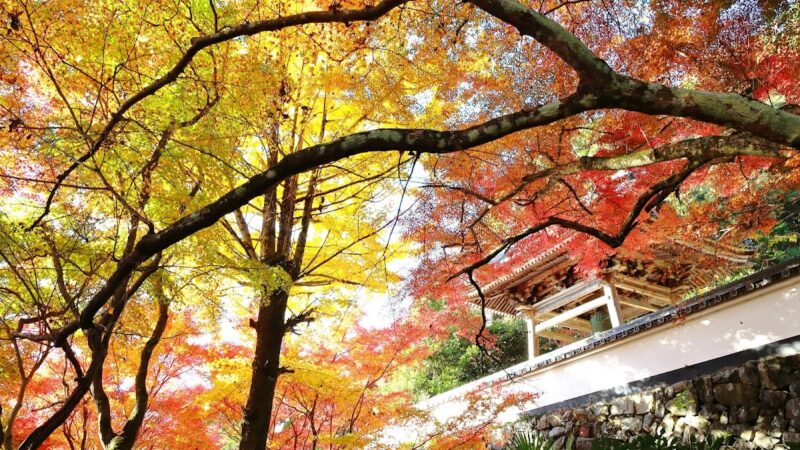
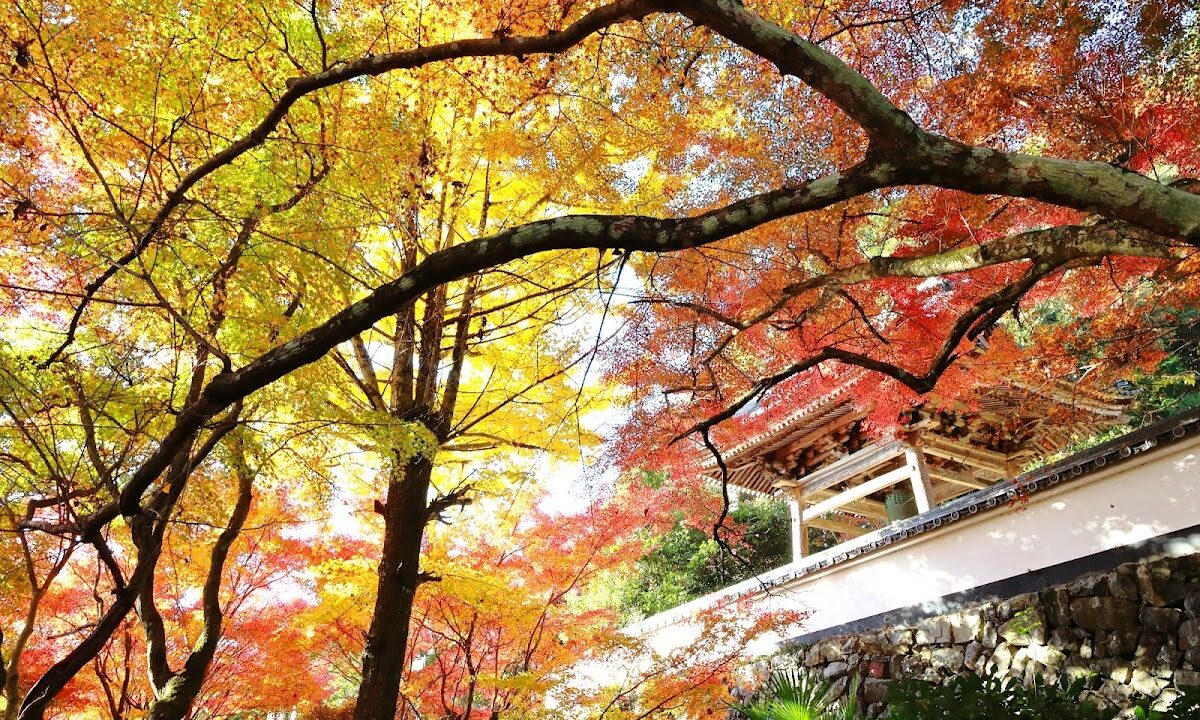
Enkoji Temple is known as one of Gifu Prefecture’s leading autumn foliage spots and has been selected as one of the “33 Best Autumn Foliage Spots in Hida and Mino.” Numerous maple and ginkgo trees are planted on the temple grounds, and in autumn they turn into a vibrant tapestry of colors.
The view from the stone steps leading to the main hall, looking north, is particularly magnificent, offering a spectacular display of colors:
- Maple Red: A diverse range of red hues, from fiery crimson to orange
- Ginkgo Yellow: A brilliant golden glow
- Camphor Green: The deep green characteristic of evergreen trees
This contrast of three colors sets Enkoji Temple’s autumn foliage apart from other famous spots.
Best Time to See Autumn Leaves
The best time to see the autumn leaves at Enkoji Temple is typically from mid-November to late November. While this may vary depending on weather conditions, this is the time when the leaves are at their most beautiful.
We recommend checking the latest autumn leaf information on the Gifu Prefecture Tourism Official Website or the Ogaki City Tourism Information website before your visit.
Recommended Spots for Viewing Autumn Leaves
The main viewpoints for enjoying the autumn leaves at Enkoji Temple are as follows:
- Stone Steps Leading to the Main Hall: The autumn leaves viewed while climbing the steps are exceptionally beautiful.
- Temple Grounds in Front of the Main Hall: The contrast between the large camphor tree and the autumn leaves is magnificent.
- Around the Tomb of Minamoto no Tomonaga: You can enjoy the autumn leaves in a tranquil atmosphere.
The temple grounds are relatively compact, allowing you to stroll around and enjoy the autumn leaves from various angles.
Illumination Information
Currently, Enkoji Temple does not regularly illuminate its autumn leaves. The best time to enjoy the autumn foliage is in the natural daylight. However, special events may be held, so it’s a good idea to check the latest information before visiting.
Highlights of Enkoji Temple
Main Hall
Rebuilt after the temple’s relocation in 1658, the main hall is a magnificent building with the solemn atmosphere characteristic of Tendai Buddhist temples. Inside, the principal image, a standing statue of the Holy Kannon Bodhisattva, is enshrined, along with the memorial tablets of the Minamoto clan.
Standing before the main hall, one can feel the weight of history and the tranquil atmosphere, providing visitors with deep spiritual peace.
Natural Environment of the Temple Grounds
Enkoji Temple is located on a hillside, surrounded by abundant nature. In addition to maple trees, the temple grounds feature seasonal flowers and plants, offering different scenery throughout the year: cherry blossoms in spring, fresh greenery in summer, autumn leaves in fall, and a serene snowscape in winter.
In particular, the large camphor tree, over 300 years old, serves as a symbolic presence on the temple grounds, welcoming visitors.
32nd Temple of the 33 Sacred Sites of West Mino
Enkoji Temple is designated as the 32nd temple of the 33 Sacred Sites of West Mino, and is a sacred site visited by pilgrims. Many visitors come seeking a Goshuin (temple stamp), which can be obtained at the temple office.
The Goshuin features the calligraphy of “Holy Kannon” and the red seal of Enkoji Temple, and is cherished as a memento of the pilgrimage.
Access
Access by Public Transportation
By Train and Bus
- Approximately 20 minutes by car from JR Tokaido Main Line “Mino-Akasaka Station”
- Approximately 15 minutes by car from Yoro Railway “Mino-Aoyagi Station”
Access by public transportation alone is difficult, so we recommend taking a taxi from the nearest station or renting a car.
Access by Car
Route from Major Roads
- Approximately 30 minutes from Meishin Expressway “Ogaki IC”
- Approximately 25 minutes from Meishin Expressway “Sekigahara IC”
- Approximately 25 minutes from Tokai-Kanjo Expressway “Ogaki-Nishi IC”
Parking
There is free parking for visitors on the temple grounds. Weekends during the autumn foliage season may be crowded, so visiting on weekdays or early in the morning is recommended.
Location
Address
237 Miya, Kamiishizu-cho, Ogaki City, Gifu Prefecture 503-1622
Inquiries
For detailed information, please contact the Ogaki City Tourism Association (TEL: 0584-77-1535) or the Gifu Prefecture Tourism Federation.
Visiting Information
Visiting Hours and Admission Fee
- Visiting Hours: Grounds are freely accessible (advance confirmation is required for viewing the interior of the main hall)
- Admission Fee: Free (separate fees may apply during special viewings)
- Closed Days: None
The principal image, the standing statue of the Holy Kannon Bodhisattva, is usually not open to the public, but may be viewable during special openings. It is recommended to check opening information in advance.
Manners During Visits
- Please maintain quiet on the temple grounds and be considerate of other visitors.
- Photography is permitted, but photography may be prohibited inside the main hall.
- Please take all your trash with you.
- Please refrain from taking fallen leaves or branches, even during the autumn foliage season.
Nearby Tourist Attractions
Famous Places in Ogaki City
When visiting Enkoji Temple, you can also visit other tourist attractions in Ogaki City:
Ogaki Castle
A historical castle that served as the headquarters of the Western Army during the Battle of Sekigahara. Located in the heart of the city, it boasts excellent accessibility.
Sunomata One-Night Castle (Sunomata Castle) A castle with a legend of being built overnight by Toyotomi Hideyoshi. It has been renovated and now serves as a historical museum.
Oku no Hosomichi Musubi no Chi Memorial Museum A facility where you can learn about the history of Ogaki, the final destination of Matsuo Basho’s “Oku no Hosomichi” (The Narrow Road to the Deep North).
Nature of the Kamiishizu Area
Kamiishizu Town, where Enkoji Temple is located, is blessed with abundant nature. There are numerous spots where you can enjoy the beauty of nature throughout the seasons, such as Tara Gorge and Makita River.
Recommended Plan for Visiting Enkoji Temple
Day Trip Plan During Autumn Foliage Season
Morning
- 9:00 Arrive at Enkoji Temple, stroll around the temple grounds and enjoy the autumn foliage (approx. 1 hour)
- 10:30 Nature walk in the Kamiishizu area or travel to Tara Gorge
Afternoon
- 12:00 Lunch in Ogaki city (including Ogaki’s famous Mizu Manju)
- 13:30 Visit Ogaki Castle and the Oku no Hosomichi Musubi no Chi Memorial Museum
- 15:30 Depart for home
Plan for Pilgrims
If you are visiting the 33 sacred sites of Nishimino, it is efficient to include the temples before and after Enkoji Temple (No. 32) in your plan. Bring your Goshuincho (stamp book) and carefully pay your respects at each temple.
The Four Seasons of Enkoji Temple
Spring at Enkoji Temple
In spring, cherry blossoms bloom on the temple grounds, and the season of fresh greenery arrives. The young leaves of the large camphor tree are also beautiful, creating a vibrant landscape.
Summer at Enkoji Temple
The temple grounds, enveloped in deep green, are filled with cool air. Visiting the temple in this tranquil atmosphere is perfect for refreshing both mind and body.
Autumn at Enkoji Temple (Autumn Foliage Season)
This is the season with the most visitors of the year. The spectacular scenery created by the contrast of three colors—maple, ginkgo, and camphor—is a must-see.
Winter at Enkoji Temple
The temple grounds, covered in snow, are enveloped in serene beauty. With fewer visitors, you can slowly reflect on the history of the temple.
Summary: The Charms of Enkoji Temple
Enkoji Temple (Ogaki City, Gifu Prefecture) is a temple with multifaceted charms, as follows:
- Historical Value: An ancient temple with over 1200 years of history, founded by Saicho in 790 AD.
- Cultural Property: Houses a standing statue of the Holy Kannon Bodhisattva, a National Important Cultural Property, as its principal image.
- Site Associated with the Minamoto Clan: As the family temple of Minamoto no Tomonaga, it tells the history of the Minamoto clan.
- Famous Autumn Foliage Spot: One of Gifu Prefecture’s leading autumn foliage spots, selected as one of the 33 best autumn foliage spots in Hida and Mino.
- Natural Beauty: A large camphor tree over 300 years old and natural scenery that changes with the seasons.
- Sacred Site: Welcoming pilgrims as the 32nd temple of the 33 sacred sites of West Mino.
Enkoji Temple, where history and nature harmonize, is a temple worth visiting not only during the autumn foliage season but throughout the year. The tranquil grounds offer a peaceful retreat, allowing you to reflect on over 1200 years of history and escape the hustle and bustle of modern life.
When visiting Ogaki City, be sure to stop by Enkoji Temple and experience the charm of this ancient temple founded by Saicho, as well as the breathtaking beauty of the autumn foliage, a representative sight of Hida and Mino.