Giōji Temple (Kyoto Prefecture) Complete Guide | The Charm and Highlights of the Moss Temple Where the Tragic Love Story of the Tale of the Heike Comes to Life
Giōji Temple, nestled deep within the quiet bamboo forest of Okusagano in Ukyo Ward, Kyoto City, is known as the setting for the tragic love story depicted in the Tale of the Heike. This nunnery continues to fascinate many visitors with its ethereal atmosphere, created by its beautiful moss garden and thatched-roof hut. This article provides a detailed introduction to Giōji Temple, from its history and highlights to its seasonal scenery and access methods, for all visitors to Kyoto.
What is Giōji Temple? | The Nunnery of the Tragic Love Story Depicted in the Tale of the Heike
Giōji Temple is a nunnery belonging to the Daikakuji branch of the Shingon sect, and is an outlying sub-temple of the head temple, Daikakuji. Its mountain name is Takamatsu-san, its temple name is Ōjō-in, and its principal image is Dainichi Nyorai. Located in Kosaka-cho, Saga Toriimoto, Ukyo-ku, Kyoto City, and situated deep within the Sagano area, it is also known as the “hidden temple of Okusagano.”
The Story of Giō, the Shirabyōshi (female dancer) from the Tale of the Heike
According to the Tale of the Heike and the Tale of the Rise and Fall of the Minamoto and Taira Clans, in the late Heian period, the shirabyōshi Giō (21 years old) was favored by Taira no Kiyomori. However, when the young shirabyōshi Hotoke Gozen (17 years old) appeared, Kiyomori’s affections shifted to Hotoke Gozen, and Giō was banished from Kiyomori’s residence.
Heartbroken, Giō decided to become a nun along with her younger sister Gijo (19 years old) and her mother Toji (45 years old). She entered a hermitage at Ōjō-in Temple deep in Sagano and spent her days in devout Buddhist practice. Afterward, Hotoke Gozen, whose affections with Kiyomori were fleeting, felt the impermanence of the world and became a nun, visiting the hermitage of Giō and the other women. It is said that the four women spent the rest of their lives together.
This tragic love story is a particularly memorable episode in the Tale of the Heike, and Giō-ji Temple continues to touch the hearts of many as the “nunnery of tragic love.”
History of Giō-ji Temple | From Ōjō-in, founded by a disciple of Hōnen
The predecessor of Giō-ji Temple is said to be Ōjō-in, a Jōdo sect temple founded by Nenbutsubō Ryōchin, a disciple of Hōnen Shōnin. Ōjō-in was built in the early Kamakura period and functioned as a Nenbutsu training hall in the region.
From Ōjō-in to Giō-ji Temple
Because Giō and the other women, known from the Tale of the Heike, entered the hermitage built on the grounds of Ōjō-in, this hermitage came to be called “Giō-ji Temple.” However, with the passage of time, the temple fell into disrepair. By the early Meiji period, it was practically a ruin.
Meiji Era Restoration
In 1895 (Meiji 28), it was restored as “Ojoin Giōji” under the management of Daikaku-ji Temple. This restoration was made possible by the efforts of people dedicated to the preservation of Kyoto’s cultural properties. The current thatched-roof main hall was constructed during this period.
Currently, it is maintained as a nunnery of the Shingon sect, Daikaku-ji branch, and as an outlying sub-temple of Daikaku-ji. Within the temple grounds remain the graves of the sisters Giō and Gijo, their mother Toji, and Hotoke Gozen, as well as a memorial tower for Taira no Kiyomori, preserving the world of the Tale of the Heike.
Giōji Temple’s Highlights | From the Moss Garden to the Rainbow Window
The charm of Giōji Temple is condensed within its tranquil grounds. Despite being a small temple, it offers many points of interest.
Beautiful Moss Garden
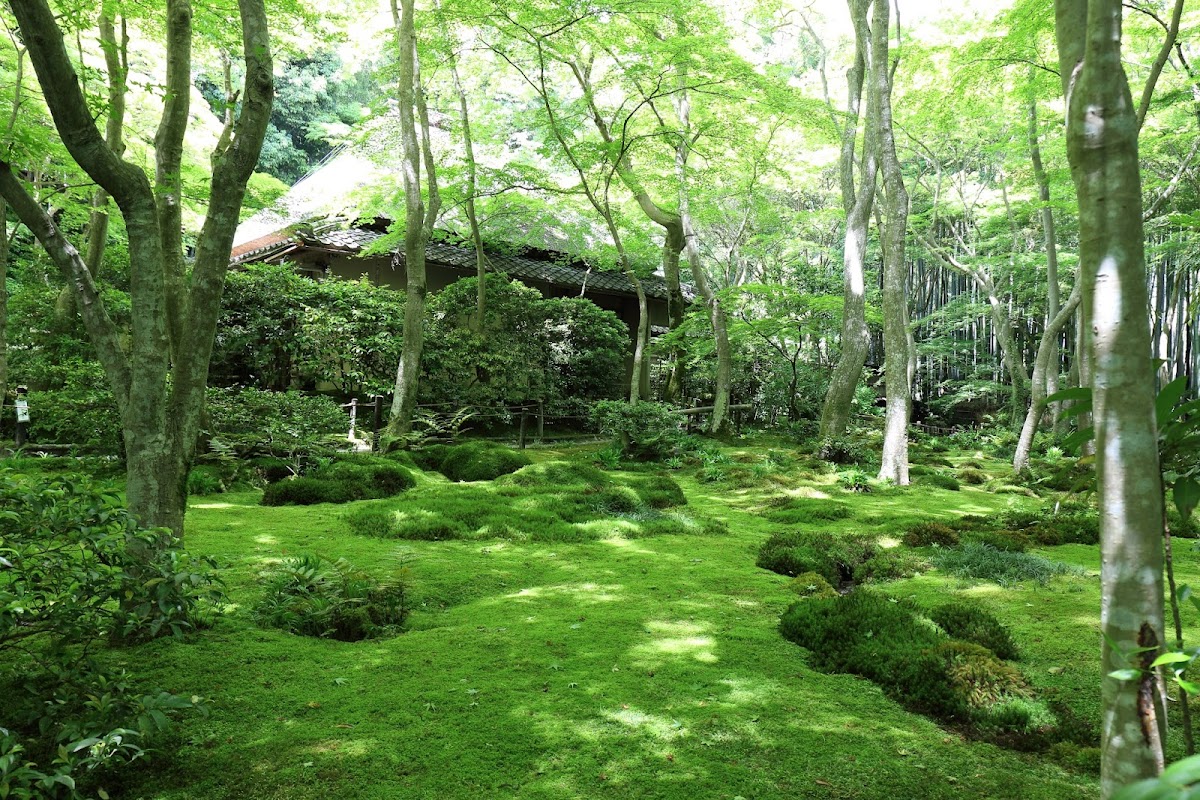
The greatest highlight of Giō-ji Temple is the beautiful moss garden that covers the entire temple grounds. Over 30 varieties of moss grow here, and its beauty, resembling a green carpet, has earned it the nickname “Moss Temple” (Saihō-ji Temple is similarly known as a Moss Temple).
Surrounded by bamboo groves and maple trees, the moss garden appears soft and fluffy on sunny days, and lush and moist on rainy days. The ability to enjoy different appearances depending on the weather is one of the garden’s charms. The way sunlight filters through the trees is described as having “an atmosphere befitting an ancient tale.”
Thatched-Roof Hermitage (Main Hall)
The thatched-roof hermitage, standing in the center of the temple grounds, is a symbolic presence of Giō-ji Temple. Its simple yet charming appearance evokes the atmosphere of the time when Giō and her followers lived there after becoming nuns.
Inside the main hall, along with the principal image of Dainichi Nyorai, are enshrined wooden statues of the sisters Giō and Gijo, their mother Toji, Hotoke Gozen, and Taira no Kiyomori. These statues are valuable cultural artifacts that visually convey the story of the Tale of the Heike.
The Rainbow Window (Yoshino Window)
The large circular window in the waiting room is a hidden gem of Giō-ji Temple. This circular window is also called the “Yoshino Window,” but because the sunlight filtering through the green leaves of the temple grounds reflects a multitude of colors onto the shoji screens, it is also known as the “Rainbow Window.”
Especially during the seasons of fresh greenery and autumn leaves, the light of green, red, and yellow reflects on the shoji screens, creating a beautiful gradation resembling a rainbow. This fantastical sight captivates many photographers and tourists.
The Graves of Giō and Others and the Memorial Tower for Taira no Kiyomori
Within the temple grounds remain the graves of four women—Giō, Gijo, Toji, and Hotoke-gozen—and a memorial tower for Taira no Kiyomori. These are important historical sites commemorating the characters of the Tale of the Heike, allowing visitors to truly feel that this was the setting of the story.
Habitat of Asarum caulescens
Giōji Temple is also known as the habitat of Asarum caulescens, a plant used in the decorations of the Aoi Matsuri, one of Kyoto’s three major festivals. This Asarum caulescens is a plant that symbolizes Kyoto’s natural environment and is carefully protected within the grounds of Giōji Temple.
Giōji Temple in the Four Seasons | Beautiful Scenery of Spring, Summer, Autumn, and Winter
Giōji Temple displays different expressions throughout the four seasons, making it worthwhile to visit in each season.
Gionji Temple in Spring
In spring, new greenery sprouts, creating a beautiful landscape where the green of the moss and the green of the young leaves overlap. The Asarum caulescens also blooms in spring, enveloping the temple grounds in a vibrant atmosphere. The spring seasonal temple stamps are popular, with designs featuring cherry blossoms and fresh greenery delighting visitors.
Gionji Temple in Summer (Green Maple Leaves)
From early summer to summer, it’s the season of green maple leaves. The bamboo grove and maple trees become lush green, creating the most beautiful harmony with the moss garden. The way sunlight filters through the trees into the moss garden creates a cool and ethereal atmosphere. The green gradation visible through the Rainbow Window is also exceptional.
Gionji Temple in Autumn (Autumn Leaves)
Gionji Temple is known as one of Kyoto’s premier spots for viewing autumn foliage. In autumn, the maple trees in the temple grounds turn red and orange, creating a garden of “fallen leaves” where the moss is covered with autumn foliage. The sight of red and yellow fallen leaves scattered on the green moss is breathtakingly beautiful, like a painting.
The contrast between the bamboo grove, moss garden, and autumn leaves creates a fantastical landscape, attracting many tourists and photography enthusiasts. The best time to see the autumn leaves is usually from mid-November to early December.
Giōji Temple in Winter
Giōji Temple in winter is enveloped in a tranquility unlike any other season. When it snows, the thatched-roof hut and moss garden are covered in snow, creating a landscape reminiscent of an ink painting. With fewer tourists, it’s a season for a peaceful visit.
Visiting Information | Admission Fee, Hours, and Estimated Time Required
Basic Information
- Address: 32 Kosaka-cho, Saga Toriimoto, Ukyo-ku, Kyoto City, Kyoto 616-8435
- Phone: 075-861-3574
- Visiting Hours: 9:00 AM – 4:30 PM (Last entry) *Visitors can enter until 4:50 PM
- Holidays: Open every day (Closed January 1st) *Closed December 31st until 3:00 PM (Last entry)
Admission Fee
- Adult: 300 yen
- Child (Elementary, Junior High, High School): 100 yen
- Gio-ji and Daikaku-ji Combined Admission Ticket: 600 yen (Adult ticket only)
Using the combined admission ticket with Daikaku-ji Temple allows you to visit both temples at a discounted price. Daikaku-ji Temple is the head temple of Giō-ji Temple and a major tourist spot in the Sagano area, so if you have time, we recommend visiting both.
Estimated Visiting Time
Giō-ji Temple is a small temple, so a visit takes about 30 minutes to an hour. However, if you want to take your time taking photos or quietly enjoy the moss garden, you should allocate a little more time.
Access | How to get to Giōji Temple
Access by Public Transportation
By Bus
From Kyoto Station
- Take Kyoto City Bus Route 28 “Arashiyama/Daikakuji-bound” from JR Kyoto Station
- Get off at “Saga Shakadō-mae” bus stop, approximately 15 minutes on foot
From Shijō Kawaramachi
- Take Kyoto City Bus Route 11 “Arashiyama-bound”
- Get off at “Saga Shakadō-mae” bus stop, approximately 15 minutes on foot
From Arashiyama
- Approximately 25 minutes on foot from Arashiyama
- Or take Kyoto City Bus Route 28 “Daikakuji-bound” and get off at “Saga Shakadō-mae,” approximately 15 minutes on foot
By Train
- Get off at JR Sagano Line “Saga-Arashiyama Station,” approximately 25 minutes on foot
- Take the Randen (Keifuku Electric Railway) Arashiyama Line to Arashiyama Station, then walk for approximately 25 minutes.
Access by Taxi or Private Car
Approximately 5-10 minutes by taxi from the Arashiyama area. However, the roads around Giōji Temple are narrow, so large vehicles may have difficulty entering.
There are a few parking spaces, but they are often full during peak seasons such as the autumn foliage season, so we recommend using public transportation.
Nearby Tourist Attractions
Giōji Temple is located in the Okusaga area, and the following tourist attractions are nearby:
- Daikakuji Temple: The head temple of Giōji Temple. Famous for Osawa Pond and Saga chrysanthemums (approx. 10-minute walk)
- Nison-in Temple: A temple known for its autumn foliage (approx. 5-minute walk)
- Jojakko-ji Temple: A famous spot for autumn leaves on the slopes of Mt. Ogura (approx. 10-minute walk)
- Adashino Nenbutsu-ji Temple: A temple known for its stone Buddha statues and bamboo grove (approx. 5-minute walk)
By combining these spots, you can enjoy a stroll through the Okusaga area.
Goshuin (temple stamp) of Giō-ji Temple | Seasonal Goshuin are also popular
Giō-ji Temple offers both regular and seasonal Goshuin.
Regular Goshuin
The basic Goshuin is of the principal image, Dainichi Nyorai. It is inscribed with “Dainichi Nyorai” in ink and stamped with the Giō-ji Temple seal.
Seasonal Goshuin
Seasonal Goshuin with designs reflecting the feeling of each season (spring, summer, autumn, and winter) are also popular. The temple’s stamps feature designs of seasonal flowers and landscapes, and many visitors collect them. However, seasonal stamps may run out once the planned number is reached, so early visits are recommended if you wish to obtain one.
Stamp reception hours are during temple visiting hours.
How to Enjoy Your Visit to Giōji Temple | Recommended Activities
Reflecting on Stories in Tranquility
Giōji Temple is a small temple, but its tranquility and beauty are exceptional. Why not sit on the veranda of the hermitage, gaze at the moss garden, and reflect on the tragic love story of Giō and others from the Tale of the Heike?
Photography Tips
Giōji Temple is also a popular photography spot. The following points are recommended:
- Rainbow Window: The gradation of light reflected on the circular window and shoji screen as seen from the waiting room.
- Thatched-Roof Hut and Moss Garden: A panoramic view of the hut with a bamboo grove in the background.
- Scattered Autumn Leaves: A carpet of autumn leaves scattered on the moss.
- Bamboo Grove Path: The bamboo grove path leading to the temple grounds.
Please be considerate of other visitors when taking photographs.
Visiting on a Rainy Day is Also Recommended
Gio-ji Temple has a unique charm even on rainy days. The moss becomes moist and even more vibrant green. Spending time quietly listening to the sound of rain will soothe your mind.
Gourmet Food and Cafes Around Giō-ji Temple
Around Giō-ji Temple, there are gourmet spots and cafes unique to Sagano.
Yudofu (Boiled Tofu)
Yudofu is a specialty of the Sagano area. Within walking distance of Giōji Temple, there are several excellent Yudofu (boiled tofu) restaurants, making them a great choice for a meal after your visit.
Sweet Shops in Sagano
Along the bamboo grove path, you’ll find numerous sweet shops offering matcha sweets, warabi mochi (bracken starch dumplings), and more. Perfect for a relaxing break after your visit.
Vegetarian Cuisine
Around Daikakuji Temple, you can find restaurants serving vegetarian cuisine, allowing you to experience Kyoto’s unique food culture.
Points to Note and Manners for Visiting Giōji Temple
Attire
Since Giōji Temple’s main feature is its moss garden, comfortable walking shoes are recommended. The ground can be particularly slippery on rainy days and during the autumn foliage season.
Photography Manners
Photography is permitted on the temple grounds, but please refrain from using tripods and speaking loudly. Remember that this is a temple that values tranquility.
Crowded Seasons
The temple is especially crowded during the autumn foliage season (mid-November to early December). Visiting early in the morning is recommended.
Summary | Experience the World of the Tale of the Heike at Giōji Temple
Giōji Temple is a temple in Kyoto with a special atmosphere, where the tragic love story depicted in the Tale of the Heike still lives on. With its beautiful moss garden, thatched-roof hut, and rainbow window, there are plenty of sights to see, and you can enjoy the scenery of each season.
When visiting the Arashiyama or Sagano area, be sure to extend your trip to Giōji Temple and reflect on the story of Giō and others who, despite being favored by Taira no Kiyomori, were tossed about by fate. The time spent in the tranquility will be a precious experience that allows you to forget the hustle and bustle of everyday life.
While gazing at the moss garden within the temple grounds, you can feel the way of life and sense of impermanence of the people of the Heian period at Giōji Temple. It is a hidden gem in Okusaga where you can deeply appreciate Kyoto’s culture and history.