Hahaki Shrine (Kurayoshi City, Tottori Prefecture) | A Complete Guide to the Sacred Site of the Kuniyuzuri Myth and the National Natural Monument Forest
What is Hahaki Shrine?
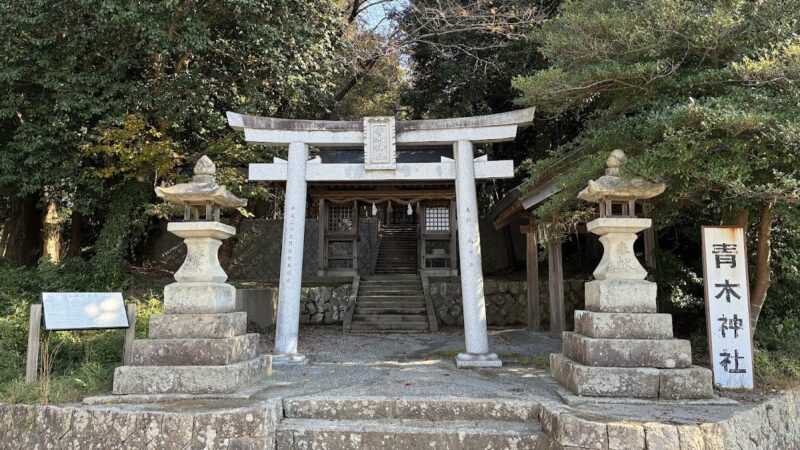
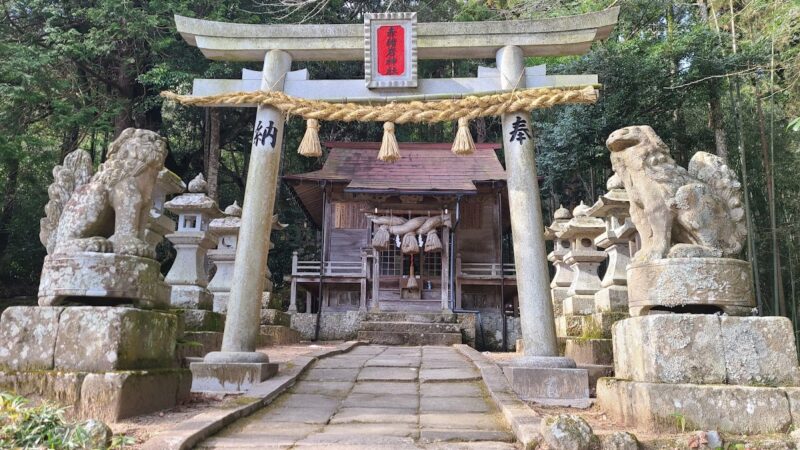
Hahaki Shrine is a Shikinaisha (a shrine listed in the Engishiki) located in Fukuba, Kurayoshi City, Tottori Prefecture. It is a historical shrine listed in the Engishiki Jinmyocho (a list of shrines compiled in 927 AD), and its former rank was Prefectural Shrine. Despite its location close to the city center, about 1 km north of JR Kurayoshi Station, the shrine grounds are home to a primeval forest designated as a National Natural Monument, creating a mystical atmosphere as if one had wandered into an ancient forest.
The main deity enshrined here is Yaekotoshironushi-no-Mikoto, and the site is said to be an important stage in the Kuniyuzuri myth in Japanese mythology. Behind the shrine grounds is the Fukuba Kofun (ancient burial mound), a Tottori Prefecture designated historical site, which conveys the history of this sacred site from ancient times.
Deities and Mythology of Habaki Shrine
Main Deity: Yaekotoshironushi-no-Mikoto
Yaekotoshironushi-no-Mikoto, the main deity of Habaki Shrine, is known as the son of Okuninushi-no-Mikoto. He played a crucial role in the myth of the transfer of the land, as recorded in the Kojiki and Nihon Shoki.
According to shrine tradition, when Yaekotoshironushi-no-Mikoto toured this land for the management of the country, he landed in the area of “Wataragai” to the west of the shrine. He is said to have then dedicated himself to the development and industrialization of this region.
The Myth of the Transfer of the Land and Amanosakate
In Japanese mythology, when the Amatsukami (heavenly gods) demanded the Kunitsukami (earthly gods) to offer the land, it is said that Yaekotoshironushi-no-Mikoto clapped his hands in a “Amanosakate” (heavenly reverse hand) and secluded himself in a cypress fence. This place where he secluded himself is believed to be the site of the present-day Habaki Shrine. The “Ama-no-Saka-te” gesture, where the hands are clapped in the opposite direction to normal clapping, is considered a special act representing divine will. The myth that Kotoshironushi-no-Mikoto made the decision to relinquish the land in this area indicates that Habaki Shrine is not merely a local shrine, but an important sacred site related to the formation of the Japanese nation.
Deities Enshrined Together
In addition to the principal deity, Yaekotoshironushi-no-Mikoto, the following deities are enshrined at Habaki Shrine:
- Ame-no-Wakahiko-no-Kami
- Shitateruhime-no-Mikoto
- Sukunahikona-no-Kami
- Takeminakata-no-Kami
- Ajisukitakahikone-no-Mikoto
- Ichikishima-hime-no-Mikoto
- Tagirihime-no-Mikoto
In 1916 (Taisho 5), the village shrine Kaita Shrine (which enshrines Usa Daimyojin and the three Munakata deities) was merged, resulting in the current composition of enshrined deities.
The History and Origins of Habaki Shrine
Habaki Shrine in Ancient Times
Habaki Shrine is believed to have been established by the Hoki Province governor and has been revered since ancient times as the principal tutelary shrine of Hoki Province. There is a theory that the name “Habaki” originated from the place name “Hoki,” illustrating the importance of the shrine in this region.
The following promotions in divine rank can be confirmed in historical records:
- Jōwa 4 (837): Appointed to Junior Fifth Rank, Lower Grade
- Saikō 3 (856): Promoted to Senior Fifth Rank, Lower Grade
- Jōgan 9 (867): Promoted to Senior Fifth Rank, Upper Grade
- Enchō 5 (927): Listed as a Shikinaisha (minor shrine) in the Engishiki Jinmyōchō (a list of shrines compiled in the Heian period)
These records indicate that the shrine was already considered important by the imperial court during the Heian period.
From the Middle Ages to the Early Modern Period
In 1543 (Tenbun 12), the Habaki Shrine suffered a disaster when its main building was destroyed by lightning. Afterward, it was enshrined in a small shrine for a long time, but in 1708 (Hoei 5), Ito Sonzaemon, a parishioner, initiated the reconstruction of the shrine building.
Furthermore, in May 1877 (Meiji 10), Fukui Zenjuro, another parishioner, became the patron, and the current shrine building was constructed. Thanks to the deep faith of the local people, the shrine has been rebuilt many times.
Changes in Shrine Status in Modern Times
- Early Meiji Era: Ranked as a local shrine
- Taisho 5 (1916): Merged with the village shrine, Kaita Shrine
- Showa 4 (1929): Promoted to a prefectural shrine
The promotion to a prefectural shrine in the Showa era can be seen as proof that the historical and religious importance of Habaki Shrine has been reaffirmed.
The Charm of the National Natural Monument “Habaki Shrine Forest”
Virgin Forest Designated in 1934
One of the most distinctive features of Habaki Shrine is the rich forest that covers the shrine grounds. On December 28, 1934, the “Habaki Shrine Forest” was designated as a national natural monument.
This forest is located on a hill on the left bank of the Tenjin River and forms a broad-leaved evergreen forest zone centered on Castanopsis sieboldii. It is rare to find such a well-preserved primeval forest in such a suburban area.
A Forest Woven by Giant Castanopsis Trees
In the tall tree layer of the shrine forest, Castanopsis trees make up over 80% of the total. Giant trees, reaching 1.5 meters in diameter at breast height and over 20 meters in height, grow densely, and many ancient trees estimated to be over 300 years old can be seen.
Besides Castanopsis trees, Machilus thunbergii and Japanese black laurel also grow together, maintaining the diversity of an evergreen broad-leaved forest. Particularly noteworthy is the abundance of young and sapling trees, indicating that the forest ecosystem is in its peak phase (climax). This is evidence that natural succession has progressed without human disturbance.
Wild Camellias and Understory Vegetation
Many wild camellias can be found in the shrine forest, blooming beautifully in spring. The understory features vegetation characteristic of evergreen broad-leaved forests, allowing visitors to experience the atmosphere of an ancient forest.
Unlike man-made cedar forests, this broadleaf forest, formed by the forces of nature, is a special space where you can feel the energy of nature just by walking through it. By strolling slowly through the forest, you can feel the power residing in nature.
Fukuba Kofun – An Ancient Heritage Sleeping on the Shrine Grounds
A Circular Burial Mound Designated as a Tottori Prefecture Historic Site
Behind the main shrine building (east side) within the grounds of Habaki Shrine lies a circular burial mound called the Fukuba Kofun. This burial mound is designated as a Tottori Prefecture Historic Site and is believed to have been constructed during the late to final stages of the Kofun period.
The Fukuba Kofun is considered academically important as one of the representative burial mounds of the final stage of the Kofun period in Tottori Prefecture. The existence of a burial mound within the shrine grounds is also evidence that this area has been considered sacred since ancient times.
Structure of the Horizontal Stone Chamber
The Fukuba Kofun is a circular burial mound with a horizontal stone chamber. A back wall can be seen inside the stone chamber, exhibiting a typical structure of the late Kofun period. A narrow path leads to the eastern side of the shrine grounds, and beyond it is the entrance to the burial mound.
While it has been noted to have features characteristic of a decorated burial mound, detailed research records are limited. The interior of the burial mound is dark, and it is recommended to bring a flashlight or similar device for viewing.
Relationship between the Burial Mound and the Shrine
The identity of the person buried in the Fukuba Burial Mound is unknown, but it is highly likely that they were a powerful local clan leader. The construction of the burial mound within the shrine’s sacred grounds suggests that this area was a political and religious center in ancient times.
A connection to the Hoki Province governor has also been suggested, and it is possible that the founding of the Habaki Shrine and the construction of the Fukuba Burial Mound were carried out by the same power.
Habaki Shrine’s Main Building and Grounds
Construction of the Current Shrine Building
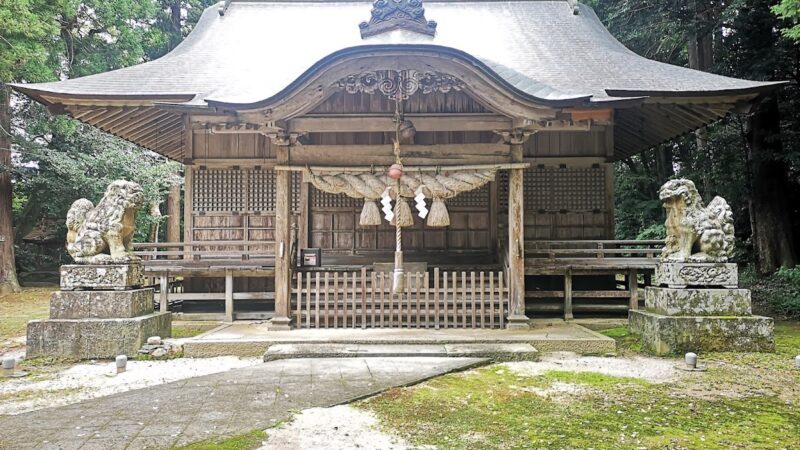
The current shrine building was constructed in 1877 (Meiji 10), giving it a history of over 140 years. This shrine, built at the behest of the local people’s faith, is a testament to the devotion of the people of the region.
Both the main hall and the worship hall follow traditional shrine architectural styles, and their presence, surrounded by towering trees, exudes a solemn atmosphere.
Subsidiary Shrines
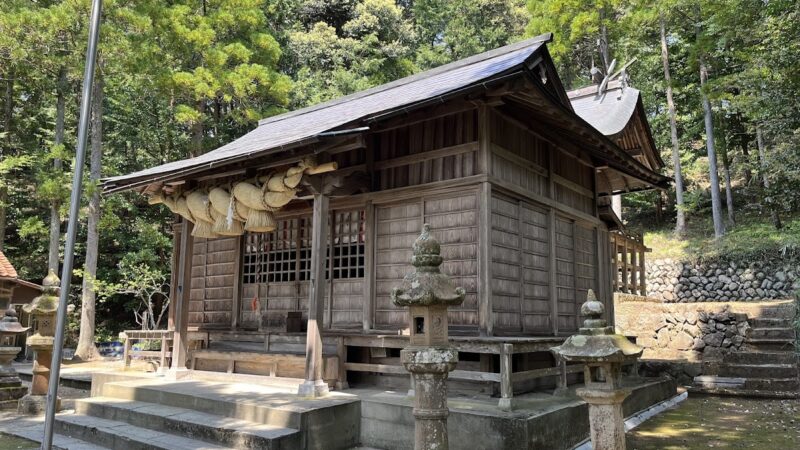
Several subsidiary shrines are enshrined within the grounds. The “Tottori Prefecture Shrine Records” mentions Kitano Shrine, a subsidiary shrine dedicated to Sugawara no Michizane, which attracts many worshippers.
In addition, numerous small shrines are scattered throughout the grounds, reflecting the shrine’s history of embracing diverse local beliefs.
A Sacred Atmosphere
The grounds of Habaki Shrine are surrounded by towering Japanese chinquapin trees, creating a dimly lit and mystical atmosphere even during the day. Walking through the grounds, where sunlight filters through the trees, one can relive the sacredness felt by people of ancient times.
Large Japanese chinquapin and Machilus thunbergii trees stand particularly prominently around the shrine, their presence overwhelming. The fact that such abundant nature remains despite its proximity to the city is a valuable asset to Kurayoshi City.
Legends about the origin of the name of Hahaki Shrine
The “Come, Mother” Legend
Several theories have been passed down regarding the origin of the name of Hahaki Shrine. One of them is the “Come, Mother” legend.
According to this legend, Inadahime, the daughter of Ashinazuchi and Tenazuchi who fled into the mountains from the Yamata no Orochi (eight-headed serpent), called out “Come, Mother, Come, Mother” because her mother was late. This is said to be the origin of the shrine’s name.
This legend suggests a connection to Izumo mythology and also aligns with the fact that Kotoshironushi is a child deity of Okuninushi.
From “Hahaki” to “Hoki”
Another important theory is that the name of the shrine, “Hahaki,” became the origin of the name of the province, “Hoki.” If this theory is correct, then Habaki Shrine is the shrine that gave rise to the name of Hoki Province, and its historical importance is immeasurable.
In ancient times, it was not uncommon for shrine names to be the origin of place names, and this can be considered strong evidence that Habaki Shrine was a central sacred site in Hoki Province.
Access and Visiting Information
Location
Address: 654 Fukuba, Kurayoshi City, Tottori Prefecture 682-0864
Transportation Access
Access by Train:
- Approximately 15 minutes on foot (approx. 1 km) north from JR San’in Main Line “Kurayoshi Station”
- Approximately 5 minutes by taxi from Kurayoshi Station
Access by Car:
- Approximately 10 minutes from San’in Expressway “Kurayoshi West IC”
- Approximately 5 minutes north from Kurayoshi city center
- Approximately 5 km south from the Sea of Japan (coastline)
Parking
There is parking space for visitors on the shrine grounds. However, access for large vehicles may be difficult, so prior confirmation is recommended.
Visiting Hours
The shrine grounds are generally open for free worship. However, the shrine forest is designated as a national natural monument, so collecting or damaging plants is strictly prohibited.
Goshuin (Shrine Seal)
Goshuin are available at Habaki Shrine. Since the shrine office may be unattended, it is recommended to contact them in advance if you definitely wish to receive a goshuin.
Nearby Attractions
Kurayoshi White-Walled Storehouse District
Located approximately 1.5 km south of Habaki Shrine, the Kurayoshi White-Walled Storehouse District is an important traditional building preservation area where buildings from the Edo and Meiji periods remain. White-walled storehouses and merchant houses line the Tamagawa River, allowing visitors to enjoy a retro townscape.
Kurayoshi Museum/Kurayoshi Historical and Folk Museum
This facility allows visitors to learn about the history and culture of Kurayoshi City. Materials related to Habaki Shrine and Fukuba Kofun (ancient burial mound) are also on display, deepening your understanding if you visit before or after your visit.
Mitoku-san Sanbutsuji Nageire-do
Located about 30 minutes by car from Kurayoshi City, the National Treasure Nageire-do is famous as an inner sanctuary built on a cliff. Known as a sacred site of Shugendo (mountain asceticism), you can experience a different religious atmosphere from Habaki Shrine.
Annual Events at Habaki Shrine
Habaki Shrine holds various festivals throughout the year. Major annual events include the Spring Festival and the Autumn Festival, where local people gather to perform Shinto rituals.
Detailed festival schedules can be found on the Kurayoshi City Tourism Association and Tottori Prefecture Shrine Association websites.
Points of Interest and Highlights for Visitors
1. Experience the Shrine Grove, a National Natural Monument
When visiting Habaki Shrine, first take a leisurely stroll through the shrine grove, designated as a National Natural Monument. The majestic atmosphere created by the giant trees of Castanopsis sieboldii and Machilus thunbergii is a precious experience that is hard to find elsewhere.
You can also expect the benefits of forest bathing, allowing you to escape the hustle and bustle of the city and calm your mind.
2. Visiting the Fukuba Kofun (ancient burial mound)
The Fukuba Kofun, located behind the shrine, is also a must-see. Following the narrow path on the east side of the shrine grounds will lead you to the burial mound. While it is possible to tour the inside of the burial mound, it is dark inside, so bringing a flashlight is recommended.
By experiencing the burial culture of ancient people, you will truly feel the depth of this land’s history.
3. Reflecting on Kotoshironushi-no-Mikoto
The main deity, Yaekotoshironushi-no-Mikoto, is a god who made a crucial decision in the myth of the transfer of the land. By visiting the shrine while reflecting on the legend that he clasped his hands in a reverse gesture and secluded himself behind a brushwood fence in this place, you will feel closer to the world of Japanese mythology.
Kotoshironushi-no-Mikoto is also worshipped as “Ebisu-sama” and is known as the god of business prosperity and fishing.
4. Finding Peace in Silence
Despite its proximity to the city center, the grounds of Habaki Shrine are surprisingly quiet. We recommend taking time to take deep breaths and calm your mind in this space surrounded by giant trees.
Spending time in this sacred place, where nature and mythology merge, away from the hustle and bustle of modern society, will surely be a memorable experience.
The History of Hoki Province as Told by Habaki Shrine
Habaki Shrine is not merely a shrine; it embodies the history of Hoki Province itself. Its status as a Shikinaisha (a shrine listed in the Engishiki), its deep connection to the myth of the transfer of the land, the rituals performed by the Hoki provincial governor, and the presence of cultural assets such as the shrine’s forest (a national natural monument) and the Fukuba Kofun (a prefecturally designated historical site)—
All of these tell the story of the continuous history of this land, dating back to ancient times. When you visit Kurayoshi, be sure to stop by Hahaki Shrine and experience its long history and mythology.
Summary
Hahaki Shrine is a Shikinaisha (a shrine listed in the Engishiki, an ancient Japanese legal text) located in Kurayoshi City, Tottori Prefecture. It is a historical shrine known as the setting for the myth of the transfer of the land. This place, where the main deity, Yaekotoshironushi-no-Mikoto, is said to have clasped his hands together and secluded himself behind a blue brushwood fence, has been revered since ancient times as the principal tutelary shrine of Hoki Province.
The shrine’s forest, designated a national natural monument in 1934, is a primeval forest densely populated with giant Japanese chinquapin trees, preserving a valuable natural environment near an urban area. Furthermore, the Fukuba Kofun (ancient burial mound) behind the shrine grounds is a Tottori Prefecture designated historical site, indicating that this area has been a sacred place since ancient times.
Despite its convenient access—approximately a 15-minute walk from JR Kurayoshi Station—stepping onto the shrine grounds evokes a mystical atmosphere, as if you’ve wandered into an ancient forest. When you visit Kurayoshi City, be sure to visit Habaki Shrine and experience the world of Japanese mythology and the rich natural beauty of the area.