Jochi-ji Temple Complete Guide | History, Highlights, and Access Information for the Fourth-Ranked Ancient Temple of Kamakura’s Five Mountains
Jochi-ji Temple is a Rinzai Zen temple of the Engaku-ji school located in Yamanouchi, Kamakura City, Kanagawa Prefecture. While it is a prestigious ancient temple ranked fourth among the Five Mountains of Kamakura, it maintains a quiet atmosphere compared to the bustling Engaku-ji and Kencho-ji temples, making it a valuable spot to experience the tranquil ambiance of a Zen temple.
This article comprehensively introduces everything you need to know before visiting Jochi-ji Temple, from its history and highlights to visiting information and access methods.
What is Jochi-ji Temple?
Jochi-ji Temple is a Rinzai Zen temple believed to have been founded around 1283 (Koan 6). Its official name is “Kinpozan Jochi-ji,” and it is ranked fourth in the Kamakura Five Mountains system.
What are the Kamakura Five Mountains?
The Kamakura Five Mountains are a ranking system for Rinzai Zen temples established during the Kamakura and Muromachi periods. The five temples designated, in order from first place, are Kencho-ji, Engaku-ji, Jufuku-ji, Jochi-ji, and Jomyo-ji. These were official temples protected by the shogunate and played a central role in politics and culture.
Jochi-ji is the smallest of the Five Mountains, and while it no longer resembles its former magnificent complex, it is beloved by many visitors as a more approachable temple where they can quietly experience the world of Zen.
History of Jochi-ji
Founding History
Jochi-ji was founded by the wife and son (Moritoki) of Hojo Munemasa, the younger brother of Hojo Tokimune, the 8th regent of the Kamakura shogunate. It is said that Munemasa died in the Mongol invasions of 1281, and that Jōchi-ji Temple was founded two years later.
The temple’s founders are said to be three high-ranking monks who came to Japan from China: Gotan Funei, Nanshū Kōkai, and Daikyū Shōnen. This is the reason why these three are enshrined as the principal deities, known as the “Three Buddhas of the Three Worlds.”
Jōchi-ji Temple at its Peak
From the Kamakura period to the early Muromachi period, Jōchi-ji Temple flourished greatly. At its peak, it was a large temple complex with seven main halls and eleven sub-temples. The temple grounds were lined with buildings such as the Buddha Hall, Dharma Hall, Abbot’s Quarters, and Kitchen, where many monks devoted themselves to their training.
Due to its status as the fourth-ranked of the Five Great Zen Temples of Kamakura, Jochi-ji Temple received protection from the shogunate and was a center of learning where many scholar-monks gathered. In particular, high-ranking monks such as Musō Soseki served as abbots, making significant contributions to the development of Zen culture.
Decline and Restoration
From the Muromachi period onward, along with the decline of Kamakura, Jochi-ji Temple gradually lost its influence. In particular, the Great Kanto Earthquake (1923) caused the collapse of many buildings, and the temple complex of its heyday was almost completely lost.
While many of the current buildings were rebuilt in the Showa era, the atmosphere and natural environment of the temple grounds strongly retain the appearance of the Kamakura period, and its historical value is still highly regarded.
Highlights of Jochi-ji Temple
Main Gate and Approach
Visiting Jochi-ji Temple begins at the main gate, accessed by climbing stone steps. The main gate is a Chinese-style bell tower gate, with a temple bell hanging on the second floor. This temple bell is a valuable artifact from the Kamakura period and is designated as a National Important Cultural Property.
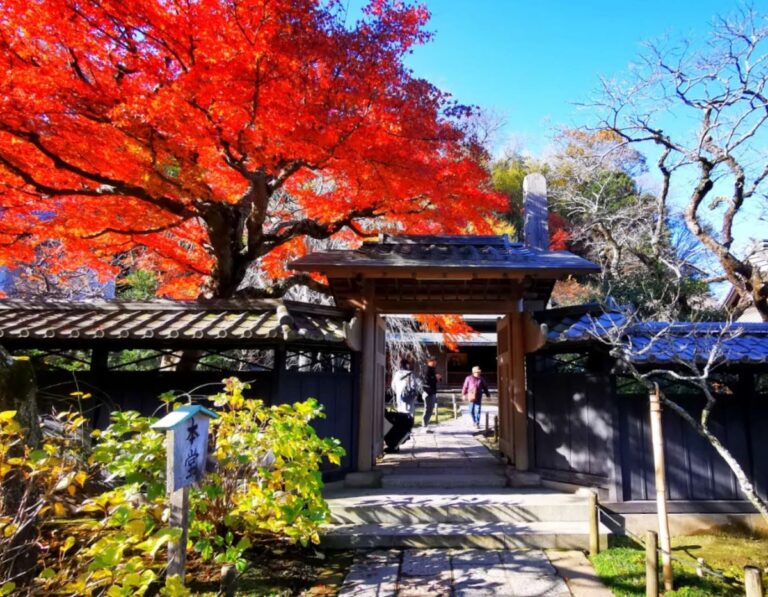
Passing through the main gate, a path lined with moss-covered stone steps appears. The dimly lit path, surrounded by trees on both sides, exudes the atmosphere of a Zen temple far removed from the secular world, inviting visitors into a world of tranquility.
Donge-den (Buddha Hall)
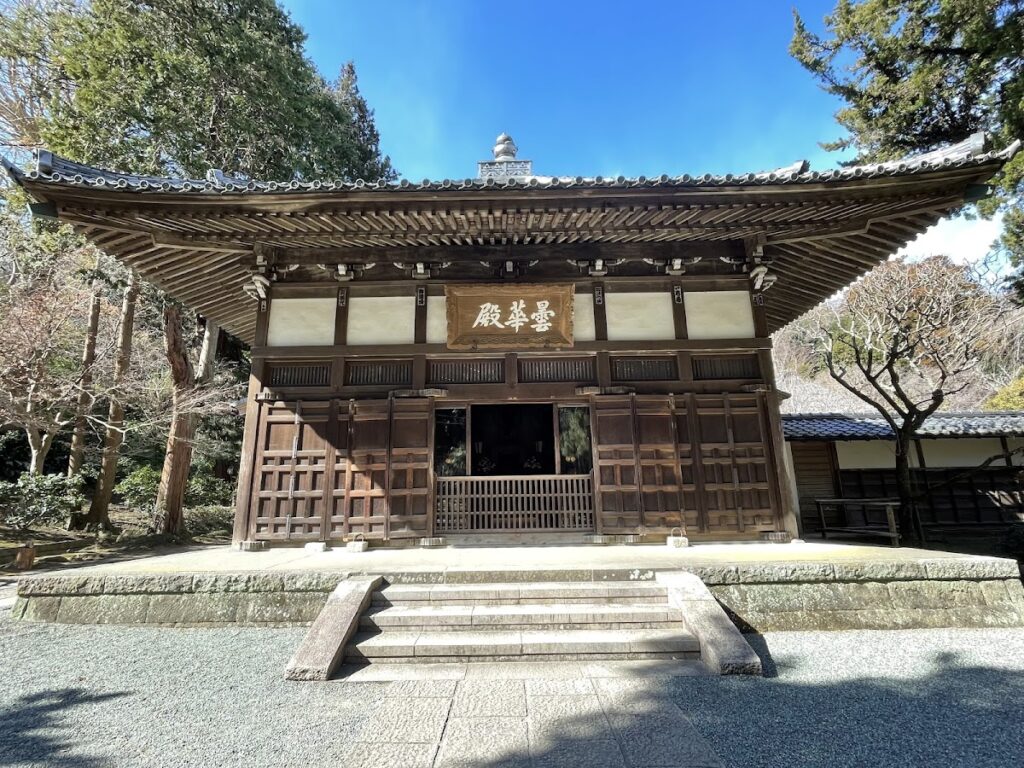
Climbing the path, you will see the Donge-den, the main hall. The current building was rebuilt in 1928 (Showa 3) after the Great Kanto Earthquake.
The Donge-den houses the Three Buddhas of the Three Ages (three Buddha statues symbolizing the past, present, and future), the principal image of Jochi-ji Temple. Amida Buddha (Past Buddha) is in the center, Shakyamuni Buddha (Present Buddha) is on the right, and Maitreya Bodhisattva (Future Buddha) is on the left, each representing the past, present, and future, respectively.
These Buddhist statues are said to represent the three founding monks and are deeply intertwined with the history of Jochi-ji Temple.
Shoin and Garden
Behind the Donka-den hall is the Shoin (study hall), and in front of it lies a beautiful garden. This garden is a pond garden, where you can enjoy the changing seasons.
Especially in early summer with its fresh greenery and in autumn with its vibrant foliage, the garden is painted in vivid colors, captivating visitors. Sitting quietly and gazing at the garden, you will feel a sense of peace that makes you forget the passage of time.
Hotei
In the back of the temple grounds, inside a cave, is enshrined Hotei, one of the Seven Lucky Gods of Kamakura. Visitors can freely rub the belly of this Hotei statue, and there is a legend that “rubbing the belly will give you energy” and “good fortune will come.”
Having been rubbed by many people, Hotei’s belly shines brightly, and its appearance is endearing, bringing peace to those who see it. It is a popular spot visited by many as part of the Kamakura Seven Lucky Gods pilgrimage. ### Yagura (Horizontal Entrance Tombs)
Around the Hotei statue, several horizontal entrance tombs called “yagura,” unique to Kamakura, can be seen. Yagura were carved into the rock face during the Kamakura and Muromachi periods as tombs for samurai and monks.
The yagura at Jochi-ji Temple are well-preserved, and some contain five-ringed stupas and Buddhist statues. They are valuable historical sites where you can experience Kamakura’s history and culture firsthand.
Temple Bell (National Important Cultural Property)
As mentioned above, the temple bell hanging on the second floor of the main gate was cast in the first year of the Jowa era (1345) during the Kamakura period and is designated as a National Important Cultural Property.
The inscription describes the history of Jochi-ji Temple and the conditions of the time, making it extremely valuable as a historical document. When passing through the main gate, be sure to look up and admire this precious bell.
Abundant Nature in the Temple Grounds
One of the charms of Jochi-ji Temple is its abundant natural environment. Many trees flourish within the grounds, and flowers bloom throughout the seasons. In particular, the cherry blossoms in spring, hydrangeas in early summer, autumn leaves, and camellias in winter offer different views depending on the season.
Furthermore, wild squirrels inhabit the temple grounds, and if you’re lucky, you might see their adorable forms. It’s a precious space where you can forget the hustle and bustle of the city and become one with nature.
Annual Events at Jochi-ji Temple
Jochi-ji Temple holds various religious events throughout the year.
New Year’s Day Prayer Service
On January 1st, the New Year’s Day Prayer Service is held. This event prays for peace and happiness in the new year, and many worshippers visit.
Flower Festival (Buddha’s Birthday)
On April 8th, the Buddha’s birthday, the Flower Festival (Buddha’s Birthday) is held. A statue of the infant Buddha is placed inside a flower-decorated shrine, and sweet tea is poured over it in celebration.
Founder’s Memorial Service
The Founder’s Memorial Service, commemorating the three founding monks, is held annually and is an important event for reflecting on the temple’s history.
New Year’s Eve Bell Ringing
On New Year’s Eve, the temple bell is rung. General visitors can also ring the bell, warding off the worldly desires of the past year and welcoming the new year with a pure heart.
Visiting Information
Visiting Hours and Admission Fee
- Visiting Hours: 9:00 AM – 4:30 PM (Last entry 4:30 PM)
- Admission Fee: Adults 200 yen, Elementary and Junior High School Students 100 yen
- Closed Days: Open all year round (However, visits may be closed due to severe weather or other special circumstances)
Estimated Time Required
The temple grounds are not very large, so a typical visit can be completed in 30 minutes to 1 hour. If you wish to leisurely admire the gardens and enjoy the natural surroundings, it is recommended to allow 1 hour or more.
Photography
Photography is generally permitted on the temple grounds, but there are some areas where photography is prohibited, such as around Buddhist statues. When taking photographs, please be considerate of other visitors and check with temple staff if necessary.
Access Methods
Access by Train
Approximately 8 minutes on foot from JR Yokosuka Line “Kita-Kamakura Station”
Exit the ticket gate at Kita-Kamakura Station and walk along the railway tracks towards Kamakura (south). After passing Engaku-ji Temple and Tokei-ji Temple, cross the railway crossing, and the entrance to Jochi-ji Temple will be on your left. The route is relatively easy to follow, and there are signs.
Access by Bus
If using the bus from Kamakura Station, take the Enoden Bus bound for “Ofuna Station” and get off at the “Jochi-ji” bus stop. However, walking from Kita-Kamakura Station is more common, and bus service is limited, so access by train is recommended.
Access by Car
Jochi-ji Temple does not have its own parking lot. Parking spaces are limited in the surrounding area, so using public transportation is strongly recommended.
If you absolutely must visit by car, it is practical to use a paid parking lot near Kita-Kamakura Station or Kamakura Station and then walk or take a bus from there.
Nearby Tourist Attractions
There are many other attractive tourist spots around Jochi-ji Temple.
Engaku-ji Temple
The second largest temple among the Five Great Zen Temples of Kamakura. Located very close to Kita-Kamakura Station, it houses many cultural assets, including the national treasure Shariden (reliquary hall). Visiting it in conjunction with Jochi-ji Temple is recommended.
Tokei-ji Temple
A Rinzai Zen temple known as a “refuge temple” and “divorce temple.” It is famous for its beautiful seasonal flowers, especially plum blossoms and irises. Approximately 4 minutes on foot from Kita-Kamakura Station.
Meigetsu-in Temple
A Rinzai Zen temple of the Kencho-ji school, famous as the “hydrangea temple.” It is bustling with tourists during the hydrangea season in June. Approximately 10 minutes on foot from Kita-Kamakura Station.
Kencho-ji Temple
The largest temple among the Five Great Zen Temples of Kamakura. Its vast grounds offer many sights to see, and it is a temple of high historical value as the oldest Zen temple in Japan. Approximately 15 minutes on foot from Kita-Kamakura Station.
Kamakura Seven Lucky Gods Pilgrimage
Jochi-ji Temple enshrines one of the Kamakura Seven Lucky Gods (Hotei), so many people visit it as part of a Seven Lucky Gods pilgrimage. Visiting it along with the other six temples and shrines (Jochi-ji, Tsurugaoka Hachimangu, Hokai-ji, Myoryu-ji, Honkaku-ji, Hase-dera, and Goryo-jinja) will allow you to enjoy a more fulfilling Kamakura sightseeing experience.
Points to Note When Visiting Jochi-ji Temple
Clothing and Items to Bring
The temple grounds have many stone steps and slopes, so it is recommended to wear comfortable shoes. Particular caution is needed on rainy days, as the stone steps can become slippery.
In summer, there are many insects such as mosquitoes, so bringing insect repellent will make your visit more comfortable. Also, don’t forget sun protection such as a parasol or hat.
Manners
Jochi-ji Temple is an active Zen temple, a place where monks practice their training. Please refrain from speaking loudly or making noise, and strive to observe the temple quietly.
Also, please be careful not to touch or damage the plants or buildings on the temple grounds. In particular, the moss-covered stone steps and gardens are delicate, so please do not stray from the designated paths.
Crowds
Jochi-ji Temple is not as crowded as Engaku-ji or Kencho-ji Temples, but it does see more visitors than usual during the autumn foliage season (late November to early December) and the New Year period when the Kamakura Seven Lucky Gods pilgrimage takes place.
If you wish to observe the temple in peace, we recommend visiting on weekday mornings or during off-peak tourist seasons.
Summary of Jochi-ji Temple’s Charms
Jochi-ji Temple, despite its prestigious status as the fourth-ranked of the Five Great Zen Temples of Kamakura, boasts a calm atmosphere that is not overly commercialized.
Although not large in scale, it offers plenty to see, including the Three Buddhas, Hotei (the god of happiness), yagura (cave tombs), and beautiful gardens. In particular, the moss-covered approach to the temple and the lush grounds offer a precious space where you can experience both the history and nature of Kamakura simultaneously.
Despite its convenient location within walking distance of Kita-Kamakura Station, Jochi-ji Temple maintains a tranquil atmosphere, making it an ideal place to connect with the spirit of Zen and find peace of mind.
When visiting Kamakura, be sure to visit not only the famous grand temples, but also hidden gems like Jochi-ji. The quiet time away from the hustle and bustle will surely soothe your soul.
Best Season to Visit Jochi-ji Temple
Jochi-ji Temple offers beautiful scenery throughout the four seasons, but each season has its own unique charm.
Spring (March-May)
Spring is a beautiful season with cherry blossoms and fresh greenery. The cherry blossoms on the temple grounds are not showy, but possess a modest beauty befitting a Zen temple. From late April to May, the fresh greenery is vibrant, allowing you to enjoy the temple grounds overflowing with life.
Summer (June-August)
During the rainy season, hydrangeas bloom, making the lush temple grounds even more vibrant. The shade of the trees in summer provides a cool respite from the city heat. However, it’s also a time when insects are abundant, so precautions are necessary.
Autumn (September-November)
Autumn is one of the most beautiful seasons at Jochi-ji Temple. The autumn foliage from late November to early December is magnificent, painting the temple grounds in shades of red and yellow. While it can get crowded during the autumn foliage season, it’s still not as busy as other famous temples, allowing for a relatively peaceful visit.
Winter (December-February)
Winter is the quietest season for visiting, with fewer visitors. Winter flowers such as camellias and daffodils can also be enjoyed. The snow-covered grounds are particularly beautiful, creating a magical atmosphere.
Jochi-ji Temple and Kamakura Culture
Jochi-ji Temple is an important temple that preserves the Zen culture of the Kamakura period.
Zen Buddhism and Samurai Culture
During the Kamakura period, Zen Buddhism was widely accepted within samurai society. The Zen teachings of “non-reliance on words and letters” (transmitting truth from heart to heart without relying on words or writing) and “directly pointing to the human heart” (directly pointing to the human heart) resonated with the samurai’s mentality.
The temples of the Kamakura Five Mountains, including Jochi-ji Temple, spread Zen teachings under the protection of the samurai government and also functioned as a gateway to Chinese culture (Song Dynasty culture).
Cultural Dissemination
Many Chinese monks visited Jochi-ji Temple, bringing not only Zen teachings but also various aspects of Chinese culture, such as calligraphy, painting, tea ceremony, and architectural styles. These cultural influences would later significantly impact Japanese culture.
While Jochi-ji Temple has lost some of its former grandeur, its spirituality and cultural value are still preserved, making it an indispensable presence for understanding Japanese Zen culture.
Summary
Jochi-ji Temple is an ancient Rinzai Zen temple with the fourth highest rank among the Five Great Zen Temples of Kamakura, yet it retains a tranquil atmosphere that is not overly commercialized.
Founded to commemorate Hojo Munemasa, it flourished greatly from the Kamakura period to the Muromachi period, but its subsequent decline and the Great Kanto Earthquake resulted in the loss of almost all of its original buildings. However, it still boasts many attractions, including the Three Buddhas, Hotei (the god of happiness), yagura (cave tombs), and beautiful gardens.
Located just an 8-minute walk from Kita-Kamakura Station, Jochi-ji Temple maintains a peaceful tranquility, making it an ideal place to experience the spirit of Zen and find peace of mind. The surrounding nature is beautiful throughout the seasons, especially during the autumn foliage season.
When visiting Kamakura, be sure to visit not only the famous large temples, but also hidden gems like Jochi-ji Temple. A quiet time away from the hustle and bustle will surely soothe your soul and deepen your understanding of Kamakura’s history and culture.