Complete Guide to Tokei-ji Temple | A Thorough Explanation from the History of the Temple of Divorce to the Highlights of the Grounds and Visiting Information
Tokei-ji Temple, located in Yamanouchi, Kamakura City, Kanagawa Prefecture, is known as a representative ancient temple of Kita-Kamakura. Belonging to the Engaku-ji branch of the Rinzai school of Zen Buddhism, its mountain name is Matsuoka-san, and its official temple name is Tokei Soji Zen-ji. Historically, it played a special role as a “temple of divorce” and “refuge,” supporting women seeking divorce. Today, it attracts many visitors as a “temple of flowers,” where flowers bloom in every season.
Conveniently located about a 4-minute walk from Kita-Kamakura Station on the Yokosuka Line, it is a popular tourist spot in the Kita-Kamakura area, alongside Engaku-ji, Jochi-ji, and Meigetsu-in. This article comprehensively introduces everything you need to know before visiting Tokei-ji Temple, from its deep history and valuable cultural assets to the highlights of the grounds and visiting information.
History of Tokei-ji Temple
Founding and Founder Kakuzan-ni
Tokei-ji Temple was founded in 1285 (Koan 8) by Kakuzan Shido-ni, the wife of Hojo Tokimune, the 8th regent of the Kamakura Shogunate. Kakuzan-ni, also the mother of Hojo Sadatoki (the 9th regent), is said to have become a nun after Tokimune’s death to pray for his soul and founded this temple.
Starting as a nunnery from its inception, Tokei-ji Temple enjoyed high status from its founding due to its deep connection with the Kamakura Shogunate’s regency family. This high status later formed the basis for the authority to implement the “Divorce Temple Laws.”
Role as a Divorce Temple and Refuge Temple
The most noteworthy reason for Tokei-ji Temple’s historical significance is its function as a “divorce temple” and “refuge temple” during the Edo period. In feudal society, it was virtually impossible for women to initiate divorce proceedings. However, only Tokei-ji Temple and Mantoku-ji Temple in Gunma Prefecture possessed a special “Divorce Temple Law” approved by the Shogunate’s Commissioner of Temples and Shrines, giving them the authority to accept divorce requests from women.
Under this system, women seeking to escape unhappy marriages could seek refuge at these temples, and after two to three years of training at the temple, their divorce would be granted. This system provided relief to many women for approximately 600 years until the abolition of the Divorce Temple Law in 1871. Tokei-ji Temple was not merely a religious institution, but also played a judicial role similar to a modern family court.
The Status of Successive Abbots and Matsuoka Imperial Palace
One reason Tokei-ji Temple was able to maintain its high authority was that successive abbots were daughters of prestigious families.
The 5th abbot, Yodo-ni, was a princess of Emperor Go-Daigo, and the 20th abbot, Tenshu-ni, was the adopted daughter of Senhime, the principal wife of Toyotomi Hideyori and daughter of Tokugawa Hidetada, thus possessing noble lineage. Because the temple was guarded by abbots with deep ties to the imperial family and the shogunate, in the late Muromachi period, the abbots were called “Gosho-sama” (Lord of the Imperial Palace), and the temple itself boasted a special status, being referred to as “Matsuoka Gosho” (Matsuoka Imperial Palace).
As an independent nunnery without a head temple, it stood apart from other temples.
Changes after the Meiji Restoration
In 1871 (Meiji 4), as part of the Meiji government’s modernization policies, the law on temples for ending divorces was abolished, ending Tokei-ji’s role as a temple for ending divorces, which had lasted for approximately 600 years. In 1902 (Meiji 35), Shakusōen was appointed as the abbot, and the temple transformed from a nunnery to a temple for male monks.
Shakusōen was a high-ranking monk who also served as the head of the Engaku-ji sect, and from this time, Tokei-ji became a branch temple of Engaku-ji. To this day, as a temple of the Rinzai sect Engaku-ji sect, it continues to be both a training ground for Zen and an open temple that welcomes many visitors. ## Cultural Properties of Tokei-ji Temple
Tokei-ji Temple houses numerous valuable cultural properties that have been passed down through its long history.
Important Cultural Properties
The Standing Statue of the Holy Kannon Bodhisattva is a Kamakura period Buddhist statue enshrined as the principal image of Tokei-ji Temple and is designated as a National Important Cultural Property. It is characterized by its elegant form and serene expression, and is highly regarded as a masterpiece of Kamakura sculpture.
In addition, Tokei-ji Temple possesses several other important cultural properties, which are stored and displayed in the temple’s treasure house (Matsuoka Treasure House). The exhibits in the treasure house are changed seasonally, allowing visitors to appreciate valuable items that tell the story of the temple’s history.
Temple Treasures and Documents
Tokei-ji Temple also preserves numerous documents from its time as a temple for women seeking divorce, as well as items related to successive head priests. Records of women who sought refuge there, documents related to divorce papers (three-and-a-half-line divorce papers), and other valuable historical materials for understanding women’s history in the Edo period remain.
Furthermore, materials related to Shakusōen and Inoue Zenjō, who served as chief priests after the Meiji era, as well as calligraphy and paintings by cultural figures who had connections with Tōkei-ji Temple, are carefully preserved as temple treasures.
Opening of the Treasure House (Matsuoka Treasure House)
The temple’s treasure house regularly displays these cultural artifacts and temple treasures. The exhibits change seasonally and according to special events, so each visit offers new discoveries. However, the treasure house is closed on the first and third Tuesdays of each month, so please be aware of this when planning your visit.
Efforts to pass on the history and culture of Tōkei-ji Temple to future generations continue, while balancing the protection and public access of cultural properties.
Highlights of the Temple Grounds
The grounds of Tōkei-ji Temple are a beautiful space where historical buildings and nature harmonize. We will introduce the temple grounds, which show different expressions with each season, along the designated route.
Main Gate (Sanmon) and Approach
The main gate, which serves as the entrance to Tōkei-ji Temple, is currently under construction. The reconstruction of the aging main gate is underway, aiming for completion on November 1st, 2026, and donations are being solicited. The new gate will be built using modern technology while adhering to traditional architectural styles.
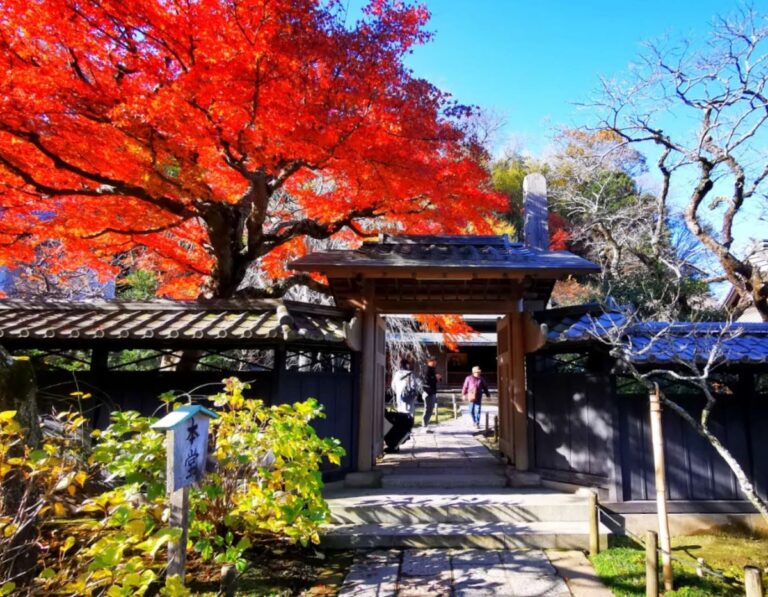
Passing through the main gate, a stone staircase leads to the main hall. Seasonal flowers are planted on both sides, welcoming visitors. The path itself becomes a beautiful sight, especially during the early spring plum blossoms, early summer hydrangeas, and autumn foliage seasons.
Main Hall and Principal Image
At the top of the path lies the main hall, where the principal image, a standing statue of the Holy Kannon Bodhisattva, is enshrined. In the tranquil atmosphere of the main hall, the head priest regularly chants sutras and gives talks, allowing visitors to experience the teachings of Zen.
Photography is prohibited around the main hall, and quiet worship is expected. This reflects the temple’s commitment to its role as a Zen training ground and its emphasis on the peace of mind of visitors.
The Charm of a Temple of Flowers
Tokei-ji Temple is known as a “temple of flowers,” with various flowers blooming throughout the year.
In early spring (January to March), the plum blossoms planted throughout the temple grounds reach their peak. The sight of white and red plum blossoms competing for attention is a springtime tradition in Kita-Kamakura.
In spring (March to May), a variety of colorful flowers such as cherry blossoms, magnolias, camellias, and kerria bloom one after another. The sight of the yellow kerria blossoms adorning the approach to the temple is particularly impressive.
In early summer (June), hydrangeas adorn the temple grounds. While Tokei-ji’s hydrangeas are not as famous as those at Meigetsu-in Temple, their charm lies in being able to appreciate them in a tranquil atmosphere. Rock tobacco and Schizophragma hydrangeoides can also be seen.
From summer to autumn (July to November), bellflowers, bush clover, spider lilies, Japanese anemones, and autumn leaves successively color the temple grounds. Especially during the autumn foliage season, the tranquil atmosphere of the Zen temple, combined with the scenery, creates a deeply evocative landscape.
Cemetery and Graves of Famous People
Many prominent figures rest in the cemetery at the back of the temple grounds.
Author Shigeo Iwanami (founder of Iwanami Shoten), philosopher Kitaro Nishida, Zen scholar Daisetsu Suzuki, and economist Jun Takami—all figures who greatly influenced modern Japanese culture and thought—chose Tokei-ji Temple as their final resting place.
This is evidence that Tokei-ji Temple is not merely a tourist temple, but a Zen training ground with profound spirituality, revered by intellectuals. The cemetery is open to the public, allowing visitors to reflect on these great figures.
Tea Room and Monthly Tea Ceremony (Suigetsu-kai)
Tokei-ji Temple has a tea room, where a monthly tea ceremony called “Tsukigama Suigetsu-kai” is held. Zen and the tea ceremony are deeply intertwined, and the tea ceremony at Tokei-ji Temple is a valuable opportunity to embody the spirit of Zen.
Participating in a tea ceremony allows you to experience a deeper charm of Tokeiji Temple that cannot be obtained through mere sightseeing.
Gift Shop and Souvenirs
There is a gift shop on the temple grounds, selling original Tokeiji Temple stamp books, amulets, books, and more. Items featuring the history and flowers of Tokeiji Temple are particularly popular as mementos of your visit.
However, please note that the gift shop is closed on the first and third Tuesdays of each month.
Visiting and Viewing Information
Basic Information
Official Name: Matsuoka-san Tokei Soji Zenji Temple
Sect: Rinzai Zen Engaku-ji School
Principal Image: Holy Kannon Bodhisattva
Location: 1367 Yamanouchi, Kamakura City, Kanagawa Prefecture
Phone: 0467-33-5100
Visiting Hours and Admission Fee
Visiting Hours:
- March to October: 8:30 AM to 4:30 PM
- November to February: 8:30 AM to 4:00 PM
Admission Fee:
- Adults: 200 yen
- Children: 100 yen
Holidays: The treasure house, gift shop, and Goshuin (temple stamp) service are closed on the 1st and 3rd Tuesdays (temple grounds are open for worship).
Access Method
Access by Train: Get off at Kita-Kamakura Station on the JR Yokosuka Line, approximately 4 minutes on foot.
Exit the east exit of Kita-Kamakura Station and proceed towards Kamakura along Kamakura Kaido (Prefectural Road 21). You will see the entrance to Tokei-ji Temple on your left. It is located past Engaku-ji Temple and before Meigetsu-in Temple.
Access by Car: Tokei-ji Temple does not have its own parking lot. We recommend using nearby paid parking lots or visiting by public transportation. The Kita-Kamakura area has narrow roads and gets crowded on weekends, so visiting by train is the most convenient option.
Notes for Visitors
Photography: Photography is prohibited in some areas of the temple grounds (such as around the main hall). Even in areas where photography is permitted, please be considerate of other visitors. Video recording is strictly prohibited.
Pets: Pets are not allowed.
Dress Code: As this is a Zen temple, please avoid revealing clothing and wear appropriate, subdued attire.
Temple Grounds Maintenance: Currently, grounds maintenance is being carried out in preparation for the construction of a new main gate. Some areas may be inaccessible, so please check the official website or social media for the latest information.
Events and Activities at Tokei-ji Temple
Tokei-ji Temple, as a Zen temple, holds various religious ceremonies and cultural activities.
Regular Events
Sunday Zen Meditation Session: A regular Zen meditation session is held every Sunday. Beginners are welcome, and you can learn the basics of Zen practice. It is a valuable opportunity to calm your mind through Zen meditation.
Kannon Festival: On the 18th of every month, a special memorial service is held as the festival day for Kannon (Goddess of Mercy). Many worshippers visit on this day to show their devotion to the principal image, the Holy Kannon Bodhisattva.
Chanting and Talk by the Head Priest: Regular sessions of chanting and talks by the head priest are held. It is a valuable opportunity to learn directly from the head priest about Zen teachings and the history of Tokei-ji Temple.
Cultural Activities
Sutra Copying Session: A sutra copying session is held where participants can calmly copy Buddhist scriptures. Sutra copying is a form of Zen practice and is gaining attention as a way to achieve inner peace in today’s stressful society.
Analects of Confucius Study Group: Tokei-ji Temple also holds a study group on the Analects of Confucius. Zen and Confucianism are deeply intertwined, and one can learn wisdom for life through the teachings of the Analects.
Monthly Tea Ceremony (Suigetsu-kai): As mentioned above, a tea ceremony is held every month, allowing participants to experience the spirit of Zen through the tea ceremony.
Donations for the New Sanmon Gate Construction Project
Currently, Tokei-ji Temple is proceeding with the construction of a new Sanmon gate (mountain gate), aiming for completion on November 1st, 2026. This is an important project to replace the aging gate and pass on the traditions of Tokei-ji Temple to the next generation.
Donations for this project are being widely solicited. Those who wish to support the future of Tokei-ji Temple can find details on the official website. Benefits are also available for donors.
Nearby Attractions
When visiting Tokei-ji Temple, we recommend also visiting the temples and shrines in the surrounding Kita-Kamakura area.
Engaku-ji Temple: Located right next to Kita-Kamakura Station, this is the second-largest temple among the Five Great Zen Temples of Kamakura. It houses many cultural assets, including the National Treasure Shariden (reliquary hall).
Meigetsu-in Temple: Famous as the “Hydrangea Temple.” It is especially popular during the hydrangea season in June. The garden viewed through the round window is also magnificent.
Jochi-ji Temple: The fourth-largest temple among the Five Great Zen Temples of Kamakura. You can appreciate Kamakura-period Zen Buddhist architecture in a tranquil atmosphere.
Kencho-ji Temple: The first-largest temple among the Five Great Zen Temples of Kamakura. It is a large temple known as Japan’s first Zen training center.
Visiting these temples as part of a “Kita-Kamakura Temple and Shrine Pilgrimage” is a classic Kamakura sightseeing route.
Tokei-ji Temple and Kamakura Culture
Tokei-ji Temple is not merely a tourist attraction; it is an important place that embodies the culture and spirituality of Kamakura.
Interactions with Cultural Figures
Since the Meiji era, Tokei-ji Temple has had deep connections with many cultural figures and intellectuals. The temple’s head priest, Shaku Soen, was close friends with Natsume Soseki, and Suzuki Daisetsu is known for his contributions to spreading Zen Buddhism worldwide.
The reason why prominent modern Japanese intellectuals such as Iwanami Shigeo and Nishida Kitaro were drawn to Tokei-ji Temple is likely because of its spiritual depth and tranquil environment, which was conducive to contemplation.
Significance in Women’s History
The history of Tokei-ji Temple as a temple for divorce holds extremely important significance in the history of women in Japan. Maintaining a system guaranteeing the freedom of divorce for 600 years in a feudal society where women’s rights were largely unrecognized is a rare example globally.
From the perspective of modern gender equality, the history of Tokei-ji Temple deserves to be re-evaluated.
Inheritance of Zen Culture
Even today, Tokei-ji Temple functions as a Zen training center. Through Zen meditation sessions, sutra copying sessions, and other activities, Tokei-ji Temple continues to provide opportunities for the general public to experience the teachings of Zen.
For modern people seeking spiritual fulfillment amidst material abundance, the significance of places like Tokei-ji Temple is increasing.
Tokei-ji Temple in Every Season
The charm of Tokei-ji Temple lies in the different expressions it displays with each season.
Tokei-ji Temple in Spring
From late February to March, the plum blossoms in the temple grounds are in full bloom. The sight of white and red plum blossoms competing for attention is a representative scene of early spring in Kamakura. After the plum blossoms, cherry blossoms, magnolias, and kerria flowers bloom one after another, enveloping the temple grounds in a vibrant atmosphere.
Tokei-ji Temple in Early Summer
June is hydrangea season. Tokei-ji Temple is less crowded than Meigetsu-in Temple, making it a charming place to enjoy hydrangeas at a leisurely pace. Rare plants such as rock tobacco and hydrangea can also be seen. Visiting on a quiet, rainy day during the rainy season is also a charming experience.
Tokei-ji Temple in Summer and Autumn
In summer, the fresh greenery is beautiful, and you can feel the coolness in the quiet temple grounds amidst the sound of cicadas. In autumn, bush clover, spider lilies, and Japanese anemones bloom, and the leaves begin to change color from late October. The best time to see the autumn leaves is mid-November, when you can enjoy the tranquil autumn scenery befitting a Zen temple.
Tokei-ji Temple in Winter
In winter, Tokei-ji Temple is less crowded and enveloped in silence. It is the season when you can best feel the solemn atmosphere inherent to a Zen temple in the crisp air. From late January, the early-blooming plum blossoms begin to bloom, announcing the arrival of spring once again.
Summary
Tokei-ji Temple is a temple with multifaceted charm, possessing a 600-year history as a temple for ending relationships, seasonal flowers, valuable cultural assets, and the spirit of Zen that lives on in the modern age.
Its convenient location, just a 4-minute walk from Kita-Kamakura Station, makes it beloved by many visitors to Kamakura. However, the true value of Tokei-ji Temple lies not merely in its status as a tourist attraction, but in its existence as a place embodying Japanese history, culture, and spirituality.
Its history as a temple that guaranteed the freedom of divorce in an era when women’s rights were largely unrecognized offers many lessons for us living in the modern age. Furthermore, as a Zen training ground, it continues to be a place open to modern people seeking inner peace.
When visiting Tokei-ji Temple, be sure to take your time to explore the grounds and reflect on its history and spirituality. By admiring the seasonal flowers, quietly practicing Zen meditation, or engaging in sutra copying, you can experience a special time away from everyday life.
In 2026, when the ongoing construction of the new main gate is completed, the new gate will add a new chapter to Tokei-ji Temple’s history. Tokei-ji Temple’s stance of carefully preserving the old while moving forward into a new era truly embodies the spirit of “unchanging principles and ever-changing trends.”
When visiting Kita-Kamakura, be sure to visit Tokei-ji Temple and experience its profound charm.