Jokeiji Temple (Chiba Prefecture) Complete Guide: The Burial Mound of Sasagawa Shigezo from the Tenpo Suikoden and its Historical Background
Located in Katori City, Chiba Prefecture, Jokeiji Temple is a historical temple deeply connected to the chivalrous culture of the Edo period. Known for housing the burial mound of Sasagawa Shigezo, a character from the Tenpo Suikoden, it is an important spot that conveys the region’s history and culture to the present day. This article provides a detailed explanation of Jokeiji Temple’s history, highlights, and access methods.
Basic Information and Overview of Jokeiji Temple
Jokeiji Temple is a Buddhist temple located in the Sasagawa district of Katori City, Chiba Prefecture, and has a long history as a center of local faith. Unlike typical tourist temples, its greatest feature is its unique historical background rooted in the chivalrous culture of the late Edo period.
Location and Access
Jokeiji Temple is located in the Sasagawa district of Katori City, in a quiet area along the Tone River. It is a bit of a distance from the nearest station, so access by car is recommended. If using public transportation, the nearest stations are Shimosa-Tachibana Station or Sasagawa Station on the JR Narita Line, but from there, you will need to travel by taxi or on foot.
Katori City is located in the northeastern part of Chiba Prefecture and is a historical area known for Katori Shrine. The Sasagawa district, where Jokeiji Temple is located, was once a thriving hub on the Tone River waterway, and its prosperity provided fertile ground for the development of a chivalrous culture.
The History of Tenpo Suikoden and Sasagawa Shigezo
Indispensable to understanding Jokeiji Temple is the story of Tenpo Suikoden and Sasagawa Shigezo. This is a chivalrous tale based on a true story from the late Edo period and is one of the representative stories of Japanese chivalrous culture.
What is Tenpo Suikoden?
Tenpo Suikoden is a story based on a real-life conflict between chivalrous figures that occurred in Shimosa Province (present-day northern Chiba Prefecture) during the Tenpo era (1830-1844). Named after the Chinese novel “Water Margin,” this story has been repeatedly adapted in storytelling, films, and plays since the Meiji era.
The central story revolves around the conflict between the Sasagawa family, led by Sasagawa Shigezo, and the Iioka family, led by Iioka Sukegoro. The two families clashed over gambling and territory in the Tone River basin, ultimately escalating into a large-scale conflict.
About Sasagawa Shigezo
Sasagawa Shigezo (1810-1847) was a yakuza boss based in the Sasagawa area. His real name was Sasagawa Masagoro, and he was known locally by the nickname “Shigezo.” He entered the world of gambling at a young age and eventually expanded his influence as the leader of the Sasagawa family.
Shigezo is said to have been a man of strong loyalty and compassion, and was beloved in the community as a yakuza boss who helped the weak. However, his conflict with Iioka Sukegoro intensified, leading to a large-scale conflict in 1844 (Tenpo 15) in which he suffered a defeat. Afterward, he became a fugitive, and was finally captured and executed in 1847 (Koka 4). He was 38 years old.
The Rivalry with Iioka Sukegoro
Iioka Sukegoro was a yakuza boss based in the Iioka district of present-day Asahi City, and is known as Sasagawa Shigezo’s rival. Sukegoro possessed greater political power than Shigezo, skillfully utilizing his relationships with the shogunate and local influential figures.
The conflict between the two is said to have stemmed not only from a simple territorial dispute, but also from differences in their lifestyles and values as yakuza bosses. While Shigezo is often depicted as a “man of righteousness,” Sukegoro is frequently portrayed in contrast as a “strategist skilled in political maneuvering.”
Main Highlights of Jōkei-ji Temple
Jōkei-ji Temple houses historical sites related to Sasagawa Shigezo, making it a valuable pilgrimage site for history enthusiasts and fans of the Tenpō Suikoden (Tale of the Tenpō Water Margin).
Sasagawa Shigezo’s Head Mound
Within the grounds of Jōkei-ji Temple lies the head mound of Sasagawa Shigezo. It is said that after Shigezo’s execution, his head was returned to Sasagawa and buried at this temple. The head mound is still carefully preserved by local people, and memorial services are held regularly.
An explanatory sign is installed in front of the head mound, where you can learn about Shigezo’s life and an overview of the Tenpō Suikoden. The tombstone is weathered, but this only adds to its sense of historical significance.
Head-Washing Well
A well called the “Head-Washing Well” also remains on the temple grounds. This well is said to be where Shigezo’s head was washed, and it is a valuable historical relic that conveys the scene of that time.
The well still holds water, and its pure water continues to flow, transcending time. The existence of this well speaks to the significant event of Shigezo’s death for the community.
Atmosphere and Architecture of the Temple Grounds
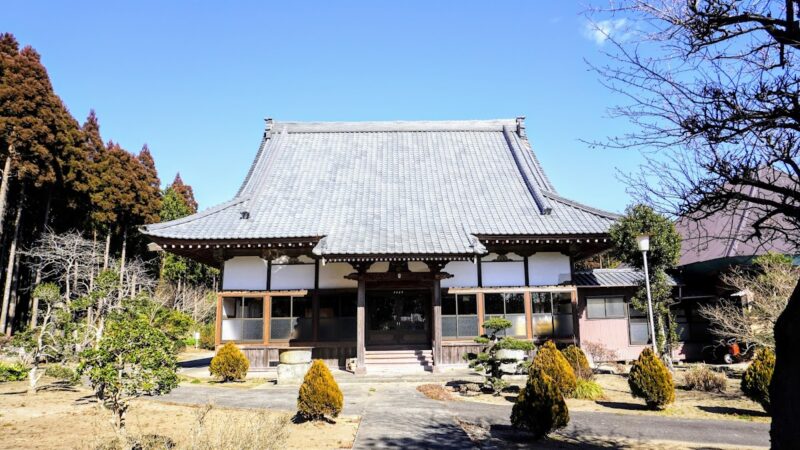
The grounds of Jokei-ji Temple are enveloped in a quiet and peaceful atmosphere. The main hall is built in the traditional Buddhist architectural style and continues to serve as a place of worship for the community.
Ancient trees line the grounds, allowing visitors to enjoy the beauty of nature throughout the seasons. Spring cherry blossoms and autumn foliage are particularly ideal times to enjoy both historical walks and nature appreciation.
History and Culture of Katori City and Surrounding Areas
Katori City, where Jokei-ji Temple is located, is a historically rich area in the northeastern part of Chiba Prefecture. Many other temples, shrines, and historical sites are scattered throughout the surrounding area, making it an ideal area for historical walks.
Relationship with Katori Shrine
The central presence of Katori City is Katori Shrine, the Ichinomiya (first-ranked shrine) of Shimosa Province. Katori Shrine is the head shrine of approximately 400 Katori shrines nationwide and is counted as one of the “Three Shrines of Eastern Japan,” along with Kashima Shrine and Ikisu Shrine.
While there is no direct relationship between Jōkei-ji Temple and Katori Shrine, visiting both historical sites located in the same city of Katori allows for a deeper understanding of the region’s history and culture.
Tone River Water Transport and Regional Development
The Sasagawa area once flourished as a key point on the Tone River water transport route. During the Edo period, the Tone River was an important logistics route connecting the Tohoku region and Edo (present-day Tokyo), and Sasagawa was one of its transit points.
This prosperity from water transport created fertile ground for gamblers and gangsters. Understanding the background of this regional economy is crucial to understanding the history of Jōkei-ji Temple.
Other Historical Temples in Chiba Prefecture
Besides Jōkei-ji Temple, Chiba Prefecture has many other historical temples. Each possesses its own unique history and culture, demonstrating the diversity of religious culture within the prefecture.
Naritasan Shinshoji Temple, Narita City
Naritasan Shinshoji Temple, located in Narita City, is the head temple of the Chizan branch of the Shingon sect and one of the most famous temples in the Kanto region, attracting approximately 10 million visitors annually. As a center of Fudo Myoo worship, it draws worshippers from all over Japan.
Nakayama Hokkeji Temple, Ichikawa City
Nakayama Hokkeji Temple, located in Ichikawa City, is one of the head temples of the Nichiren sect. Known for its connection to Nichiren Shonin, it houses numerous important cultural properties, including buildings and temple treasures.
Hondoji Temple, Matsudo City
Hondoji Temple in Matsudo City is affectionately known as the “Hydrangea Temple,” boasting approximately 10,000 hydrangea bushes in full bloom during early summer. A Nichiren sect temple, it is popular for its seasonal flowers.
Iinuma Kannon in Choshi City
Iinuma Kannon (Enpuku-ji Temple) in Choshi City is the 27th temple on the Bando Thirty-Three Kannon Pilgrimage. Located near the mouth of the Tone River, it has long been a place of worship for those involved in the fishing industry.
Points to Note When Visiting Jokei-ji Temple
There are several points to note when visiting Jokei-ji Temple. Since it differs from typical tourist temples, it is recommended to check beforehand.
Manners and Attire for Visitors
Jokei-ji Temple is a temple that still conducts religious activities. When visiting, please do so quietly and with respect. Photography is permitted, but please be considerate of the interior of the main hall and other visitors.
There are no specific dress code requirements, but appropriate and modest attire for a temple is desirable. Especially during the summer, consider taking precautions against insects.
Visiting Hours and Fees
Jokei-ji Temple is generally open to visitors, but entry may be restricted during temple events and ceremonies. It is recommended to contact the Katori City Tourism Association or other relevant organizations in advance.
There is no set entrance fee, but you are welcome to offer a donation or offering as a token of your appreciation.
Combining sightseeing with surrounding facilities
A visit to Jokei-ji Temple alone will only take about 30 minutes to an hour. Combining it with other nearby tourist attractions such as Katori Shrine and the townscape of Sawara will make for a more fulfilling trip.
The Sawara area is known as “Little Edo of Northern Chiba,” and its Edo-period townscape is well-preserved. There are many sights to see, including historical buildings along the Ono River and the Ino Tadataka Memorial Museum.
Cultural influence of Tenpo Suikoden
Tenpo Suikoden has had a significant influence on Japanese popular culture. Jokei-ji Temple, as one of the settings in the story, occupies an important position in cultural history.
Popularity in Kodan and Rokyoku
Since the Meiji era, Tenpo Suikoden has become a popular subject in Kodan and Rokyoku performances. The scene known as “Sasagawa’s Flower Gathering” is particularly famous for depicting the confrontation between Shigezo and Sukegoro.
The famous opening line, “The moon is hazy, and the bonfires of whitebait are obscured in the spring sky,” remains beloved by many.
Depictions in Film and Theater
During the Showa period, numerous films based on Tenpo Suikoden were produced. Repeatedly adapted into films, such as Toei’s yakuza film series, Sasagawa Shigezo was portrayed as a symbol of a chivalrous figure deeply devoted to loyalty and compassion.
It has also been performed in Kabuki and modern theater, making it an important work in the history of Japanese theater.
Re-evaluation in Modern Times
In recent years, with the growing interest in Edo period popular culture and regional history, Tenpo Suikoden is being studied from a new perspective. It is recognized not merely as a yakuza tale, but also as a historical document reflecting the social structure and economic conditions of the time.
Jokeiji Temple plays an important role as a site for such historical research.
Tourism and Regional Development in Katori City
Katori City is working on regional development utilizing its historical and cultural heritage, including Jokeiji Temple. It aims for sustainable community development by balancing the use of these sites as tourist resources with the preservation of local history.
Historical and Cultural Preservation Activities
Katori City is engaged in activities to preserve and pass on historical sites related to the Tenpo Suikoden (a famous historical novel). The maintenance and management of Jokeiji Temple is supported by the cooperation of local residents and the administration.
Regular cleaning activities and the installation of explanatory signs are being carried out to create an environment where visitors can easily learn about history.
Development of Tourist Routes
The Katori City Tourism Association proposes historical walking routes that include Jokeiji Temple. The course visiting Katori Shrine, the townscape of Sawara, and Jokeiji Temple is a popular route for experiencing the history and culture of northeastern Chiba Prefecture.
Collaboration with Local Events
Tourist plans combining tourism with local traditional events, such as the Sawara Grand Festival, are also popular. Visiting during the summer or autumn festival seasons allows you to experience the vibrant local culture and history simultaneously.
Local Cuisine and Specialties Around Jokeiji Temple
When visiting Katori City, enjoying the local cuisine and specialties is one of the highlights. The food culture nurtured by the bounty of the Tone River and fertile farmland will captivate visitors.
Local Cuisine of Sawara
In the Sawara area, eel dishes are a specialty. Eels raised in the Tone River system are fatty and delicious, and there are many long-established eel restaurants.
It is also known as a town of soy sauce brewing, and soy sauce made using traditional methods is a popular souvenir.
Agricultural Products of Katori City
Katori City is also known as a rice-producing area, producing high-quality rice. Vegetable and fruit cultivation is also thriving, and fresh agricultural products can be purchased at roadside stations and other locations.
Best Season to Visit Jokeiji Temple
Jokeiji Temple can be visited year-round, but each season offers a different charm.
Spring (March-May)
Spring is cherry blossom season, with the temple grounds and surrounding areas in full bloom. The fresh greenery is also beautiful, making it an ideal time for a stroll. The weather is mild, making it suitable for historical walks.
Summer (June-August)
Summer is a season of lush greenery and vibrant life. However, due to the heat and humidity, early morning or evening visits are recommended. Don’t forget insect repellent.
Autumn (September-November)
Autumn is the season of autumn leaves, with the trees on the temple grounds changing color. The weather is stable, making it an ideal time for sightseeing. Combining a visit with the Sawara Grand Festival (Autumn Festival) is also recommended.
Winter (December-February)
Winter is a season with fewer visitors, allowing for a quiet visit. Although the cold is severe, you can reflect on history in the crisp air. ## Summary: The Historical Weight Conveyed by Jokei-ji Temple
Jokei-ji Temple is a small temple located in Katori City, Chiba Prefecture, but it holds great historical value as an important setting for the Tenpo Suikoden, a story representative of Japanese popular culture. The burial mound and head-washing well of Sasagawa Shigezo are valuable historical sites that convey the chivalrous culture of the Edo period.
When visiting Katori City, be sure to visit Jokei-ji Temple along with Katori Shrine and the townscape of Sawara. In its tranquil grounds, you can feel the weight of history and the depth of traditional Japanese culture.
Even today, the story of the Tenpo Suikoden, which questions duty, compassion, and the way of life, continues to resonate with many people. Jokei-ji Temple will undoubtedly continue to be carefully preserved as a place to contemplate such universal themes.