Mizumadera Temple Complete Guide: The History and Benefits of the Ancient Temple in Kaizuka, Osaka, Known for its Exorcism Kannon
Mizumadera Temple, located in Mizuma, Kaizuka City, Osaka Prefecture, is a special head temple of the Tendai sect, affectionately known as “Mizuma no Kannon-san” by locals. Known as Ryukokuzan, this temple, widely revered as an exorcism Kannon, is said to have been founded by the Nara period high priest Gyoki and boasts a history of over 1300 years.
This article comprehensively introduces information you should know before visiting Mizumadera Temple, from the legend surrounding its founding to the temple grounds’ highlights, prayer information, annual events, and access methods.
History of Mizumadera Temple: The Founding Legend Related to Emperor Shomu and Gyoki
The Legend of the Appearance of the Holy Kannon Bodhisattva
A mystical legend related to the Holy Kannon Bodhisattva remains surrounding the founding of Mizumadera Temple. During the Tenpyo era (729-749), Emperor Shomu, the 45th emperor, fell seriously ill at the age of 42, a year considered unlucky in Japan. His recovery was slow, causing concern among the court. Then, in a dream, the emperor received a mysterious message.
In the dream, he was told that a miraculous Kannon Bodhisattva would appear in the southwest. Emperor Shomu, by imperial decree, ordered Gyoki, a renowned monk at the time, to search for this Kannon.
Founding of Mizumadera Temple by Gyoki
Gyoki, having received the imperial command, departed Nara and traveled southwest. He arrived in what is now Mizumadera, Kaizuka City, Osaka Prefecture. It is said that while Gyoki was practicing asceticism at a waterfall in this area (the waterfall behind the current main hall), a statue of the Holy Kannon Bodhisattva, measuring 1.8 inches (approximately 5.5 centimeters) and made of Jambudvipa gold, appeared from the waterfall basin. When Gyōki presented this Kannon statue to Emperor Shōmu, the Emperor’s illness was completely cured. Deeply moved, Emperor Shōmu ordered Gyōki to construct an imperial temple to enshrine this miraculous Kannon statue, and thus Mizumadera Temple was founded.
History of the Main Hall’s Transformation and Reconstruction
Since its founding, Mizumadera Temple has attracted many worshippers, but its history has not been smooth. In 1585, during Toyotomi Hideyoshi’s attack on Negoro, many buildings, including the main hall, were destroyed by fire.
Later, in the Edo period, the main hall was rebuilt in 1811. The current main hall was built at that time and holds significant cultural value as a valuable building dating back to the Edo period within Osaka Prefecture. Inside the main hall, a 1.8-inch (approximately 2.8 cm) statue of the Holy Kannon Bodhisattva, passed down since the temple’s founding, is enshrined as a hidden Buddha image. It continues to attract many worshippers as the principal deity for warding off evil.
Mizumadera Temple Grounds and Highlights
Main Hall: The Center of Faith, Dedicated to the Holy Kannon Bodhisattva
The heart of Mizumadera Temple is the main hall, rebuilt in 1811 (Bunka 8). Here, a 1.8-inch (approximately 2.8 cm) statue of the Holy Kannon Bodhisattva, passed down since the temple’s founding, is enshrined as a hidden Buddha image. Prayers are offered daily, year-round, in the main hall, attracting worshippers with various wishes, including protection from evil, family safety, and business prosperity.
The architectural style of the main hall strongly reflects the characteristics of the late Edo period, and its dignified presence leaves a solemn impression on visitors.
Three-Storied Pagoda: The Only Edo Period Pagoda in Osaka Prefecture
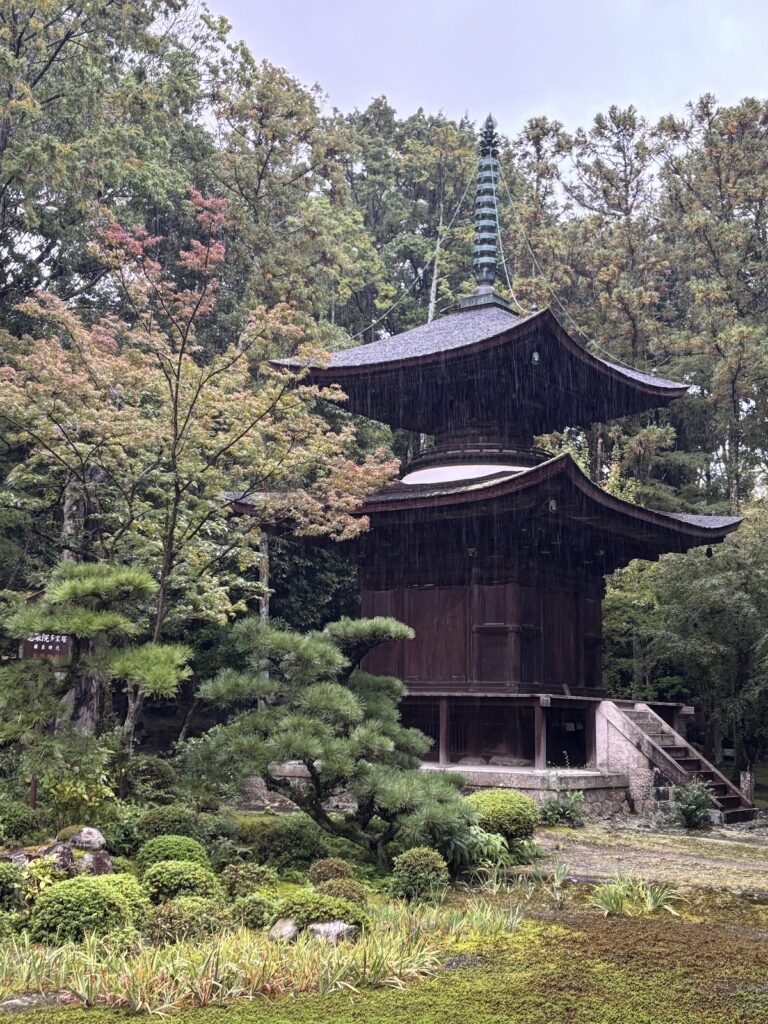
One of the symbolic structures of Mizumadera Temple is the three-storied pagoda towering within the temple grounds. This three-story pagoda is entirely constructed of zelkova wood and is a valuable structure, being the only one of its kind in Osaka Prefecture dating back to the Edo period.
The first story (the first tier) features vivid carvings of the two zodiac animals (the west), and the meticulously crafted details captivate viewers. The three-story pagoda is a central feature of the Mizumadera temple landscape, and especially during cherry blossom and autumn foliage seasons, it presents a beautiful sight in harmony with the surrounding nature.
Goma Hall: A place of prayer dedicated to Fudo Myoo
Separate from the main hall, there is a Goma Hall on the temple grounds. Fudo Myoo is enshrined here, and Goma prayers are performed. Goma prayer is one of the rituals of Esoteric Buddhism, known as a powerful prayer method for burning away worldly desires and fulfilling wishes.
Prayers at the Goma Hall are often chosen by worshippers with particularly difficult wishes or strong determination, and the prayers performed amidst the burning flames are extremely solemn and powerful.
Aizen-do Hall: A Famous Place for Matchmaking and Romantic Fulfillment
The Aizen-do Hall, located within the temple grounds, enshrines Aizen Myoo, the deity of matchmaking, and is a popular spot for visitors praying for romantic success and good relationships. Aizen Myoo is believed to possess the power to transform worldly desires into enlightenment, and is particularly effective for wishes related to love and relationships.
Many young visitors and couples visit to pray for good relationships and romantic fulfillment. This is why Mizumadera Temple is known not only as a temple for warding off evil but also as a temple for matchmaking.
Jojakko-do Hall: A Place for Ancestor Worship
The Jojakko-do Hall is a hall for ancestor worship and perpetual memorial services. Mizumadera Temple also offers guidance on memorial services at the Jojakko-do Hall, and it is used by many parishioners and visitors as a place to pray for the repose of the deceased and to honor the spirits of ancestors.
At the Jōjakkōdō Hall, memorial services are available in various forms, from individual ceremonies to perpetual memorial services. Details can be discussed at the temple office.
Benefits and Prayers at Mizumadera Temple
Prayers for Protection Against Misfortune
Mizumadera Temple is most famous for its blessings as a Kannon (Goddess of Mercy) for protection against misfortune. As evidenced by the legend of its founding, the principal image, the Holy Kannon Bodhisattva, is believed to have the power to ward off misfortune and heal illnesses.
People from all over Japan visit the temple to receive prayers for protection against misfortune, not only those entering their unlucky years, but also those facing turning points or difficult times in their lives. Prayers are performed daily in the main hall, and reservations are not required. However, it is especially crowded during the unlucky years (January-February), so prior confirmation is recommended.
Prayers for Traffic Safety
Traffic safety prayers are also popular at Mizumadera Temple. Prayers related to cars and motorcycles are available, such as blessings for new car purchases and prayers for driver safety. Traffic safety amulets and stickers are also given out, and many drivers display them in their cars.
Other Prayers
In addition to protection from evil and traffic safety, Mizumadera Temple offers the following prayers:
- Family Safety
- Business Prosperity
- Academic Success
- Passing Exams
- Recovery from Illness
- Safe Childbirth
- Good Health
- Finding a Good Partner
Mailing Service for Prayer Amulets
For those living far away or unable to visit in person, Mizumadera Temple offers a service to mail prayer amulets. Applications can be made by phone or through the website, and after the prayer is performed, the amulet will be mailed to you. This service is especially popular with those who have visited Mizumadera Temple before and wish to receive prayers again, as well as elderly people who find it difficult to visit in person.
Annual Events at Mizumadera Temple
New Year’s Service and Thousand-Rice Cake Pounding (January)
One of the most grand events at Mizumadera Temple is the New Year’s Service and Thousand-Rice Cake Pounding, held every New Year. This event is designated as an Intangible Cultural Property of Kaizuka City and attracts many visitors.
During the Thousand-Rice Cake Pounding, literally a thousand rice cakes are pounded and distributed to visitors. There is a tradition that eating these rice cakes will bring good health and protection from illness for the entire year, and many people visit to obtain them. The temple is especially crowded during the first three days of the New Year, and the grounds are bustling with people praying for protection from evil.
Setsubun Festival (February)
On Setsubun in February, the Setsubun Festival is held. Beans are scattered, and lucky beans and raffle tickets are distributed to visitors. With the chant of “Good fortune in, demons out!”, this traditional event, which wards off evil and invites good fortune, is cherished by the local community.
Spring and Autumn Equinox Ceremonies (March and September)
During the spring and autumn equinoxes, ancestral memorial services are held. Many parishioners and visitors come to pay their respects at their ancestors’ graves, and memorial services are held. Special services and sermons may also be held during the equinox period.
Kannon Festival (August)
In August, the Kannon Festival is held, with a service offering gratitude to the principal image, the Holy Kannon Bodhisattva. Lanterns are lit on summer nights, creating a magical atmosphere for visitors.
New Year’s Eve Bell Ringing (December 31st)
On New Year’s Eve, the New Year’s Eve bell is rung. The bell, believed to dispel the 108 worldly desires, is open to the public, and many people visit to purify their hearts before welcoming the new year.
Mizumadera Temple and the New Saigoku Thirty-Three Kannon Pilgrimage
Mizumadera Temple is widely known among pilgrims as the 4th temple of the New Saigoku Thirty-Three Kannon Pilgrimage. The New Saigoku Thirty-Three Pilgrimage is a pilgrimage route centered in the Kinki region, with Kannon Bodhisattva enshrined at each temple.
Pilgrims receive a stamp at each temple, aiming to complete the pilgrimage. Mizumadera Temple offers stamps at its main hall, attracting many pilgrims. It is also designated as the 12th temple of the Shinto-Buddhist Pilgrimage in Osaka and the 26th temple of the Izumi Saigoku Pilgrimage, occupying an important position as a pilgrimage site for multiple pilgrimage routes.
Access and Visiting Information
Access by Train
The most convenient way to access Mizumadera Temple is by train.
Access from Mizuma Kannon Station:
- Get off at Mizuma Kannon Station on the Mizuma Railway, approximately 5 minutes on foot.
- Transfer to the Mizuma Railway at Kaizuka Station on the Nankai Main Line.
Access from Kaizuka Station:
- Transfer to the Mizuma Railway from Kaizuka Station on the Nankai Main Line, approximately 10 minutes to Mizuma Kannon Station.
- From Osaka city (Namba Station) to Kaizuka Station, it takes approximately 30 minutes on the Nankai Main Line.
The Mizuma Railway features retro-style streetcar-like vehicles, offering a leisurely and enjoyable travel experience. Mizuma Temple is approximately a 5-minute walk from Mizuma Kannon Station along the approach to the temple.
Access by Car
Using the Expressway:
- Approximately 10 minutes from Kaizuka IC on the Hanwa Expressway.
- Parking available (several free parking lots for visitors are located around the temple grounds).
During New Year’s and major events, parking can become crowded, so using public transportation is recommended.
Visiting Hours and Admission Fee
- Visiting Hours: Grounds are freely accessible (Main Hall is generally open from 8:00 to 17:00)
- Admission Fee: Free (Prayers are charged separately)
- Prayer Reception Hours: 9:00 to 16:00 (Open all year round)
Location and Contact Information
- Address: 638 Mizuma, Kaizuka City, Osaka Prefecture
- Phone: 072-446-1355 (Temple Office)
- Official Website: https://mizumadera.or.jp/
Attractions Around Mizumadera Temple
Mizuma Park
Mizuma Park is located near Mizumadera Temple and is known as a famous cherry blossom viewing spot. In spring, approximately 1000 cherry trees bloom, attracting many visitors. Enjoying nature in conjunction with a visit to Mizumadera Temple is highly recommended.
Mizuma Railway
The Mizuma Railway, used to access Mizuma Temple, itself has a retro charm. Older trains are still in operation, making it popular with railway enthusiasts. Enjoy the leisurely scenery from the train windows while making your pilgrimage to Mizuma Temple a memorable experience.
Historical Spots in Kaizuka City
Besides Mizuma Temple, Kaizuka City is dotted with historical spots. There are many temples and shrines that are irresistible to history buffs, such as Kaizuka Gobo Gansenji Temple and Koonji Temple, making it a great place to spend a day exploring.
Points and Manners for Visiting Mizuma Temple
Etiquette for Visiting
- Bow before passing through the temple gate: Before entering the temple grounds, compose yourself and bow.
- Purify at the water basin: Purify your hands and mouth at the water basin before praying.
- Pray at the main hall: Join your hands in prayer in front of the main hall and pray with all your heart.
- Offering: There is no set amount, but please offer with sincerity.
Points to Note When Receiving Prayers
- Reservations are not required for prayers, but advance notice is recommended for groups.
- Prayer fees vary depending on the prayer requested; please check at the reception.
- Formal attire is not required, but please wear clean clothing when visiting.
Regarding Photography
Photography is generally permitted on the temple grounds, but photography inside the main hall and during prayers is prohibited. Please observe proper etiquette when taking photos so as not to disturb other visitors.
Summary: Find Peace of Mind and Protection from Evil at Mizumadera Temple
Mizumadera Temple is an ancient temple in Kaizuka City, Osaka Prefecture, with a history of over 1300 years, and continues to attract many worshippers as a Kannon temple dedicated to warding off evil. It boasts numerous attractions, including the founding legend related to Emperor Shomu and Gyoki, the magnificent main hall rebuilt during the Edo period, and the only Edo-period three-story pagoda in Osaka Prefecture.
Mizumadera Temple offers various blessings, including protection from misfortune, traffic safety, and matchmaking, and prayers are available year-round. Its annual events, such as the New Year’s mochi-making ceremony, are also appealing, making it a place to visit in every season.
Its convenient location, just about 30 minutes by train from Osaka city center, makes it ideal for a day trip. It’s also known as the 4th temple on the New Saigoku Thirty-Three Kannon Pilgrimage, making it a popular spot for pilgrims.
Those facing a year of misfortune, those at a turning point in their lives, or those seeking inner peace should definitely visit Mizumadera Temple. You’ll feel the warm blessings of “Mizuma no Kannon-sama.”