Complete Guide to On’ei-ji Temple (Ishikawa Prefecture) | History and Charm of a Jodo Shinshu Honganji-ha Temple in Yamanaka Onsen
On’ei-ji Temple, nestled in Yamanaka Onsen in Kaga City, Ishikawa Prefecture, is a historic temple belonging to the Jodo Shinshu Honganji-ha sect. With Mount Hakuhōō as its mountain name, this temple has long been a center of faith for the local community in a quiet corner of the hot spring town. This article provides comprehensive information useful for visitors, including detailed information about On’ei-ji Temple, its history, the appeal of visiting, and nearby attractions.
Basic Information about On’ei-ji Temple
Location and Access
Official Address: 35-Re, Yunode-machi, Yamanaka Onsen, Kaga City, Ishikawa Prefecture 922-0124 (Some sources list “Ta 12”)
Sect: Jodo Shinshu Honganji-ha (Nishi Honganji-ha)
Mountain Name: Hakuhōōzan
Corporate Number: 1220005004246
Phone Number: 0761-78-0644
On’ei-ji Temple is located in Yunode-machi, slightly away from the center of Yamanaka Onsen, offering a quiet environment away from the hustle and bustle of the hot spring town. The nearest station is Daishoji Station on the JR Hokuriku Main Line, approximately 7.8 km away. Access by car is convenient, approximately 20 minutes from the Kaga Interchange on the Hokuriku Expressway.
Visiting Hours and Admission Fee
While On’ei-ji Temple is generally open to visitors, it is recommended to contact the temple in advance if you wish to view the interior of the main hall or participate in special events. As with most temples, visiting the temple itself is free, but separate consultation is required for the use of the ossuary and communal graves.
History and Origins of On’ei-ji Temple
About the Jodo Shinshu Honganji School
On’ei-ji Temple belongs to the Jodo Shinshu Honganji School, a branch of Jodo Shinshu Buddhism founded by Shinran Shonin. Its head temple is Nishi Honganji (Ryukoku-zan Honganji) in Kyoto, and it is one of the largest Buddhist sects in Japan, with over 10,000 temples nationwide.
Shinran Shonin (1173-1263), a disciple of Honen Shonin, deepened the teachings of Pure Land Buddhism and established the concept of “absolute reliance on the power of others.” The teaching that anyone can attain rebirth in the Pure Land through the power of Amida Buddha’s vow by chanting “Namu Amida Butsu” was accepted by many people, regardless of social status.
The Origin of Hakuhōōzan On’ei-ji Temple
While there are various theories regarding the exact founding date of On’ei-ji Temple, it has functioned as a center of local faith alongside the development of Yamanaka Onsen. The mountain name “Hakuhōōzan” (White Phoenix Mountain) is derived from the auspicious symbol of the white phoenix, indicating the temple’s status and importance to the region.
Yamanaka Onsen is one of the leading hot spring resorts in the Hokuriku region, said to have been discovered by Gyōki Bodhisattva during the Nara period. It is also known for being visited by Matsuo Bashō during his journey on “Oku no Hosomichi” (The Narrow Road to the Deep North), where he composed the haiku, “In Yamanaka, I will not pick chrysanthemums, for the scent of the hot springs is too strong.” On’ei-ji Temple has been passed down through generations as a spiritual pillar for the local residents in this historic hot spring resort.
Highlights of On’ei-ji Temple
Main Hall and Temple Grounds
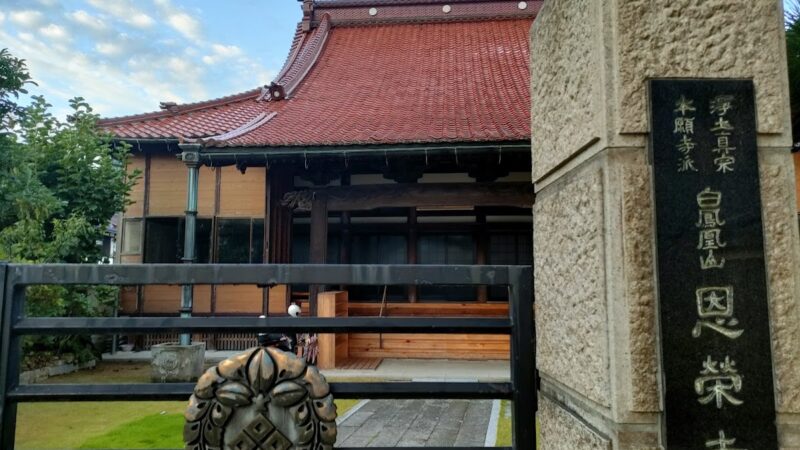
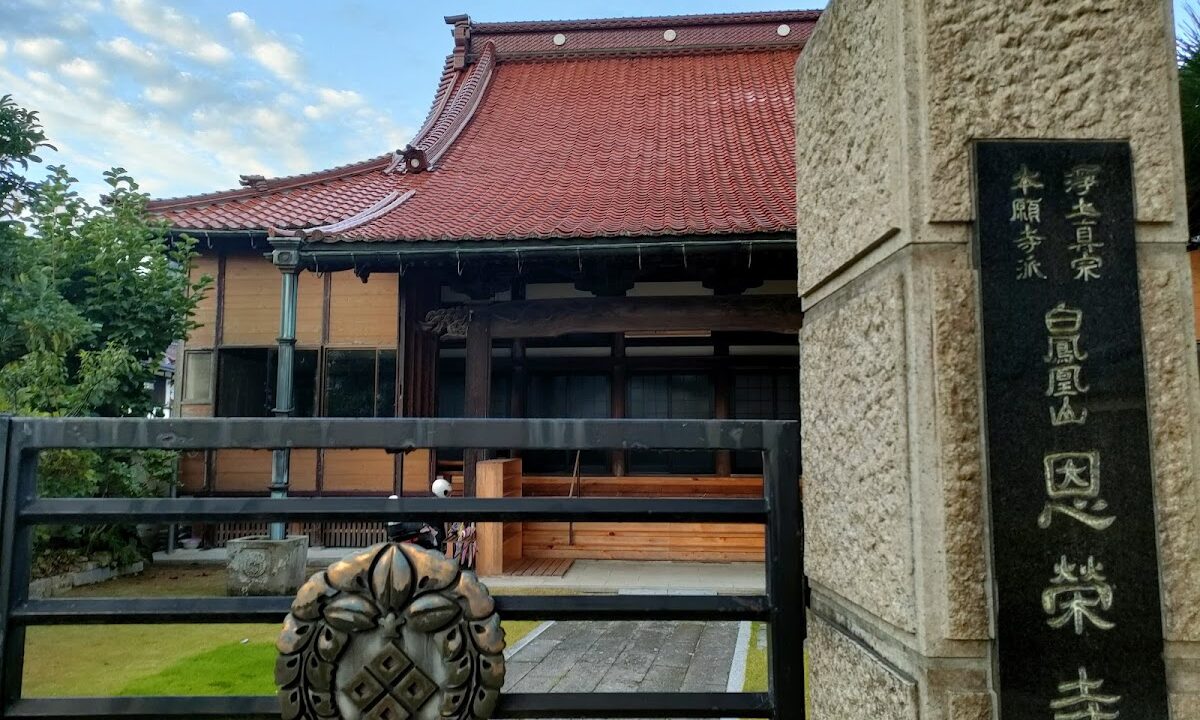
On’ei-ji Temple’s main hall is built in the traditional style of the Jodo Shinshu Honganji sect. The main hall houses Amida Buddha as the principal image, and also enshrines a portrait of Shinran Shonin. The temple grounds are meticulously maintained, providing a peaceful environment for worship while appreciating the changing seasons.
Commemorative Gifts and Goshuin (Temple Seals)
On’ei-ji Temple is known for offering special commemorative gifts to visitors. While goshuin (temple seals) have become popular at many temples and shrines in recent years, many Jodo Shinshu temples traditionally do not offer them. However, On’ei-ji Temple offers its own unique commemorative gift as proof of worship.
The commemorative gift bears the temple name “Hakuhōōzan On’ei-ji” and is cherished by many visitors as a memento of their visit. For details, please contact the temple directly or check the official website (https://onneiji.net).
Columbarium and Communal Grave
In response to changes in modern lifestyles, Onneiji Temple is also developing a columbarium and a communal grave. For those without successors or those who are concerned about the management of their graves, the temple provides a cemetery where memorial services are performed perpetually. This is attracting attention as a pioneering initiative in Ishikawa Prefecture.
Teachings and Practices of the Jodo Shinshu Honganji School
Teachings of Shinran Shonin
The core of Shinran Shonin’s teachings is “other-power vow.” This is the idea that salvation is achieved not through one’s own power (self-power), but through the power of Amida Buddha’s vow (other-power). By chanting “Namu Amida Butsu,” one is enveloped in Amida Buddha’s infinite compassion, and rebirth in the Pure Land is promised.
Shinran Shonin developed a revolutionary philosophy that all people, regardless of whether they are monks or laypeople, are equally saved. This had a profound impact on the Buddhist world at the time and continues to be a source of spiritual support for many people to this day.
Characteristics of Jodo Shinshu Buddhism
Jodo Shinshu Buddhism has several characteristics that differ from other Buddhist sects:
1. Rejection of Precepts: It takes the stance that salvation can be achieved solely through chanting the Buddha’s name, without the need for rigorous training or precepts.
2. Allowing Meat Consumption and Marriage: Shinran Shonin himself married and recognized the right of monks to marry. This was groundbreaking at the time.
3. Approach to Funerals: Based on the belief that the deceased has already been guided to the Pure Land by Amida Buddha, funerals are positioned not so much as “ceremonies to send off the deceased” but rather as “an opportunity for those left behind to connect with Buddhism.”
4. Regarding Temple Seals: It is a tradition in many Jodo Shinshu temples not to issue temple seals. This is based on a doctrine that rejects the idea of “accumulating merit.” However, in recent years, an increasing number of temples are preparing unique commemorative items for visitors.
Temple Culture in Ishikawa Prefecture and On’ei-ji Temple
The Spread of Jodo Shinshu Buddhism in Ishikawa Prefecture
Ishikawa Prefecture is known as a region where Jodo Shinshu Buddhism is particularly prevalent. During the history of the Kaga Domain, the Ikko-ikki (armed uprisings by Jodo Shinshu followers) had a significant influence, and the faith has been passed down as a deeply rooted belief in the region ever since.
Numerous temples of the Jodo Shinshu Honganji sect and the Shinshu Otani sect (Higashi Honganji sect) exist in Ishikawa Prefecture, playing a central role in local communities. On’ei-ji Temple is one of the important temples in the Yamanaka Onsen area that carries on this tradition.
Temple Culture of Kaga City
Kaga City, located in the southwestern part of Ishikawa Prefecture, is a tourist city boasting three hot spring resorts: Yamanaka Onsen, Yamashiro Onsen, and Katayamazu Onsen. At the same time, it has many historical temples and shrines, forming a unique culture where faith and tourism are intertwined.
Besides On’ei-ji Temple, various temples of different sects are scattered throughout Kaga City. Diverse Buddhist cultures, including Soto Zen, Shingon Buddhism, and Nichiren Buddhism, coexist, offering visitors a rich spiritual experience.
Attractions Around On’ei-ji Temple
The Charm of Yamanaka Onsen
When visiting On’ei-ji Temple, be sure to also enjoy a stroll through Yamanaka Onsen. Yamanaka Onsen is a hot spring resort with a 1300-year history, and the hot spring town spreads along the Daishoji River.
Koorogi Bridge: A representative scenic spot of Yamanaka Onsen, this bridge, made entirely of cypress wood, spans the Kakusenkei Gorge. Enjoy the beautiful gorge scenery throughout the seasons.
Ayatori Bridge: A modern, S-shaped bridge, offering a contrasting beauty to the Koorogi Bridge.
Kakusenkei Walking Trail: A 1.3km walking trail where you can enjoy forest bathing while listening to the gentle murmur of the river.
Yamanaka-za Theater: A facility where you can enjoy Yamanaka Onsen’s traditional performing arts, such as Yamanaka-bushi and lion dance.
Nearby Temples and Shrines
Besides On’ei-ji Temple, there are several other temples and shrines worth visiting around Yamanaka Onsen:
Yakushi-ji Temple: An ancient temple known as the guardian temple of Yamanaka Onsen.
Hiyoshi Shrine: A shrine situated on a hill overlooking the hot spring town, worshipped as the tutelary deity of Yamanaka Onsen.
Hakusan Shrine: One of several Hakusan worship shrines in Kaga City.
Access and Sightseeing Route
Access by Car:
- Approximately 20 minutes from Kaga IC on the Hokuriku Expressway
- Approximately 30 minutes from Komatsu Airport
- Approximately 50 minutes from Kanazawa city center
Public Transportation:
- Approximately 20 minutes by bus from Daishoji Station on the JR Hokuriku Main Line, get off at “Yamanaka Onsen Bus Terminal”
- Route buses also operate from Komatsu Station
Recommended Sightseeing Route:
- Arrive at Yamanaka Onsen Bus Terminal
- Stroll along the Kakusenkei Gorge walking trail (1-2 hours)
- Lunch in Yamanaka Onsen town
- Visit Onneiji Temple (30 minutes – 1 hour)
- Enjoy a hot spring bath or footbath
- Watch traditional performing arts at Yamanaka-za (if time permits)
Onneiji Temple’s Modern Initiatives
Online Information Dissemination
Onneiji Temple has launched an official website (https://onneiji.net) to actively disseminate information about the temple’s activities, messages from the head priest, and Buddhist teachings. Furthermore, we utilize social media (Twitter/X, Facebook) to prioritize communication with modern people.
Our website offers accessible content such as a column called “The Abbot’s Musings” and a “Buddhist Wife’s 4-Panel Manga,” making Buddhism more relatable.
The “Zero Buddha” Project
One of On’ei-ji Temple’s distinctive initiatives is the “Zero Buddha” project. This project re-examines the role of Buddhism in modern society and aims to deliver Buddhist teachings to a wider audience. Details can be found on the official website.
Engagement with the Local Community
On’ei-ji Temple is closely involved with the local community of Yamanaka Onsen. Through religious services and events, we deepen our ties with local residents, ensuring that the temple serves not merely as a religious facility, but also as a place for preserving local culture and history.
Etiquette and Manners for Visiting a Temple
Jodo Shinshu Temple Visiting Etiquette
Jodo Shinshu temple visiting etiquette differs slightly from other sects:
1. Joined Prayer and Bowing: Upon entering the main hall, first join your hands in prayer (namu amida butsu) towards the principal image of Amida Buddha and bow once.
2. Chanting: Chant “Namu Amida Butsu” with sincerity.
3. Incense Offering: Incense is offered during memorial services, but in the Jodo Shinshu Honganji sect, it is offered only once (the number of times varies depending on the sect).
4. No Clapping: Unlike Shinto shrines, clapping is not done at temples. Simply join your hands in prayer (namu) quietly.
Attire and Manners for Visiting a Temple
Attire: Unless it is a special memorial service, everyday clothes are acceptable, but avoid revealing clothing.
Photography: Photography is generally permitted within the temple grounds, but may be prohibited inside the main hall. Please check in advance or follow any signs.
Offerings: When receiving a commemorative gift or requesting a special prayer, an offering is expected. There is no set amount; an amount that expresses your gratitude is acceptable.
Understanding Buddhist Culture in Ishikawa Prefecture
Major Sects of Japanese Buddhism
Japanese Buddhism is broadly classified into the following sects:
Pure Land Buddhism: Jodo-shu, Jodo Shinshu (Hongwanji-ha, Otani-ha, etc.), Ji-shu
Zen Buddhism: Soto-shu, Rinzai-shu, Obaku-shu
Esoteric Buddhism: Shingon-shu, Tendai-shu
Lotus Sutra: Nichiren-shu, Nichiren Shoshu
Nara Buddhism: Kegon-shu, Hosso-shu, Ritsu-shu
Each sect has its own unique doctrines and practices, shaping the diverse Buddhist culture of Japan.
The Two Major Branches of Jodo Shinshu Buddhism
After the death of Shinran Shonin, Jodo Shinshu Buddhism split into several branches in the process of passing on his teachings. The two main branches are:
Jodo Shinshu Honganji Branch (Nishi Honganji Branch): Its head temple is Nishi Honganji in Kyoto. On’ei-ji Temple belongs to this branch.
Shinshu Otani Branch (Higashi Honganji Branch): Its head temple is Higashi Honganji in Kyoto.
While the fundamental doctrines of these two branches are the same, there are differences in the details of rituals and organizational management. Many temples of both branches exist within Ishikawa Prefecture.
Practical Information for Visiting Onneiji Temple
Summary of Visiting Information
Address: 35-Re, Yunode-machi, Yamanaka Onsen, Kaga City, Ishikawa Prefecture 922-0124
Phone: 0761-78-0644
Sect: Jodo Shinshu Honganji-ha
Visiting Hours: Daytime (Please check for details)
Admission Fee: Free (for temple grounds)
Parking: Available (Please check with the temple for details)
Official Website: https://onneiji.net
Seasonal Highlights
Spring (March-May): The temple grounds and the surrounding Yamanaka Onsen town are beautifully colored during cherry blossom season. A visit combining a stroll through the lush green Kakusenkei Gorge is recommended.
Summer (June-August): You can enjoy a cool visit amidst the verdant temple grounds. The entire area becomes lively during the Yamanaka Onsen summer festival.
Autumn (September-November): This is a beautiful season for autumn foliage. Enjoy the autumn scenery of Yamanaka Onsen, including the autumn leaves of Kakusenkei Gorge.
Winter (December-February): Enjoy a tranquil visit amidst a snowy landscape. This season is particularly appealing when combined with the hot springs.
Nearby Accommodations
Yamanaka Onsen has numerous hot spring inns and hotels:
- Luxury Ryokans: Hanashizuku, Kocho, Kissho Yamanaka, etc.
- Mid-range Ryokans: Scattered throughout Yamanaka Onsen
- Business Hotels: Located around Daishoji Station
When visiting On’eiji Temple, it is recommended to stay in Yamanaka Onsen and enjoy the hot springs and temple visits.
Historical Connections between On’eiji Temple and Yamanaka Onsen
Relationship between Hot Spring Resorts and Buddhism
There are deep historical connections between Japanese hot spring resorts and Buddhist temples. Many hot springs are said to have been discovered by monks, and temples have been built in hot spring resorts since ancient times.
Yamanaka Onsen also has a legend of being discovered by Gyoki Bodhisattva, and temples have played an important role as spiritual support for people who visit seeking the medicinal properties of the hot springs. On’ei-ji Temple has also existed within this history as a spiritual anchor for the local people.
History of Kaga and Jodo Shinshu Buddhism
Jodo Shinshu Buddhism holds a special place in the history of the Kaga region. From the late 15th to the 16th centuries, Kaga was known as a “country owned by the peasants,” where Jodo Shinshu followers governed the region.
Even during the Maeda family’s rule of the Kaga domain, the faith of Jodo Shinshu Buddhism remained deeply rooted in the region. Even today, there are many Jodo Shinshu temples in Ishikawa Prefecture, especially in the Kaga region, and On’ei-ji Temple is one of those temples that carries on this tradition.
Summary: The Charm of On’ei-ji Temple and the Significance of Visiting It
On’ei-ji Temple, located in Yamanaka Onsen, Kaga City, Ishikawa Prefecture, is a Jodo Shinshu Honganji-ha temple with a long history and tradition, yet it is a temple that is open to many people through modern initiatives. With its prestigious mountain name, Hakuhōōzan, On’ei-ji Temple, which carries on the teachings of Shinran Shōnin to the present day, is more than just a tourist spot; it offers visitors peace of mind and an opportunity to connect with Buddhist teachings.
Located in the scenic Yamanaka Onsen hot spring resort, it’s possible to combine sightseeing with religious devotion. The opportunity to heal your body in the hot springs and calm your mind at On’ei-ji Temple—such a luxurious experience is a major attraction of this region.
Through information dissemination via its official website and social media, initiatives that meet modern needs such as a columbarium and communal grave, and close ties with the local community, On’ei-ji Temple is a prime example of a temple that preserves tradition while adapting to the times.
When visiting Ishikawa Prefecture, especially if you have the opportunity to stay in Yamanaka Onsen, be sure to visit On’ei-ji Temple. The time spent experiencing the teachings of Jōdo Shinshū Buddhism and finding peace in its tranquil grounds will surely deepen your travel memories.
Among the many Jodo Shinshu Honganji sect temples spread throughout Japan, On’ei-ji Temple, situated in a unique location in a hot spring resort, is a fascinating temple where faith and tourism, tradition and innovation, are in perfect harmony.