About Suwa Grand Shrine
Suwa Grand Shrine, located around Lake Suwa in Nagano Prefecture, is the head shrine of approximately 25,000 Suwa shrines throughout Japan. While its founding date is unknown, it is considered one of the oldest shrines in Japan, even appearing in the Kojiki (Records of Ancient Matters).
Its most distinctive feature is its unique structure, composed of four shrines: Kamisha Honmiya, Kamisha Maemiya, Shimosha Harumiya, and Shimosha Akimiya. None of the shrine buildings have a main sanctuary; the Kamisha uses Mount Moriya as its sacred object, while the Shimosha uses a cedar tree, preserving ancient forms of worship.
The Onbashira Festival, held every seven years (every seven years according to the traditional Japanese age counting system), is a magnificent festival where giant logs, approximately 17 meters long and weighing about 10 tons, are pulled by human power and erected at the four corners of the shrine. It is considered one of Japan’s three great unusual festivals.
History and Origins
Ancient Beliefs
The origins of Suwa Grand Shrine are said to date back to the Jomon period, and it is deeply connected to the Jomon culture that flourished around Lake Suwa. In the Kojiki’s myth of the transfer of the land, Takeminakata-no-kami appears as the son of Okuninushi-no-mikoto, and it is recorded that he fled to the land of Suwa after being defeated in a test of strength against Takemikazuchi-no-kami.
Development in the Middle Ages
During the Heian period, it was already revered by the imperial court, and it is listed as “Minakata-Tomi Shrine” in the Engishiki Jinmyocho (a list of shrines compiled in the Heian period). From the Kamakura period onward, the Suwa clan served as both the chief priest (Ohoori) and the feudal lord, strengthening their ties with the samurai government.
During the Sengoku period, Takeda Shingen conquered Suwa, and the Suwa clan temporarily declined. However, the faith in Suwa Grand Shrine was inherited by the Takeda clan, and the worship of the shrine as a god of war spread throughout the country.
Since the Early Modern Period
During the Edo period, the shrine received the patronage of the Tokugawa Shogunate, and the lord of the Suwa-Takashima Domain served as the chief priest. Following the Meiji Restoration’s separation of Shinto and Buddhism, it became known as “Suwa Grand Shrine,” a name it retains to this day.
Deities and Benefits
Main Deities
- Takeminakata-no-Kami: The main deity of the Upper and Lower Shrines. Worshipped as the god of agriculture, war, and hunting.
- Yasakatome-no-Kami: The consort of Takeminakata-no-Kami. Guardian Deity of Women
Benefits
- Good Fortune and Prosperity: Powerful spiritual efficacy dating back to ancient times
- Long-lasting Military Fortune and Success in Competition: Revered by many warlords, including Takeda Shingen
- Abundant Harvest: Characterized as an agricultural deity
- Matchmaking and Marital Harmony: Due to the enshrinement of a married couple deity
- Protection from Evil and Protection from Inauspicious Directions: A belief in the four shrines protecting the four directions
Characteristics of Each of the Four Shrines
Kamisha Honmiya (Upper Shrine Main Sanctuary)
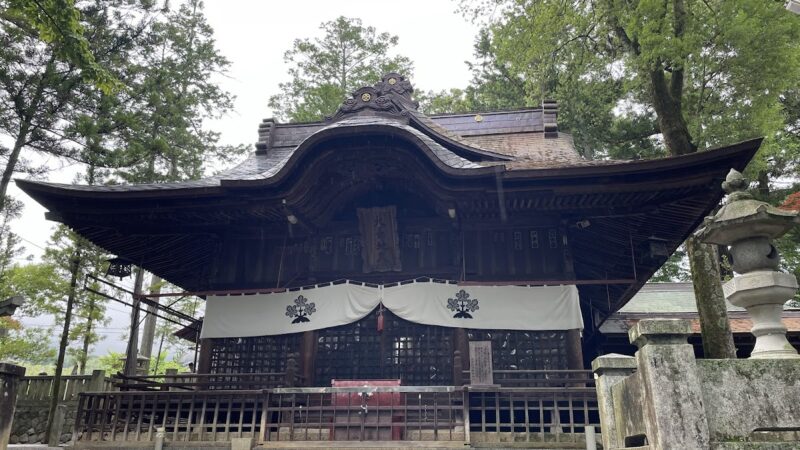
Located in Nakasu, Suwa City. Considered to have the highest rank among the four shrines. It retains an ancient form of worship, with Mount Moriya behind it as its sacred object, and lacking a main shrine building.
Highlights
- Entrance Gate: A magnificent gate tower designated as a National Important Cultural Property.
- Nunobashi Bridge: A corridor bridge formerly used for Shinto rituals.
- Chokuganden Hall: A shrine said to have been donated by Tokugawa Ieyasu.
- Treasure Hall: Displays valuable cultural artifacts, including a sword donated by Takeda Shingen.
Kamisha Maemiya Shrine
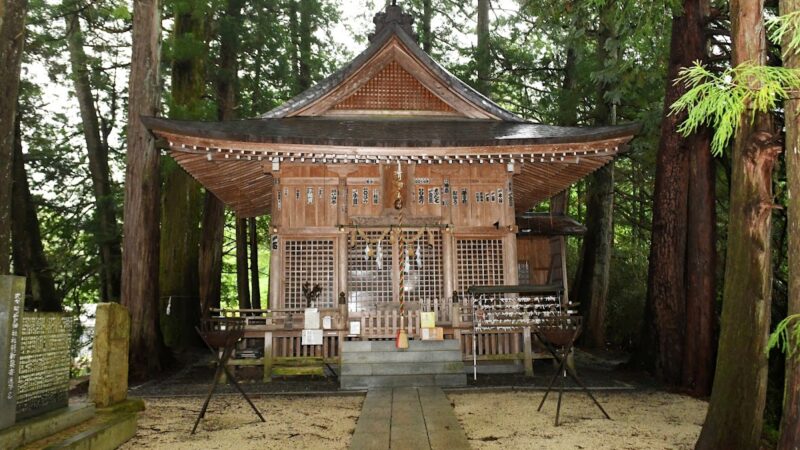
Located in Miyagawa, Chino City. It is considered the oldest site of worship among the four shrines and is said to be the birthplace of Suwa faith. It is characterized by its tranquil atmosphere.
Highlights
- Main Shrine: A simple yet solemn presence
- Ten-Ken Corridor: A long corridor where Shinto rituals were once performed
- Suiga: Pure spring water flowing from Mount Moriya, the sacred object of worship
- Omuro Shrine: An ancient ritual site
Shimosha Harumiya
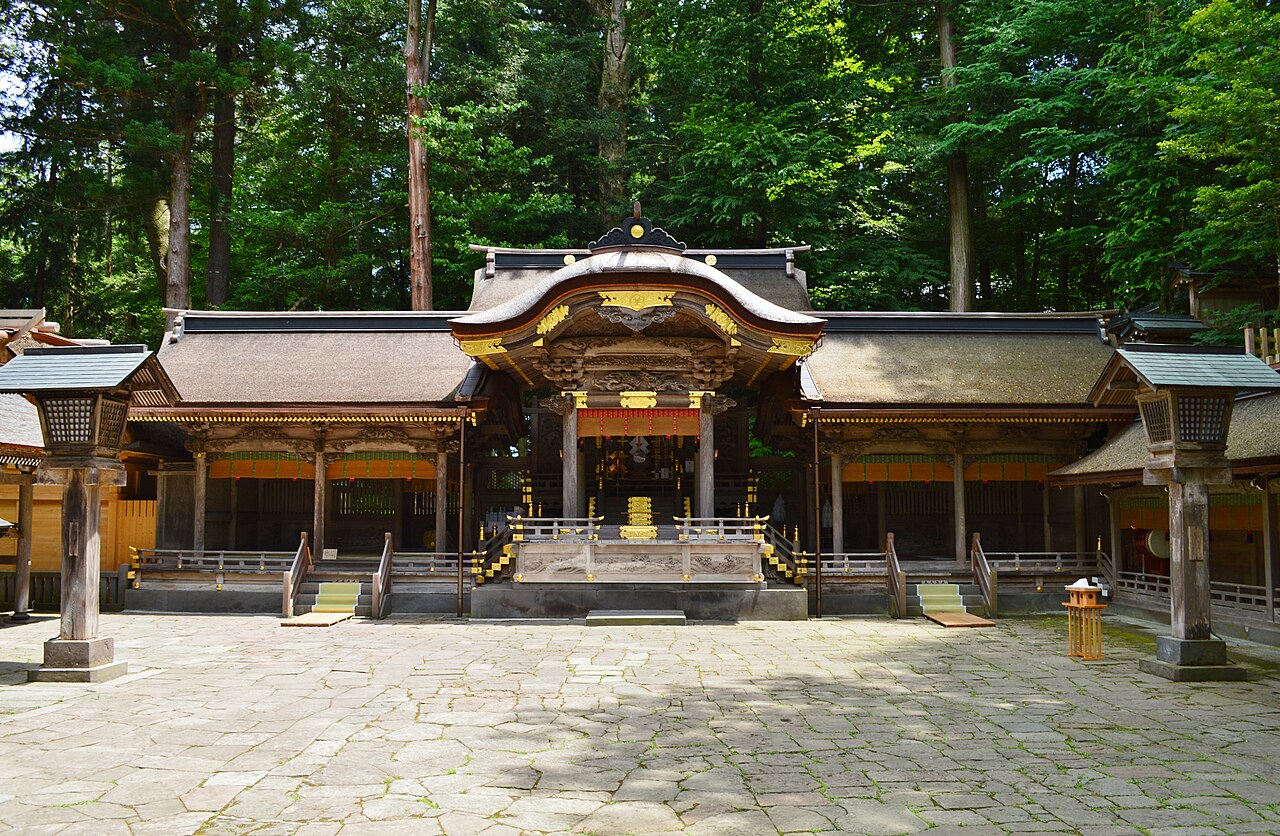
Located in Shimosuwa Town. The enshrined deity resides here from February to July. The sacred object of worship is a cedar tree, and the shrine building is a nationally important cultural property.
Highlights
- Heihaiden: Exquisite carvings, built in 1780 (An’ei 9).
- Kaguraden: Built in 1835 (Tenpo 6), characterized by its large shimenawa (sacred rope).
- Manji Stone Buddha: A 2-meter-tall, round stone Buddha, a 5-minute walk from Harumiya Shrine.
- Shimoumabashi: A drum bridge from the Muromachi period.
Shimosha Akimiya (Lower Shrine Autumn Shrine)
Located in Shimosuwa Town. The enshrined deity resides here from August to January. It has a shrine building with almost the same structure as Harumiya Shrine.
Highlights
- Kagura-den (Sacred Dance Hall): Home to the largest bronze guardian lion statues in Japan.
- **Heihai-den (Offering and Worship Hall): Exquisite carvings that complement the Harumiya (Spring Shrine).
- Onbashira (Sacred Pillars): Giant pillars standing at the four corners.
- **Onsen-machi (Hot Spring Town): The surrounding area is home to the Shimosuwa Onsen hot springs.
Onbashira Festival
Overview
Held in the Year of the Tiger and the Year of the Monkey, this is the largest Shinto ritual of Suwa Grand Shrine. Officially called the “Shikinen Zōei Onbashira Taisai” (Periodic Construction of the Sacred Pillars Festival), it boasts a history of over 1200 years.
Festival Flow
Yamada-shi (April): Giant trees are cut down from the foot of the Yatsugatake Mountains and pulled down by human power. The highlight is the “Kiotoshi” (tree-dropping), where the sacred pillars slide down a slope with a maximum incline of 35 degrees—a truly spectacular sight.
Satobiki (May): The sacred pillars are pulled through the town to each shrine and erected at the four corners of the shrines. The “Kawagoshi” (river crossing) features a magnificent scene of the sacred pillars being pulled into the Miyagawa River.
Number of Participants
This is a large-scale festival with hundreds of thousands of participants, attracting not only local residents but also spectators from all over Japan. The next festival is scheduled for 2028.
Worship Etiquette and Model Course
Order of Visiting the Four Shrines
While there is no officially prescribed order of worship, the following course is generally recommended.
- Kamisha Honmiya (Estimated time: 30-45 minutes)
- Kamisha Maemiya (Estimated time: 20-30 minutes)
- Shimosha Akimiya (Estimated time: 30-40 minutes)
- Shimosha Harumiya (Estimated time: 30-40 minutes)
If traveling by car, the entire trip takes approximately 3-4 hours.
Etiquette for Worship
At Suwa Grand Shrine, worship is performed using the same “two bows, two claps, one bow” method as at most shrines. Visiting all four shrines completes the “Four Shrine Pilgrimage,” and is believed to bring greater blessings.
Recommended Time to Visit
- Spring (April-May): Especially lively during the Onbashira Festival
- Summer (July-August): Beautiful fresh greenery, and the Gosenza-sai (relocation ceremony) is held at the lower shrine
- Autumn (October-November): Stunning autumn foliage
- Winter (January-February): The snowy landscape and crisp air create a mystical atmosphere
Goshuin (Shrine Seal) Information
Goshuin of the Four Shrines
Each shrine offers a different design of goshuin. The offering fee is 500 yen each.
- Kamisha Honmiya: Calligraphy of “Suwa Taisha”
- Kamisha Maemiya: Calligraphy of “Suwa Taisha Maemiya”
- Shimosha Harumiya: Calligraphy of “Suwa Taisha Harumiya”
- Shimosha Akimiya: Calligraphy of “Suwa Taisha Akimiya”
Special Goshuin (Shrine Seal)
A special goshuin is given out during the Onbashira Festival. Also, a “Certificate of Pilgrimage to All Four Shrines” may be issued to those who collect all four shrine seals.
Hours of Service
All shrines: 9:00-16:30 (may vary depending on the season)
Access
Access to Kamisha Honmiya
Train: Approximately 30 minutes by bus from JR Chuo Main Line “Chino Station,” get off at “Kamisha”
Car: Approximately 2km (5 minutes) from Chuo Expressway “Suwa IC”
Parking: Free parking available (approximately 100 spaces)
Access to Kamisha Maemiya
Train: Approximately 10 minutes by taxi from JR Chuo Main Line “Chino Station”
Car: Approximately 3km (7 minutes) from Chuo Expressway “Suwa IC”
Parking: Free parking available (approximately 20 spaces)
Access to Shimosha Akimiya
Train: Approximately 10 minutes on foot from JR Chuo Main Line “Shimosuwa Station”
Car: Approximately 5km (15 minutes) from Chuo Expressway “Okaya IC”
Parking: Free parking available (approximately 50 spaces)
Access to Shimosha Harumiya Shrine
Train: Approximately 15 minutes on foot from JR Chuo Main Line “Shimosuwa Station”
Car: Approximately 1 km from Shimosha Akimiya Shrine, also accessible on foot
Parking: Free parking available (approximately 30 cars)
Bus Touring the Four Shrines
During the tourist season, a sightseeing bus connecting the four shrines may operate. Please contact the Suwa Regional Tourism Association for details.
Nearby Tourist Attractions
Lake Suwa
Lake Suwa, the base for visiting the four shrines, is the largest lake in Shinshu (Nagano Prefecture). Enjoy sightseeing boat rides and lakeside strolls. The Lake Suwa Festival Fireworks Display on August 15th is one of the largest in Japan.
Takashima Castle
A castle known as the “Floating Castle” located in Suwa City. From the castle tower, you can enjoy a panoramic view of Lake Suwa and the direction of Kamisha Honmiya Shrine.
Manji Stone Buddha
A 2-meter-tall stone Buddha located near Shimosha Harumiya Shrine. It became famous after being highly praised by Taro Okamoto. ### Suwa Lake Geyser Center
A facility where you can see one of Japan’s largest geysers. A footbath is also available.
Points to Note When Visiting
- If visiting all four shrines in one day, please allow at least 4-5 hours including travel time.
- The parking lot at Kamisha Maemiya is small, so there may be waiting times during peak hours.
- In winter, there is snow, so please prepare warm clothing and non-slip shoes.
- During the Onbashira Festival, it gets very crowded, so early morning visits are recommended.
- The shrine offices close around 4:30 PM, so please allow ample time if you wish to receive a Goshuin (shrine stamp).
Summary
Suwa Grand Shrine is a rare shrine that preserves one of Japan’s oldest faiths. Each of the four shrines has its own unique charm, and visiting all of them allows you to understand the overall picture of Suwa faith. The Onbashira Festival, held once every seven years, is one of Japan’s most representative festivals and a spectacular sight that you should see at least once in your lifetime. Enjoy a fulfilling pilgrimage to Lake Suwa, taking in its rich natural beauty, hot springs, and historical and cultural attractions.