Suwa Shrine (Hata, Sakuho-machi, Nagano Prefecture) Complete Guide | A Regional Guardian Deity with Three Rare Kasuga-style Main Halls Standing Side-by-Side
Located in Hata, Sakuho-machi, Minamisaku-gun, Nagano Prefecture, Suwa Shrine is a historic shrine situated in the mountainous region of Shinshu. As one of approximately 25,000 Suwa Shrines nationwide, it has long been a center of local devotion. The most distinctive feature of this shrine is its extremely rare arrangement in Shinshu: three Kasuga-style main halls standing side-by-side. This article provides a detailed overview of Suwa Shrine, including its history, architectural features, enshrined deities, and visiting information.
Overview of Suwa Shrine (Hata, Sakuho-machi)
Basic Information
Location: 1456 Hata, Sakuho-machi, Minamisaku-gun, Nagano Prefecture 384-0701 (Hata, Jōka)
Shrine Rank: Village Shrine
Deity: Takeminakata-no-kami
Suwa Shrine is located on the foot of the mountain in the Hata settlement of Sakuho-machi, in a quiet environment surrounded by abundant nature. Sakuho-machi was formed in 2005 through the merger of Saku-machi and Yachiho-mura, and Suwa Shrine has existed as a spiritual pillar of the region since before the merger.
History and Origins of Suwa Shrine
Suwa Shrine is a shrine whose head shrine is Suwa Taisha (the Ichinomiya of Shinano Province), located in Suwa City, Nagano Prefecture. Suwa Grand Shrine is the center of the Suwa faith, which is said to have over 10,000 shrines nationwide, and enshrines Takeminakata-no-kami as its principal deity.
The Suwa Shrine in Hata, Sakuho-machi, is also a shrine that follows this Suwa faith and has long attracted the faith of local residents. The Hata area is located in the mountainous region of Saku, and has historically been a place where life revolved around agriculture. The Suwa Shrine has been revered as a guardian deity of the region, possessing divine virtues such as abundant harvests, family safety, and protection from evil.
As the place name “Joka” (castle town) suggests, it is possible that some kind of castle facility once existed in this area, indicating that it was a historical center of the region.
Three Kasuga-style Main Halls Standing Side-by-Side | Architectural Features
Rare Arrangement of Three Main Halls Standing Side-by-Side
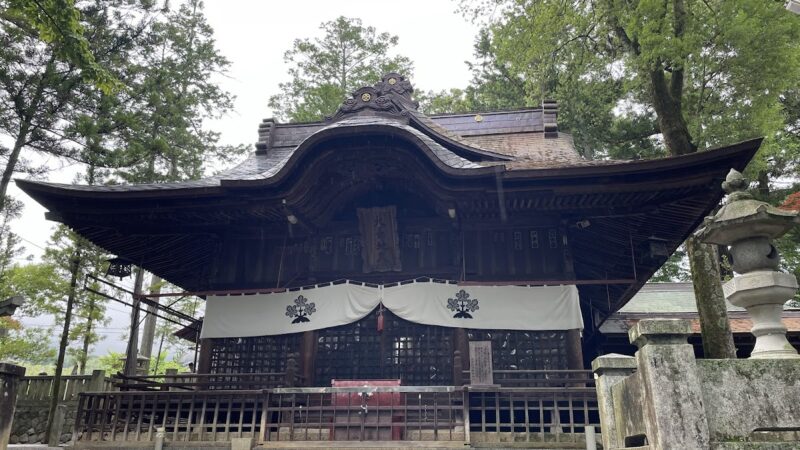
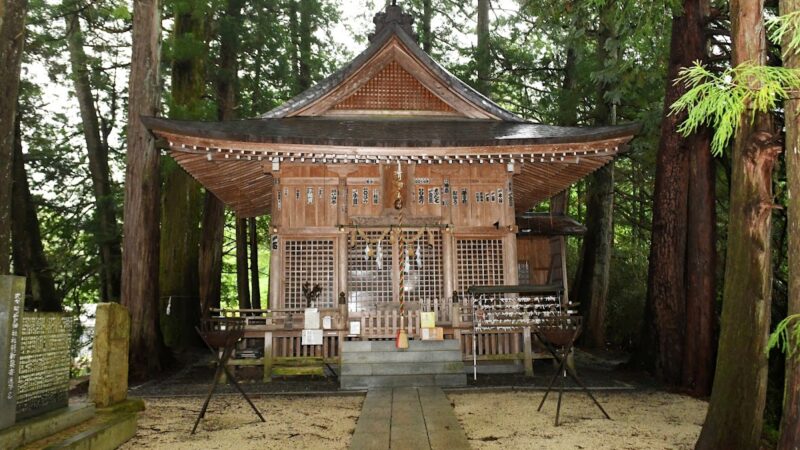
The most distinctive feature of the Suwa Shrine in Hata, Sakuho-machi, is that three Kasuga-style main halls are arranged side-by-side. This arrangement is extremely rare in Shinshu (Nagano Prefecture) and is a structure that is noteworthy from an architectural history perspective. In typical Shinto shrines, the main hall is usually a single building, or even when multiple deities are enshrined, multiple divine seats are often housed within a single building. However, Suwa Shrine employs a unique style, with three independent main halls standing side by side.
Kasuga-zukuri Architectural Style
Kasuga-zukuri is a style of shrine architecture exemplified by Kasuga Taisha Shrine in Nara. Its characteristics are as follows:
- Gable roof: The roof is shaped like an inverted book.
- Gable entrance: The entrance is on the short side (gable end) of the building.
- With portico: A canopy-like roof extends in front of the main building.
- Decorative carvings: Carvings are often found on the rainbow beams and wooden brackets.
The main hall of Suwa Shrine in Hata, Sakuho-machi, is a standard Kasuga-zukuri style in terms of size and content, but the three buildings standing side by side create a unique landscape.
Architectural Value and Preservation
The three main shrine buildings are each constructed as independent structures, preserving the techniques and designs of wooden architecture to this day. Each shrine features intricate carvings and decorations, well-preserving the characteristics of local shrine architecture from the Edo to Meiji periods.
They are currently maintained by local parishioners, with regular repairs and cleaning carried out.
Highlights of the Shrine Grounds
Approach and Torii Gate
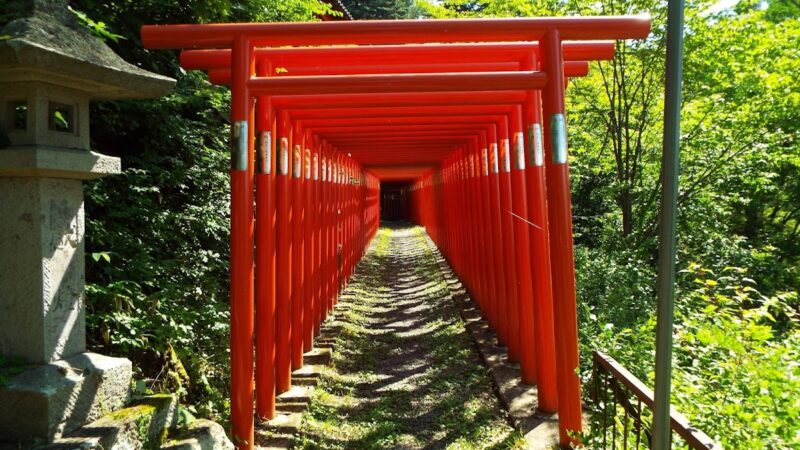
Access to the Suwa Shrine grounds is via an approach path leading from the village to the foot of the mountain. Passing through the torii gate, one enters a sacred area enveloped in a tranquil atmosphere.
Worship Hall
A worship hall is located in front of the main shrine, where worshippers offer their prayers. While relatively newer than the main shrine, the worship hall is carefully maintained as a place of local faith.
Subsidiary Shrines and Stone Monuments
In addition to the main shrine of Suwa Shrine, several small subsidiary shrines and stone monuments are scattered throughout the grounds. These are valuable historical materials that tell the story of the region’s history and the evolution of its beliefs.
There is also a possibility that medieval stone memorial towers called “itabi” remain, which are noteworthy as historical artifacts found in temples and shrines in the Koshin region.
Natural Environment
Suwa Shrine is situated on the foot of a mountain, surrounded by lush forests. Visitors can enjoy the beauty of nature throughout the seasons, from the fresh greenery in spring to the vibrant autumn leaves. The ancient and giant trees within the shrine grounds also tell the story of the shrine’s history.
Deity and Divine Virtues
Takeminakata-no-Kami
The deity enshrined at Suwa Shrine is Takeminakata-no-Kami. This god appears in the Kojiki (Records of Ancient Matters) and is considered a son of Okuninushi-no-Kami. According to mythology, during the transfer of power in Izumo Province, he was defeated in a test of strength against Takemikazuchi-no-Kami and fled to the Suwa region, where he took up residence.
Takeminakata-no-kami is believed to possess the following divine virtues:
- God of Valor: Due to myths of strength contests, he is worshipped as a god of martial arts improvement and good fortune in competitions.
- God of Agriculture: As the pioneering god of the Suwa region, he is the object of prayers for abundant harvests and bountiful harvests.
- God of Hunting: He also has characteristics as a god of mountains and hunting.
- God of Wind: Known as the god who controls the wind, he is the object of prayers for safe voyages and stable weather.
- Protection from Evil and Good Fortune: Due to his strong divine power, he is also believed to possess divine virtues for protection from evil and good fortune.
Characteristics of Suwa Faith
Suwa faith spread throughout Japan, and was particularly devout among the samurai class. It is believed that from the Kamakura period onward, samurai families, including the Takeda clan, placed great importance on Suwa faith and established Suwa shrines in various locations, leading to its nationwide spread.
The Saku region was also within the sphere of influence of the Takeda clan, and therefore Suwa faith took deep root in this area. ## Annual Events and Festivals
Grand Festival
Suwa Shrine holds its annual Grand Festival every year. Local parishioners gather for Shinto rituals, Kagura (sacred dance) performances, and a Naorai (celebratory feast), making it an important event that strengthens the bonds of the local community.
Other Festivals
- New Year’s Day Festival: A festival praying for peace in the new year
- Spring Festival: A festival praying for a bountiful harvest
- Autumn Festival: A festival giving thanks for the harvest
Specific festival dates may vary from year to year, so it is recommended to check in advance if you plan to visit.
Access and Visiting Information
Access by Car
Chubu Trans-Japan Expressway:
- Approximately 15 minutes from Sakuho IC
- Approximately 20 minutes from Yachiho Kogen IC
Take the prefectural road from National Route 141 and head towards Hata settlement. Following the signs within the village towards the mountainside will lead you to Suwa Shrine.
Access by Public Transportation
JR Koumi Line:
- Get off at “Sakuho Station” or “Yachiho Station”
- It’s a bit of a walk from the station, so we recommend taking a taxi (approximately 10-15 minutes).
Bus routes are limited, so it’s important to check the timetable in advance if using public transportation.
Parking
There may be some parking space on the shrine grounds or nearby, but due to the small size of the shrine, visiting with large vehicles or multiple vehicles may be difficult.
Precautions When Visiting the Shrine
- The shrine grounds are managed by local parishioners, so please be mindful of proper etiquette during your visit.
- The shrine office may not always be staffed.
- Please check in advance regarding Goshuin (shrine stamps) and other items.
- During winter, snowfall may be present, so caution is advised when visiting.
About the Hata District of Sakuho Town
Regional Characteristics
The Hata district of Sakuho Town is a rural settlement located in the mountainous area of Minamisaku County. As the name “Hata” (field) suggests, agriculture has been practiced in this area since ancient times, and a tranquil landscape of fields and rice paddies remains today.
The Hata district includes several sub-districts such as Ueno, Uguisunokuchi, Okubo, Kamihata, Saguchi, Shimizumachi, Shimohata, Daimon, Nakahata, and Miyamae, and “Joka,” where Suwa Shrine is located, is one of them.
Nearby Tourist Spots
Yachiho Plateau: A representative tourist destination of Sakuho Town, a plateau resort with beautiful birch forests. Many tourists visit from spring to autumn.
Matsubara Lake: Located at an altitude of 1,200m, this lake offers opportunities for fishing and camping.
Sakuho Town Hot Springs: Day-trip hot spring facilities such as Happo-no-Yu are also available.
Suwa Shrine and Local Beliefs
Role as a Guardian Deity
Suwa Shrine has served as the guardian deity of the Hata district, acting as a spiritual pillar for the local residents. A guardian deity is the protector of a land, a god that safeguards the people (parishioners) living in that area.
Important milestones in the community, such as:
- Birth of a child (first shrine visit)
- Growth milestones (Shichi-Go-San)
- Exorcism during unlucky years
- Reporting marriage or new construction
The custom of reporting to the guardian deity and praying for protection at various points in life continues to this day.
Connection with the Local Community
The maintenance and management of Suwa Shrine and the operation of festivals are carried out by the local parishioner organization. Events such as the annual festival provide a valuable opportunity for local residents to gather together, fostering intergenerational exchange.
In mountainous and rural areas facing depopulation and an aging population, shrines play a crucial role in maintaining the region’s identity.
The Spread of Suwa Faith and the Saku Region
Relationship between Suwa Grand Shrine and Branch Shrines
All Suwa shrines throughout Japan consider Suwa Grand Shrine, located around Lake Suwa, as their head shrine. Suwa Grand Shrine consists of two shrines and four sub-shrines: the Upper Shrine (Honmiya and Maemiya) and the Lower Shrine (Harumiya and Akimiya). It has long been revered as the Ichinomiya (first-ranked shrine) of Shinano Province.
The Suwa Shrine in Hata, Sakuho Town, is also thought to be one of the branch shrines established by inviting deities from Suwa Grand Shrine.
Suwa Faith in the Saku Region
The Saku region is adjacent to the Suwa region and has long been strongly influenced by Suwa faith. Especially during the period under the rule of the Takeda clan, particularly from the medieval era onward, the Suwa faith, which the Takeda clan deeply revered, permeated the region.
Numerous shrines bearing the names Suwa Shrine or Suwa-sha exist in the Saku region, each with its own distinct worship tradition.
The Mystery and Considerations of the Three-Building Main Hall
Why Three Buildings?
While there may not be clear records explaining why the Suwa Shrine in Hata, Sakuho Town, has three main halls, several hypotheses can be considered:
1. To enshrine multiple deities individually
In Suwa faith, in addition to Takeminakata-no-kami, his consort Yasakatome-no-kami and other divine children are sometimes enshrined. It’s possible that each deity was enshrined in a separate main hall.
2. Consolidation of multiple settlements
It’s possible that the small shrines that several small settlements within the Hata district each had were gathered and enshrined in one place, resulting in the three main halls.
3. Additions Over Time
Originally, the main shrine was a single building. Over time, as faith expanded and the number of parishioners increased, it’s possible that a second and third building were added.
4. Architectural and Religious Reasons
The number three has been considered sacred since ancient times and can have religious significance, representing the Trinity, heaven, earth, and humanity.
Similar Examples in Shinshu
While there are shrines with multiple main shrines in Nagano Prefecture, the arrangement of three identical main shrines standing side-by-side is considered rare. Such arrangements may reflect unique regional beliefs or historical circumstances, and further research is anticipated.
Manners and Etiquette for Worship
Basic Worship Etiquette
Here are some basic manners for worshipping at a shrine:
1. Bow Before Passing Through the Torii Gate
The torii gate is the entrance to the sacred area. Bow before entering the grounds.
2. How to Walk Along the Shrine Path
The center of the path is considered the path of the gods. Please walk along the sides.
3. Purification at the Water Basin
If there is a water basin, purify your hands and mouth before praying.
4. Praying at the Main Hall
- A slight bow
- Place your offering
- Ring the bell if there is one
- Two bows, two claps, one bow
- Express your wishes and gratitude silently
5. When Leaving
After exiting the torii gate, turn around and bow.
Regarding Photography
Photography is generally permitted on the shrine grounds, but please note the following:
- Do not take photos in areas where photography is prohibited, such as inside the main hall.
- During festivals, be considerate and avoid interfering with religious ceremonies.
- Respect the privacy of other worshippers.
History and Culture of Sakuho Town
Origins of the Town
Sakuho Town was formed on March 20, 2005 (Heisei 17) through the merger of Saku Town and Yachiho Village. The town’s name was derived from one character each from the names of the two former towns.
Before the merger, Saku Town was a long-established agricultural area, while Yachiho Village was known as a highland resort. The merger has led to the town’s development as a center of both agriculture and tourism.
Cultural Properties and Historical Heritage
Besides Suwa Shrine, Sakuho Town has many other temples, shrines, and cultural properties. The area boasts numerous buildings showcasing the distinctive architectural features of temples and shrines in the Koshin region, as well as scattered stone cultural artifacts such as steles, making it a fascinating region for history enthusiasts.
Seasonal Attractions of Suwa Shrine
Spring (March-May)
As the snow melts, new greenery sprouts, filling the shrine grounds with vitality. This is also the time for the spring festival, allowing visitors to experience the vibrant energy of the community.
Summer (June-August)
Sakuho Town, with its high altitude, enjoys a relatively cool and pleasant climate even in summer. The shrine grounds, enveloped in deep green, offer a healing space that allows you to forget the heat of the city.
Autumn (September-November)
The autumn foliage season is the most beautiful time around Suwa Shrine. The contrast between the colorful trees and the shrine buildings is magnificent. Thanksgiving for the harvest is offered at the autumn festival.
Winter (December-February)
The snow-covered shrine grounds are enveloped in silence, further enhancing the sacred atmosphere. However, due to snowfall, thorough preparation is necessary for visiting the shrine.
Summary
The Suwa Shrine, located in Hata, Sakuho-machi, Nagano Prefecture, is a rare and valuable shrine in Shinshu (Nagano Prefecture) with its unique architectural layout, featuring three Kasuga-style main halls standing side by side. It plays a vital role in the nationwide Suwa faith and has long been revered as the local guardian deity.
Dedicated to Takeminakata-no-kami, this shrine, which offers blessings for abundant harvests, family safety, and protection from evil, is still carefully preserved by the local residents. When visiting Sakuho-machi, be sure to visit this historic Suwa Shrine and experience its unique architectural style and tranquil atmosphere.
The architectural feature of the three main halls standing side by side, its location in a mountain village, and the deep faith of the local people—all of these elements combine to create the unique charm of the Suwa Shrine (Hata, Sakuho-machi). This shrine, steeped in history and tradition, quietly speaks to us, who live in the modern age, about the importance of local Japanese faith.