Suwa Shrine (Tomioka City, Gunma Prefecture) Complete Guide | History, Goshuin (Shrine Seal), and Access Information
Located in the heart of Tomioka City, Gunma Prefecture, Suwa Shrine is a historic shrine within walking distance of the World Heritage Site, Tomioka Silk Mill. With a history of being established through the enshrinement of a deity from Suwa Grand Shrine, the Ichinomiya (first-ranked shrine) of Shinano Province, it remains a beloved guardian deity of the Tomioka area, enjoyed by many worshippers.
This article comprehensively covers everything you need to know before visiting Suwa Shrine, including its detailed history, enshrined deities, highlights within the grounds, goshuin information, and access methods.
Basic Information about Suwa Shrine
Location
Address: 1130 Tomioka, Tomioka City, Gunma Prefecture
Postal Code: 370-2316
Suwa Shrine is located approximately 200 meters south of Joshu-Tomioka Station, next to the Tomioka intersection. The entrance faces the shopping street, and despite its central urban location, this shrine offers a peaceful and tranquil atmosphere for worship.
Deities Enshrined
The main deities enshrined at Suwa Shrine are the following two:
- Takeminakata-no-Mikoto: The principal deity of Suwa Grand Shrine, revered as a god of war and martial prowess. Also worshipped as a god of agriculture, hunting, and wind and rain.
- Yasakatome-no-Mikoto: The consort of Takeminakata-no-Mikoto. Believed to bestow blessings of matchmaking and family safety.
These deities were invited from Suwa Grand Shrine in Shinano Province and have long been revered in the Tomioka area.
History of Suwa Shrine
Founding and Establishment
The exact founding date of Suwa Shrine is unknown, but it is believed to have begun with the establishment of a divided spirit from Suwa Grand Shrine (Suwa region, Nagano Prefecture), the Ichinomiya (first-ranked shrine) of Shinano Province. Initially, it was located in Miyazaki Village, Kanra District, Kozuke Province (present-day Miyazaki district, Tomioka City).
Suwa faith was widely practiced by the samurai class, including the Takeda clan, from the medieval period to the Sengoku period, and Suwa shrines were established in various locations. It is thought that a divided spirit of Suwa Grand Shrine was enshrined in Tomioka as the guardian deity of the region.
Fall of Miyazaki Castle and Relocation
A significant turning point in the history of Suwa Shrine was the fall of Miyazaki Castle in 1590 (Tensho 18). In that year, following Toyotomi Hideyoshi’s siege of Odawara, the Toyotomi army, led by Uesugi Kagekatsu, invaded Kozuke Province. Miyazaki Castle was attacked and fell.
Following the fall of the castle, the residents of Miyazaki Village were forced to relocate to Tomioka. At this time, Suwa Shrine was also moved to its current location in Tomioka City, Tomioka, along with the residents. This suggests that the shrine, as a spiritual anchor for the local community, was carefully preserved even in their new home.
Developments since the Edo Period
In 1601 (Keicho 6), when Okudaira Nobumasa, the lord of Miyazaki Castle, was transferred to the Mino-Kano Domain (present-day Gifu City, Gifu Prefecture), Miyazaki Castle was officially abandoned. However, Suwa Shrine, relocated to Tomioka, continued to attract worshippers as the local tutelary deity.
Throughout the Edo period, Tomioka developed as a thriving sericulture region, and in the Meiji era, the government-run Tomioka Silk Mill was established. Suwa Shrine has grown alongside the development of Tomioka town and remains a central place of worship for the local residents to this day.
Highlights of the Shrine Grounds
Shrine Architecture
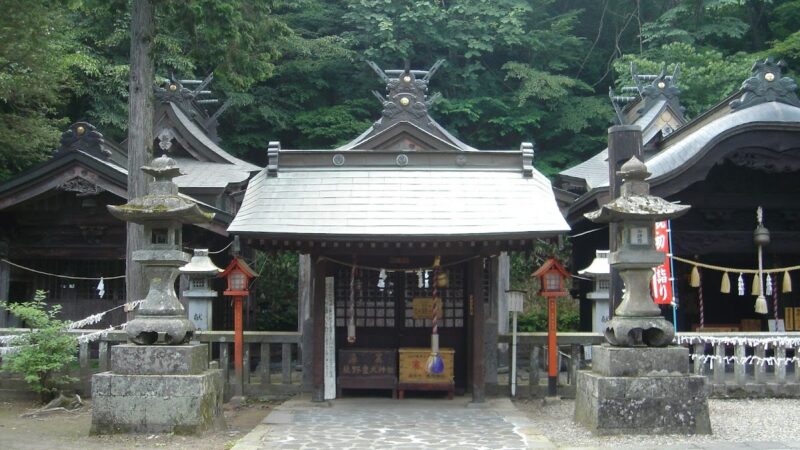
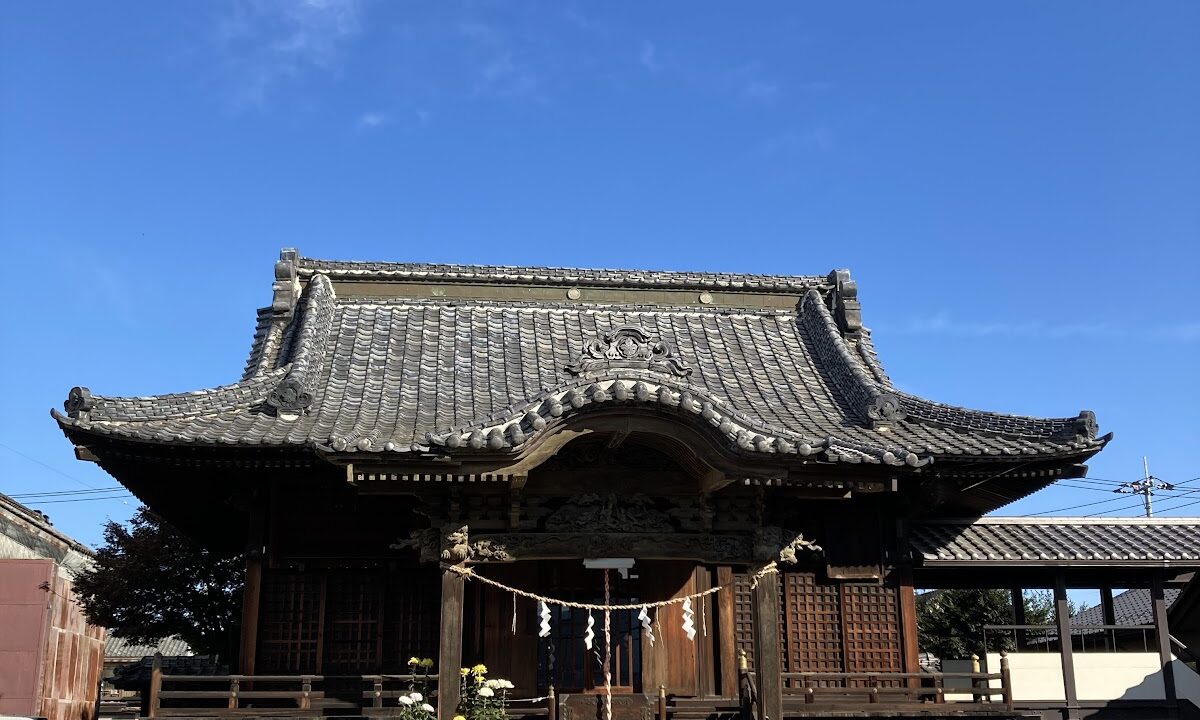
The Suwa Shrine’s buildings are a traditional shrine architecture consisting of a main hall and a worship hall. While the grounds are not particularly large, a refreshing space, meticulously maintained, unfolds before you.
Worship Hall: The worship hall, where worshippers offer their prayers, is a dignified wooden building. Despite being a shrine in the city, it maintains a tranquil atmosphere.
Main Hall: Located behind the worship hall, the main hall enshrines the deity. The intricate carvings showcase the craftsmanship that has continued since the Edo period.
Carvings at Okuni Shrine
Of particular note within the grounds is the Okuni Shrine (a subsidiary shrine). Though small, it boasts magnificent carvings and possesses cultural value well worth a visit. The carvings on the shrine building delicately depict flowers, birds, and scenes from mythology, conveying the high level of skill of the craftsmen of that time.
Distinctive Komainu (Guardian Lion-Dogs)
Another highlight of Suwa Shrine is the unusually shaped komainu (guardian lion-dogs) placed within the shrine grounds. Their unique expressions and postures, different from typical komainu, attract the attention of visitors. As valuable stone sculptures reflecting the region’s history and religious characteristics, they are also a popular spot for photography.
Atmosphere of the Shrine Grounds
Stepping into the shrine grounds from the entrance facing the shopping street, you enter a quiet space far removed from the hustle and bustle of the city. Surrounded by trees, the grounds are a place of relaxation where you can feel the changing seasons. Visiting in the early morning or evening, in particular, allows you to calm your mind in an even more serene atmosphere.
Goshuin (Shrine Seal) and Goshuincho (Shrine Seal Book) Information
About Goshuin
Goshuin are available at Suwa Shrine. Goshuin are popular among many visitors as proof of their visit to the shrine and as a memento of their trip.
Features of the Goshuin (Shrine Seal):
- The name of the shrine, “Suwa Shrine,” is written in ink.
- The shrine’s seal is stamped on the seal.
- The date is also included.
Please note the following when receiving a Goshuin:
- Complete your prayers first: The Goshuin is proof of your prayers, so be sure to complete your prayers before receiving it.
- Prepare a Goshuincho (Shrine Seal Book): It is recommended to bring a dedicated Goshuincho.
- Prepare the offering: Generally, it is around 300 to 500 yen (it is polite to prepare the exact amount to avoid needing change).
- Check the shrine office’s hours: They may be absent, so if you want to be sure to receive a Goshuin, it is recommended to check in advance.
Goshuincho
For information on Suwa Shrine’s original Goshuincho, please inquire at the shrine office. Those visiting shrines throughout Gunma Prefecture may also consider using a Goshuincho common to all shrines in Gunma Prefecture.
Access Information
Access by Train
Nearest Station: Joshu-Tomioka Station (Joshin Electric Railway)
- Approximately 2 minutes on foot from Joshu-Tomioka Station (approximately 182 meters)
- Exit the station and walk straight south; it’s near the Tomioka intersection.
The Joshin Electric Railway runs from Takasaki Station towards Tomioka, and it takes approximately 40 minutes from Takasaki Station to Joshu-Tomioka Station. It’s very close to the station, making it easily accessible on foot.
Route from JR Takasaki Station:
- Get off at JR Takasaki Station
- Transfer to the Joshin Electric Railway
- Get off at Joshu-Tomioka Station (approximately 40 minutes)
- Suwa Shrine is approximately 2 minutes on foot.
Access by Bus
Local buses operating within Tomioka City are also available. The nearest bus stops are “Tomioka Silk Mill” or “Tomioka City Hall,” both a few minutes’ walk away. However, walking from Joshu-Tomioka Station is the most convenient way to access the shrine.
Access by Car
Access from Major Roads:
- Approximately 10 minutes from the Tomioka Interchange on the Joshinetsu Expressway
- Accessible via National Route 254
Parking Information:
There is no large dedicated parking lot for the shrine, but there are paid parking lots nearby. If you are visiting in conjunction with a tour of the Tomioka Silk Mill, it is convenient to use the Tomioka Silk Mill’s parking lot and walk (approximately 7-8 minutes on foot, about 600 meters, from the Tomioka Silk Mill to Suwa Shrine).
Access from Tomioka Silk Mill
Suwa Shrine is approximately 7-8 minutes on foot, about 600 meters, from the World Heritage Site, Tomioka Silk Mill. Many people visit the shrine before or after visiting the Tomioka Silk Mill, and we recommend visiting both together.
Directions from Tomioka Silk Mill to Suwa Shrine:
- Exit the main gate of Tomioka Silk Mill.
- Proceed north along the shopping street.
- Head towards Tomioka Intersection.
- Walk straight for approximately 600 meters to reach Suwa Shrine.
There are many restaurants and souvenir shops along the way, allowing you to enjoy the townscape of Tomioka as you walk.
Manners and Etiquette for Visiting a Shrine
Basic Etiquette for Visiting a Shrine
Please observe the basic etiquette for visiting a shrine and offer your prayers with sincerity.
How to Pass Through the Torii Gate:
- Bow before passing through the torii gate.
- Walk along the edge of the path, as the center is considered the path of the gods.
How to Perform the Hand-Washing Ritual:
- Take the ladle with your right hand and wash your left hand.
- Switch the ladle to your left hand and wash your right hand.
- Switch the ladle back to your right hand, receive water in your left hand, and rinse your mouth.
- Finally, stand the ladle upright to wash the handle and return it to its original position.
Worship at the Main Hall:
- Stand in front of the offering box and bow slightly.
- Gently place your offering in the box.
- If there is a bell, ring it.
- Perform the two bows, two claps, one bow (two deep bows, two claps, one deep bow).
Appropriate Attire for Worship
There are no specific rules, but it is desirable to wear clothing that reflects the sacred nature of the place. Avoid revealing or overly flashy clothing, and aim for clean and presentable attire.
Regarding Photography
Photography is generally permitted on the shrine grounds, but please observe the following points:
- Do not take photos in areas where photography is prohibited, such as inside the main hall.
- Be considerate of other worshippers.
- Remember that this is a sacred place and behave respectfully.
Nearby Tourist Attractions
Tomioka Silk Mill (World Heritage Site)
Located about a 7-8 minute walk from Suwa Shrine, the Tomioka Silk Mill is an industrial heritage site symbolizing Japan’s modernization, registered as a World Heritage Site in 2014. Established in 1872 (Meiji 5), it was a government-run model factory that greatly contributed to the development of Japan’s silk industry.
Highlights:
- East and West Cocoon Warehouses (National Treasures)
- Reeling Factory (National Treasure)
- Historical buildings such as the Brunat House and the Chief’s Residence
Gunma Prefectural Museum of Natural History
Located in Kamikuroiwa, Tomioka City, this natural history museum features extensive exhibits on dinosaur fossils and the nature of Gunma Prefecture. This is a popular spot for families.
Mount Myogi
Located northwest of Tomioka City, Mount Myogi is a scenic spot counted as one of Japan’s three most unusual landscapes. Its unique scenery, with its series of strangely shaped rocks and boulders, is popular with people who enjoy mountain climbing and hiking.
Nukisaki Shrine
Located in Ichinomiya, Tomioka City, this is the Ichinomiya (first-ranked shrine) of Kōzuke Province, an ancient shrine with a history of over 1400 years. Known for its rare “descending shrine” style, it is designated as a National Important Cultural Property.
Annual Events and Festivals
Suwa Shrine holds various festivals and events throughout the year.
Main Annual Events
New Year’s Day Festival (January 1st)
A festival celebrating the New Year. It is bustling with many visitors making their first shrine visit of the year.
Setsubun Festival (around February 3rd)
Events such as bean-throwing are held.
Spring Grand Festival
A festival celebrating the arrival of spring. Summer Purification Ceremony (June 30th)
A Shinto ritual to cleanse away the sins and impurities accumulated over the past six months.
Autumn Grand Festival
A festival to give thanks for the autumn harvest. One of the important local festivals.
Shichi-Go-San (around November 15th)
A prayer for the healthy growth of children.
Year-End Purification Ceremony (December 31st)
A purification ceremony to cleanse away the sins and impurities accumulated over the past year and prepare for the New Year.
For detailed dates and content, we recommend inquiring at the shrine office during your visit or checking in advance.
Recommended Suwa Shrines in Gunma Prefecture
There are several Suwa Shrines located within Gunma Prefecture. Visiting the Suwa Shrine in Tomioka City in conjunction with others is also recommended.
Suwa Shrine (Tashino, Tomioka City)
Address: 944-1 Tashino, Tomioka City, Gunma Prefecture
This is another Suwa Shrine within Tomioka City, located in the Tashino district.
Other Suwa Shrines
Shrines established by inviting deities from Suwa Grand Shrine are scattered throughout Gunma Prefecture, each attracting worshippers in its respective region. You can feel the spread of Suwa faith.
Best Season for Visiting
Suwa Shrine can be visited year-round, but each season offers a different charm.
Spring (March-May)
During cherry blossom season, the shrine grounds and surrounding areas are filled with flowers, creating a vibrant atmosphere. The weather is mild, making it an ideal time for visiting.
Summer (June-August)
Summer events, such as the Natsukoshi no Oharae (summer purification ceremony), are held. The lush green grounds offer a refreshing and cool atmosphere.
Autumn (September-November)
This is the time of the Autumn Grand Festival, where you can enjoy the atmosphere of a local festival. The surrounding nature is also beautifully colored during the autumn foliage season.
Winter (December-February)
The shrine is bustling with many worshippers during the New Year’s visit period. Visiting the shrine in the quiet winter grounds, in a solemn atmosphere, also has its own charm.
The History of Tomioka City and Suwa Shrine
The Position of Suwa Shrine in Tomioka’s Local History
Suwa Shrine is deeply intertwined with the history of Tomioka City. Its relocation to its current location after the historical turning point of the fall of Miyazaki Castle tells the story of the changes in the local community during the transition from the Sengoku period to the Edo period.
The history of a shrine moving with its residents demonstrates that the shrine was not merely a religious facility, but a spiritual pillar of the local community.
Connection to Sericulture and Silk Reeling
From the Edo period to the Showa period, Tomioka prospered from sericulture and silk reeling. Established during the Meiji era, the Tomioka Silk Mill is registered as a World Heritage Site, symbolizing Japan’s modernization.
Suwa Shrine has watched over the development of this industry and served as a spiritual center for the local residents. The female workers at the silk mill likely visited Suwa Shrine to pray for safety and health.
Role in Modern Times
Even today, Suwa Shrine plays an important role as the tutelary shrine of Tomioka citizens and as a historical site welcoming tourists. With the increase in tourists visiting the World Heritage Site, the Tomioka Silk Mill, the number of visitors to Suwa Shrine has also increased.
About Suwa Faith
Suwa Grand Shrine and the Spread of Suwa Faith
Suwa faith is a faith centered around Suwa Grand Shrine, located in the Suwa region of Nagano Prefecture. Suwa Grand Shrine is the Ichinomiya (first-ranked shrine) of Shinano Province, consisting of four shrines: Kamisha Honmiya, Kamisha Maemiya, Shimosha Akimiya, and Shimosha Harumiya. It is a historically significant shrine with a long history dating back to ancient times.
Suwa worship was widely practiced by the samurai class, including the Takeda clan, from the medieval period onward, and Suwa shrines were established throughout Japan. Currently, there are estimated to be approximately 5,000 Suwa shrines and Suwa sanctuaries nationwide.
Divine Virtues of the Enshrined Deity
Takeminakata-no-Mikoto is a deity appearing in the Kojiki (Records of Ancient Matters), appearing as the son of Okuninushi-no-Mikoto in the Izumo land transfer myth. After being defeated in a test of strength, he is said to have arrived in the land of Suwa and settled there.
Main Divine Virtues:
- Long-lasting military fortune and good fortune in competitions
- Protection of agriculture and hunting
- Regulation of wind and rain
- Good fortune and protection from evil
Yasakatome-no-Mikoto, as the consort of Takeminakata-no-Mikoto, is believed to bestow blessings such as family safety and matchmaking.
Visitor Voices and Reviews
The following are some comments from visitors who have come to Suwa Shrine.
Accessibility:
“Conveniently located just a 2-minute walk from Joshu-Tomioka Station. I visited before touring the Tomioka Silk Mill.”
Atmosphere of the Shrine Grounds:
“Despite being in the city center, it has a quiet and peaceful atmosphere. It was a truly refreshing experience.”
Heavy History:
“Visiting after learning about the history of the fall of Miyazaki Castle gave me a deeper sense of awe.”
Beauty of the Sculptures:
“The carvings at Okuni Shrine are magnificent. It’s a small shrine, but there are many things to see.”
Goshuin (Shrine Seal):
“The carefully written goshuin became a wonderful memento of my trip.”
Points to Note When Visiting
Shrine Office Hours
If you wish to receive a goshuin or prayer, the shrine office may be unattended, so it is recommended to check in advance. Especially if you want to be sure to receive a goshuin, it is best to inquire by phone before visiting.
Crowds During Festivals
During festivals such as the first three days of the New Year and the annual grand festival, there are more visitors than usual. For those who wish to visit the shrine at a leisurely pace, weekdays or early mornings are recommended.
Coordination with surrounding facilities
Many visitors combine their visit with a tour of the Tomioka Silk Mill, so plan your time accordingly. A tour of the Tomioka Silk Mill takes approximately 1-2 hours, so it’s advisable to allocate about half a day for both a visit to Suwa Shrine and a visit to the Tomioka Silk Mill.
Summary
Suwa Shrine, located in Tomioka City, Gunma Prefecture, is a historical shrine that was established by inviting a deity from the Suwa Grand Shrine in Shinano Province. After the historical turning point of the fall of Miyazaki Castle, it was relocated to its current location and has walked hand in hand with the town of Tomioka.
Despite its convenient location just a 2-minute walk from Joshu-Tomioka Station, the shrine grounds offer a quiet and peaceful atmosphere, providing visitors with solace. There are plenty of sights to see, including the magnificent carvings of the Okuni Shrine and the distinctive guardian lion-dogs.
Located approximately 7-8 minutes’ walk from the World Heritage Site, the Tomioka Silk Mill, it is recommended to visit in conjunction with a tour of the silk mill. Why not experience the history and culture of Tomioka while offering a heartfelt visit to the shrine?
You can also receive a Goshuin (shrine stamp), making it a recommended shrine for those who enjoy visiting various shrines. When you visit Tomioka, please be sure to pay your respects at Suwa Shrine.