Suwa Shrine (Yamanashi Prefecture, Yamanashi City) Complete Guide | History, Onbashira Festival, and Cultural Heritage
Suwa Shrine, located in Kami-Imasuwa, Yamanashi City, Yamanashi Prefecture, is a venerable shrine with deep historical ties to the Shinshu Suwa Grand Shrine. This guide provides a detailed introduction to this shrine, which boasts many attractions, from its history and highlights to its festivals and events.
History and Origins of Suwa Shrine
Deep Connection to Shinshu Suwa Grand Shrine
Suwa Shrine in Kami-Imasuwa, Yamanashi City, was established by inviting the deity from the Suwa Grand Shrine in Nagano Prefecture, and is considered one of the oldest Suwa Shrines located outside of Nagano Prefecture. The place name “Kami-Imasuwa” itself speaks to its deep connection with Shinshu Suwa.
Similar to the Shinshu Suwa Grand Shrine, this Suwa Shrine also has five subsidiary shrines, strongly preserving the traditions of Suwa faith. Furthermore, there is another Suwa Shrine in Shimo-Ima-Suwa, and the two shrines, Kami-Ima-Suwa and Shimo-Ima-Suwa, have supported the local faith as a pair.
Deity and Divine Virtues
The deity enshrined at Suwa Shrine is Takeminakata-no-Mikoto. Takeminakata-no-Mikoto is known in Japanese mythology as the son of Okuninushi-no-Mikoto and is worshipped as a brave and fierce god.
Main Divine Virtues:
- Long-lasting military fortune and improved luck in competitions
- Abundant harvests and protection of agriculture
- Protection of hunting and fishing
- Good fortune and prosperity
- Family safety
Suwa faith has been deeply revered by samurai and farmers since ancient times, and in Kai Province (Yamanashi Prefecture) in particular, it attracted the reverence of samurai families, including the Takeda clan.
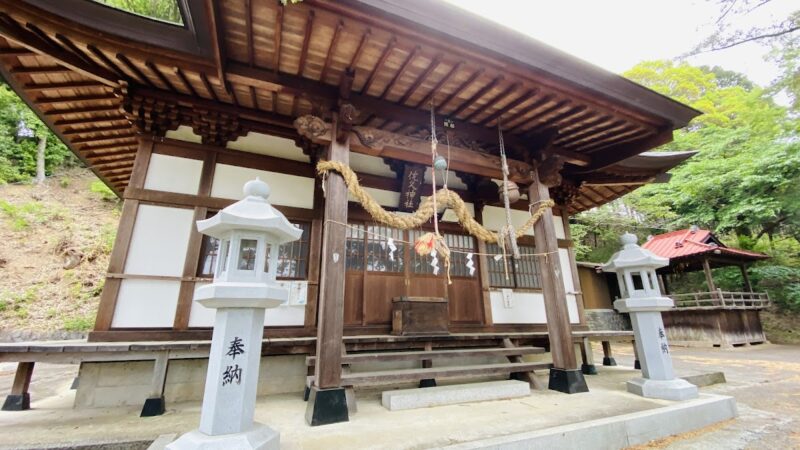
Main Hall, a Yamanashi Prefecture Designated Cultural Property
Reconstruction in 1793 and the Skill of Shimoyama Carpenters
The current main hall was rebuilt in 1793 by Tsuchibashi Bunzo Shigeyoshi, a Shimoyama carpenter. The Shimoyama carpenters were a group of temple and shrine carpenters based in the vicinity of Otsuki City and Koshu City in Yamanashi Prefecture, known as master craftsmen who worked on many temple and shrine buildings both within and outside the prefecture.
Tsuchibashi Bunzo Shigeyoshi was a particularly skilled master carpenter among the Shimoyama carpenters, and the Suwa Shrine main hall can be considered a masterpiece that embodies the pinnacle of their skills.
Architectural Style and Features
The main shrine’s architectural style has the following features:
Structure:
- One-bay, hip-and-gable roof
- Front with a chidori-hafu (gable with curved roof)
- Front with a karahafu (curved gable)
- Iron plate roofing (possibly originally cypress bark or persimmon bark)
Scale:
As a medium-sized shrine main hall, it exhibits a dignified presence befitting a center of local faith.
Exquisite Sculptural Decoration
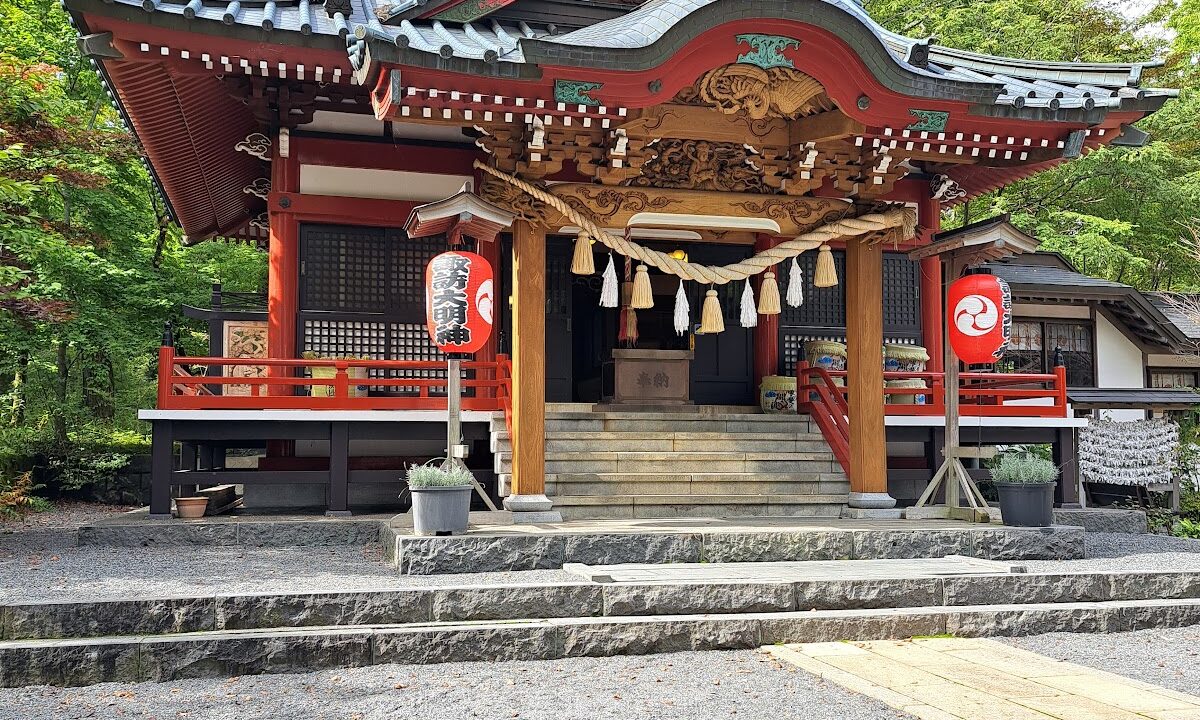
The main highlight of the main shrine is the exquisite carvings found throughout. The following carvings are particularly famous:
Main carving motifs:
- Ascending and Descending Dragons: The dragon carvings on the pillars and transoms of the main hall are full of dynamism and have a powerful presence, as if they could move at any moment.
- Birds and Animals: Various mythical and auspicious animals are depicted, expressing the sacredness of the shrine grounds.
- Flowers and Birds: Flowers and birds of the four seasons are delicately carved.
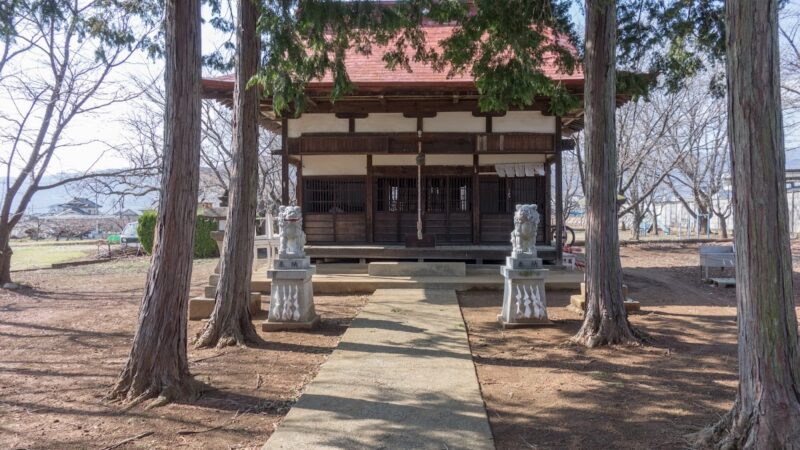
- Chinese Lions: Placed as guardian beasts to ward off evil spirits.
These carvings strongly retain the characteristics of decorative carving from the late Edo period and are designated as Yamanashi Prefecture Designated Cultural Properties, serving as valuable cultural assets that convey the high level of craftsmanship of the time.
The Onbashira Festival Held Every Seven Years
A Traditional Event Modeled After the Shinshu Suwa Grand Shrine
The largest festival event at Suwa Shrine is the Onbashira Festival, held every seven years (seven years by traditional Japanese age counting) in the Year of the Tiger and the Year of the Monkey. This festival is modeled after the Onbashira Festival of Suwa Grand Shrine in Shinshu, and is attracting attention as one of the few shrines outside Nagano Prefecture where a full-fledged Onbashira Festival is held.
Joint Grand Festival of Kami-Imasuwa and Shimo-Imasuwa
The Onbashira Festival is held jointly by the Suwa Shrine in Kami-Imasuwa and the Suwa Shrine in Shimo-Imasuwa. The parishioners of both districts cooperate from preparation to the festival itself, making it an important opportunity to deepen community bonds.
Details of the Onbashira Festival
Main Flow of the Onbashira Festival:
- Mountain Descent: Giant trees to be used as sacred pillars are cut down from the mountains and pulled to the shrine.
- Tree Dropping: A magnificent ritual in which the sacred pillars are pulled down steep slopes (scale varies depending on the terrain).
- Village Parade: The sacred pillars are pulled through the village.
- Erecting the Sacred Pillars: The sacred pillars are erected at the four corners of the shrine.
The Onbashira Festival is an important ritual that renews the sacred area and enhances the divine power of the shrine. For local residents, it is also a place for the transmission of traditional culture that is passed down through generations.
Recent Onbashira Festivals
Most recently, a grand Onbashira Festival was held in the Year of the Tiger, 2022 (Reiwa 4). Many parishioners and spectators participated, greatly contributing to the transmission of tradition and the revitalization of the region. The next festival is scheduled for the Year of the Monkey, 2028 (Reiwa 10).
Highlights of the Shrine Grounds
Five Subsidiary Shrines
One of the distinguishing features of Suwa Shrine, similar to Shinshu Suwa Grand Shrine, is the presence of five subsidiary shrines. These subsidiary shrines also attract local devotion, each possessing its own unique divine virtues.
The existence of these subsidiary shrines indicates that this shrine is not merely a small local shrine, but a prestigious shrine that traces its lineage back to the legitimate Suwa faith.
Sacred Tree
A sacred tree, estimated to be several hundred years old, stands tall within the shrine grounds. This sacred tree is a living witness that has watched over the history of the shrine, and its majestic presence deeply impresses visitors.
Shrine Building Layout
The shrine grounds follow the traditional layout of shrine architecture, with the approach, torii gate, worship hall, offering hall, and main shrine arranged in a straight line. Surrounded by abundant nature, visitors can enjoy the beauty of the four seasons.
Annual Events and Festivals
Main Annual Events
Suwa Shrine holds various festivals and events throughout the year:
Spring Grand Festival
- Time: Spring (around April)
- Content: A festival to pray for a bountiful harvest
Summer Purification Ceremony
- Time: June 30th
- Content: A ceremony to purify oneself of the impurities accumulated over the past six months and pray for good health and well-being for the remaining half of the year
Autumn Grand Festival
- Time: Autumn (around September-October)
- Content: A festival to express gratitude for the harvest, including a portable shrine procession
Year-End Purification Ceremony
- Time: December 31st
- Content: A ceremony to purify oneself of the impurities accumulated over the past year and prepare to welcome the new year with a pure mind and body
First Shrine Visit of the Year
- Time: January 1st-3rd
- Content: New Year’s visit to the shrine; many parishioners and local residents come to worship.
Onbashira Festival (Held every seven years)
As mentioned above, the most important festival is the Onbashira Festival, held every seven years in the Year of the Tiger and the Year of the Monkey.
Visiting Information
Basic Information
Name: Suwa Shrine
Location: Kami-Imasuwa, Yamanashi City, Yamanashi Prefecture
Deity: Takeminakata-no-Mikoto
Shrine Rank: Former Village Shrine
Visiting Hours: Grounds are freely accessible (Shrine office may be unattended)
Admission Fee: Free
Access
Access by Train:
- Approximately 15 minutes by car from JR Chuo Main Line “Yamanashi-shi Station”
- Approximately 10 minutes by car from JR Chuo Main Line “Kasugai-cho Station”
Access by Car:
- Approximately 20 minutes from Chuo Expressway “Ichinomiya-Misaka IC”
- Approximately 15 minutes from Chuo Expressway “Katsunuma IC”
Parking:
- Limited parking space available on the grounds or nearby (limited number of spaces)
- Temporary parking may be available during festivals
Etiquette for Visiting Shrines
Please observe basic shrine etiquette when visiting a shrine:
- Bow before the torii gate: A greeting before entering the sacred area
- Walk along the edge of the path: The center is the path for the gods
- Purify yourself at the water basin: Left hand → Right hand → Mouth → Handle of the ladle in the left hand
- Two bows, two claps, one bow: Basic worship etiquette at the main hall
Nearby Tourist Attractions
Historical and Cultural Facilities in Yamanashi City
Nezu Memorial Museum
- Approximately 10 minutes by car from Suwa Shrine
- A memorial museum for Kaichiro Nezu, known as the “Railway King”
Manriki Park
- Approximately 15 minutes by car from Suwa Shrine
- A public park known for its cherry blossoms
Fuefukigawa Fruit Park
- Approximately 20 minutes by car from Suwa Shrine
- A complex facility where you can enjoy orchards and night views
Nearby Shrines and Temples
Suwa Shrine in Shimo-Imasuwa
- Sister shrine that jointly holds the Onbashira Festival
- Approximately 5 minutes by car from Kami-Imasuwa
Kubo Hachiman Shrine
- An ancient shrine in Yamanashi City
- A shrine associated with the Takeda clan
Yamanashi City’s Local Products
Yamanashi City is a region where fruit cultivation is thriving:
- Peaches: Harvested from spring to summer, popular for their high sugar content
- Grapes: Many varieties including Kyoho, Pione, and Shine Muscat
- Wine: Wineries using locally grown grapes are scattered throughout the area
When visiting the shrines, you can also enjoy seasonal fruit picking and winery tours.
Suwa Faith and Yamanashi Prefecture
Suwa Shrines in Yamanashi Prefecture
Yamanashi Prefecture has 127 Suwa Shrines, boasting the second-highest number of Suwa Shrines after Nagano Prefecture. This indicates that Kai Province bordered Shinano Province and that cultural and economic exchanges between the two provinces flourished from ancient times.
The Takeda Clan and Suwa Faith
The Takeda clan, who ruled Kai Province during the Sengoku period, had marital ties with the Suwa clan and therefore placed great importance on Suwa faith. Before Takeda Shingen’s principal wife, Lady Sanjo, there was Suwa Goryōnin (from the Suwa clan), and their son was Takeda Katsuyori, who would become his successor.
Due to this historical background, many Suwa shrines were established in Yamanashi Prefecture, attracting local devotion.
Characteristics of Suwa Faith
Suwa faith has the following characteristics:
- Onbashira Festival: A grand festival held every seven years to renew the sacred grounds
- Character as a Hunting God: Worship as a mountain god and hunting god
- Worship as a War God: Revered by the samurai class
- Aspect of Agricultural God: Prayers for a bountiful harvest
- God of Wind and Water: Worship as a god who governs natural phenomena
Visitor Voices
A Shrine Where You Can Feel History and Tradition
Visitors have shared the following comments:
- “The carvings on the main hall are wonderful; I was impressed by the craftsmanship of Edo-period artisans.”
- “Visiting during the Onbashira Festival, I felt the power of the region’s traditional culture.”
- “My mind was at peace in the quiet grounds, and my daily fatigue was healed.”
- “I felt that this shrine is cherished by the local people.”
The Power of the Onbashira Festival
From those who experienced the Onbashira Festival, held every seven years:
- Many people have commented: “I was deeply moved by the faithful, albeit small-scale, recreation of the Onbashira Festival of Suwa Grand Shrine in Nagano.”
- “I was touched by the unity of the local people and their commitment to preserving tradition.”
- “I definitely want to come and see the next Onbashira Festival.”
The Cultural Value of Suwa Shrine
Yamanashi Prefecture Designated Cultural Property
The main hall of Suwa Shrine has been recognized for the value of its architectural style and carvings, and is a Yamanashi Prefecture Designated Cultural Property. It retains many characteristics of late Edo period shrine and temple architecture and is highly regarded academically as a valuable building that conveys the techniques of Shimoyama carpenters.
Preservation and Inheritance
Regular restoration and preservation work is carried out to pass on its value as a cultural property to future generations. Parishioners, local residents, and the government cooperate to protect this valuable cultural heritage.
The Place Name “Kami-Imasuwa” in Yamanashi City
The place name “Kami-Imasuwa” itself tells of the deep connection between this region and Shinshu Suwa. The place name “Ima-Suwa” means “present-day Suwa,” referring to the shrine that was invited from Suwa. The division into “Kami” (upper) and “Shimo” (lower) is thought to correspond to the division of the Suwa Grand Shrine in Shinshu (Nagano Prefecture) into an upper and lower shrine.
The fact that a shrine’s name remains in a place name indicates that the shrine was not merely a religious facility for the region, but a core element of its regional identity.
Summary: A Historic Shrine Worth Visiting
The Suwa Shrine in Kami-Ima-Suwa, Yamanashi City, Yamanashi Prefecture, has deep historical ties to the Suwa Grand Shrine in Shinshu and is a valuable historical site as one of the oldest Suwa Shrines outside of Nagano Prefecture.
The Charms of Suwa Shrine:
- Onbashira Festival Held Every Seven Years: A traditional grand festival held in the Year of the Tiger and the Year of the Monkey.
- Main Hall, a Prefectural Designated Cultural Property: Exquisite carvings by Shimoyama carpenters.
- Five Subsidiary Shrines: A dignified arrangement modeled after Suwa Grand Shrine.
- Center of Local Faith: A shrine cherished by its parishioners.
- Rich Natural Environment: Shrine grounds where you can enjoy the beauty of each season.
When visiting Yamanashi Prefecture, be sure to visit this historic Suwa Shrine and experience the traditions of Suwa faith, which originated in Shinshu, the excellent architectural techniques of the Edo period, and the deeply rooted faith of the region. Especially during the Onbashira Festival, it’s an excellent opportunity to witness a rare traditional event unique to this region.
In the tranquil grounds, you can offer your prayers, gaze upon the sacred tree with centuries of history, and admire the craftsmanship in the intricate carvings—a visit to Suwa Shrine will be a memorable experience that allows you to deeply feel Japan’s traditional culture and the history of the region.