Complete Guide to Raijin Shrines | A Thorough Explanation of the History, Deities, Blessings, and Visiting Information of Raijin Shrines Nationwide
Raijin shrines are a general term for shrines throughout Japan that enshrine the god of thunder. Since ancient times, thunder has been considered a symbol of heavenly power, and has been revered as a god that brings rain essential for agriculture and as a god that protects people from disasters. This article provides a comprehensive introduction to major Raijin shrines throughout Japan, from their historical background to their current state.
What are Raijin Shrines? | The Origin and Significance of Raijin Worship
Raijin shrines are shrines that enshrine the god of thunder as their principal deity. In Japanese Shinto, thunder symbolizes heavenly power and was particularly important in agricultural societies. Because the rain that falls with thunder brings water essential for rice cultivation, the god of thunder has been worshipped as a god of abundant harvests.
Historical Background of Raijin Worship
The worship of the god of thunder in Japan has existed since ancient times. The Nihon Shoki and Kojiki also contain descriptions of the thunder god, and Honoi-ikazuchi-no-kami appears as a god born from Izanami-no-mikoto. This Honoi-ikazuchi-no-kami is enshrined as the principal deity in many thunder shrines.
During the Heian period, Sugawara no Michizane became associated with the thunder god and was revered as “Hono-ikazuchi-tenjin” (Hono-ikazuchi Heavenly God). This stems from the fact that after Michizane’s death, a series of lightning strikes and other anomalies occurred in Kyoto, leading to his enshrinement as a heavenly deity to appease his vengeful spirit.
Benefits of the Thunder God
The gods enshrined in thunder shrines are believed to offer the following benefits:
- Abundant Harvest and Agricultural Prosperity: Prayers for a bountiful harvest as the god who brings rain.
- Protection from Weather Disasters: Protection from lightning strikes and thunderstorms.
- Protection from Evil and Misfortune: Driving away evil spirits with the power of heaven.
- Business Prosperity: Drawing on the power of thunder.
- Academic Success: In the case of shrines associated with Sugawara no Michizane.
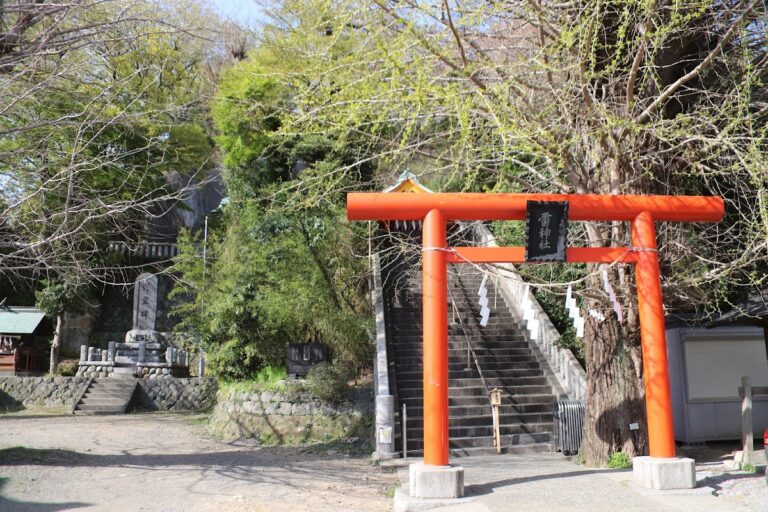
Raijin Shrine in Yokosuka City | A Representative Ancient Shrine of Kanagawa Prefecture
Located in Oppama, Yokosuka City, Kanagawa Prefecture, Raijin Shrine is a historical shrine said to have been founded in the first year of the Shohei era (931).
Origin and History
Yokosuka’s Raijin Shrine is said to have been founded in the first year of the Shohei era (931) during the reign of Emperor Suzaku. At that time, this area was called Shiohama, Naewari, or Tsukijima, and the sea extended to the riverbank in what is now Oppama-cho 3-chome.
On June 15, 1559 (Eiroku 2), lightning struck Tsukijima, and twelve young women who were there were in peril. Legend says that a large juniper tree took the brunt of the strike, saving their lives. This incident is an important episode in the history of the Raiden Shrine.
In 1581 (Tensho 9), Asakura Notonokami, the lord of Urago Village (Uranosato Village) at the time, moved the shrine from Tsukijima to its current location and re-established it as the Raiden Shrine. According to the “Shinpen Sagami no Kuni Fudoki Ko” (New Compilation of the Topography of Sagami Province), compiled in the late Edo period, it was also recorded as “Raiden-sha” or “Raiden Daimyojin” at that time.
Deity and Beliefs
The deity enshrined at Yokosuka’s Raijin Shrine is Honoikazuchi-no-Mikoto. Honoiikazuchi-no-Mikoto is said to be a god born when Izanami-no-Mikoto gave birth to the god of fire, and is known as a powerful deity who controls the power of thunder and fire.
Records show that the shrine has long been a place for “rain-making” rituals, and was an important site for religious ceremonies supporting local agriculture.
Sacred Ginkgo Tree
Within the shrine grounds stands a sacred ginkgo tree, said to be over 400 years old. This ginkgo tree is revered as a symbol of protection against weather-related disasters, and displays magnificent yellow foliage in autumn. The ginkgo tree is a symbolic presence of Raijin Shrine and is beloved by many visitors.
Regular Festivals and Annual Events
Yokosuka’s Raijin Shrine holds various festivals and events throughout the year.
- Spring Festival: A grand spring festival praying for a bountiful harvest.
- Autumn Festival: A grand autumn festival giving thanks for the harvest.
- Annual Grand Festival: The shrine’s most important festival.
- Monthly Festival: A regular festival held every month.
Through these festivals, the shrine maintains strong ties with the local community.
Access and Visiting Information
Address: 3-13 Oppama-cho, Yokosuka City, Kanagawa Prefecture
Transportation Access:
- Approximately 10 minutes on foot from Oppama Station on the Keikyu Main Line
- Approximately 15 minutes on foot from Taura Station on the Yokosuka Line
Visiting Hours: Grounds are freely accessible (Shrine office has time restrictions)
Parking: Limited parking available
Raijin Shrine in Itoshima City, Fukuoka Prefecture | An Ancient Shrine Located on the Slopes of Mt. Raizan
Raijin Shrine in Itoshima City, Fukuoka Prefecture, consists of the Upper Shrine, located at the 7th station of Mt. Raizan, and the Lower Shrine, which was located within the grounds of Sennyoji Daihioin Temple.
Relationship between Mt. Raizan and Raijin Shrine
Mt. Raizan is a mountain with an elevation of 955 meters and has been worshipped since ancient times as the “mountain where the thunder god resides.” The mountain’s name itself reflects the worship of the thunder god, and it was a center of thunder god worship in this region.
The upper shrine, also known as Sozogi Shrine, possesses a unique form of worship that blends mountain worship and thunder god worship. The lower shrine, known as Kasaori Shrine, was located in a more easily accessible place for worshippers.
Kannon Cedar and Giant Ginkgo
At Itoshima’s Raijin Shrine, there is a giant cedar tree called “Kannon Cedar” and a magnificent giant ginkgo tree. These giant trees are revered as living witnesses to the shrine’s long history and as sacred trees.
The giant ginkgo tree, in particular, turns a magnificent golden color in autumn, making it a popular spot for worshippers and tourists.
Visiting Information
Location: 148 Raizan, Itoshima City, Fukuoka Prefecture
Access: Use the hiking trail to Raizan. Access by car is possible, but caution is advised as it is a mountain road.
Raijin Shrine in Asahi City, Chiba Prefecture | Raijin Worship in the Boso Region
A Raijin Shrine is located in Asahi City, Chiba Prefecture, and serves as a center of Raijin worship in the Boso region.
Role in the Region
The Boso Peninsula faces the Pacific Ocean and is known for frequent thunderstorms. Raijin Shrine in Asahi City has been cherished by local residents as a place to pray for protection from lightning strikes and for agricultural prosperity in these weather conditions.
Visiting Information
Details about Raijin Shrine in Asahi City can be found on local tourism information websites.
Raijin Shrine in Nagareyama City, Chiba Prefecture | Hiregasaki Obisha Festival
Raijin Shrine, located in the Hiregasaki district of Nagareyama City, Chiba Prefecture, is a former village shrine rebuilt in 1708 (Hoei 5). While the exact founding date is unknown, it is known as a shrine with a long history.
History and Origin
In 1873 (Meiji 6), six shrines were merged, resulting in its current form. The enshrined deity is Ōikazuchi-no-kami. Despite being located in a residential area, the shrine features a uniquely shaped building compared to other shrines in Nagareyama City.
Hiregasaki Obisha Festival
Every year on the third Sunday of January, the “Hiregasaki Obisha Festival,” which is said to have continued since the Edo period (1716-1736), takes place. This festival is designated as a Nagareyama City Intangible Folk Cultural Property and is passed down as an important regional tradition.
“Obisha” refers to a festival centered around target archery (matoi), praying for a bountiful harvest and the safety of the village. The Hiregasaki Obisha has a history of approximately 300 years and plays an important role in strengthening the bonds of the local community.
Access Information
Location: Hiregasaki, Nagareyama City, Chiba Prefecture
Transportation Access: Within walking distance from Heiwadai Station on the Nagareyama Electric Railway
Raijin Shrine in Rifu Town, Miyagi Prefecture | Raijin Worship in the Tohoku Region
The Raijin Shrine, located in the Hongō district of Rifu Town, Miyagi Prefecture, is a shrine that has attracted local faith since ancient times.
History and Rain-Praying Legend
The exact date of its founding and the circumstances of its establishment are unclear, but it has long been enshrined in the Hongō district as the Raijin Shrine.
A legend remains that on August 25th, 1559 (Eiroku 2) during the Muromachi period, when a drought continued in the district, the parishioners prayed for rain at the Raijin Shrine, and rain poured down, reviving all things. It is said that the local people, moved by this divine power, renovated the shrine, and it has been deeply revered in the region as a god of rain.
Characteristics of Thunder God Worship in Tohoku
In the Tohoku region, agriculture faced challenges due to harsh weather conditions such as cold damage and drought. Thunder god shrines were particularly important as gods who brought moderate rain and bountiful harvests.
Common Characteristics of Thunder God Shrines Nationwide
Thunder god shrines throughout Japan share several common characteristics.
The Presence of Sacred Trees
Many thunder god shrines have large trees, some hundreds of years old, as sacred trees. Ginkgo, cedar, and juniper trees are particularly common. These large trees often have legends of “substitutes” that protected people from lightning strikes, and are closely linked to the history of the shrine.
Legends of Lightning Strikes
Many thunder god shrines have legends related to lightning strikes. Stories linking the natural phenomenon of lightning strikes with divine protection, such as the legend of the twelve maidens and the giant cypress tree at the Raijin Shrine in Yokosuka, form the basis of this faith.
Deep Connection to Agriculture
Many Raijin Shrines are located in agricultural areas and have functioned as places of prayer for bountiful harvests and rain. Spring and autumn festivals are held to coincide with key agricultural milestones, praying for the safety and prosperity of local agriculture.
Faith for Protection from Weather Disasters
There is a belief that worshipping the thunder god paradoxically protects one from weather disasters such as lightning strikes. This is similar to the idea of “fighting fire with fire,” the idea that by revering the god who possesses the power of lightning, one can avoid such calamities.
How to Visit and Manners at Raijin Shrines
Here are some basic manners to observe when visiting a Raijin Shrine.
Basic Etiquette for Worship
- Bow before passing through the torii gate: This is a sign of respect before entering the sacred area.
- Purify yourself at the water basin: Purify your left hand, then your right hand, then your mouth.
- Walk along the edge of the path: The center is considered the path of the gods.
- Etiquette in front of the main hall: Two bows, two claps, and one bow are the basics.
- Respect for the sacred tree: Touch it with respect.
Meaning of Offerings
Offerings express gratitude to the gods. The sentiment is more important than the amount. Quietly place your offering in the offering box and express your gratitude, not your wishes.
About Goshuin (Shrine Seals)
Many Raijin shrines offer Goshuin. Goshuin are proof of your visit and a tangible record of your connection with the gods. It’s a good idea to check the shrine office’s opening hours in advance.
Relationship between Raijin Shrine and Other Shrines
Relationship with Tenjin Shrines
Some Tenjin shrines (Tenmangu shrines) dedicated to Sugawara no Michizane are associated with thunder god worship, known as “Kaminari Tenjin.” The history of Raijin Shrine in Yokosuka also mentions a relationship with Kitano Tenjin, demonstrating a fusion of thunder god worship and Tenjin worship.
Relationship with Water Gods and Dragon Gods
Since thunder brings rain, it is sometimes associated with water gods and dragon gods. In some areas, Raijin Shrines and Water Gods are enshrined close together, demonstrating the complexity of water-related beliefs.
Relationship with Hamasora Shrine
Hamasora Shrine is enshrined as a subsidiary shrine within the grounds of Raijin Shrine in Yokosuka. Hamasora Shrine reflects the unique beliefs of this region and is revered as a god of the sea and sky (heaven).
Significance of Raijin Shrine in Modern Times
Center of the Local Community
Even in modern times, Raijin Shrine remains a central presence in the local community. Through spring and autumn festivals and other annual events, these shrines serve as places where local residents gather and deepen their bonds.
Value as a Cultural Asset
Many Raijin shrines possess cultural value in their shrine architecture, sacred trees, and festival rituals. Some, like the Hiregasaki Obisha Festival in Nagareyama City, are designated as Intangible Folk Cultural Properties, playing an important role in conveying the history and culture of the region.
Utilization as a Tourism Resource
Like the Raijin Shrine in Itoshima, its beautiful sacred trees and location linked to mountain worship have attracted attention as a tourism resource. Its space, where historical value and natural beauty merge, draws many visitors.
Challenges in the Preservation and Transmission of Raijin Shrines
Maintenance and Management of Shrine Buildings
Many Raijin shrines face the challenge of renovating aging shrine buildings. Even at the Raijin Shrine in Yokosuka, a major renovation of the main shrine’s roof is planned, demonstrating the significant costs and effort required to maintain historical structures.
Decline in Parishioners and Countermeasures
Due to depopulation and urbanization, the traditional parishioner system is changing. However, many shrines continue their efforts to maintain and pass on their traditions through support from worshippers beyond their local area and public support from the perspective of cultural property preservation.
Passing on Festival Rituals
Passing on festival rituals to younger generations is also an important issue. To pass on traditional events such as the Hiregasaki Obisha ritual to the next generation, efforts are being made in various places, including collaboration with school education and the creation of documentary videos.
Best Season for Visiting Raijin Shrine
Spring (March-May)
This is the time of the spring festival, a season of beautiful fresh greenery. There are also opportunities to participate in festivals celebrating the start of agricultural work.
Autumn (September-November)
The autumn festival coincides with the autumn foliage season, and the time when the sacred ginkgo tree turns golden is particularly magnificent. You can experience the atmosphere of festivals offering gratitude for the harvest.
The Dates of the Annual Festivals
Checking the dates of each shrine’s annual festivals before visiting allows you to experience a special atmosphere different from the usual. You may also witness portable shrine processions and dedication ceremonies.
Summary | The Charm and Significance of Visiting Raijin Shrines
Raijin shrines are historical shrines located throughout Japan, deeply intertwined with the climate, culture, and history of each region. While Raijin shrines in Yokosuka, Itoshima, Nagareyama, Rifu, and other locations all enshrine the thunder god, each possesses its own unique history and characteristics.
Reverence for the natural phenomenon of lightning, gratitude for rain essential for agriculture, and a desire for protection from weather-related disasters—these sentiments have supported the worship of the thunder god for over a thousand years. Even today, Raijin shrines continue to play an important role as centers of local communities and as cultural assets.
When visiting a Raijin shrine, quietly offer your prayers while reflecting on its long history and the depth of faith of the local people. Looking up at the sacred ginkgo and juniper trees, you can feel the weight of the faith that has been preserved for hundreds of years.
Throughout Japan, each Raijin Shrine is a treasure of its region and a valuable presence that conveys Japan’s spiritual culture. If you have the opportunity, please visit a Raijin Shrine near you.