Toyoji Temple (Obuchi, Konan-ku, Niigata City, Niigata Prefecture) | Detailed Guide to a Soto Zen Temple
Located in Obuchi, Konan-ku, Niigata City, Toyoji Temple is a historic temple belonging to the Soto Zen sect. Rooted in the area known as Kameda-go, it has long been a cherished center of faith for local residents. This article provides detailed information useful for those considering visiting Toyoji Temple or searching for a burial plot, including its history, temple grounds, access methods, and cemetery information.
Basic Information on Toyoji Temple
Temple Name: Toyoji Temple
Sect: Soto Zen
Address: 998 Obuchi, Konan-ku, Niigata City, Niigata Prefecture
Phone Number: Please contact the temple directly for inquiries
Access: Approximately 10 minutes by car from JR Shin’etsu Main Line “Kameda Station”
Toyoji Temple is located in the Obuchi area of Konan-ku, Niigata City, surrounded by a rich natural rural landscape. Niigata City’s Konan Ward, formerly known as Kameda-go, is a historical area that developed as a rural town with a six-day market from the Edo period onward.
About the Soto Zen School
The Soto Zen school, to which Toyoji Temple belongs, is a branch of Zen Buddhism introduced to Japan by Zen Master Dogen during the Kamakura period. It is characterized by its emphasis on seated meditation (zazen) called “shikan taza” and is one of the largest Buddhist sects in Japan, with approximately 15,000 temples nationwide.
The two main temples of the Soto Zen school are Eiheiji Temple in Fukui Prefecture and Sojiji Temple in Kanagawa Prefecture, collectively known as the “Two Great Main Temples.” The teachings of the Soto Zen school are based on the concept of “shusho itto” (the unity of practice and enlightenment), which holds the belief that practice itself is enlightenment.
Characteristics of Soto Zen Temples
Soto Zen temples exhibit the following characteristics:
- Zazen-do: A building or space dedicated to Zen meditation practiced by trainee monks.
- Kaisan-do: A hall enshrining the memorial tablet of the temple’s founder.
- Hatto: The central building where religious services and sermons are held.
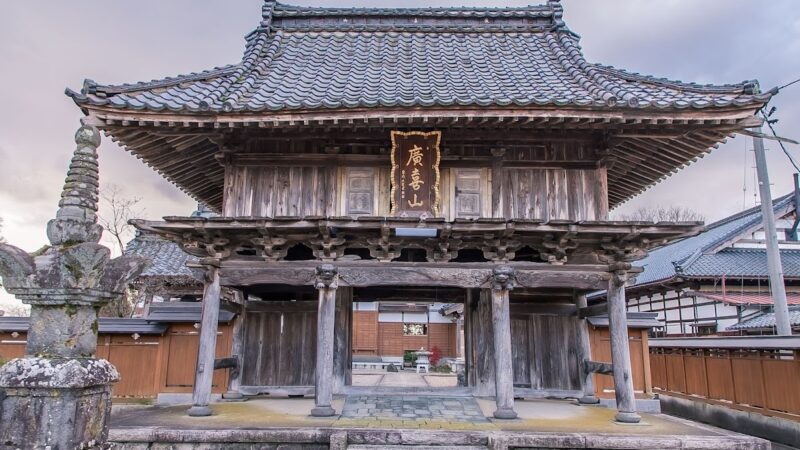
- Sanmon: The gate that serves as the entrance to the temple, marking the boundary between the secular world and the sacred realm.
History and Regional Characteristics of Konan Ward, Niigata City
Konan Ward in Niigata City is one of the administrative districts established in 2007 when the city became a designated city. The area mainly consists of the Kameda-go region, centered around the former Kameda Town.
History of Kameda-go
Kameda-go is a low-lying wetland area sandwiched between the Shinano River and the Agano River, with a long history of battling floods. During the Edo period, it flourished as a castle town of the Kameda Domain, developing into a commercial center with a six-day market. Since the Meiji era, the area has developed as an agricultural region due to the development of drainage pumping stations, and currently functions as a commuter town for Niigata City.
Temple Culture in Konan Ward
Many temples, including Toyoji Temple, are scattered throughout Konan Ward, Niigata City. Major temples include:
- Joganji: A Jodo Shinshu Buddhist temple
- Shinkoji: A temple that attracts the faith of the local community
- Seiyo-ji: One of the historically significant temples
- Eikaku-ji: A representative temple of Konan Ward
- Entsuji: A temple beloved by local residents
- Honkoji: A Nichiren Buddhist temple located in the Obuchi district
These temples, while belonging to different sects, play an important role in supporting the spiritual culture of the region.
History and Origin of Toyoji Temple
Detailed records of Toyoji Temple’s founding date and its founder are limited, but it is a Soto Zen temple with a history deeply rooted in the community. The Obuchi area has long been a thriving agricultural region, and Toyoji Temple has functioned as a family temple and spiritual support for the local residents.
Meaning of the Temple Name
The name “Toyo” means the sun rising from the east, symbolizing light and hope in Buddhism. Many Soto Zen temples have temple names with such auspicious meanings.
Highlights of the Temple Grounds
Toyoji Temple’s grounds are situated in a tranquil environment surrounded by nature. It is a place where one can experience the changing seasons within the unique climate and landscape of Niigata Prefecture.
Main Hall
The main hall is the central building of the temple, where the principal image is enshrined. While Shakyamuni Buddha is generally the principal image of Soto Zen temples, it may vary depending on the temple. It is an important space where memorial services, funerals, and other religious ceremonies are held.
Cemetery
Toyoji Temple has an attached temple cemetery, which is used by parishioners and local residents. For those seeking a cemetery in Konan Ward, Niigata City, this is one option.
Seasonal Scenery
Niigata Prefecture is known as one of Japan’s leading heavy snowfall areas, and the temple grounds are covered in snow during winter. You can enjoy the beauty of each season: cherry blossoms and fresh greenery in spring, lush trees in summer, and autumn leaves in fall. The nature of the temple grounds, which changes its appearance with the weather, provides peace to visitors.
Access
Access to Toyoji Temple is primarily by car.
Access by Car
- From Niigata Station: Approximately 20 minutes via National Route 49
- From Niigata Chuo IC: Approximately 15 minutes from the Ban-etsu Expressway Niigata Chuo IC
- From Kameda Station: Approximately 10 minutes by car from JR Shin-etsu Main Line Kameda Station
Parking is available for visitors and those paying respects at the graves; please contact the temple directly for details.
Access by Public Transportation
If using public transportation, the nearest station is Kameda Station on the JR Shin’etsu Main Line. From the station, you will need to take a taxi or bus. For the latest information on public transportation in Konan Ward, Niigata City, we recommend checking the ward’s official website.
Cemetery and Burial Ground Information
Toyoji Temple offers burial plots as a temple cemetery. It is an important option for those looking for a cemetery or burial ground in or around Konan Ward, Niigata City.
Advantages of Temple Cemeteries
Temple cemeteries offer the following advantages:
- Permanent Management: As long as the temple exists, the cemetery will continue to be managed.
- Religious Security: You can receive memorial services and Buddhist rituals performed by monks.
- Community: Connections are formed with other parishioners of the same sect.
- Access: Convenient location rooted in the local community makes it easy to visit the graves.
Points to Consider When Choosing a Cemetery
When choosing a cemetery, it is important to check the following points:
- Sect: Is becoming a parishioner of the Soto Zen sect a requirement?
- Cost: Total cost including perpetual use fee, management fee, and tombstone cost.
- Plot Size: Size appropriate for the number of family members and future plans.
- Management Status: Is the temple grounds and cemetery well-maintained and clean?
- Access: Is the location easily accessible for family visits?
- Perpetual Memorial Service: Is perpetual memorial service available in case there are no successors?
The Process of Building a Grave
When acquiring a burial plot at Toyoji Temple, the general process is as follows:
- Inquiry to the Temple: Confirmation of burial plot availability and conditions
- Site Visit: A visit to the temple grounds and cemetery
- Contract: Contract for perpetual use rights and payment of usage fees
- Tombstone Selection: Consult with a stonemason to decide on the tombstone design
- Construction: Installation of the tombstone
- Consecration Ceremony: A memorial service to imbue the tombstone with a spirit
About Grave Closure
In recent years, due to the declining birthrate, aging population, and population concentration in urban areas, the maintenance of burial plots has become increasingly difficult. Toyoji Temple may also accept consultations regarding grave closure (grave relocation) and reburial.
When considering closing a grave:
- Consultation with relatives: Discuss thoroughly with family and relatives.
- Consultation with the temple: Confirm the disaffiliation fee and procedures.
- Administrative procedures: Obtain a reburial permit.
- Relocation site for remains: Select a permanent memorial grave or columbarium.
Regarding memorial services and rites
Toyoji Temple conducts various memorial services and rites in accordance with the customs of the Soto Zen sect.
Main Memorial Services
- Funeral: A ceremony to send off the deceased
- First Seven Days: A memorial service held on the seventh day after death
- Forty-Ninth Day: An important memorial service marking the end of the mourning period
- First and Third Anniversary: Annual memorial services
- Obon: A ceremony to welcome the spirits of ancestors
- Ohigan: Memorial services held during the spring and autumn equinoxes
Perpetual Memorial Services
An increasing number of temples are offering perpetual memorial services for those without successors or those concerned about future grave maintenance. It may be possible to inquire about perpetual memorial services at Toyoji Temple; please contact them directly for details.
Comparison with Temples in the Konan Ward Area of Niigata City
In addition to Toyoji Temple, there are many other temples in the Konan Ward of Niigata City, each with its own unique characteristics. When searching for a cemetery plot, it is recommended to compare and consider multiple temples.
Temples by Sect
There are temples of various sects in Konan Ward, Niigata City:
- Soto Zen: Toyoji Temple, etc.
- Jodo Shinshu: Joganji Temple, etc.
- Nichiren Buddhism: Honkoji Temple, etc.
- Shingon Buddhism: Multiple temples in the area
- Jodo Buddhism: Temples of the Jodo sect
Points to Consider When Choosing a Temple
When choosing a temple, you should consider the following points:
- Sect: The sect of your ancestors or your own faith
- Location: Ease of access from your home
- Atmosphere: The atmosphere and cleanliness of the temple grounds
- Personality of the Chief Priest: Whether the chief priest is easy to talk to
- Danka System: Obligations and fees as a danka
- Word of Mouth: Local reputation and the voices of actual users
Manners and Etiquette for Visiting a Temple
When visiting Toyoji Temple, please observe basic temple etiquette.
Basic Manners for Visiting a Temple
- Attire: Dress neatly and appropriately.
- Temple Gate: Bow before entering the temple grounds.
- Water Basin: If there is a water basin, cleanse your hands and mouth.
- Main Hall: Quietly join your hands in prayer and pray with sincerity.
- Photography: Take photographs sparingly on the temple grounds; permission may be required.
- Private Conversation: Avoid loud conversations.
Soto Zen Etiquette
The Soto Zen sect has the following etiquette:
- Gassho: Join both hands in front of your chest.
- Worship: Bow deeply.
- Incense Offering: Press the powdered incense to your forehead before placing it in the incense burner (usually once).
Connection with the Community
Toyoji Temple, as a temple in the Obuchi district, has deep ties with the local community.
Participation in Local Events
Many temples participate in local festivals and events, functioning as members of the local community. Toyoji Temple may also be involved in local traditional events and cultural activities.
The Danka System
Many temples in Japan are supported by the Danka system. By becoming a Danka, one receives support from the temple during funerals and memorial services, and contributes to the maintenance and operation of the temple.
Other Toyoji Temples in Niigata Prefecture
There are several temples named “Toyoji” in Niigata Prefecture. In particular, there is a Toyoji Temple in Agano City, which is also known as a historical temple. When searching for a temple, it is important to confirm the exact location.
Toyoji Temples Nationwide
The temple name “Toyoji” can be found throughout Japan, each with its own unique history and characteristics. When visiting Toyoji Temple in Konan Ward, Niigata City, please confirm the address (998 Obuchi, Konan Ward, Niigata City).
Nearby Tourist Attractions and Facilities
There are places around Toyoji Temple where you can experience the charm of Konan Ward, Niigata City.
Major Facilities in Konan-gu
- Kameda Station Area: The heart of the area with many commercial facilities and restaurants
- Konan-gu Office: The base for administrative services
- Konan-gu Cultural Center: A facility where cultural events are held
- Kameda Park: A park where you can enjoy nature
Nearby Temples and Shrines
There are other temples such as Honkoji Temple in the vicinity of the Obuchi area, so you can enjoy visiting temples and shrines.
Inquiries about Toyoji Temple
If you would like to know more about Toyoji Temple, or if you would like to consult about cemeteries or memorial services, please contact the temple directly.
Preparation Before Inquiry
When contacting a temple, it’s helpful to organize the following points beforehand:
- Purpose: Searching for a burial plot, requesting a memorial service, visiting, etc.
- Desired Conditions: Budget, timing, scale, etc.
- Questions: List what you want to ask in advance.
Points to Note During Visit
For first-time visits:
- Prior Contact: If possible, contact by phone in advance.
- Time of Day: A reasonable time from morning to evening.
- Attire: Clean and subdued clothing.
- Attitude: Polite and courteous.
Summary
Toyoji Temple, located in Obuchi, Konan-ku, Niigata City, is a Soto Zen temple with a long history rooted in the local community. It is a beloved place for local residents to quietly visit and pay respects at gravesites in a rich natural environment.
If you are looking for a cemetery or burial ground in Konan Ward, Niigata City, or if you are seeking a Soto Zen temple, or if you would like to learn more about Toyoji Temple, please visit us. Visiting the temple grounds in person will allow you to experience its atmosphere and location firsthand, leading to a better decision.
Choosing a temple is one of the most important decisions in life. We recommend comparing several temples, discussing it thoroughly with your family, and making a choice you are comfortable with. We hope that Toyoji Temple will become a place of solace for you and be used for many years to come as a place for honoring your ancestors.
The grounds of Toyoji Temple, which show different expressions depending on the weather and season, offer peace and healing to visitors. Spending time quietly praying while experiencing Niigata Prefecture’s rich nature and historical temple culture will be a precious moment in today’s busy life.