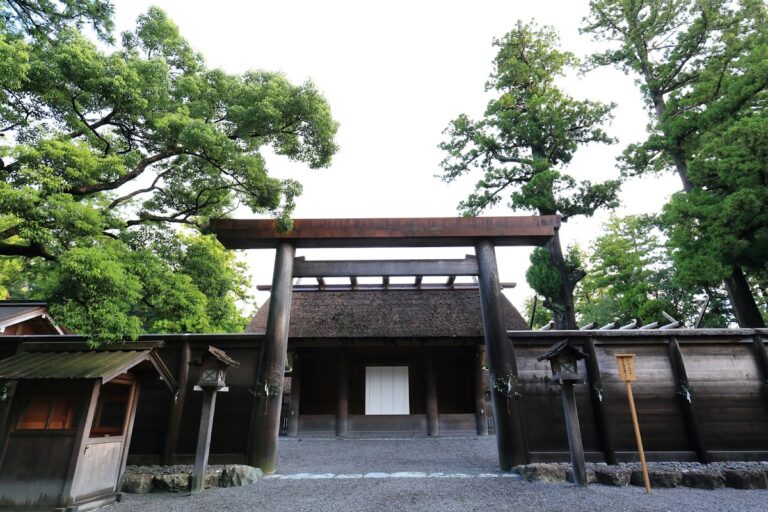
About Tsukiyomi-no-Miya
Tsukiyomi-no-Miya is a sub-shrine of the Outer Shrine (Toyouke Daijingu) of Ise Grand Shrine, and enshrines Tsukuyomi-no-Mikoto, considered the younger brother of Amaterasu Omikami, as its principal deity.
Located approximately 500 meters north of the Outer Shrine, about a 10-minute walk, it is a sacred site quietly nestled within a residential area. As the first sub-shrine of the Outer Shrine, it enjoys high status and is considered an important shrine second only to the main shrine.
Deity and Mythology
About Tsukuyomi-no-Mikoto
Tsukuyomi-no-Mikoto is one of the three noble children born when Izanagi-no-Mikoto performed a purification ritual in Japanese mythology. While Amaterasu Omikami rules the sun and Susanoo-no-Mikoto rules the seas, Tsukuyomi-no-Mikoto was born as the god who rules the world of night.
Because the phases of the moon became the basis for the calendar, Tsukuyomi-no-Miya is also worshipped as the god who governs time, the calendar, and the tides.
Relationship between Tsukuyomi-no-Miya and Tsukuyomi-no-Miya
There are two shrines dedicated to Tsukuyomi-no-Mikoto at Ise Grand Shrine:
- Tsukuyomi-no-Miya (Outer Shrine Auxiliary Shrine): Belongs to the Outer Shrine as an auxiliary shrine of Toyouke-no-Daijingu
- Tsukuyomi-no-Miya (Inner Shrine Auxiliary Shrine): Belongs to the Inner Shrine as an auxiliary shrine of Kotai-Jingu
Both shrines enshrine the same deity, but belong to different main shrines. It is common to visit Tsukuyomi-no-Miya when visiting the Outer Shrine, and Tsukuyomi-no-Miya when visiting the Inner Shrine.
History and Origins
Founding History
The founding date of Tsukuyomi-no-Miya is not clear, but it is already listed in the Engishiki Jinmyocho (927 AD) from the Heian period, confirming that it has a history of at least 1000 years.
According to the “Toyuke-no-Miya Rituals Record” (804 AD), there is a legend that when the Outer Shrine was established, Tsukuyomi-no-Mikoto appeared and promised to protect Toyouke-no-Okami.
Shikinen Sengu (Periodic Relocation of the Shrine)
Tsukuyomi-no-Miya is also subject to the Shikinen Sengu (periodic relocation of the shrine) which takes place once every 20 years, and like the main shrine, the shrine buildings are rebuilt. Most recently, the 62nd Shikinen Sengu was held in 2013 (Heisei 25), and the shrine was relocated to a new building.
Highlights of the Shrine Grounds
Layout of the Shrine Buildings
The grounds of Tsukuyomi-no-Miya, like the Outer Shrine, adopt the Yuiitsu Shinmei-zukuri (unique Shinmei-zukuri) style of shrine buildings. From the front:
- Torii Gate: A simple Shinto torii gate.
- Approach to the Shrine: A tranquil path paved with pebbles.
- Haiden (Worship Hall): The place where worshippers pay their respects.
- Mikaki (Sacred Fence): A sacred area surrounded by four layers of fences.
- Seiden (Main Sanctuary): The building housing the sacred object, located at the very back.
Worship of Mount Takakura
Behind Tsukiyomi-gu Shrine lies Mount Takakura, which has been considered sacred since ancient times. The shrine buildings are built with Mount Takakura at their backs, positioned to receive the sacred energy of the mountain.
Atmosphere of the Shrine Grounds
In contrast to the bustling atmosphere of the Outer Shrine, Tsukiyomi-gu Shrine is characterized by a calm and peaceful atmosphere. Despite being located in a residential area, stepping onto the grounds evokes a sacred atmosphere, giving a sense of time slowing down.
Points to Note When Visiting
Order of Visiting
The general rule for visiting Ise Grand Shrine is to “visit the Outer Shrine first.” When visiting Tsukiyomi-no-miya:
- Visit the Outer Shrine Main Sanctuary
- Visit the Outer Shrine Sub-Shrines (Taga-no-miya, Tsuchi-no-miya, Kaze-no-miya)
- Visit Tsukiyomi-no-miya
- Afterwards, proceed to the Inner Shrine
This is the official order, but due to time constraints, it is also possible to visit only Tsukiyomi-no-miya after visiting the Outer Shrine Main Sanctuary.
Proper Worship Etiquette
The proper way to worship at Tsukiyomi-gu Shrine is the same as for most shrines:
- Bow before passing through the torii gate.
- Avoid walking in the center of the path (the center is the path for the gods).
- Perform two bows, two claps, and one bow in front of the main hall.
- Express gratitude for daily blessings rather than personal wishes.
- Bow again at the torii gate on your way out.
Suitable Times for Worship
- Early Morning (6:00-8:00): Fewer worshippers, allowing for a peaceful and refreshing visit.
- Evening (after 16:00): As the shrine enshrines the moon god, visiting at dusk offers a special atmosphere.
- Full Moon Night: Popular as a time to feel a special sense of sacredness.
Estimated Time Required
If you are only visiting Tsukiyomi-gu Shrine, it will take approximately 15-20 minutes. If you wish to stroll around the grounds at a leisurely pace, allow about 30 minutes.
Benefits and Divine Virtues
Main benefits believed to be bestowed at Tsukuyomi Shrine:
Protection of Time
Tsukuyomi-no-Mikoto, as the god who governs the calendar, is believed to grant:
- Improved Time Management
- Planned Life Design
- Decision-Making at the Right Time
These are some of the wishes related to time that are believed to be granted.
Safety at Night
As the guardian deity of the night:
- Prayer for safety at night
- Safety for night shift workers
- Safe travel (especially nighttime travel)
Protection of Agriculture and Fisheries
Because the deity governs the phases of the moon and the tides:
- Prayer for a bountiful harvest
- Prayer for a good catch
- Harmony with nature
Other Benefits
- Safety within the family
- Peace of mind (peace like the stillness of night)
- Protection for women (related to the lunar cycle and women’s bodily rhythms)
Access Information
Access from Geku
Walking: Approximately 500 meters from Geku Kita-Gomon, 10 minutes on foot
- Exit Geku Kita-Gomon and turn right
- Go straight north on Prefectural Road 37
- Turn left at the “Tsukiyomi-no-Miya-mae” intersection
- A torii gate is 50 meters ahead on the left.
Access from Ise City Station
Walking: Approximately 1.2 kilometers from JR/Kintetsu Ise City Station, 15 minutes on foot.
- Exit the station and head towards the Outer Shrine (Geku).
- Pass the Outer Shrine and head north.
- Follow the same route as above from the Outer Shrine.
Bus: Get off at “Geku-mae” bus stop (Mie Kotsu Bus), 8 minutes on foot.
Taxi: Approximately 5 minutes from Ise City Station, fare approximately 700 yen.
Access by Car
There is no dedicated parking lot. It is common to use the Outer Shrine’s parking lot (free) and visit on foot.
- Approximately 5 minutes from the Ise IC on the Ise Expressway to the Outer Shrine (Geku)
- 10 minutes on foot from the Outer Shrine parking lot to Tsukiyomi-no-miya Shrine
Visiting Hours
Tsukiyomi-no-miya Shrine is open 24 hours for worship, but entry to the inner sanctuary (Mikakiuchi) is restricted by time:
- January-April, September: 5:00-18:00
- May-August: 5:00-19:00
- October-December: 5:00-17:00
Notes on Visiting
Attire
As this is a sub-shrine of Ise Grand Shrine, please dress appropriately for worship:
- Avoid excessive exposure
- Shoes are preferable to sandals
- Remove your hat before passing through the torii gate
Photography
- Photography is permitted outside the torii gate
- Photography is prohibited within the sacred area (Mikakiuchi).
- Please be considerate of other worshippers.
Other
- Personal offerings are prohibited.
- Offering money: While not strictly required at Ise Grand Shrine, offerings are appreciated as a token of gratitude if an offering box is provided.
- Goshuin (temple/shrine stamp): Not available at Tsukiyomi-no-miya (available at the Outer Shrine’s offering office).
Nearby Attractions
Outer Shrine (Toyouke Daijingu)
Located a 10-minute walk away, the Outer Shrine is the main sanctuary dedicated to Toyouke-no-Omikami. It’s a must-visit before or after visiting Tsukiyomi-no-miya.
Around Ise City Station
- Geku Sando: A lively street lined with restaurants and souvenir shops.
- Sengu-kan: A museum where you can learn about the history of the Shikinen Sengu (periodic rebuilding of the shrine).
Towards Naiku (Inner Shrine)
From Tsukiyomi-no-miya to Naiku:
- Bus: Approximately 15 minutes from Geku-mae to Naiku-mae.
- Taxi: Approximately 10 minutes, fare approximately 1,500 yen.
- Walking: Approximately 4 kilometers, about 50 minutes.
Summary
Tsukiyomi-no-miya is a tranquil detached shrine, slightly removed from the hustle and bustle of Geku, and a special place where you can feel the sacred presence of Tsukuyomi-no-Mikoto. It is a sacred area that you should definitely visit when visiting Geku.
By taking your time and visiting slowly, you can experience the “flow of time” and “stillness of the night” governed by the moon god. When visiting Ise Grand Shrine, you can have a deeper religious experience by visiting not only the main shrine but also the auxiliary shrines.