
Ikkanji Temple (Hakusan City, Ishikawa Prefecture) Complete Guide | Japan’s Largest Rock-Carved Fudo Myoo Buddha, History, Benefits, and Access Information
Ikkanji Temple, located in Tsurugi Honmachi, Hakusan City, Ishikawa Prefecture, is an ancient Jodo sect temple known for its largest rock-carved Fudo Myoo statue in Japan, carved into a single natural rock face. The imposing Fudo Myoo statue, standing approximately 8 meters tall, has long attracted many worshippers seeking blessings for healing eye diseases, business prosperity, and protection against evil. This article provides detailed information you should know before visiting Ikkanji Temple, including its history, highlights, benefits, and access methods.
What is Ikkanji Temple? | A Sacred Site Connected to Hakusan Faith
Ikkanji Temple is a Jodo sect temple located at 4-Chi 18, Tsurugi Honmachi, Hakusan City, Ishikawa Prefecture. Its official name is “Fudosan Ikkanji,” and it is located in the Tsurugi area, a sacred site of Hakusan faith. This sacred site has a deep connection to Taichō Daishi, known as the founder of Mount Hakusan, and remains cherished by the local people.
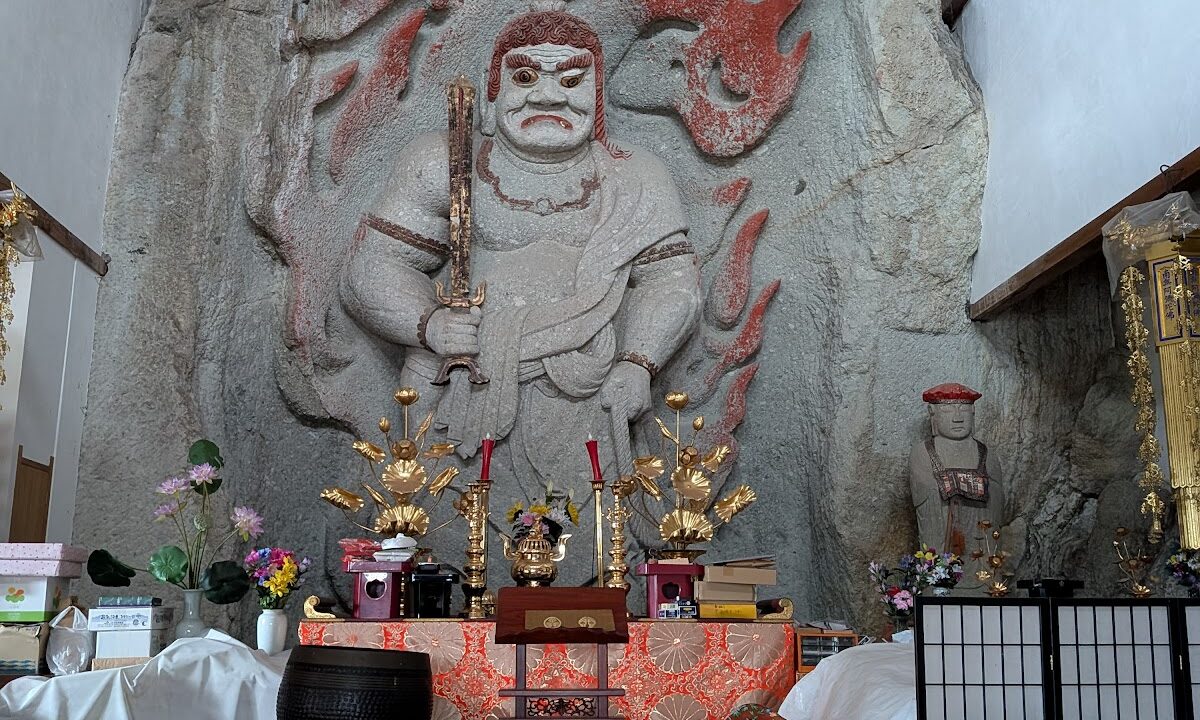
The temple’s most striking feature is the colossal rock-carved statue of Fudo Myoo (Acala) that stands within its grounds. Carved from a single natural rock face, this statue reaches a height of approximately 8 meters (2.5 jo), making it one of the largest in Japan. Its powerful expression and overwhelming presence leave a profound impression on visitors.
Connection to Hakusan Faith
The Tsurugi district of Hakusan City, where Ikkanji Temple is located, is a temple town that has flourished since ancient times as a gateway to the sacred Mount Hakusan. Mount Hakusan is said to have been opened by Taichō Daishi in 717 AD, and since then, it has been a sacred site for Shugendō practitioners, attracting many ascetics. The rock-carved Buddha at Ikkanji Temple is also thought to have originated within this tradition of Hakusan faith.
History of Ikkanji Temple | From Taichō Daishi to the End of the Edo Period
Legend of Founding by Taichō Daishi
The rock-carved Fudo Myoo (Acala) at Ikkanji Temple is said to have been first carved by Taichō Daishi, the founder of Mount Hakusan. Taichō Daishi was a high-ranking priest of the Nara period and is known as a Shugendō practitioner from Echizen Province (present-day Fukui Prefecture). A legend remains that he carved the Fudo Myoo at this site when Mount Hakusan was opened, and the origins of Ikkanji Temple are thought to date back more than 1300 years.
Reconstruction in 1631
Ikkanji Temple was officially founded as a temple in 1631 (Kanei 8). Ungyō Zenji, the 5th abbot of Hōenji Temple, made the already existing rock-carved Buddha the principal image and built a temple building surrounding it. This established the formal appearance of a temple as “Fudozan Ikkanji.”
Fire and Reconstruction in the Tenpo Era
During the Tenpo era (1830s) in the late Edo period, Ikkanji Temple suffered a disaster when its buildings were destroyed by fire. However, the temple was later rebuilt by Abbot Dokkaku. At the same time, the Fudo Myoo rock-carved Buddha was also restored.
Completion of the Current Rock-Carved Buddha
After the fire in the Tenpo era, the stonemason brothers Bunsuke and Shichiemon undertook the restoration and carving of the Fudo Myoo rock-carved Buddha that we see today. This work took a long three years and three months, and the current form was completed at the end of the Edo period. It is easy to imagine that carving such a massive statue, approximately 8 meters (25 feet) tall, into a single natural rock was an extremely difficult technical task.
Japan’s Largest Rock-Carved Fudo Myoo | Highlights and Features
Overwhelming Scale
The most striking feature of the standing Fudo Myoo rock-carved Buddha statue at Ikkanji Temple is its overwhelming scale. At approximately 8 meters tall, this is one of the largest rock-carved Buddha statues in Japan. Carved from a single natural rock face, it possesses a unique presence, seamlessly integrated with the rock surface.
Looking up at it from close range, one is overwhelmed by its sheer power. Every detail is meticulously carved, from the wrathful expression characteristic of Fudo Myoo (Acala), the halo of flames, the demon-subduing sword in his right hand, to the lasso (kensaku) in his left.
What are Rock-Carved Buddhas?
Rock-carved Buddhas are Buddhist statues directly carved into natural rock faces or massive boulders. While the Usuki Stone Buddhas and Kumano Rock-Carved Buddhas in Oita Prefecture are famous in Japan, the Fudo Myoo statue at Ikkanji Temple is particularly large.
It is a rare rock-carved Buddha in Ishikawa Prefecture and an important cultural asset representing the Hokuriku region. Its integration with the natural rock creates a mystical atmosphere unlike artificially created Buddha statues.
The Meaning and Symbolism of Fudo Myoo
Fudo Myoo is the central figure of the Five Great Wisdom Kings in Esoteric Buddhism and is considered an incarnation of Dainichi Nyorai (Vairocana Buddha). As his name “Fudo” (immovable) suggests, he symbolizes an unwavering will that is unshaken by any worldly desires or obstacles, and plays the role of subduing evil and protecting people.
The statue of Fudo Myoo at Ikkanji Temple is depicted in a typical form, holding a demon-subduing sword in his right hand to sever worldly desires, and a lasso in his left hand to bind evil. The flaming halo behind him (Garuda flame) represents the flame of wisdom that burns away worldly desires.
Permission to Use the Maeda Family Crest of the Kaga Domain
Ikkanji Temple is also known for receiving special devotion from the Maeda family, the lords of the Kaga Domain. As proof of this, the temple was permitted to use the Maeda family crest, “Ken Umebachi” (sword and plum blossom), and this crest is still used on the temple’s roof tiles today.
This is important evidence that Ikkanji Temple held a special position in the region, indicating that it was maintained under the patronage of the Kaga Domain.
Benefits of Ikkanji Temple | Healing of Eye Diseases, Business Prosperity, and Protection from Evil
Miraculous Healing of Eye Diseases
The Fudo Myoo (Acala) of Ikkanji Temple is particularly known for its efficacy in healing eye diseases. Since ancient times, people suffering from eye ailments have visited the temple to pray for recovery. This faith continues to this day, with a constant stream of visitors praying for the healing of eye diseases.
It is believed that Fudo Myoo’s keen insight allows him to foresee people’s eye ailments and guide them toward healing. It is an important object of worship for those who wish for eye health and those praying for the restoration of their eyesight.
Benefits of Business Prosperity
The Fudo Myoo of Ikkanji Temple is also known for its efficacy in bringing business prosperity. It is believed that the powerful force of Fudo Myoo removes obstacles to business and brings about business success.
The Tsurugi district of Hakusan City has a long history as a thriving commercial town, and local merchants have visited Ikkanji Temple to pray for business prosperity. Even today, business owners and self-employed individuals seeking success visit the temple.
Protection Against Evil Spirits
Fudo Myoo (Acala) is originally a deity with the power to subdue evil spirits. The Fudo Myoo at Ikkanji Temple is also believed to offer protection against evil and misfortune. It is believed to ward off disaster and protect the safety of the home, and many people in their unlucky years or those facing life-changing events visit the temple.
Guide to Ikkanji Temple Grounds | Points to Note for Visitors
Main Hall and Rock-Carved Buddha
The grounds of Ikkanji Temple are relatively compact and arranged for easy visitor access. Upon passing through the temple gate, the main hall is directly ahead, and behind it, the rock-carved Fudo Myoo is enshrined.
The rock-carved Buddha is protected by a protective structure, shielding it from wind and rain. Visitors can worship Fudo Myoo from in front of the protective structure. Especially on sunny days, natural light shines in, beautifully illuminating the image of Fudo Myoo carved into the rock face.
Proper Worship Etiquette
Although Ikkanji Temple belongs to the Jodo sect, Fudo Myoo is a deity of Esoteric Buddhism. Therefore, it is important to pray with clasped hands and a sincere heart. No special rituals are required, but it is recommended to stand before Fudo Myoo quietly and with a calm mind.
If praying for healing from an eye disease, pray for the health of your eyes. If praying for business prosperity, pray while silently wishing for the development of your business.
Atmosphere of the Temple Grounds
The grounds of Ikkanji Temple are enveloped in a tranquil atmosphere. Despite being located in the town of Tsurugi, entering the temple grounds feels like entering another world. Visiting in the early morning or evening offers an even more mystical atmosphere.
Access Information | How to Get to Ikkanji Temple
Location
Address: 4-Chi-18, Tsurugi Honmachi, Hakusan City, Ishikawa Prefecture
Access by Public Transportation
Using the Hokuriku Railway Ishikawa Line
- Take the Hokuriku Railway Ishikawa Line from Kanazawa Station
- Get off at “Tsurugi Station” (approximately 30 minutes)
- Approximately 15 minutes on foot from Tsurugi Station (approximately 1.2 km)
Tsurugi Station is the central station of Hakusan City, and the route to Ikkanji Temple is mostly flat. Since it is within walking distance from the station, visiting by public transportation is perfectly feasible.
Using the Bus
Hokuriku Railway bus routes are also available, but since the number of buses is limited, it is recommended to check the timetable in advance.
Access by Car
From Kanazawa
- Head south on National Route 157 towards Hakusan
- Aim for Tsurugi town center
- Estimated time: Approximately 30 minutes from central Kanazawa
From Hakusan
- Head north on National Route 157 towards Kanazawa
- Aim for Tsurugi town center
Parking
Due to the size of the temple, there is no dedicated large parking lot, but there are parking spaces nearby. However, since the number of spaces is limited, we recommend considering using public transportation.
Nearby Tourist Spots | Places to Visit Along with Ikkanji Temple
Kinkengu Shrine
Kinkengu Shrine, located within walking distance of Ikkanji Temple, is one of the central shrines of Hakusan faith. It is also known as a power spot for increasing wealth, and many worshippers visit. Visiting both Ikkanji Temple and Kinkengu Shrine will provide a more fulfilling experience of Hakusan faith.
Shirayama Hime Shrine
Shirayama Hime Shrine, the head shrine of the Hakusan faith, is located about a 10-minute drive from Ikkanji Temple. It is the head shrine of approximately 3,000 Hakusan shrines nationwide and a must-see spot when visiting Hakusan.
Tsurugi Townscape
Tsurugi is a temple town that flourished as a gateway to climbing Mount Hakusan, and its old townscape remains. Historic merchant houses and sake breweries are scattered throughout, making it a pleasant place to stroll.
Hakusan Hot Spring Village
There are several hot spring resorts within Hakusan City, and relaxing in a hot spring after visiting Ikkanji Temple is highly recommended. You can enjoy hot springs with unique characteristics, such as Hakusan Ichirino Onsen and Shiramine Onsen.
Points to Note and Manners When Visiting
Visiting Hours
Ikkanji Temple is generally open for daytime visits, but it gets dark in the early morning and after sunset, so visiting during daylight hours is recommended. The rock-carved Buddhas, in particular, are most impressive when viewed in natural light.
Photography
Photography is generally permitted on the temple grounds, but consideration should be given to avoiding disturbing other visitors. Photography should be avoided, especially inside the main hall or during prayers. Photography of the rock-carved Buddhas is permitted, but please use flash sparingly.
Clothing and Belongings
No special attire is required, but please wear clean clothing appropriate for visiting a temple. In summer, the sun is strong, so a hat or parasol is useful. In winter, please take precautions against the cold.
Annual Events at Ikkanji Temple
Ikkanji Temple holds various Buddhist events throughout the year. In particular, special services are sometimes held on the 28th of each month, which is the auspicious day of Fudo Myoo. For detailed event schedules, it is recommended to inquire with the temple in advance.
History and Cultural Background of Hakusan City
Center of Hakusan Faith
Hakusan City, overlooking the sacred Mount Hakusan, has long been a center of Hakusan faith. Mount Hakusan is one of Japan’s three sacred mountains, alongside Mount Fuji and Mount Tateyama. Since its opening in 717 AD by Taicho Daishi, it has attracted many practitioners as a sacred site of Shugendo (mountain asceticism).
History of Tsurugi
The Tsurugi area is a temple town that developed as a gateway to climbing Mount Hakusan. During the Edo period, under the patronage of the Kaga Domain, it flourished as a base for pilgrimages to Mount Hakusan. Many pilgrims visited, and it also functioned as a post town.
Ikkanji Temple is one of the temples that has played an important role in this history of Hakusan faith.
How to Enjoy Visiting Ikkanji Temple | Seasonal Attractions
Spring at Ikkanji Temple
In spring, the temple grounds and surrounding areas are filled with cherry blossoms, creating a vibrant atmosphere. The contrast between the cherry blossoms and the rock-carved Buddha is beautiful, making it the perfect season for photography.
Summer at Ikkanji Temple
In summer, the fresh greenery is beautiful, and the temple grounds have a cool atmosphere. Visiting early in the morning is especially refreshing, allowing you to refresh both mind and body.
Autumn at Ikkanji Temple
In autumn, the temple grounds are adorned with colorful autumn leaves. Hakusan City has many famous spots for autumn foliage, and you can enjoy the beautiful autumn colors around Ikkanji Temple.
Winter at Ikkanji Temple
In winter, you can see the rock-carved Buddha amidst a snowy landscape. The tranquil temple grounds covered in snow create an even more mystical atmosphere. However, caution is needed when walking in heavy snow.
Cultural Properties of Ikkanji Temple and Ishikawa Prefecture
The standing statue of Fudo Myoo (Acala) at Ikkanji Temple is one of Ishikawa Prefecture’s important cultural properties. It is recognized for its value as one of the largest rock-carved Buddhas in Japan, and as a valuable legacy that conveys the stonemasonry techniques of the late Edo period.
While Ishikawa Prefecture boasts numerous temples and shrines, rock-carved Buddha statues like those at Ikkanji Temple are extremely rare, attracting many researchers and cultural heritage enthusiasts from both within and outside the prefecture.
Summary | The Charm of Ikkanji Temple and the Significance of Visiting
Ikkanji Temple, located in Hakusan City, Ishikawa Prefecture, is a historic temple housing one of Japan’s largest rock-carved Buddha statues of Fudo Myoo (Acala). The awe-inspiring Fudo Myoo statue, approximately 8 meters tall, is a work of art carved into a single natural rock face, and attracts the faith of many who believe it offers blessings for healing eye diseases, business prosperity, and protection against evil.
Ikkanji Temple has a long history, beginning with its connection to Taicho Daishi, the founder of Hakusan, and culminating in its current form being completed by two stonemason brothers in the late Edo period. Paid under the protection of the Maeda family, the lords of the Kaga Domain, and beloved by the local people, this temple is a valuable resource that conveys the history of Hakusan faith.
Its convenient access, approximately a 15-minute walk from Tsurugi Station on the Hokuriku Railway Ishikawa Line, is another of its attractions. Ikkanji Temple can be visited in conjunction with sightseeing in Kanazawa, and a recommended sightseeing route combines it with nearby spots such as Hakusan Hime Shrine and Kinken-gu Shrine, which are central to the Hakusan faith.
Visiting Ikkanji Temple allows you to experience the rich religious culture and history of Ishikawa Prefecture. Standing before the gigantic rock-carved Buddha and experiencing its power and mystique will surely be an unforgettable memory. Ikkanji Temple is a must-see spot not only for those praying for healing from eye diseases or business prosperity, but also for those interested in Japanese cultural properties and history, and those who want to learn about the Hakusan faith.
When visiting Hakusan City, be sure to visit Ikkanji Temple and quietly offer your prayers before the largest rock-carved Fudo Myoo in Japan. You will surely feel its overwhelming presence and the power of faith woven over a long history.


