Complete Guide to Kanbodaiji Temple (Shogatsudo Hall) | Everything You Need to Know About This National Treasure-Class Temple and its Shusho-e Ceremony in Iga City, Mie Prefecture
Kanbodaiji Temple, located in Shimagahara, Iga City, Mie Prefecture, is an ancient temple of the Buzan branch of Shingon Buddhism, affectionately known as “Shogatsudo Hall.” Founded in the Nara period by Abbot Jitchu of Todaiji Temple, this temple holds a significant position in the history of Japanese Buddhism as the birthplace of the Shusho-e ceremony, and continues to protect valuable buildings and hidden Buddha statues designated as important national cultural properties.
This article will introduce the charms of this historic temple in their entirety, from its historical background and architectural value to its annual events and access methods.
History and Origins of Kanbodaiji Temple
Founding in the Tenpyo Period and Abbot Jitchu
Kanbodaiji Temple was founded in the third year of Tenpyo-Shoho (751 AD), during the reign of Emperor Shomu, by Abbot Jitchu of Todaiji Temple in Nara. Abbot Jitchū is also known as the founder of the Nigatsudō Hall at Tōdai-ji Temple and was a highly respected priest who established the traditions of Kannon worship and the Shūshō-e ceremony.
According to temple tradition, when Abbot Jitchū visited this area, he felt the miraculous power of Kannon Bodhisattva and founded Fumon-zan Kanbodai-ji Temple. Initially positioned as a branch temple of Tōdai-ji Temple, it developed into a temple with deep ties to Nara.
Origin of the Name “Shōgatsudō”
The reason Kanbodai-ji Temple is called “Shōgatsudō” (New Year’s Hall) is because the ritual ceremony (Shūshō-e) for the principal image, the Eleven-Faced Kannon Bodhisattva, is held during the Lunar New Year. This Shūshō-e ceremony is now held annually from February 11th to 12th and is deeply rooted in the community as an important religious service praying for a bountiful harvest and good health.
Interestingly, the famous “Omizutori (Shuni-e)” ceremony at Nagato-ji Temple’s Nigatsu-do Hall in Nara is said to have originated as a preliminary event to the Shushō-e ceremony at this Shōgatsu-do Hall, which is why Kanbodai-ji Temple is also considered the birthplace of the Shushō-e ceremony.
Oda Nobunaga’s Invasion of Iga and Reconstruction
A major turning point in the history of Kanbodai-ji Temple was Oda Nobunaga’s invasion of Iga in 1579. This conflict resulted in the destruction of most of the temple’s main buildings.
The remaining gatehouse and main hall (Shōgatsu-do Hall) either survived the war or were rebuilt shortly afterward, making them valuable cultural assets that preserve the architectural style of the early Muromachi period (late 14th to early 15th centuries). While many buildings once stood within the vast grounds, today the temple grounds are tranquil, centered around the gatehouse and main hall.
Visiting National Important Cultural Properties
Tower Gate (Important Cultural Property)
The tower gate of Kanbodaiji Temple is a three-bay, single-entrance, two-story gate estimated to have been built in the early Muromachi period, and is designated as a National Important Cultural Property. While based on the Japanese style, this gate exhibits an eclectic style incorporating elements of the Zen Buddhist style, clearly representing the characteristics of medieval temple architecture.
The structure of the tower gate is a traditional form with main pillars on the lower level and brackets on the upper level, and the roof is a hip-and-gable roof covered with traditional tiles. Although weathered by age, the exquisite wooden joinery, a testament to the high level of technology at the time, can be seen throughout.
Passing through the gate, a tranquil temple grounds unfolds, and the view of the main hall standing in front provides visitors with a deep sense of peace.
Main Hall (Shogatsu-do) (Important Cultural Property)
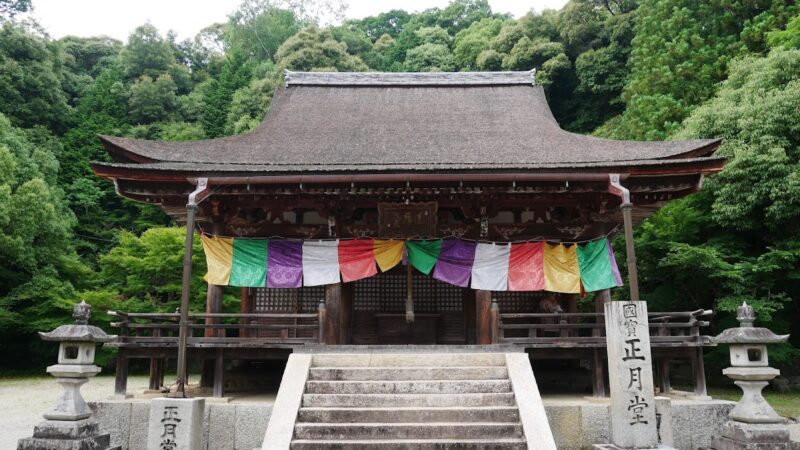
The main hall, also known as Shogatsu-do, is, like the tower gate, a building from the early Muromachi period. This magnificent building has a nearly square floor plan with five bays in length and five bays in width, and is topped with a hipped roof covered with traditional tiles.
The interior is divided into an inner sanctuary and an outer sanctuary. In the center of the inner sanctuary is a shrine housing the principal image, a hidden Buddha statue of the Eleven-Headed Kannon. The pillars and beams inside the hall exhibit architectural techniques from the Muromachi period, making it a building of great historical value.
A distinctive feature of the main hall is the large space provided for conducting Buddhist ceremonies such as the Shushō-e. Every year in February, during the Shushō-e, monks solemnly perform chanting and religious services in this hall, attracting many worshippers.
Wooden Eleven-Headed Kannon Statue (Hidden Buddha, Important Cultural Property)
The wooden Eleven-Headed Kannon statue, the principal image of Kanbodaiji Temple, is known as a hidden Buddha statue that is only unveiled once every 33 years. This Kannon statue is also designated as a National Important Cultural Property and is estimated to have been created in the late Heian period to the early Kamakura period.
The Eleven-Faced Kannon is a Bodhisattva of Kannon with eleven faces on its head, and is an object of worship that watches over all directions and saves all sentient beings. The Eleven-Faced Kannon at Kanbodaiji Temple is carved from a single piece of cypress wood and is characterized by its gentle expression and graceful form.
The next public viewing will be several decades away, so the doors of the shrine are usually closed, and its mystique attracts even more devotion. However, during special Buddhist ceremonies such as Shushō-e, prayers can be offered in front of the shrine.
Shushō-e (New Year’s Ceremony) – A Traditional Ceremony with a Thousand Years of History
What is Shushō-e?
Shūshō-e is a Buddhist ceremony held at the beginning of the year to correct the mistakes of the previous year and pray for a bountiful harvest and good health in the new year. The Shushō-e ceremony at Kanbodai-ji Temple is held annually from February 11th to 12th, preserving the tradition of coinciding with the lunar New Year.
This ceremony is conducted according to ancient customs dating back to the Nara period, with monks chanting sutras, performing Buddhist chants (shōmyō), and engaging in unique rituals that continue throughout the night.
Significance as the Origin of the Shushō-e Ceremony
Kanbodai-ji Temple holds a significant position in Buddhist history as the birthplace of the Shushō-e ceremony. It is believed that the form of the Shushō-e ceremony started here by Abbot Jitchū later developed into the Shuni-e (Omizutori) ceremony at Tōdai-ji Temple’s Nigatsu-dō Hall, and spread to temples throughout Japan.
The Omizutori ceremony at Tōdai-ji Temple’s Nigatsu-dō Hall is a nationally renowned spring event in Nara, held every March. The fact that its origin lies in this Shushō-dō Hall is a fascinating fact for understanding the spread of Buddhist culture.
Highlights of the Shushō-e Ceremony
The following rituals are performed at the Shushō-e ceremony at Kanbodaiji Temple:
- Dattan Ritual: A magnificent ritual using fire, symbolizing the burning away of worldly desires.
- Shomyo: A solemn atmosphere created by the unique chanting style of monks.
- Goma Fire Ritual: Goma wood, imbued with the wishes of worshippers, is burned.
- Sange: A ritual of scattering flowers before the Buddha.
During the Shushō-e ceremony, the temple grounds are bustling with local people and worshippers from afar, and food stalls and other vendors create a festive atmosphere.
Annual Events at Kanbodaiji Temple
New Year’s Visit (December 31st – January 1st)
Kanbodaiji Temple welcomes worshippers for their first visit of the year from New Year’s Eve to New Year’s Day. From 11:24:20 PM on December 31st, the general public can ring the temple bell and participate in the New Year’s Eve ritual to dispel worldly desires.
From exactly midnight on New Year’s Day, auspicious “Fukuno-Kami” (God of Fortune) talismans will be distributed to the first 300 people. These talismans are believed to bring happiness throughout the year, and many worshippers visit the temple early in the morning every year. The annual number of visitors for the first shrine visit of the year is estimated at around 2,000.
Other Annual Events
In addition to the Shushō-e (New Year’s service) and Hatsumode (first shrine visit of the year), Kanbodaiji Temple also holds the following Buddhist events:
- Spring Equinox Service (around the spring equinox in March)
- Autumn Equinox Service (around the autumn equinox in September)
- Segaki Service (August)
- Monthly Buddhist Service (e.g., the first Sunday of each month)
These events are primarily held by local parishioners and believers, maintaining the connection between the temple and the local community.
Seasonal Scenery of the Temple Grounds
Spring at Kanbodaiji Temple
In spring, Kanbodaiji Temple is adorned with cherry blossoms and azaleas. The cherry trees planted around the main gate reach full bloom from early to mid-April, creating a magnificent contrast between the imposing gate and the pale pink blossoms.
From late April to early May, the azaleas planted throughout the grounds bloom in vibrant colors, announcing the arrival of the season of fresh greenery. Strolling through the quiet grounds in the gentle spring sunshine is a particularly delightful experience.
Summer at Kanbodaiji Temple
In summer, Kanbodaiji Temple is enveloped in deep green. The trees on the grounds grow lush, creating a cool and refreshing shade. Amidst the sound of cicadas, quietly offering prayers in the main hall envelops you in a tranquility that makes you forget the hustle and bustle of the city.
Kanbodaiji Temple in Autumn
Autumn is one of the most beautiful seasons at Kanbodaiji Temple. The maple and ginkgo trees in the temple grounds change color, vividly adorning the main gate and main hall. Especially during the autumn foliage season from mid- to late November, many photography enthusiasts and tourists visit.
The large ginkgo tree in the temple grounds is estimated to be several hundred years old, and its golden appearance in autumn is breathtaking. Walking on the yellow carpet of fallen leaves is a unique autumn pleasure.
Kanbodaiji Temple in Winter
In winter, Kanbodaiji Temple exudes a fantastical atmosphere with its snow-covered grounds. The Iga region often experiences snowfall in winter, and the snow-covered main gate and main hall have a sumi-e (ink painting)-like quality.
Around the time of the Shusho-e (New Year’s service) in February, the weather is still quite cold, but the service held in that cold weather takes on an even more solemn atmosphere.
Access and Basic Information to Kanbodaiji Temple
Location and Contact Information
Location: 1349 Shimagahara, Iga City, Mie Prefecture 519-1711
Phone: 0595-59-2009 (Shimagarahara Branch Office)
Sect: Shingon-shu Buzan-ha
Mountain Name: Fumonzan
Principal Image: Eleven-faced Kannon Bodhisattva
Visiting Information
Visiting Hours: Grounds are freely accessible (year-round)
Admission Fee: Free
Holidays: Open every day
Parking: Available (Free, approximately 20 spaces for regular cars)
*Entry into the main hall is not usually permitted. Entry is only permitted during Buddhist services such as Shusho-e.
*The hidden principal image is unveiled only once every 33 years.
Access by Car
From Nagoya:
- Approximately 15 minutes from the Ouchi Interchange on the Meihan Expressway
- Approximately 20 minutes from the Konan Interchange on the Shin-Meishin Expressway
From Osaka/Kyoto:
- Approximately 15 minutes from the Ouchi Interchange on the Meihan Expressway
- Approximately 1 hour via the Keina-Wa Expressway
Parking: There is a free parking lot on the temple grounds, accommodating approximately 20 regular-sized cars. Temporary parking may be available during events such as the Shusho-e (New Year’s Day) ceremony.
Access by Public Transportation
Train:
- Approximately 20 minutes on foot (approximately 1.5 km) from Shimagahara Station on the JR Kansai Main Line
- Approximately 15 minutes by taxi from Iga-Ueno Station on the JR Kansai Main Line
Bus:
- The Shimagahara Line of the Iga City Community Bus is available (prior confirmation is necessary due to limited service).
*Due to limited public transportation, access by car is recommended.
Estimated Time Required
- Strolling the temple grounds only: 30 minutes to 1 hour
- Visiting the Shusho-e ceremony: 2 to 3 hours
- Including sightseeing in the surrounding area: Half a day to a full day
Nearby Tourist Attractions
Iga Ueno Castle
Located about 20 minutes by car from Kanbodaiji Temple, Iga Ueno Castle is a famous castle built by Todo Takatora. Its stone walls, boasting the highest height in Japan, and its beautiful white keep make it a central tourist spot in Iga.
Iga-ryu Ninja Museum
This museum allows visitors to learn about the history and culture of Iga, known as the home of ninjas. Interactive exhibits such as a trick house tour and ninja shows are popular, making it recommended for families.
Basho Memorial Museum
Iga, the birthplace of the haiku master Matsuo Basho, has a memorial museum exhibiting materials related to Basho. Through Basho’s life and works, you can experience the culture of the Edo period.
Shimagahara Onsen Yabuccha
This is a day-trip hot spring facility located about 10 minutes by car from Kanbodaiji Temple. It’s perfect for relaxing after sightseeing, and you can also enjoy dishes made with local ingredients.
Tsukigase Plum Grove
Tsukigase in Nara Prefecture, about 30 minutes by car from Kanbodaiji Temple, is one of Kansai’s leading plum blossom viewing spots. In early spring, approximately 10,000 plum trees bloom, offering a spectacular view.
Etiquette and Manners for Visiting Kanbodaiji Temple
Proper Way to Visit
- Bow before passing through the main gate: The main gate is the entrance to a sacred area. Bow before entering the temple grounds.
- Pray and bow in front of the main hall: Quietly put your hands together in front of the main hall and pray with all your heart.
- Photography Etiquette: Photography is generally permitted on the temple grounds, but please be considerate of those performing religious services or other visitors.
- Maintaining Silence: Temples are places of prayer. Please refrain from loud conversations and remain quiet.
Regarding Attire
There are no specific dress code requirements, but clean, understated attire appropriate for visiting a temple is desirable. For religious services such as Shushō-e, slightly more formal attire is appropriate.
Regarding Goshuin (Temple Seals)
Goshuin are available at Kanbodaiji Temple. However, since there may not always be staff present, it is recommended to check in advance. Goshuin are guaranteed during events such as Shushō-e.
To Maximize Your Enjoyment of Kanbodaiji Temple
Recommended Time to Visit
Shōshō-e Period (February 11th-12th): This is the most special time to experience traditional events. The nighttime religious services are mystical and well worth seeing.
Cherry Blossom Season (Early to Mid-April): Enjoy a peaceful stroll through the temple grounds while feeling the arrival of spring.
Autumn Foliage Season (Mid to Late November): A beautiful time to admire the contrast between the vibrant autumn leaves and the historical buildings.
New Year’s Visit (December 31st to January 3rd): A special period to offer prayers for the new year and receive a lucky charm from the god of fortune.
Required Time and Sightseeing Plans
Short Course (1 hour): A basic course that includes viewing the exterior of the main gate and main hall, and a walk around the temple grounds.
Standard Course (2-3 hours): In addition to strolling through the temple grounds, this course includes attending Buddhist services such as the Shusho-e ceremony.
Comprehensive Course (Half-Day): In addition to visiting Kanbodaiji Temple, this course includes visits to nearby Iga Ueno Castle and the Ninja Museum.
Full-Day Course: A fulfilling course that visits major tourist spots in the Iga area and includes relaxation at a hot spring.
Useful Items to Bring
- Camera: You can photograph historical buildings and seasonal scenery.
- Goshuincho (stamp book): Necessary if you wish to receive temple stamps.
- Comfortable Walking Shoes: Some parts of the temple grounds are unpaved.
- Warm Clothing (Winter): The Shusho-e ceremony in February is extremely cold, so proper cold weather gear is necessary.
- Rain Gear: As the weather in this mountainous area can change quickly, a folding umbrella is recommended.
Historical Background of Iga City and Kanbodaiji Temple
History of the Iga Region
The Iga region has flourished since ancient times as a transportation hub connecting Kyoto and Ise. During the Heian period, manors developed, and from the Kamakura period onward, it became a region where samurai groups held sway. It is particularly known as the home of the Iga ninja, and a unique culture has developed there.
The Shimagahara district, where Kanbodaiji Temple is located, is situated in a mountainous area along the Kizu River, on the route connecting Nara and Iga. Therefore, it had deep ties with Todai-ji Temple in Nara and served as an important hub on the transmission route of Buddhist culture.
About the Buzan Branch of Shingon Buddhism
The Buzan branch of Shingon Buddhism, to which Kanbodai-ji Temple belongs, is a branch of Shingon Buddhism with Hase-dera Temple in Sakurai City, Nara Prefecture, as its head temple. It inherits the teachings of Shingon Esoteric Buddhism, founded by Kobo Daishi Kukai, and is known as a sect that particularly emphasizes the worship of Kannon (Avalokiteshvara).
A characteristic of the Buzan branch is its emphasis on a unique chanting method called Shomyo, and this tradition is also carried on in the Shuni-e ceremony at Kanbodai-ji Temple.
Deep Connections Between Kanbodai-ji Temple and Todai-ji Temple’s Nigatsu-do Hall
Abbot Jitchu and the Transmission of the Shuni-e Ceremony
Abbot Jitchu is known as a high-ranking priest who founded Todai-ji Temple’s Nigatsu-do Hall and initiated the Shuni-e ceremony (Omizutori). It is said that Abbot Jitchū visited this Iga region during his travels throughout Japan and founded Kanbodai-ji Temple.
There is a theory that the Shushō-e ceremony, which began at Kanbodai-ji Temple, was later brought back to the Nigatsu-dō Hall of Tōdai-ji Temple and developed into the larger Shuni-e ceremony. For this reason, Kanbodai-ji Temple holds an important position in Buddhist history as the “birthplace of the Shushō-e ceremony.”
Continued Exchange in the Modern Age
Even today, there is a deep connection between Kanbodai-ji Temple and the Nigatsu-dō Hall of Tōdai-ji Temple, and monks from Tōdai-ji Temple sometimes visit during the Shushō-e ceremony. While the Shushō-e ceremonies of both temples share the same origin, they have each developed independently and are passed down as traditional events rooted in their respective regions.
Cultural Value and Preservation Activities
Architectural Historical Value
The gate and main hall of Kanbodai-ji Temple are valuable cultural assets that convey the architectural style of the early Muromachi period. Temple architecture from this period is characterized by an eclectic style, based on the Japanese style but incorporating elements of the Zen Buddhist style (Tang style) introduced during the Kamakura period.
The buildings of Kanbodaiji Temple are important resources for understanding Muromachi period architectural techniques in regional temples and are attracting attention from architectural historians.
Preservation and Restoration
The gatehouse and main hall, designated as important national cultural properties, undergo regular preservation and repair work. Since wooden buildings inevitably deteriorate over time, expert surveys and appropriate restoration work are continuously carried out.
Regular cleaning and maintenance of the temple grounds are also conducted by local residents and parishioners, ensuring both the preservation of cultural properties and the maintenance of the local community.
Shushō-e as an Intangible Cultural Heritage
The Shushō-e ceremony at Kanbodaiji Temple, a traditional event that has continued for over a thousand years, also possesses intangible cultural heritage value. The continuation of rituals according to ancient customs is an important element in forming the region’s cultural identity.
In recent years, passing on traditions to younger generations has become a challenge, but thanks to the efforts of the local people, this precious tradition continues to be preserved.
Voices of Visitors to Kanbodaiji Temple
Perspective of History Enthusiasts
Many visitors comment, “Despite its history dating back to the Nara period, the quiet atmosphere, unspoiled by tourism, is wonderful. The architectural beauty of the gate and main hall is worth taking the time to appreciate.”
Perspective of Photography Enthusiasts
“The temple grounds, which show different expressions in each season, are a perfect spot for photography. The gate, especially during the autumn foliage season, is so beautiful that you’ll never tire of it, no matter how many times you visit.” Visitors with cameras are constantly present.
Voices of Participants in the Shushō-e Ceremony
“The Shushō-e ceremony, held on a cold winter night, is brutally cold, but the religious service experienced there leaves a deep impression. You are enveloped in a solemn atmosphere that cannot be experienced in modern society.”
Summary: The Charm of Kanbodaiji Temple
Kanbodaiji Temple (Shogatsudo Hall) in Iga City, Mie Prefecture, is a historically significant temple in Japanese Buddhism, boasting a history dating back to the Tenpyo era, buildings and hidden Buddha statues designated as important national cultural properties, and a tradition as the birthplace of the Shusho-e ceremony.
The quiet temple grounds, untouched by urbanization, are ideal for escaping the hustle and bustle of the city and finding peace of mind. The harmony of the seasonal natural beauty and historical buildings, along with the continuing traditional events, deeply impresses visitors.
When visiting Iga, be sure to visit this historic temple in addition to the ninjas and castles. Kanbodaiji Temple, where over a thousand years of history quietly breathes, is a special place that allows you to feel the profound depth of Japanese spiritual culture.
While many visitors come during the Shusho-e ceremony and the autumn foliage season, you can also offer peaceful prayers in the tranquil grounds at any other time of year. Why not have a valuable experience of encountering the best of old Japanese culture at Kanbodaiji Temple, where history and tradition, nature and architectural beauty are in harmony?