Izumio Shrine (Taisho Ward, Osaka Prefecture) Complete Guide | History, Deities, Access, and Goshuin Information
Izumio Shrine, located in Izumio 2-chome, Taisho Ward, Osaka City, is a shrine with a history of over 300 years, serving as a guardian deity of the region. Founded during the Edo period alongside land reclamation, it survived wartime destruction and remains a beloved local landmark. This article provides a detailed guide to Izumio Shrine, including its history, enshrined deities, highlights within the grounds, access information, and details about its Goshuin (shrine stamp).
Basic Information about Izumio Shrine
Location: 2-17-8 Izumio, Taisho-ku, Osaka City, Osaka Prefecture
Deities Enshrined: Sumiyoshi-no-Okami, Okuninushi-no-Kami, Hachiman-no-Okami
Founded: Genroku 11 (1698)
Former Shrine Rank: Village Shrine
Annual Festival: Mid-October
Shrine Office: Available (Goshuin stamps available)
Parking: None (Use nearby coin parking)
Izumio Shrine is a shrine quietly nestled in a residential area of Taisho-ku, Osaka City, and has long been revered by local parishioners and worshippers. While the grounds are not particularly large, they maintain a well-maintained and clean space, making it a beloved place to escape the hustle and bustle of everyday life and find peace of mind.
The History of Izumio Shrine | From Land Reclamation to the Present
Founding and Land Reclamation in the Genroku Period
The history of Izumio Shrine dates back to the mid-Edo period, specifically to Genroku 11 (1698). At that time, a man named Kitamura Rokuemon, originally from Senshu Kutsuo (present-day Sennan area of Osaka Prefecture), obtained official permission from the shogunate to begin land reclamation in this area.
To pray for the success of his business and the prosperity of the land, Kitamura Rokuemon erected a local guardian shrine (ubusuna Jinja) in the Mikami-higashi area. This is the origin of Izumio Shrine. A ubusuna Jinja is a shrine dedicated to the guardian deity of a particular land, and it was common practice to erect them to pray for the safety and development of newly cultivated land.
The place name Izumio is also said to have been named after “Senshu,” the birthplace of Kitamura Rokuemon. Through land reclamation, this area gradually developed, and Izumio Shrine came to play an important role as the center of faith for the local residents.
Merger with Ibara Sumiyoshi Shrine and Restoration
Due to the Meiji era’s shrine reorganization policy, Izumio Shrine was once merged with the nearby Ibara Sumiyoshi Shrine. This was part of the Meiji government’s shrine consolidation and merger, a period when many small shrines were reorganized and consolidated.
However, due to strong demands from local parishioners and residents, Izumio Shrine was restored in 1936 as a “flying shrine” within the grounds of Ibara Sumiyoshi Shrine. A flying shrine refers to a shrine located separately from the main shrine. With this restoration, Izumio Shrine once again functioned as an independent place of worship.
Osaka Air Raids and Post-War Reconstruction
In 1945, during the final stages of the Pacific War, the Izumio Shrine buildings were reduced to ashes in the Osaka air raids. The Taisho Ward area also suffered extensive damage, with many buildings destroyed by fire.
However, during the post-war reconstruction period, thanks to the enthusiasm and efforts of local residents, the shrine was rebuilt in 1954. This reconstruction was a crucial event in restoring a spiritual anchor to a community devastated by war.
Interestingly, the guardian lion-dogs (komainu) on the shrine grounds are said to have survived the Great Osaka Air Raid. These lion-dogs have guarded the shrine grounds from before the war to the present day and are cherished as valuable cultural assets that convey the history of war damage.
Deities and Divine Virtues
Three deities are enshrined at Izumio Shrine.
Sumiyoshi Okami
Sumiyoshi Okami is the collective name for three deities: Sokotsutsu-no-Mikoto, Nakatsutsu-no-Mikoto, and Uwatsutsu-no-Mikoto. They are known as gods of the sea and navigation. Sumiyoshi Okami is the principal deity of Sumiyoshi Taisha Shrine, a representative shrine of Osaka, and has been deeply revered in the Osaka Bay coastal region since ancient times.
Divine Virtues: Safe voyages, protection of maritime traffic, business prosperity, protection from evil, protection of waka poetry and literature
Given the Izumio area’s proximity to Osaka Bay, it is geographically and historically natural that Sumiyoshi Okami is enshrined as the main deity.
Okuninushi-no-Kami
Okuninushi-no-Kami is a god of nation-building, famous as the principal deity of Izumo Taisha Shrine. Affectionately known as “Daikoku-sama,” he is often syncretized with Daikokuten, one of the Seven Lucky Gods.
Divine Virtues: Matchmaking, family safety, business prosperity, abundant harvests, protection of medicine and pharmaceuticals
In land development projects such as shinden (new rice field development), enshrining Okuninushi-no-Kami, the god of nation-building, embodies the wish for the prosperity of the land and the happiness of the residents.
Hachiman-no-Okami
Hachiman-no-Okami is a god of war and protection, with Emperor Ojin as its principal deity. It is the enshrined deity in approximately 40,000 Hachiman shrines nationwide, making it one of the most widely worshipped deities in Japan.
Divine Virtues: Long-lasting military fortune, success in competitions, protection from evil, national peace, and prosperity of descendants.
Hachiman-no-Okami is worshipped as a guardian deity of the region and as a god who protects the safety and prosperity of the parishioners.
These three deities, each possessing different divine virtues, harmonize as guardian deities of the Izumio region, attracting the faith of local residents.
Highlights of the Shrine Grounds
Main Hall and Worship Hall
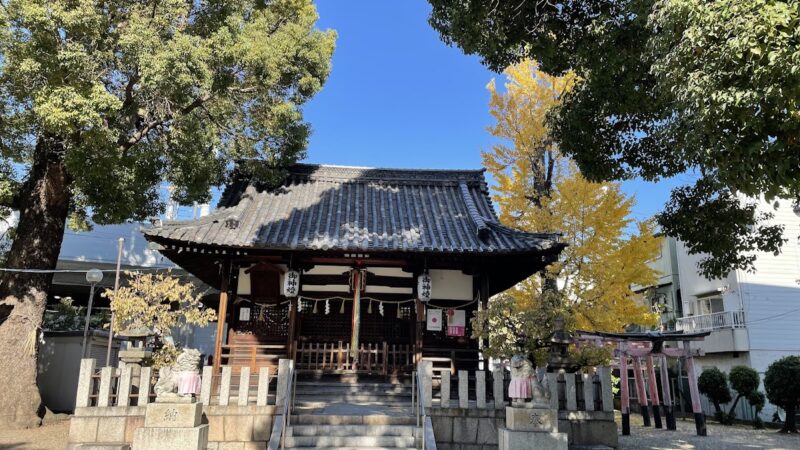
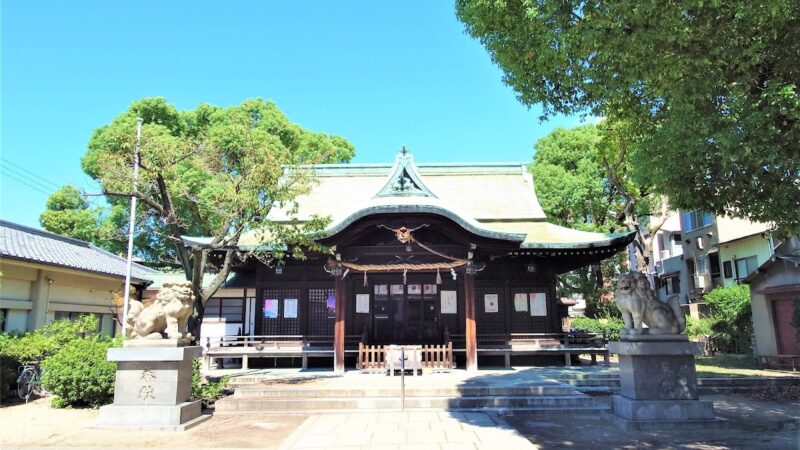
The shrine buildings, rebuilt in 1954, are simple yet dignified. Built during the post-war reconstruction period, the decorations are understated, but they are carefully maintained, creating a clean and impressive appearance.
A donation box is placed in front of the worship hall, allowing worshippers to quietly offer their prayers. The entire shrine grounds are compactly arranged, creating a calm atmosphere perfect for a leisurely visit.
Komainu (Guardian Lion-Dogs) that Survived the War
Of particular note within the shrine grounds are the pair of komainu that survived the Great Osaka Air Raid. These komainu have guarded the grounds from before the war to the present day, serving as a valuable reminder of the war’s history.
Based on their style and degree of weathering, they are presumed to have been dedicated sometime between the Meiji and early Showa periods. Having survived the ravages of war, these komainu attract the attention of many visitors as living witnesses to the region’s history.
Shrine Name Marker and Torii Gate
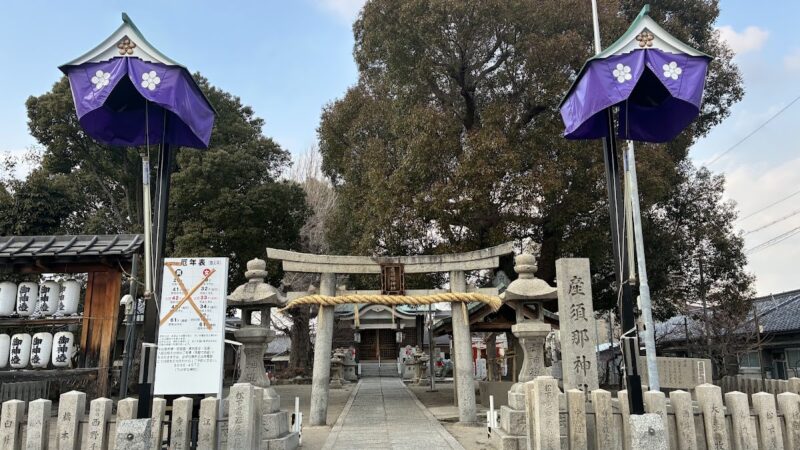
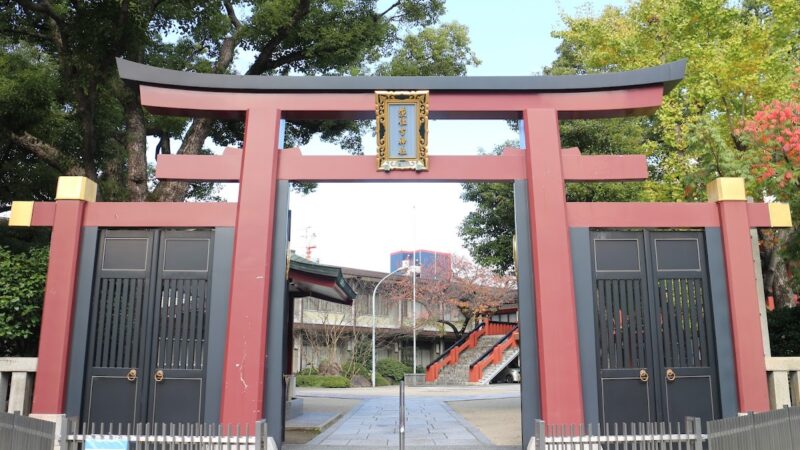
A shrine name marker and torii gate stand at the entrance to the grounds. Despite being located in a residential area, passing through the torii gate evokes a serene atmosphere befitting a sacred place.
Subsidiary Shrines and Stone Monuments
Within the shrine grounds are stone monuments and memorials that tell the history of the region. These are valuable resources for understanding the history of Izumio Shrine and the development of the area.
Annual Events and Festivals of Izumio Shrine
Grand Festival (Autumn Grand Festival)
The Grand Festival, held annually in mid-October, is the most important festival at Izumio Shrine. Parishioners and local residents gather for the portable shrine procession and offering ceremonies. As an important event praying for the prosperity of the region and the safety of its residents, it attracts many participants.
New Year’s Visit
At the start of the new year, visitors, mainly local parishioners, come to the shrine for their first shrine visit of the year. While not as crowded as large shrines, it offers a warm atmosphere unique to a community-based shrine where visitors can offer their prayers for the new year.
Monthly Festivals
Monthly festivals are held regularly, praying for the safety and prosperity of the region.
Goshuin (Shrine Seal) Information
Goshuin (shrine seals) are available at Izumio Shrine.
Goshuin (Shrine Seal) Reception: At the shrine office (we recommend checking in advance as staff may be absent).
Offering Fee: Approximately 300-500 yen
Goshuincho (Shrine Seal Book): Must be brought by the shrine
Reception Hours: Approximately 9:00 AM to 5:00 PM (approximate)
The goshuin will have the name “Izumio Shrine” written in ink and stamped with the shrine’s seal. The simple yet carefully written goshuin is popular as a memento of your visit.
If you wish to receive a goshuin, please note that the shrine office may be unattended. Therefore, we recommend calling in advance to confirm or visiting on a day with an event such as the annual festival.
Access Methods
Access by Train
From JR Osaka Loop Line “Taisho Station”
- Approximately 10 minutes on foot (approx. 800m)
- Exit the station and head southwest towards Izumio Shopping Street.
From Osaka Metro Nagahori Tsurumi-ryokuchi Line “Taisho Station”
- Approximately 10 minutes on foot
- Accessible via the same route as JR Taisho Station.
Access by Bus
Osaka City Bus
- Route 71 bound for “Tsurumachi 4-chome”
- Get off at “Eirakubashi” bus stop, approximately 5 minutes on foot.
Access by Car
Hanshin Expressway
- Approximately 5 minutes from Hanshin Expressway Route 1 Loop Line “Taisho-Nishi Exit”
- Approximately 7 minutes from Hanshin Expressway Route 4 Wangan Line “Taisho Exit”
Parking: There is no dedicated parking lot for the shrine. Please use nearby coin-operated parking lots.
Address: 2-17-8 Izumio, Taisho-ku, Osaka City, Osaka Prefecture
Nearby Landmarks
Izumio Shrine is located near the Izumio Shopping Street. Since it’s in a residential area, first-time visitors are advised to use a map app. There aren’t many signs from Taisho Station, so smartphone navigation is convenient.
Nearby Attractions and Related Facilities
Ibaraki Sumiyoshi Shrine
Ibaraki Sumiyoshi Shrine, where Izumio Shrine was formerly enshrined, is within walking distance. This is also a historical shrine, and a visit to both is recommended.
Izumio Shopping Street
Near the shrine is a traditional shopping street where you can experience the local culture and lifestyle. It’s a good place to stop by after visiting the shrine.
History of Taisho Ward
Taisho Ward was formerly part of Osaka City’s Minato Ward, but became independent in 1932. Surrounded by the Kizu River and Shirinashi River, it has a history of developing as a canal town. The history of Izumio Shrine is closely intertwined with the development history of this region.
Etiquette for Visiting Izumio Shrine
Basic Worship Etiquette
- Bow before passing through the torii gate: As a sign of respect when entering the sacred area, bow before the torii gate.
- Purify yourself at the water basin: If there is a water basin, purify your hands and mouth.
- Walking along the approach: The center of the approach is considered the path of the gods, so walk along the sides.
- Etiquette at the main hall: The basic etiquette is two bows, two claps, one bow (two bows, two claps, one bow).
- Bow upon leaving: Before leaving through the torii gate, turn around and bow.
Photography
Photography is generally permitted on the shrine grounds, but please refrain from taking pictures inside the main hall or during Shinto rituals. Also, please be considerate of other worshippers.
The Role of Izumio Shrine in the Community
Izumio Shrine plays a role not only as a religious facility but also as a central hub for the local community.
Spiritual Pillar of the Community
For over 300 years, Izumio Shrine has been a spiritual anchor for the local residents. It has a history of being a part of people’s lives, from important life events such as the first shrine visit for a newborn, Shichi-Go-San (a traditional rite of passage for children), and exorcism rituals.
Center of Local Events
Annual events, including the Grand Festival, provide valuable opportunities for local residents to gather and interact. The Grand Festival, in particular, fosters interaction between generations who don’t usually see each other, strengthening community bonds.
Passing on History
The guardian lion-dogs that survived the war and the history stemming from land reclamation are important cultural heritage that conveys the region’s memory to future generations. The very existence of Izumio Shrine tells the story of this region’s history.
Visitor Voices and Reviews
The following are comments from visitors who have actually visited Izumio Shrine:
- “A quiet shrine nestled in a residential area, offering a peaceful atmosphere.”
- “A warm and welcoming shrine beloved by the locals.”
- “I felt the weight of history in the guardian lion-dogs that survived the war.”
- “It’s not a large shrine, but it’s meticulously maintained, which is very appealing.”
- “The goshuin (shrine stamp) was carefully written, creating a wonderful memory.”
Points to Note When Visiting Izumio Shrine
Recommended Time to Visit
- Annual Festival (Mid-October): The most lively time, where you can witness the portable shrine procession.
- New Year’s Visit (January 1st-3rd): Ideal for New Year’s prayers.
- Weekday Mornings: Recommended for those who want a quiet and peaceful visit.
Time Required
The shrine grounds are compact, so the visit itself takes about 15-20 minutes. If you plan to receive a goshuin or explore the grounds thoroughly, allow about 30 minutes.
Attire
While there are no strict dress code regulations, clean and appropriate attire for visiting a shrine is desirable. For special prayers, slightly more formal attire is preferable.
Summary | The Charm of Izumio Shrine
Izumio Shrine is a historic shrine that has been worshipped as the guardian deity of the Izumio area in Taisho Ward, Osaka City, for over 300 years since its founding in 1698 (Genroku 11).
It enshrines three deities: Sumiyoshi-no-Okami, Okuninushi-no-Kami, and Hachiman-no-Okami, and continues to watch over the safety and prosperity of the region. Its history, intertwined with the development of new rice fields, its story of recovery after overcoming the devastation of the Osaka air raids, and its continued presence as a place of deep-rooted community faith, truly represent the history of the region itself.
Unlike large-scale tourist shrines, Izumio Shrine offers a quiet and peaceful atmosphere, making it an ideal place to escape the hustle and bustle of everyday life and find peace of mind. Its convenient location, within walking distance of Taisho Station, is another attractive feature.
If you’re visiting shrines in Osaka City, interested in local history, or simply want to find peace of mind in a quiet shrine, be sure to visit Izumio Shrine. The warm atmosphere of this small, beloved local shrine will surely make for a memorable visit.