Tamasaki Shrine Complete Guide | History, Blessings, and the Secret of the Ley Line of Kazusa Province’s Ichinomiya
Tamasaki Shrine, located in Ichinomiya-machi, Chosei-gun, Chiba Prefecture, boasts a history of over 1200 years and is a prestigious shrine that has long been revered by the imperial court and samurai families as the Ichinomiya (first-ranked shrine) of Kazusa Province. Situated at the southern end of Kujukuri Beach, it is known as the eastern starting point of the “Path of the Rising Sun/Ley Line” and is visited by many worshippers as one of the leading power spots in the Kanto region.
History and Origins of Tamasaki Shrine
Origin of Founding and Ancient Status
While the exact founding date of Tamasaki Shrine is unclear, it is listed in the “Engishiki Jinmyocho” (a list of shrines compiled during the Heian period) as “Tamasaki Shrine, Nagara-gun, Kazusa Province, Myojin Taisha” (a high-ranking shrine), indicating its status as a Myojin Taisha, the highest-ranking shrine. It is also mentioned in the “Nihon Sandai Jitsuroku” (a historical record of Japan), indicating its importance to the imperial court.
During the Kamakura period, it established itself as the Ichinomiya (first-ranked shrine) of Kazusa Province, and from the Muromachi period through the Edo period, it continued to attract the faith of samurai and commoners alike. The place name Ichinomiya-cho itself derives from the existence of this shrine, demonstrating its deep connection to the region.
Architectural Value and Cultural Heritage of the Shrine
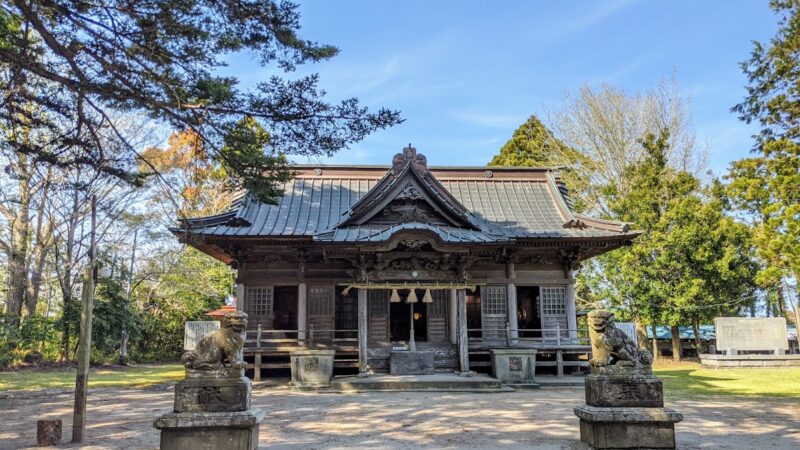
The current shrine building was constructed in 1687 (Jōkyō 4) and is designated as a tangible cultural property of Chiba Prefecture. According to the ridge beam inscription, the main hall was completed in March of that year, followed by the worship hall and offering hall in August.
The most distinctive feature of the shrine is its rare Gongen-zukuri style, entirely painted in black lacquer. This complex shrine, connecting the main hall and worship hall with the offering hall, boasts a majestic presence that embodies the pinnacle of Edo period architectural technology, overwhelming visitors. The lustrous shine of the black lacquer conveys a timeless beauty.
Deity Tamayorihime-no-Mikoto and Divine Virtues
Legend of the Sea Goddess
The deity enshrined at Tamasaki Shrine is Tamayorihime-no-Mikoto. Tamayorihime-no-Mikoto is the mother of Emperor Jimmu and a goddess known as the daughter of the sea god. According to legend, Tamayorihime-no-Mikoto landed on Kujukuri Beach by riding a wave, and it is said that she came to be enshrined in this place.
The name “Tamasaki” means “the princess who serves as a vessel for the jewel (soul),” and she has been revered as a sacred being inhabited by a divine spirit. Combined with its location facing the sea, it is also deeply revered as a guardian deity of the sea and a god of safe voyages.
Benefits as a Shrine for the Protection of Women
Because Tamayorihime-no-Mikoto is a female deity, Tamasaki Shrine has been known since ancient times as a shrine that protects women, especially motherhood. The main benefits are as follows:
- Matchmaking: Believed to have the power to bring good relationships, many women visit the shrine.
- Childbearing/Fertility: Fulfills the wishes of couples who wish to have children.
- Safe Childbirth: Protects pregnant women for safe childbirth.
- Child Rearing: Watches over the healthy growth of children.
- Good Fortune and Prosperity: Enhances luck in all aspects of life.
- Business Prosperity: Leads to the development and success of businesses.
Especially for prayers for safe childbirth, there is a custom of visiting on the “Day of the Dog,” and the shrine publishes a calendar of the Day of the Dog for the convenience of visitors.
Eastern Starting Point of the Ley Line and a Power Spot
What is the Path of the Sunrise/Ley Line?
The biggest reason why Tamasaki Shrine is attracting attention as one of the leading power spots in the Kanto region is that it is located at the eastern starting point of the “Path of the Sunrise/Ley Line.”
A ley line refers to the phenomenon where sacred sites and spiritual places are aligned in a straight line. This ley line, starting from Tamasaki Shrine, aligns the following sacred sites in a straight line with the direction of sunrise on the spring and autumn equinoxes:
- Tamasaki Shrine (Ichinomiya-machi, Chiba Prefecture)
- Samukawa Shrine (Samukawa-machi, Kanagawa Prefecture)
- Mount Fuji Summit (Shizuoka and Yamanashi Prefectures)
- Moto-Ise Kono Shrine (Miyazu City, Kyoto Prefecture)
- Izumo Taisha Shrine (Izumo City, Shimane Prefecture)
This arrangement is unlikely to be a coincidence, and it has been suggested that ancient people may have intentionally placed these sacred sites.
The Most Auspicious Direction in Feng Shui
From a Feng Shui perspective, Tamasaki Shrine is considered to be located in the “most auspicious direction” from Tokyo. East is the direction from which the sun rises, symbolizing new beginnings, growth, and development.
For this reason, worshippers come from all over Japan to pray for good fortune and business prosperity, and it is particularly known for its strong devotion among business owners and entrepreneurs. As a place where positive energy gathers, it is also a popular spot for power spot enthusiasts.
Highlights and Cultural Assets of the Shrine Grounds
Black Lacquered Main Hall and Worship Hall
As mentioned above, the shrine buildings of Tamasaki Shrine are built in a rare style, entirely covered in black lacquer, and their majestic beauty is well worth seeing. The Gongen-zukuri style complex shrine buildings, with the main hall, offering hall, and worship hall integrated into one structure, demonstrate the high level of architectural technology of the Edo period.
Matsuo Basho’s Haiku Monument
Within the shrine grounds is a haiku monument inscribed with a poem attributed to the renowned haiku poet Matsuo Basho during his visit to Tamasaki Shrine. Basho is said to have visited this place during his journey chronicled in “Kashima Kiko,” making it an interesting spot for history and literature enthusiasts.
Grove of Podocarpus macrophyllus
The shrine grounds are home to a magnificent grove of giant Podocarpus macrophyllus trees, a testament to the shrine’s long history. Podocarpus macrophyllus is a warm-climate evergreen tree, and these trees, having grown over many years, further enhance the sacred atmosphere of the shrine grounds.
Sacred Tree and Subsidiary Shrines
Within the shrine grounds is a large tree revered as a sacred tree, and it is believed that touching its vitality will bring good fortune. Furthermore, several subsidiary shrines are enshrined within the grounds, each with its own unique divine blessings.
Kazusa Twelve Shrine Festival and Kazusa Kagura
The Largest Festival in Kujukuri
Held every September, the Kazusa Twelve Shrine Festival is the largest festival in the Kujukuri region, centered around Tamasaki Shrine. Over a dozen portable shrines from twelve shrines in Kazusa Province gather at Tamasaki Shrine, and the sight of young men, bare-chested, galloping across the vast ocean of Kujukuri against this backdrop is both magnificent and breathtaking.
This festival is an important event that conveys the history and culture of the region to the present day, attracting many tourists and photography enthusiasts. The procession of the portable shrines along the coast is a sight unique to Tamasaki Shrine, which enshrines the god of the sea.
Chiba Prefecture Intangible Folk Cultural Property: Kazusa Kagura
At Tamasaki Shrine, Kazusa Kagura is performed seven times a year. This Kagura is designated as an Intangible Folk Cultural Property of Chiba Prefecture, and its ancient and elegant dance and music are offered to the gods.
Kagura can be considered the prototype of traditional Japanese performing arts, and the dances that express the world of mythology invite viewers into a sacred world. If you have the opportunity to see it during the festival, we highly recommend experiencing it.
Information for Visitors
Access
Access by Train
- Approximately 8 minutes on foot from JR Sotobo Line “Kazusa-Ichinomiya Station”
- Signposts are installed from the station to the shrine, so you can arrive without getting lost.
Access by Car
- Approximately 5 minutes from Kujukuri Toll Road “Ichinomiya IC”
- Approximately 20 minutes from Ken-O Expressway “Mobara-Chonan IC”
- Free parking available (approximately 50 regular cars)
Visiting Hours and Shrine Office
- Visiting Hours: The shrine grounds are open 24 hours a day.
- Shrine Office: 8:30 AM to 5:00 PM (may vary depending on the season)
- Prayer Reception: 9:00 AM to 4:30 PM
Main Prayers
The following prayers are available at Tamasaki Shrine.
- Prayer for safe childbirth (Day of the Dog)
- First shrine visit (Omiyamairi)
- Shichi-Go-San (7-5-3) ceremony
- Exorcism/Protection from evil
- Traffic safety
- Business prosperity
- Family safety
- Prayer for passing exams
If you wish to have a prayer performed, we recommend contacting us by phone in advance.
Items and Amulets
Tamasaki Shrine offers a variety of items.
- Matchmaking Amulet: An amulet to attract good relationships
- Safe Childbirth Amulet: An amulet to protect the safety of pregnant women
- Childbearing Amulet: An amulet to be blessed with children
- Good Fortune Amulet: An amulet to improve one’s luck
- Goshuin (Shrine Seal): You can receive a Goshuin with beautiful calligraphy.
Goshuin are especially popular as a memento of your visit, and special seasonal Goshuin are sometimes offered.
Nearby Tourist Attractions
Kujukuri Beach
Within walking distance of Tamasaki Shrine lies Kujukuri Beach, one of Japan’s most representative coastlines. This approximately 66km-long sandy beach is world-renowned as a surfing mecca, and Ichinomiya Town is also known as a “surfer’s paradise.”
After visiting the shrine, we recommend strolling along the coast or enjoying seafood cuisine. Visiting the coast at sunrise, in particular, will allow you to more deeply appreciate the significance of Tamasaki Shrine as the starting point of a ley line.
Ichinomiya Town Tourist Facilities
- Tsurigasaki Beach: A sacred site used as the surfing venue for the Tokyo 2020 Olympics
- Ichinomiya Beach: Enjoy swimming and marine sports
- Michi-no-Eki “Tsudoi-no-Sato Mutsuzawa”: Local specialty products can be purchased
Kujukuri Power Spot Tour
The Kujukuri region, including Tamasaki Shrine, is dotted with numerous power spots and temples and shrines. A stamp rally for the “Kujukuri Power Spot: Seven Lucky Gods of the Beach” is also held, making it a fun experience to spend a day visiting the shrines.
Annual Events and Festivals
Tamaki Shrine holds various festivals and ceremonies throughout the year.
- January 1st: New Year’s Day Festival (a festival celebrating the New Year)
- February 3rd: Setsubun Festival (bean-throwing ceremony)
- March (Spring Equinox): Spring Festival
- July 31st: Summer Purification Ceremony
- September 13th: Kazusa Twelve Shrines Festival (Grand Festival)
- September (Autumn Equinox): Autumn Festival
- November: Shichi-Go-San Festival
- December 31st: Great Purification Ceremony and New Year’s Eve Festival
Also, in Ichinomiya Town, the Ichinomiya Town Summer Fireworks Festival is held in the summer, with fireworks launched from the coast illuminating the night sky.
Guidelines for Visiting Tamasaki Shrine
Correct Worship Etiquette
- Bow before passing through the torii gate: A courtesy before entering the sacred area.
- Purify yourself at the water basin: Purify your left hand, right hand, and mouth in that order.
- Walk along the edge of the path: The center is considered the path of the gods.
- Etiquette at the main hall: Two bows, two claps, and one bow are the basics.
- Be quiet on the shrine grounds: Remember that this is a sacred place.
Visiting as a Power Spot
Tamaki Shrine, the starting point of a ley line, is especially recommended for early morning visits. By visiting at sunrise, you can feel the energy of the rising sun in the east most strongly.
Also, the spring and autumn equinoxes are special days when sacred sites on the ley line and the sun align in a straight line. Visiting on these days is said to allow you to receive even more powerful energy.
Summary of the Charms of Tamasaki Shrine
Tamaki Shrine, with its history spanning over 1200 years, is a prestigious shrine that embodies the essence of Japanese shrine culture, serving as the Ichinomiya (first-ranked shrine) of Kazusa Province. As a guardian deity for women, it offers blessings for matchmaking, safe childbirth, and child-rearing. Due to its geographical location as the eastern starting point of a ley line, it is also known as a power spot for good fortune and business prosperity.
The shrine grounds offer numerous attractions, including a beautiful shrine building entirely covered in black lacquer, a haiku monument by Matsuo Basho, and a cluster of Japanese yew trees. Traditional events such as the Kazusa Twelve Shrines Festival and Kazusa Kagura (sacred dance) are also preserved.
Combined with its stunning location on Kujukuri Beach, it’s a fascinating shrine where you can enjoy both worship and sightseeing simultaneously. While easily accessible for a day trip from Tokyo, Tamasaki Shrine, with its deep history and powerful energy, is undoubtedly one of the most important sacred sites in the Kanto region that you should visit at least once.
Whether you’re praying for a successful marriage, safe childbirth, good fortune at a turning point in your life, or simply interested in traditional Japanese culture and history, this shrine offers something for everyone. Be sure to visit Tamasaki Shrine at least once and experience its sacred atmosphere and power for yourself.