Inari Shrine (Yamamoto, Godai, Hirosaki City, Aomori Prefecture) | Complete Guide to History, Benefits, and Access
Located in Yamamoto, Godai, Hirosaki City, Aomori Prefecture, Inari Shrine is a historic shrine long cherished by local residents. This article provides detailed information you should know before visiting, including the shrine’s historical background, benefits, features of the grounds, how to worship, and access information.
Basic Information on Inari Shrine (Yamamoto, Godai, Hirosaki City)
Location: Yamamoto, Godai, Hirosaki City, Aomori Prefecture
Main Deity: Ukanomitama-no-kami
Shrine Rank: Village Shrine (Former Shrine Rank)
Annual Festival Date: Varies by region, but generally the annual festival is held in spring and autumn.
The Godai area of Hirosaki City is located in the fertile agricultural region of the Tsugaru Plain, and has long been a thriving area for agriculture, primarily rice cultivation. The Inari Shrine located in this area has a long history as a center of local faith, praying for a bountiful harvest.
History and Origins of the Inari Shrine
Background of Founding
The origin of Inari shrines lies in the Inari faith, which is said to have over 30,000 shrines throughout Japan. The head shrine is Fushimi Inari Taisha in Kyoto, founded in 711 AD during the Nara period.
While the specific founding date of the Inari Shrine in Yamamoto, Godai, Hirosaki City, is known through local historical documents and oral traditions, it is believed to have been built during the Edo and Meiji periods, coinciding with the development of the region and agricultural progress, to pray for a bountiful harvest and peace in the area.
Inari Faith in the Tsugaru Region
The Tsugaru region has a history of development as a castle town of the Hirosaki Domain. From the Edo period onward, an economy based on agriculture prevailed, and Inari faith was widely accepted not only by farmers but also by merchants and artisans.
Inari, originally worshipped as a god of agriculture and grain, has come to be revered over time as a god of business prosperity, family safety, and industrial development. The Inari Shrine in the Godai district of Hirosaki City has also become deeply rooted in the local community within this evolution of faith.
Development since the Modern Era
Due to the Meiji-era reform of the shrine system, shrines throughout Japan were reorganized under a shrine ranking system. The Inari Shrine in Yamamoto, Godai, Hirosaki City, was designated a village shrine and officially recognized as the local guardian deity.
Although the shrine ranking system was abolished by the post-war Shinto Directive, shrines continue to be carefully preserved to this day as places of worship for local residents and as centers of the local community.
Main Deity and Benefits
Ukanomitama-no-kami
Ukanomitama-no-kami, the main deity of Inari shrines, is a god who presides over food and grains, appearing in the Kojiki and Nihon Shoki. “Uka” means grain or food, and “Mitama” represents a divine spirit.
This deity is said to be the child of Susanoo-no-Mikoto and Kamu-Oichihime, and is a central figure in Inari worship.
Main Benefits
At the Inari Shrine in Yamamoto, Godai, Hirosaki City, the following benefits are worshipped:
Abundant Harvest and Agricultural Prosperity
This is the benefit of Inari as an agricultural deity, the original divine nature of the god. Prayers can be offered for abundant harvests and safety in agricultural work.
Business Prosperity and Development
Since the Edo period, worship has spread as a god of commerce. Many worshippers visit to pray for business success and development.
Family Safety and Health
It is believed that the deity protects the peace of the home and the health of all family members.
Good Fortune and Fulfillment of Wishes
It is believed that the deity brings good fortune in all aspects of life and has the power to grant various wishes. Protection from Evil and Misfortune
This shrine offers protection from disaster and misfortune, ensuring peaceful days.
Highlights of the Shrine Grounds
Features of the Shrine Building
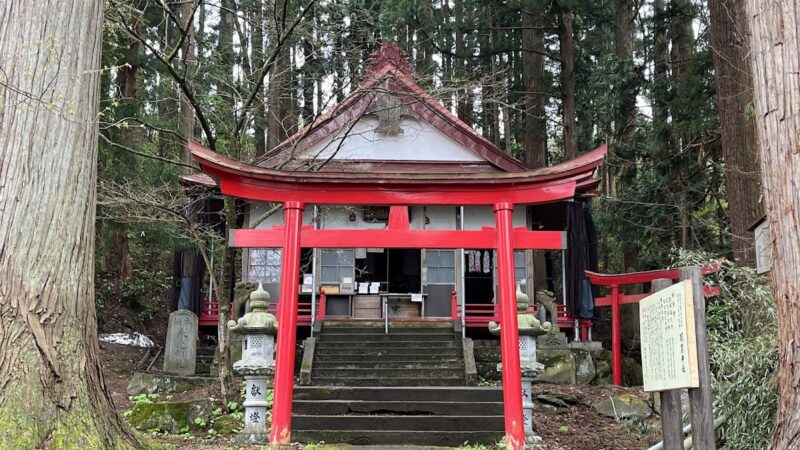
The shrine building of Inari Shrine in Yamamoto, Godai, Hirosaki City, preserves the traditional style of shrine architecture in the Tsugaru region. It features a robust construction adapted to the climate of Aomori Prefecture, a heavy snowfall area.
In front of the shrine building are stone statues of foxes, the symbol of Inari shrines. Foxes, considered messengers of the Inari god, have been cherished since ancient times as beings that convey the will of the gods to people.
Torii Gate and Approach
A vermilion torii gate stands at the entrance to the shrine, guiding worshippers into the sacred area. Vermilion (red) is the typical color of torii gates at Inari shrines, symbolizing protection from evil and vitality.
The approach to the shrine is meticulously maintained by local residents, preserving an environment where visitors can appreciate the changing seasons and nature.
Natural Environment of the Shrine Grounds
The Godai area is located in a rural area of the Tsugaru Plain, surrounded by a picturesque rural landscape. Trees are planted within the shrine grounds in harmony with the local environment, offering particularly beautiful scenery during the fresh greenery of spring and the vibrant autumn foliage.
How to Worship and Manners
Basic Worship Etiquette
Here are some basic manners for visiting an Inari shrine:
1. How to Pass Through the Torii Gate
Bow before passing through the torii gate. The torii gate is the entrance to the sacred area, and showing respect is important.
2. How to Walk Along the Approach
The center of the approach is called “seichu” and is considered the path of the gods. It is polite for worshippers to walk to either the left or right side.
3. Purification at the Water Basin
If there is a water basin, purify yourself in the following order:
- Hold the ladle in your right hand and purify your left hand.
- Switch the ladle to your left hand and purify your right hand.
- Switch the ladle back to your right hand, receive water in your left hand, and rinse your mouth.
- Purify your left hand again.
- Hold the ladle upright, purify the handle, and return it to its original position.
4. Worship at the Main Hall
Worship using the general “two bows, two claps, one bow” method:
- Place your offering in the offering box.
- Ring the bell if there is one.
- Bow deeply twice.
- Clap your hands twice.
- State your wish silently.
- Finally, bow deeply once.
5. Departure
After exiting the torii gate, turn around and bow towards the shrine.
Attire for Visiting the Shrine
Unless it’s a special festival, everyday clothes are acceptable for visiting the shrine. However, to show respect to the gods, please dress neatly and cleanly.
Annual Events and Festivals
New Year’s Visit (January 1st-3rd)
Hatsumode (first shrine visit of the year) is an important event at Inari shrines, where people pray for safety and peace throughout the year. Families from the community visit the shrine to pray for a bountiful harvest, business prosperity, and family safety in the new year.
Spring Grand Festival
With the arrival of spring, a festival is held to pray for a good harvest before the start of farming. This is an important festival unique to agricultural areas, where people ask the gods for safety during rice planting and a bountiful harvest.
Autumn Grand Festival
This festival, held in the autumn harvest season, is a time to give thanks for the year’s harvest. Along with expressing gratitude for the bountiful harvest, prayers are offered for a good harvest in the coming year. In some regions, portable shrines and dedication ceremonies may be held.
Hatsuumasai Festival (First Horse Day in February)
The Hatsuumasai Festival is a festival unique to Inari shrines. Held on the first Horse Day of February, it is an important festival originating from the founding date of Fushimi Inari Taisha Shrine. It is bustling with worshippers praying for business prosperity and family safety.
Access Information
Location
Address: Yamamoto, Godai, Hirosaki City, Aomori Prefecture
Access by Car
From Hirosaki City Center:
- Approximately 15 minutes (approx. 8km) from Hirosaki Station
- Via National Route 7 towards Godai
From the Expressway:
- Approximately 20 minutes from the Tohoku Expressway “Owani-Hirosaki IC”
- Via National Route 7 towards the Godai area
Parking: There is parking space for visitors on or around the temple grounds (spaces may be limited)
Access by Public Transportation
By Bus:
- Take a Konan Bus from Hirosaki Station Bus Terminal
- Board a bus bound for Godai
- Get off at the nearest bus stop and walk for a few minutes
*Please check the Konan Bus timetable in advance, as bus services may be limited.
Important Notes Regarding Access
Winter (December-March)
Aomori Prefecture is a heavy snowfall area, so please be extremely careful of snow and ice on the roads during winter. Snow tires are essential. The shrine grounds may also be covered in snow, so please wear warm clothing and non-slip shoes.
Agricultural Season
During the spring rice planting season and autumn harvest season, agricultural vehicles may be using the surrounding roads. Please drive safely.
Nearby Tourist Attractions
Here are some nearby tourist attractions you might want to visit when you come to Inari Shrine in Yamamoto, Godai, Hirosaki City.
Hirosaki Castle and Hirosaki Park
Distance: Approximately 20 minutes by car from Inari Shrine
Hirosaki Castle, a symbol of Hirosaki City, is one of the 12 remaining original castles and is designated as a National Important Cultural Property. Its spring cherry blossom festival, in particular, is known as one of Japan’s three major cherry blossom viewing spots, with approximately 2,600 cherry trees in full bloom.
Iwaki-yama Shrine
Distance: Approximately 25 minutes by car from Inari Shrine
Located at the foot of Mt. Iwaki, also known as Tsugaru Fuji, this is the Ichinomiya (first-ranked shrine) of Tsugaru Province. With a history of over 1,200 years, it is revered as the most sacred site in the Tsugaru region.
Apple Orchards and Direct Sales Outlets
Distance: Scattered throughout the surrounding area
Hirosaki City is Japan’s top apple-producing region. There are many apple orchards around the Godai area, and in autumn, you can purchase freshly picked apples at direct sales outlets. Some orchards offer apple-picking experiences.
Tsugaru Traditional Crafts Museum
Distance: Approximately 15 minutes by car from Inari Shrine
This museum exhibits and sells traditional crafts of the Tsugaru region, such as Tsugaru lacquerware, Kogin embroidery, and Tsugaru pottery. Demonstrations and workshops are also held.
Characteristics of the Godai District, Hirosaki City
Regional History
The Godai district is a region where agriculture thrives, taking advantage of the fertile land of the Tsugaru Plain. It developed primarily from rice cultivation during the Edo period, and after the Meiji era, apple cultivation was introduced. Currently, it is a diversified agricultural area where both rice and apple cultivation are practiced.
Agriculture and Regional Culture
The culture of this region is closely intertwined with the agricultural cycle. Seasonal agricultural work—rice planting in spring, weeding in summer, rice and apple harvesting in autumn, and snow protection in winter—coexists with the region’s annual events, forming a unique culture.
Inari shrines have played an important role in this agriculture-centered community as spiritual centers for praying for abundant harvests and expressing gratitude for the harvest.
Basic Knowledge of Inari Faith
Origin of Inari Shrines
Inari faith is believed to have originated at Fushimi Inari Taisha in Kyoto during the Nara period. The name “Inari” originates from “Inari” (稲成) and “Inari” (稲生り), meaning the ripening of rice.
Foxes as Divine Messengers
There are various theories as to why foxes are considered divine messengers at Inari shrines, but the most likely explanation is that they were considered sacred because they prey on mice that damage crops, thus protecting agriculture.
The fox statues at Inari shrines often hold keys, jewels, rice stalks, or scrolls in their mouths, each with a different meaning:
- Key: Symbolizes the key to the rice storehouse or treasure
- Jewel (Jewel): Symbolizes the spiritual power to grant wishes
- Rice Stalk: Symbolizes a bountiful harvest
- Scroll: Symbolizes wisdom and learning
Inari Faith Across Japan
There are over 30,000 Inari shrines throughout Japan, making them the most numerous type of shrine in the country. These shrines are found not only in rural areas but also in urban areas, and are often invited to businesses and shopping districts as gods of business prosperity.
How to Make a Wish During Worship
Make a Specific Wish
When making a wish to the gods, it’s important to be as specific as possible, rather than making a vague wish. If you wish for “business prosperity,” clearly communicate in your heart what kind of prosperity you want. If you wish for “family safety,” specify what kind of health you wish for each family member.
Don’t Forget Gratitude
It’s important not only to make wishes but also to express gratitude for daily peace and small joys. The gods are not simply beings who listen to wishes; they are beings who watch over us every day.
Offer Thanks After Your Wish is Granted
When your wish is granted, it’s important to offer thanks. Expressing gratitude to the gods and reporting your success strengthens the bond of faith.
Connection with the Community
The Parishioners’ Organization and Shrine Maintenance
The Inari Shrine in Yamamoto, Godai, Hirosaki City, is carefully maintained by the local parishioners’ organization. Parishioners are local residents who worship the shrine’s guardian deity and support the shrine.
The parishioners support the shrine in various ways, including cleaning the grounds, preparing for festivals, and repairing the shrine buildings. It is this community cooperation that has allowed the shrine to be preserved throughout its long history.
Center of the Community
Shrines are not only religious facilities but also the center of the local community. Through festivals and events, they serve as a place for local residents to gather and interact.
Especially in rural areas facing depopulation and an aging population, shrines play a crucial role in maintaining community bonds.
Recommended Time to Visit
Spring (April-June)
Spring in Tsugaru, arriving with the melting snow, is a beautiful season of fresh greenery. Preparations for rice planting begin, and the entire community regains its vitality. Visiting Hirosaki Park in conjunction with the cherry blossoms is highly recommended.
Summer (July-August)
Summer, with its lush green rice fields, is a season where you can feel the vitality of rural life. However, precautions against the heat and insects are necessary.
Autumn (September-November)
This is Tsugaru’s most charming season, with its beautiful golden rice fields and bright red apples. You can feel the atmosphere of the region filled with the joy of harvest.
Winter (December-March)
The tranquil shrine grounds, covered in snow, have a solemn atmosphere. The New Year’s visit period is special, but sufficient precautions against snow and cold are necessary.
Guidelines for Visiting Inari Shrines
Respect and Gratitude
The most important thing when visiting a shrine is a heart of respect and gratitude towards the gods. Formal etiquette is important, but even more important is a heartfelt reverence.
Recognition as a Sacred Place
The shrine grounds are a sacred place where the gods reside. Please refrain from making loud noises or engaging in inappropriate behavior.
Consideration for the Natural Environment
Please take your trash with you and cherish the natural environment of the shrine grounds. Protecting the shrine’s environment is an important role for visitors.
Summary
Inari Shrine in Yamamoto, Godai, Hirosaki City, Aomori Prefecture, is a historical shrine deeply rooted in the local community, situated in the rich agricultural region of Tsugaru. It offers various blessings, including abundant harvests, business prosperity, and family safety.
Visiting it in conjunction with famous tourist spots such as Hirosaki Castle and Iwakiyama Shrine will allow you to gain a deeper understanding of the history and culture of the Tsugaru region. Why not quietly pray in the shrine grounds, surrounded by the beautiful nature of the four seasons, and pray for daily peace and happiness?
This shrine, cherished and protected by the local community, teaches visitors the warm hearts of Tsugaru and the value of traditional Japanese life centered on agriculture. Please do visit sometime.