Eifuku-ji Temple (Chiba Prefecture) Complete Guide | An Ancient Temple Associated with the Chiba Clan, Known for its Sakao Cherry Blossoms
Eifuku-ji Temple, located in Omiya-cho, Wakaba-ku, Chiba City, is an ancient Tendai sect temple boasting a history of approximately 900 years. Known as a temple associated with the Chiba clan, its beautiful weeping cherry tree, known as “Sakao Cherry Blossoms,” attracts many visitors every year. This article provides a detailed introduction to Eifuku-ji Temple, from its history and highlights within the temple grounds to its cultural assets and access methods.
Overview of Eifuku-ji Temple
Eifuku-ji Temple is a Tendai sect temple located at 3869 Omiya-cho, Wakaba-ku, Chiba City, Chiba Prefecture. Its mountain name is Sakao-san, and its official name is Sakao-san Eifuku-ji. As a direct branch temple of Enryaku-ji Temple of the Tendai sect, it is located approximately 5 km southeast of Chiba city center, and the surrounding area formerly belonged to Chiba-sho Ikeda-go.
The principal image is Amida Buddha, and the temple grounds contain various buildings including the main hall, the temple gate, and the Myoken Jizo Hall. Known as “ancient temple where one can experience the atmosphere of an ancient capital while remaining in Chiba,” its grounds and architecture strongly reflect the atmosphere of an ancient capital.
History of Eifuku-ji Temple
Origin of its Founding
The history of Eifuku-ji Temple dates back to the late Heian period. According to temple tradition, on September 22, 1130 (Daiji 5), four years after Chiba Tsuneshige established his residence at Chiba Castle in 1126 (Daiji 1), Sakao Goroji, a retainer of the Chiba clan, enshrined Myoken-son, the guardian deity of the Chiba family, on Sankakuyama in the former Nagamine Village, west of the present temple grounds. This is considered the origin of the temple.
On May 22, 1131 (Tensho 1), Hokutozan Kongoju-ji Temple and Omiya Gongen Shrine were established. This founding period coincides with the Chiba clan’s expansion of power in Boso, suggesting that the temple developed as a symbol of the Chiba clan’s faith and authority.
Conversion from Shingon to Tendai Buddhism
Eifuku-ji Temple was originally a Shingon Buddhist temple, but it underwent a major turning point on January 17, 1625 (Kanei 2). The then-chief priest, Kaiun, converted to the Tendai sect under the tutelage of Tenkai Sojo, and along with 28 neighboring branch temples, converted to the Tendai sect. At this time, the temple’s name was changed to Nyoizan Yofuku-ji Muryoin, and the principal image became Amida Buddha.
Tenkai Sojo was a highly respected priest known as a key advisor to Tokugawa Ieyasu, and played a significant role in the expansion of the Tendai sect’s influence in the early Edo period. It is believed that Abbot Kaiun’s devotion and conversion were closely related to the religious policies of the time.
Developments after the Edo Period
After converting to the Tendai sect, Eifuku-ji Temple functioned as a direct branch temple of Enryaku-ji Temple and as a central Tendai temple in the region. It held a position of overseeing 28 neighboring branch temples and played a religiously and socially important role.
Eifuku-ji Temple is said to have been founded by Gyoki, but the details of its history are unclear. It still coexists with Kumano Shrine within the same grounds, suggesting that it was once deeply revered as a form of Shinto-Buddhist syncretism. This tradition of Shinto-Buddhist syncretism is attracting attention as a valuable trace in the history of Japanese religion.
Highlights of the Temple Grounds
Main Gate
Upon entering the grounds of Eifuku-ji Temple, visitors are first greeted by a magnificent main gate. Located at the front of the temple, the main gate plays an important role as the entrance to the temple grounds. Upon passing through the temple gate, a tranquil atmosphere unfolds, allowing you to forget the hustle and bustle of the city.
Main Hall
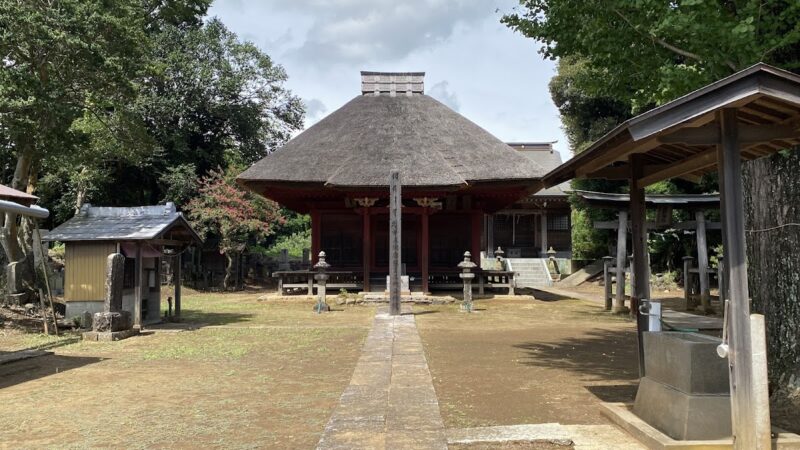
The main hall is located in the center of the temple grounds and houses the principal image, Amida Buddha. Daily services are performed inside, making it the center of faith for parishioners. The main hall’s architectural style exhibits characteristics of traditional temple architecture, and its solemn atmosphere leaves a deep impression on visitors.
Myoken Jizo Hall
The Myoken Jizo Hall is one of the important buildings on the temple grounds. It is an old-style building, and the front porch is adorned with carvings of three dragons and celestial maidens. These carvings are crafted with exquisite skill, demonstrating the high level of craftsmanship of the Edo period.
Myoken worship has deep ties to the Chiba clan, and the Myoken Jizo Hall is important evidence that Eifuku-ji Temple is a temple associated with the Chiba clan. Myoken Bodhisattva is enshrined inside, and many worshippers still visit the hall today.
Sakao’s Cherry Blossom (Weeping Cherry)
The biggest highlight of Eifuku-ji Temple is the weeping cherry tree known as “Sakao’s Cherry Blossom” within the temple grounds. Upon entering the grounds, a gigantic weeping cherry tree immediately catches the eye. It is said that this cherry tree was planted in gratitude for the recovery of the wife of Sakao Goroji, the temple’s founder.
Every spring, it blooms magnificently, delighting visitors. During peak bloom, it attracts approximately 3,000 visitors, making it a popular cherry blossom viewing spot and widely known as one of Chiba City’s representative cherry blossom locations. The elegant appearance of the weeping cherry tree is also popular with photography enthusiasts, and many beautiful photos are shared on social media.
Himezakura (Princess Cherry)
Along with the weeping cherry tree, Himezakura (princess cherry) trees are also planted on the temple grounds. These are also said to have been planted in gratitude for the recovery of Sakao Goroji’s wife. They are a different variety from the weeping cherry tree, and each offers its own unique beauty.
Coexistence with Kumano Shrine
Eifuku-ji Temple still stands adjacent to Kumano Shrine within the same grounds, preserving the tradition of syncretism between Shinto and Buddhism. This coexistence, maintained even after the Meiji-era separation of Shinto and Buddhism, is rare and a valuable example of the region’s religious history.
Cultural Property
Eifuku-ji Yakushi-do Hall
Eifuku-ji Temple houses the Eifuku-ji Yakushi-do Hall, a cultural property designated by Chiba Prefecture. The Yakushi-do Hall is one of Eifuku-ji Temple’s important buildings, enshrining Yakushi Nyorai (the Medicine Buddha) as its principal deity. Yakushi Nyorai is widely worshipped as a Buddha for healing illnesses and praying for good health, attracting many visitors.
The architectural style and decoration of the Yakushi-do Hall retain many characteristics of Edo-period temple architecture and are considered to have high architectural historical value. It is protected as a cultural property of Chiba Prefecture, and regular restoration and preservation activities are carried out.
Sculpture and Decoration
The three sculptures of dragons and celestial maidens on the front of the Myoken Jizo Hall are an important element demonstrating the artistic value of Eifuku-ji Temple. These sculptures are believed to be the work of Edo period craftsmen, showcasing the high level of sculptural skill of the time. The expressions and movements of the dragons, and the graceful figures of the celestial maidens, captivate viewers.
The Relationship Between Eifuku-ji Temple and the Chiba Clan
Eifuku-ji Temple has deep ties to the Chiba clan. The Chiba clan was a samurai family that ruled the Boso region from the late Heian period to the Sengoku period, and their influence extended throughout the Kanto region. The origin of Eifuku-ji Temple lies in the time when Chiba Tsuneshige established his residence at Chiba Castle, and his retainer, Sakao Goroji, enshrined Myoken-son.
Myoken worship is known as the guardian deity worship of the Chiba clan, and Myoken shrines and Myoken halls were built at the Chiba clan’s various bases. The Myoken Jizo Hall at Eifuku-ji Temple is one such example, symbolizing the faith and authority of the Chiba clan.
Near Eifuku-ji Temple, the remains of Shiroyama Castle (Chiba Castle) also exist, indicating that this area was an important base for the Chiba clan. Visiting Eifuku-ji Temple allows you to experience the history and culture of the Chiba clan.
Annual Events and Memorial Services
Eifuku-ji Temple, as a Tendai sect temple, holds various annual events and memorial services. It plays an important role in supporting the religious lives of its parishioners and is a central figure in the local community.
During the cherry blossom season in spring, many visitors come, and the temple grounds become lively. Special memorial services and events are sometimes held during this time, making it an important annual event for the local people.
The temple grounds are equipped with memorial service facilities and a multi-purpose hall, providing facilities to accommodate various memorial services and events.
Cemetery and Burial Grounds
Eifuku-ji Temple also functions as a temple cemetery, with general burial plots available. In a tranquil environment surrounded by lush greenery, you can pay your respects at your own pace. This is a temple cemetery operated by the religious corporation Eifuku-ji, and membership in the temple is required.
The temple grounds have ample parking, making it easy to visit by car. There are also facilities for memorial services, allowing you to perform both grave visits and memorial services in the same location.
The cemetery is properly managed by the temple, maintaining a clean and well-maintained environment. From the cemetery, you can enjoy views of the surrounding nature, creating a peaceful setting for remembering your loved ones.
Access Methods
Access by Train and Bus
To access Eifuku-ji using public transportation, it is convenient to take a bus from JR Chiba Station. Take a bus from Chiba Station and get off at the “Sakao” bus stop. Eifuku-ji is approximately a 5-minute walk from the bus stop.
The nearest station is Omoridai Station on the Keisei Chihara Line. From the station, you can access the temple on foot or by taxi. Since there is a certain distance from Omoridai Station to Eifuku-ji, it is recommended to allow ample time for your visit.
Access by Car
If you are coming by car, it’s about a 10-minute drive from the Keisei Chihara Line’s “Omoridai Interchange.” It’s located about 5km southeast of Chiba city center and is easily accessible from major roads.
There is a parking lot on the temple grounds, so you can visit by car. During peak seasons such as cherry blossom season, when crowds are expected, it is recommended to visit earlier in the day.
Location
Address: 3869 Omiya-cho, Wakaba-ku, Chiba City, Chiba Prefecture
The surrounding area is a quiet environment where residential areas and nature harmonize. Despite its easy access from urban areas, it maintains a peaceful atmosphere.
Points to Note When Visiting
Best Time to See Cherry Blossoms
If you’re visiting Eifuku-ji Temple, cherry blossom season is highly recommended. Every year, from late March to early April, the weeping cherry trees reach full bloom, painting the temple grounds in a beautiful pink hue. During peak season, approximately 3,000 cherry blossom viewers visit, so aiming for less crowded times, such as weekday mornings, will allow you to enjoy the blossoms at your leisure.
Strolling the Temple Grounds
The temple grounds are spacious, allowing for a leisurely stroll. From the main gate to the main hall, Myoken Jizo Hall, and cherry trees, you can experience the atmosphere of this ancient temple with its approximately 900-year history.
Photography
There are numerous photo opportunities, including the weeping cherry trees and the carvings on the Myoken Jizo Hall. The cherry blossom season is especially ideal for photography, attracting many photography enthusiasts. However, please be mindful of other visitors and observe proper etiquette when taking photos.
Etiquette for Visiting
Eifuku-ji Temple is an active temple and a place of worship for its parishioners. Please maintain silence and be considerate of other visitors during your visit. It is important to observe basic manners, such as refraining from eating, drinking, and smoking on the temple grounds, and always taking your trash with you.
Nearby Attractions
Shiroyama Castle (Chiba Castle)
The remains of Shiroyama Castle are located near Eifuku-ji Temple. As a castle site associated with the Chiba clan, visiting it along with Eifuku-ji Temple will allow you to gain a deeper understanding of the Chiba clan’s history.
Kumano Shrine
Kumano Shrine, adjacent to the same grounds as Eifuku-ji Temple, is also worth a visit. It is a valuable place that preserves the tradition of syncretism of Shinto and Buddhism, and visiting it along with Eifuku-ji Temple will allow you to feel the diversity of Japanese religious culture.
Nature in Wakaba Ward, Chiba City
Wakaba Ward in Chiba City, where Eifuku-ji Temple is located, is an area that retains abundant nature despite being an urban area. There are many parks and green spaces in the surrounding area, so you can enjoy nature walks in conjunction with your visit to Eifuku-ji Temple.
Summary of the Charms of Eifuku-ji Temple
Eifuku-ji Temple, a Tendai sect temple with a history of approximately 900 years, is one of the representative temples of Chiba Prefecture’s religious culture. It boasts many attractions, including its historical value as a temple associated with the Chiba clan, the beautiful weeping cherry tree known as “Sakao no Sakura,” and the Myoken Jizo Hall with its intricate carvings.
While it is a popular spot attracting around 3,000 visitors during the spring cherry blossom season, it usually maintains a quiet and peaceful atmosphere, providing a tranquil environment for worship. It is easily accessible from Chiba city center, both by car and public transport.
As a direct branch temple of Enryaku-ji Temple of the Tendai sect, it remains an active temple supporting the faith of its parishioners and continuing traditional religious activities. At the same time, it is protected as an important cultural property that conveys the history and culture of the region, a valuable entity to be passed down to future generations.
When visiting Chiba Prefecture, be sure to visit Eifuku-ji Temple and experience its history and beauty. A visit during cherry blossom season is especially special and will surely create unforgettable memories.
Visitor Feedback
Visitors to Eifuku-ji Temple have shared comments such as, “The weeping cherry trees in the temple grounds were truly beautiful,” “The carvings in the Myoken Jizo Hall are wonderful,” and “I was able to pray peacefully in a quiet and tranquil atmosphere.”
Especially during cherry blossom season, many visitors comment, “I never thought I could see such beautiful cherry blossoms in Chiba City,” and “I visit every year, but I’m always moved.” Furthermore, many visitors seem interested in the historical and cultural aspects, saying things like, “It was good to learn about the history of the Chiba clan,” and “I was interested in the fact that the tradition of Shinto-Buddhist syncretism remains.”
Summary
Sakao-san Eifuku-ji Temple is an ancient Tendai sect temple located in Wakaba Ward, Chiba City, boasting a history of approximately 900 years. It is beloved by many as a temple associated with the Chiba clan and as a famous cherry blossom viewing spot known as “Sakao’s Cherry Blossoms.”
Since its founding in 1130, Eifuku-ji Temple has served as a center of local faith, undergoing a conversion from Shingon Buddhism to Tendai Buddhism. The temple grounds boast numerous attractions, including the main hall, Myoken Jizo Hall, and beautiful weeping cherry trees, as well as the Yakushi-do Hall, a Chiba Prefecture designated cultural property.
Access is convenient, with bus service from JR Chiba Station and ample parking available for those traveling by car. While it’s a popular spot attracting around 3,000 visitors during the spring cherry blossom season, it offers a quiet and peaceful atmosphere for worshippers in other seasons as well.
We recommend a visit to Eifuku-ji Temple for those who wish to experience Chiba Prefecture’s history and culture, enjoy beautiful cherry blossoms, or find peace in a tranquil temple.