Complete Guide to Nishisaka Shrine (Katori City, Chiba Prefecture) | A Thorough Explanation of the Main Hall (a Prefectural Designated Cultural Property) and its History
Nishisaka Shrine, located in the Nishisaka district at the western edge of Katori City, Chiba Prefecture, is a historic shrine said to have been founded during the Hakuhō period. Affectionately known locally as “Nishisaka Ōkami” or “Nishisaka no Myōjin-sama,” its main hall, designated a prefectural cultural property, preserves a valuable architectural style. This article provides a detailed explanation of Nishisaka Shrine’s history, cultural value, enshrined deities, highlights, and access methods.
Basic Information on Nishisaka Shrine
Location and Overview
Location: Nishisaka area, Katori City, Chiba Prefecture
Deities Enshrined: Omodaru-no-Mikoto, Onamuchi-no-Mikoto, etc.
Founding: Traditionally believed to be in the 2nd year of the Hakuhō era (673)
Relocation to Current Location: 1st year of the Saikō era (854)
Other Names: Nishisaka Ōkami, Nishisaka no Myōjin-sama
Nishisaka Shrine is located at the western edge of Katori City and has a long history as a center of local faith. It is believed to have moved to its current location in the 1st year of the Saikō era (854) during the Heian period, making it one of the oldest shrines in Chiba Prefecture.
Cultural Property Designation Status
Type: Chiba Prefecture Designated Tangible Cultural Property (Building)
Designation Date: March 2, 1973
Designated Property: Nishisaka Shrine Main Hall (1 building)
Owner: Nishisaka Shrine
The Nishisaka Shrine Main Hall has been officially designated as an important cultural property of Chiba Prefecture by the Chiba Prefectural Board of Education. This indicates that its architectural and historical value has been highly evaluated.
Architectural Value of Nishisaka Shrine Main Hall
What is Sankensha Nagare-zukuri?
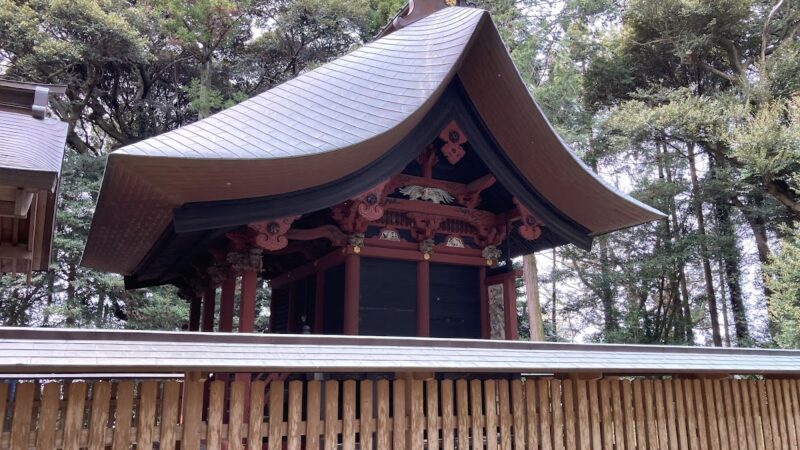
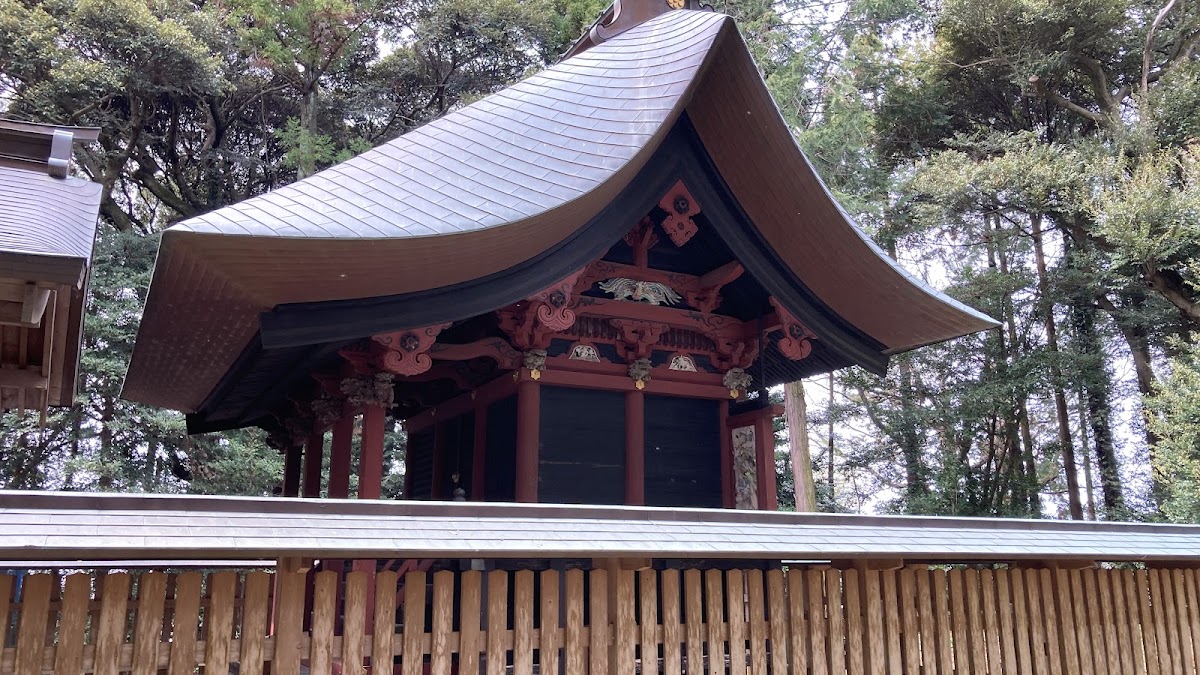
The Nishisaka Shrine Main Hall is built in the traditional architectural style called “Sankensha Nagare-zukuri.” This style is highly prestigious among shrine architecture and has the following characteristics:
Architectural Style Characteristics:
- Three-Bay Frontal Pillar Spacing: The main hall has three bays between the pillars on its front.
- Gable Roof: The roof is shaped like the Japanese character “へ” (he).
- Main Building (Moya): The main central part of the building.
- Fronting Pavement (Gohai): A projecting eaves extending from the front.
- Nagare-zukuri Roof: A roof that flows and extends towards the front.
This architectural style developed from the Muromachi period to the Edo period and is a rare style found only in a limited number of shrines in Chiba Prefecture.
Building Structure and Characteristics
The main hall of Nishizaka Shrine has a beautiful structure in which the main building and the fronting pavement are integrated. The steep slope of the gable roof not only provides excellent drainage for rainwater but also gives a powerful visual impression.
Structural Details:
- Columns: Thick timbers are used to create a structure that can withstand long-term loads.
- Jointwork: Complex wooden joinery distributes the weight of the roof.
- Sculptures: Decorative carvings are applied throughout.
- Painting: Protective paint applied using traditional techniques.
The entire building is designed with harmonious proportions, embodying the aesthetic sensibilities of Japanese architecture.
Preservation Status and Restoration History
Since its designation as a prefectural cultural property in 1973, the main hall of Nishisaka Shrine has been properly preserved and managed. Regular inspections and necessary restorations have preserved its original appearance as much as possible.
Wooden buildings are susceptible to moisture, insect damage, and deterioration over time, but the efforts of local residents have kept it in good condition. The Cultural Properties Protection Department of the Chiba Prefectural Board of Education also conducts regular condition checks, and necessary preservation measures are taken.
History and Origins of Nishisaka Shrine
Legend of Founding and the Hakuhō Period
Nishisaka Shrine is said to have been founded in the second year of the Hakuhō era (673). The Hakuhō period was a transitional period from the Asuka period to the Nara period, and this shrine is extremely old, having been founded during the formation of Japan’s ancient state.
During this period, with the formation of a centralized state, official roads were developed in the provinces, and shrines were built throughout the country. Nishizaka Shrine is thought to have originated as one of these ancient centers of worship.
Relocation during the Heian Period
Nishizaka Shrine is believed to have moved to its current location in the first year of the Saikō era (854). Saikō was a reigning era of Emperor Ninmyō, corresponding to the early Heian period.
The reason for the relocation is not clearly known, but the following possibilities can be considered:
- Floods or disasters: The need to relocate due to flooding of the Tone River system, etc.
- Settlement relocation: Relocation due to changes in people’s place of residence
- Discovery of a more suitable sacred site: Relocation to a place more appropriate as a sacred area
- Political reasons: Changes in the power structure at the time
Development from the Middle Ages to the Early Modern Period
From the Kamakura period to the Edo period, Nishizaka Shrine developed as the guardian shrine of the region. In particular, it is presumed that the current main hall was built during the Edo period, establishing its position as the center of local faith.
While the Katori region was under the influence of Katori Jingu Shrine, each settlement had its own guardian shrine, and Nishizaka Shrine was one of them, serving as a spiritual pillar of the local community.
Progress since the Modern Era
Even after the Meiji-era separation of Shinto and Buddhism, Nishizaka Shrine continued to exist as a local shrine. The designation as a prefectural cultural property in 1973 marked a significant milestone, officially recognizing its historical and architectural value.
It is still carefully preserved by local parishioners, and various festivals are held there throughout the year.
About the Deities
Omodaru-no-Mikoto
Omodaru-no-Mikoto is a deity appearing in Japanese mythology, one of the gods of land formation. In the Kojiki and Nihon Shoki, he is recorded as the sixth of the seven generations of the Age of the Gods.
Divine Aspects:
- A god symbolizing the completion of the land
- A god bringing stability to the earth
- A god protecting the foundation of agriculture
Onamuchi-no-Mikoto
Onamuchi-no-Mikoto is another name for Okuninushi-no-Mikoto, and is an important deity also known as the principal deity of Izumo Taisha Shrine.
Deities:
- God of nation-building
- God of agriculture and medicine
- God of matchmaking
- God of commercial prosperity
Meaning of the combination of enshrined deities
The combination of these enshrined deities embodies the intention to pray for the prosperity and stability of the region. It can be said that these deities personify the fundamental elements of the local community: the stability of the land (Omotaru-no-Mikoto) and the development of industry (Ōkuninushi-no-Mikoto).
Positioning as a cultural property of Katori City
Overview of cultural properties in Katori City
There are 186 cultural properties designated by the national, prefectural, and city governments within Katori City (latest data from the Reiwa era). This makes it one of the regions in Chiba Prefecture with a rich cultural heritage.
Major Cultural Properties of Katori City:
- National Treasure: Katori Shrine’s Sea Beast and Grape Mirror, etc.
- Nationally Designated Important Cultural Property: Katori Shrine’s Main Hall, Tower Gate, and many others
- Prefecturally Designated Cultural Property: Buildings, sculptures, ancient documents, etc., including the Nishisaka Shrine Main Hall
- City-Designated Cultural Property: Diverse cultural properties rooted in the local community
Importance as a Prefecturally Designated Cultural Property
The Nishisaka Shrine Main Hall is a cultural property recognized as particularly important by Chiba Prefecture. Prefecturally designated cultural properties are selected based on the following criteria:
- Historical Value: Represents or clearly demonstrates the characteristics of its era
- Academic Value: Important for research in architectural history, art history, history, etc.
- Rarity: Few similar cultural properties exist, making it valuable
- Regional Relevance: Important for understanding the history and culture of Chiba Prefecture
The Nishisaka Shrine Main Hall is evaluated as a building that meets all of these criteria.
Katori City’s Regional Plan for the Preservation and Utilization of Cultural Properties
Katori City has formulated a “Regional Plan for the Preservation and Utilization of Cultural Properties” based on the Cultural Properties Protection Law, and the main hall of Nishisaka Shrine is included in this plan.
Main contents of the plan:
- Appropriate preservation and management of cultural properties
- Promotion of public use
- Passing on to future generations
- Utilization for regional development
- Strengthening of disaster prevention and crime prevention measures
Through this plan, the main hall of Nishisaka Shrine is positioned not merely as an object to be preserved, but as a cultural resource that contributes to the revitalization of the region.
Highlights of Nishisaka Shrine
Architectural Beauty of the Main Hall
The greatest highlight is undoubtedly the main hall, a prefecturally designated cultural property. The three-bay nagare-zukuri style, viewed from the front, possesses a beautifully balanced proportion.
Points to Note:
- Roof Curve: The graceful curve of the roof.
- Carvings on the Front Porte: Carefully crafted decorative carvings down to the smallest detail.
- Woodworking Technique: Traditional joinery without the use of nails.
- Overall Balance: Harmony between the main building and the front porte.
Atmosphere of the Shrine Grounds
Nishisaka Shrine, nestled in the quiet environment of the Nishisaka district, has a tranquil atmosphere. Surrounded by ancient trees, the grounds allow visitors to experience the changing seasons.
Seasonal Charms:
- Spring: A season of fresh greenery and cherry blossoms, the grounds are full of vitality.
- Summer: A cool space enveloped in deep green.
- Autumn: A season of autumn leaves and gratitude for the harvest.
- Winter: A solemn atmosphere enveloped in silence.
As a Place of Local Worship
Nishisaka Shrine continues to function as a place of worship for the local people. Various festivals are held throughout the year, playing a role in strengthening the bonds of the local community.
Notes on Visiting and Viewing
Precautions During Your Visit
Nishisaka Shrine is a religious facility and a cultural property. Please observe the following points when visiting:
- Respectful Attitude: Observe proper etiquette as a worshipper.
- No Touching the Buildings: To protect the cultural property, do not touch the main hall or other structures.
- Photography: Photography is permitted on the grounds, but consideration is needed during religious ceremonies.
- Take Your Trash Home: Maintain cleanliness on the grounds.
- Quiet: Refrain from loud conversations.
Main Hall Public Access Status
The exterior of the main hall can be viewed at any time, but the interior is not usually open to the public. It may be opened on special occasions, so we recommend contacting the cultural property department of Katori City.
Etiquette for Visiting a Shrine
Following the basic etiquette for visiting a shrine will make your visit more fulfilling:
- Bow before passing through the torii gate.
- Purify your hands and mouth at the water basin.
- Avoid walking in the center of the approach to the shrine.
- Bow twice, clap twice, and bow once in front of the main hall.
- Bow once again at the torii gate on your way out.
Access Information
Location Details
Address: Nishisaka area, Katori City, Chiba Prefecture
*For specific street addresses, please contact Katori City Hall.
Access by Public Transportation
Nishisaka Shrine is located at the western edge of Katori City, making access by public transportation somewhat inconvenient.
Nearest Station:
- JR Narita Line, Omigawa Station or Shimosa-Tachibana Station
- Taxi or rental bicycle from the station is recommended.
Access by Car
From Tokyo:
- Approximately 30 minutes from the Daiei Interchange on the Higashi-Kanto Expressway
- Via National Route 51
From Narita:
- Approximately 40 minutes via National Route 356 and prefectural roads
Parking: There is parking space for visitors on the shrine grounds, but the number of spaces is limited.
Nearby Tourist Attractions
When visiting Nishisaka Shrine, we recommend also visiting other cultural properties and tourist attractions in Katori City.
Katori Shrine:
- Approximately 20 minutes by car
- One of the leading ancient shrines in the Kanto region, possessing numerous national treasures and important cultural properties
- The head shrine of approximately 400 Katori shrines nationwide
Ino Tadataka Memorial Museum:
- Approximately 25 minutes by car
- Exhibits the achievements of Ino Tadataka, the great figure who created the first accurate map of Japan
Townscape along the Ono River:
- A historical townscape retaining the atmosphere of the Edo period
- Important Preservation District for Groups of Traditional Buildings
Katori City’s Cultural Property Protection Initiatives
Cultural Property Protection System
In Katori City, the Cultural Properties Section of the Lifelong Learning Division of the Board of Education plays a central role in protecting and utilizing cultural properties within the city.
Main Activities:
- Regular Condition Surveys: Confirmation of the deterioration status of cultural properties
- Implementation of Restoration Projects: Preservation and repair as needed
- Public Awareness Activities: Holding lectures and tours for citizens
- Record Keeping: Detailed records using photographs and drawings
- Disaster Prevention Measures: Preparation for fires and earthquakes
Collaboration with the Community
The protection of Nishisaka Shrine requires the cooperation of local residents. The following activities are carried out, primarily by the parishioners’ organization:
- Daily cleaning and maintenance
- Continuation of annual events
- Environmental maintenance of the shrine grounds
- Fire and crime prevention monitoring
Thanks to these community efforts, Nishisaka Shrine remains in good condition.
Utilization of Cultural Properties
In Katori City, efforts are being made not only to preserve cultural properties but also to utilize them for regional development and education.
Examples of Use:
- Local history lessons for elementary and junior high school students
- Implementation of cultural heritage tours
- Dissemination of information as a tourist resource
- Creation of a digital archive
Annual Events of Nishisaka Shrine
Main Festivals
Nishisaka Shrine holds various festivals throughout the year. These are important events that preserve local traditions.
Main Annual Events:
- New Year’s Day Festival: Praying for peace in the new year
- Spring Grand Festival: Praying for the arrival of spring and a bountiful harvest
- Summer Purification Ceremony: Cleansing away the impurities of the past six months
- Autumn Grand Festival: Expressing gratitude for the harvest and praying for the prosperity of the region
- Year-End Purification Ceremony: Cleansing away the impurities of the past year and preparing for the new year
*Specific dates may vary from year to year.
Connections with the Community
These festivals are not merely religious ceremonies, but important opportunities to strengthen the bonds of the local community. As a place for intergenerational exchange, Nishisaka Shrine is an indispensable presence in the local community.
The Position of Nishisaka Shrine in Chiba Prefecture’s Shrine Architecture
Three-Bay Nagare-Zu Style Architecture in the Prefecture
While there are many shrines in Chiba Prefecture, only a limited number have a main hall built in the three-bay nagare-zukuri style. The main hall of Nishisaka Shrine is a valuable example, well-preserved and retaining many of the architectural features.
Architectural Historical Significance
The main hall of Nishisaka Shrine is an important document demonstrating the technological level of shrine architecture from the Edo period to the modern era. The following points demonstrate its academic value:
- Transmission of Techniques: An example of traditional woodworking techniques
- Regional Characteristics: Architectural features of the Shimousa region
- State of Preservation: Relatively well preserved from its original form
- Purity of Style: A typical example of the three-bay nagare-zukuri style
Comparative Architecture
The following buildings in Chiba Prefecture are comparable to the main hall of Nishisaka Shrine:
- Katori Shrine Main Hall (Nationally Designated Important Cultural Property)
- Tamasaki Shrine Main Hall (Prefecturally Designated Cultural Property)
- Other shrines with nagare-zukuri style main halls
Comparison with these buildings reveals differences in architectural styles across eras and regions.
Challenges and Future of the Cultural Heritage Site
Preservation Challenges
The main hall of Nishizaka Shrine, a wooden structure, faces the following challenges:
- Aging Deterioration: Natural aging of wood
- Climate Change: Impact of global warming
- Insect Damage: Risk of damage from termites, etc.
- Disaster Risk: Preparedness for earthquakes, typhoons, and fires
- Technical Skill Transfer: Shortage of successors to traditional restoration techniques
Preservation Efforts
The following measures are being taken to address these challenges:
- Regular inspections and early detection
- Implementation of preventative preservation measures
- Technical guidance by experts
- Development of disaster prevention equipment
- Thorough record keeping
Passing on to the Next Generation
To pass on cultural heritage to future generations, it is crucial not only to physically preserve it, but also to convey its value and significance to the next generation.
Initiatives for Inheritance:
- Utilization in school education
- Inheritance of traditional events to local children
- Recording and publication using digital technology
- Promoting participation of younger generations in the parishioner organization
Summary
Nishisaka Shrine is a historic shrine located in the Nishisaka district of Katori City, Chiba Prefecture, said to have been founded in 673 (Hakuhō 2). The main hall, a prefectural designated cultural property, boasts a dignified architectural style known as the Sanmasha Nagare-zukuri, and occupies an important position in the history of shrine architecture in Chiba Prefecture.
Dedicated to Omotaru-no-Mikoto and Ōkuninushi-no-Mikoto, it has been protected by the local people for over 1300 years as a place of worship where prayers for the prosperity and stability of the region are offered. Even today, thanks to the efforts of the parishioners, it remains in excellent condition, and various festivals are held throughout the year.
Katori City has 186 designated cultural properties, and the Nishisaka Shrine main hall is among them of high architectural value. Visiting Nishisaka Shrine in conjunction with other cultural properties such as Katori Shrine will allow you to gain a deeper understanding of the rich history and culture of this region.
While addressing the challenges of preservation, utilization, and transmission to future generations, Nishisaka Shrine will continue to be carefully protected as a spiritual pillar of the community and a valuable cultural heritage.
When you visit Chiba Prefecture, be sure to stop by Nishisaka Shrine and experience the weight of history and the beauty of traditional architecture in its tranquil grounds.