Complete Guide to Kakuhanji Temple (Sendai City, Miyagi Prefecture) | History and Highlights of the Temple of Date Terumune
Kakuhanji Temple, located in Kitayama, Aoba Ward, Sendai City, Miyagi Prefecture, is a Rinzai Zen temple of the Myoshinji school, known as the family temple of Date Terumune, the father of Date Masamune. It is one of the five major temples of Kitayama and is an important temple indispensable to understanding the history of Sendai, attracting many visitors.
This article provides a detailed explanation of everything you need to know before visiting Kakuhanji Temple, from its history and highlights to information on temple stamps and access.
What is Kakuhanji Temple? | Basic Information
Kakuhanji Temple is a Rinzai Zen temple of the Myoshinji school, located in Kitayama 1-chome, Aoba Ward, Sendai City. Its official name is “Kakuhan Zenji,” and its mountain name is “Seiryuzan.”
Basic Information
- Sect: Rinzai Zen Myoshinji School
- Mountain Name: Seiryuzan
- Principal Image: Shakyamuni Buddha
- Founder: Kosai Soitsu
- Established: Tensho 14 (1586)
- Founder: Date Masamune
- Address: 1-12-7 Kitayama, Aoba-ku, Sendai City, Miyagi Prefecture
- Phone Number: 022-234-0829
- Postal Code: 981-0931
Kakuganji Temple was founded by Date Masamune, the founder of the Sendai Domain, to commemorate his father, Date Terumune. It remains a temple closely associated with the Date family and is carefully preserved to this day.
History of Kakuganji Temple | The Path from Yonezawa to Sendai
Founding in 1586 (Tensho 14) | Founding in Yonezawa
The history of Kakuganji Temple dates back to 1586 (Tensho 14). In this year, Lord Date Masamune founded Kakuganji Temple in Toyama Village, Dewa Province (present-day Yonezawa City, Yamagata Prefecture) as the family temple of his father, Lord Date Terumune.
The temple’s founding abbot was Kosai Soitsu (1530-1611, 69th abbot of Myoshinji Temple), known as the restorer of Shifukuji Temple. Kosai Soitsu was also Lord Masamune’s teacher and a highly influential monk who greatly influenced his education.
Lord Date Terumune was abducted in 1585 (Tensho 13) during a meeting with Hatakeyama Yoshitsugu, lord of Nihonmatsu Castle, and lost his life in the chaos of the subsequent rescue operation. He died at the young age of 42. Lord Masamune deeply mourned his father’s sudden death and built Kakuganji Temple to commemorate him.
Relocation to Iwadeyama in 1591 (Tensho 19)
In 1591 (Tensho 19), by order of Toyotomi Hideyoshi, Lord Date Masamune moved his castle from Yonezawa to Iwadeyama (present-day Osaki City, Miyagi Prefecture). At this time, Kakuganji Temple also relocated to Iwadeyama, following Lord Masamune.
Lord Masamune maintained a spiritual foundation for his family by moving temples associated with the Date family along with his territory. Kakuganji Temple was one such temple, rebuilt near Lord Masamune’s castle.
1601 (Keicho 6) | Relocation to Sendai and Formation of the Kitayama Five Temples
After the Battle of Sekigahara in 1600 (Keicho 5), Lord Masamune was granted permission by Tokugawa Ieyasu to relocate to Sendai. In 1601 (Keicho 6), he began construction of Sendai Castle. At this time, Kakuganji Temple also relocated to Sendai.
Initially, Kakuganji Temple was moved to Atagoyama (present-day Taihaku Ward, Sendai City), but later moved to its current location in Kitayama. Kitayama is located north of Sendai Castle and was considered an important location protecting Sendai’s northeast direction (the “demon’s gate”).
Lord Masamune established five temples, including Kakuganji Temple, in Kitayama, and these came to be known as the “Kitayama Five Temples.” The five temples of Kitayama are as follows:
- Shifuku-ji – The family temple of the Date clan
- Kakuhan-ji – The family temple of Lord Date Terumune
- Komyoji – The Date clan’s place of prayer
- Tosho-ji – One of the Date clan’s family temples
- Rinno-ji – The Date clan’s place of prayer
These temples played a role in the defense of Sendai Castle while also providing spiritual support to the Date clan.
From the Edo Period to the Present
Throughout the Edo period, Kakuhan-ji was maintained under the patronage of the Date clan and served as the family temple of Lord Terumune. While there is no tomb for Lord Terumune within the temple grounds, there is a tomb for Lord Masamune’s mother, Hoshun-in (Yoshihime), and a memorial tower for Lord Date Munekiyo, Masamune’s third son and lord of Kurokawa Castle (present-day Yamato-cho, Miyagi Prefecture).
The temple survived the anti-Buddhist movement after the Meiji Restoration and suffered damage during the Sendai air raids of World War II, but was rebuilt after the war and stands to this day. The main hall and priest’s quarters were rebuilt in reinforced concrete, but the long approach and Niomon gate retain the atmosphere of the past.
Kakuganji Temple Grounds and Highlights
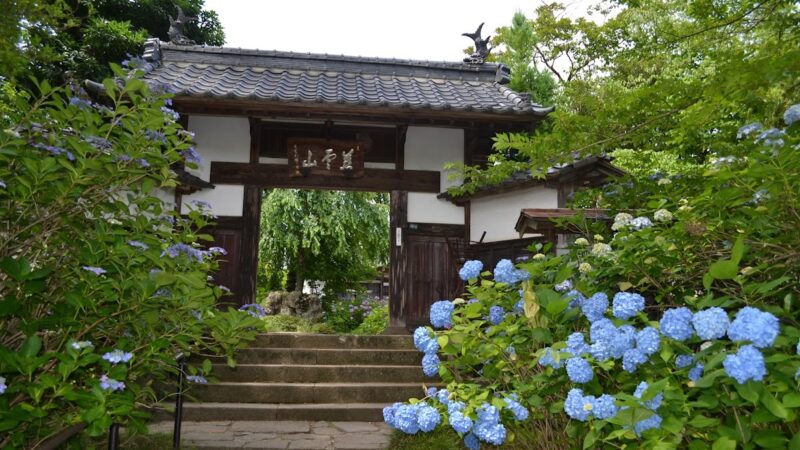
Long Approach and Stone Steps
Kakuganji Temple is located on a mountain in Kitayama, so a long approach leads from the road. This approach consists of stone steps and is a tranquil space surrounded by lush greenery.
As you climb the stone steps, you can escape the hustle and bustle of the city and find peace of mind. The atmosphere of the approach to the temple is particularly charming among the Kitayama Five Mountains, allowing visitors to enjoy the beauty of nature throughout the seasons.
In spring, the fresh greenery; in summer, the deep green; in autumn, the vibrant autumn leaves; and in winter, the snowy landscape—each season presents a different face.
Niomon Gate
Upon reaching the top of the approach, visitors are greeted by the magnificent Niomon Gate. This gate houses Nio statues on either side, protecting the temple.
The Niomon Gate is one of the important structures that conveys the history of Kakuganji Temple. When passing through the gate, be sure to pay attention to the powerful figures of the Nio statues.
Main Hall
After passing through the Niomon Gate, the main hall comes into view. The current main hall is a reinforced concrete reconstruction, but it houses the principal image, Shakyamuni Buddha.
Daily services are held in the main hall, allowing visitors to quietly offer their prayers. As befits a Rinzai Zen temple, it exudes a simple yet solemn atmosphere.
Kuri (Monk’s Quarters)
Next to the main hall is the Kuri. The Kuri is the living space for the monks and also serves as the temple office. When requesting a Goshuin (temple stamp), you should speak to someone here.
The Grave of Hoshun-in and the Memorial Tower of Date Munekiyo
Behind the main hall are the grave of Hoshun-in (Yoshihime), the mother of Date Masamune, and the memorial tower of Date Munekiyo, Masamune’s third son and lord of Kurokawa Castle.
About Hoshun-in (Yoshihime)
Hoshun-in was born the daughter of Mogami Yoshimori and married Date Terumune. While known as Masamune’s mother, her relationship with him was complicated, and she led a turbulent life, including Masamune’s murder of her younger brother Kojiro and their conflict during the Battle of Sekigahara.
She spent her later years in Sendai and died in 1614 (Keicho 19). The reason the tomb was established at Kakuganji Temple is thought to be because this temple, which is Lord Terumune’s family temple, was chosen as a place to mourn the couple.
About Lord Date Munekiyo
Date Munekiyo was born as the third son of Lord Masamune and became the lord of Kurokawa Castle (present-day Yamato-cho, Miyagi Prefecture). As Lord Masamune’s son, he played an important role in the Date family, but there are few records about his detailed life, and some aspects remain shrouded in mystery.
The fact that his memorial tower is located at Kakuganji Temple suggests that Lord Masamune wished to mourn his son at his father’s family temple.
Atmosphere of the Temple Grounds
The grounds of Kakuganji Temple are a quiet space surrounded by the nature of Kitayama. It lies on the same ridge as the adjacent Rinnoji Temple and is a popular part of the walking course around the five mountains of Kitayama.
Especially during the autumn foliage season, the temple grounds are beautifully colored, attracting many worshippers and tourists. Furthermore, the winter snowscape is exceptional, offering a peaceful and calming experience.
Goshuin (Temple Seal) and Goshuincho (Seal Book) Information
About Goshuin
At Kakuganji Temple, you can receive a Goshuin. Goshuin are popular among many visitors as proof of their visit and as a way to forge a connection with the temple.
Goshuin Details
Kakuganji Temple’s Goshuin features the calligraphy of “Shakyamuni Buddha” or “Kakuganji” in the center, along with the temple’s seal. It is characterized by its simple yet powerful brushwork.
How to Obtain a Goshuin
Goshuin can be obtained at the temple office (kuri). After your visit, go to the kuri, present your Goshuincho, and request one.
The offering fee for a Goshuin is usually around 300 to 500 yen. It’s a good idea to have small change ready so you don’t need to give change.
Important Notes
- Goshuin (temple stamps) are given after visiting the temple. Please avoid getting a goshuin without visiting the temple.
- If you forget your goshuincho (stamp book), you may be able to get a pre-written goshuin.
- Goshuin may not be available if the temple is closed or during a memorial service. It’s best to call ahead to confirm.
About Goshuincho
We recommend checking during your visit whether Kakuganji Temple has its own original goshuincho. There are also goshuincho specifically for visiting the five temples of Kitayama, offering the enjoyment of visiting multiple temples.
Access Information | How to Get to Kakuganji Temple
Access by Train
Nearest Station: JR Senzan Line “Kita-Sendai Station”
- Approximately 12-15 minutes on foot from Kita-Sendai Station (approx. 974m)
- Exit the station and head northwest, passing through the Kitayama residential area and climbing the hill. Access from Sendai Station
- Take the Senzan Line from JR Sendai Station and get off at Kita-Sendai Station (approximately 5 minutes).
- Approximately 12-15 minutes on foot from Kita-Sendai Station.
Access by Bus
If using Sendai City Buses, the nearest bus stop is “Kitayama.” Approximately 5-10 minutes on foot from the bus stop.
Access by Car
From Central Sendai
- Approximately 15 minutes by car from Sendai Station.
- Approximately 20 minutes by car from the Tohoku Expressway “Sendai-Miyagi IC.”
Parking
Kakuganji Temple has a parking lot for visitors. However, space is limited, so when visiting the Kitayama Five Temples, we recommend using nearby parking lots or public transportation.
Nearby Attractions | Kitayama Five Temples Pilgrimage
When visiting Kakuganji Temple, be sure to also visit the other temples of the Kitayama Five Temples.
- Rinno-ji Temple: Located west of Kakugan-ji Temple, known as a prayer temple for the Date family.
- Shifuku-ji Temple: The ancestral temple of the Date family, with Toraya Soetsu as its restorer.
- Tosho-ji Temple: One of the Date family’s ancestral temples, known for its tranquil grounds.
- Komyoji Temple: Played an important role as a prayer temple for the Date family.
These temples are within walking distance, allowing you to enjoy a stroll while appreciating the nature of Kitayama. Visiting all of them takes approximately 2-3 hours.
Manners and Precautions for Visiting Temples
Etiquette for Visiting Temples
Kakugan-ji Temple is a Zen temple of the Rinzai sect, Myoshin-ji school. When visiting, please keep the following etiquette in mind:
- Bow at the Niomon Gate: Before passing through the Niomon Gate, bow before entering the temple grounds.
- Praying at the Main Hall: Quietly join your hands in prayer before the main hall and offer your respects with sincerity.
- Respectful Respect: Remain quiet within the temple grounds and be considerate of other visitors.
Photography
Photography is generally permitted within the temple grounds, but there are areas where photography is prohibited, such as inside the main hall and the cemetery. If unsure, please check with the temple office.
Also, please be considerate of the privacy of other visitors and avoid including people in your photos.
Dress Code
There are no specific dress code requirements, but clean and subdued attire is preferred when visiting a temple. Avoid revealing or flashy clothing.
Visiting Hours
While you can generally visit the grounds of Kakuganji Temple freely, you must visit during the temple office’s opening hours if you wish to receive a temple stamp (Goshuin) or view the interior of the main hall.
The general opening hours are from 9:00 AM to around 4:00 PM, but these may change during memorial services or other events. It is recommended to check by phone in advance.
Tourist Attractions near Kakuganji Temple
Sendai Castle Ruins (Aoba Castle Site)
Located about 15 minutes by car from Kakuganji Temple, the Sendai Castle Ruins are the site of the castle built by Date Masamune for the Sendai Domain. Currently, it is maintained as a park and features an equestrian statue of Date Masamune and an observation deck offering panoramic views of Sendai city.
Zuihoden Mausoleum
Zuihoden Mausoleum, the mausoleum of Date Masamune, is also located about 15 minutes by car from Kakuganji Temple. This magnificent Momoyama-style mausoleum is designated as a National Important Cultural Property.
Sendai City Museum
The Sendai City Museum exhibits items related to the Date family and the history of Sendai. It is worth visiting to gain a deeper understanding of the history of Kakuganji Temple.
Annual Events at Kakuganji Temple
Kakuganji Temple holds various events throughout the year. The main events are as follows:
- New Year’s Day: New Year’s prayers
- Spring Equinox: Equinox memorial service
- Obon: Obon festival
- Autumn Equinox: Equinox memorial service
During these events, parishioners and local residents gather to commemorate their ancestors and offer prayers. Some events are open to the general public; please inquire in advance if you are interested.
About Date Terumune | The Life of Date Terumune, the Father of Date Masamune
Let’s briefly review the life of Date Terumune, the founder of Kakuganji Temple.
Date Terumune was born in 1546 (Tenbun 15) as the eldest son of Date Harumune. In 1567 (Eiroku 10), he inherited the family headship, becoming the 16th head of the Date family.
Lord Terumune is known as a wise ruler who maintained and expanded the power of the Date clan amidst the turmoil of the Sengoku period, and who also possessed excellent diplomatic skills. In particular, he strengthened the alliance with the Mogami clan by marrying Yoshihime, the daughter of Mogami Yoshimori, as his principal wife.
However, on October 8, 1585 (Tensho 13), he was abducted during a meeting with Hatakeyama Yoshitsugu, lord of Nihonmatsu Castle, and lost his life in a battle with the Date army that rushed to his rescue. He was 42 years old.
This sudden death is said to have had a profound impact on the young Lord Masamune and deeply influenced his life thereafter. The fact that Lord Masamune founded Kakuganji Temple to mourn his father can be seen as a testament to his deep respect and affection for his father.
Summary | Kakuganji Temple: A Famous Temple Where You Can Feel the History of Sendai
Kakuganji Temple, located in Kitayama, Aoba-ku, Sendai City, Miyagi Prefecture, is a Rinzai Zen temple of the Myoshinji school, founded by Date Masamune to commemorate his father, Terumune.
Since its founding in Yonezawa, Yamagata Prefecture in 1586, it has moved from Iwadeyama to Atagoyama before relocating to its current location in Kitayama, where it has continued to watch over Sendai’s history as one of the five temples of Kitayama.
With its long approach, Niomon gate, tranquil grounds, and numerous sights to see, including the tomb of Hoshun-in and the memorial tower of Date Munekiyo, Kakuganji Temple is well worth a visit as part of a tour of the five temples of Kitayama and as a place to experience the history of the Date family.
When you visit Sendai, be sure to stop by Kakuganji Temple and experience the history of the Date family and the nature of Kitayama. Offering prayers in the tranquil temple grounds will leave you with a refreshing and cleansing feeling.
A stroll around the Kitayama Five Mountains while collecting temple stamps is also highly recommended. You can enjoy the beautiful nature of each season and the atmosphere of these historic temples.