
Complete Guide to Hayasuhime Shrine | An Ancient Shrine in Saganoseki Known for the Legend of Emperor Jimmu and the Octopus Abstinence Prayers
Located in Saganoseki, Oita City, Oita Prefecture, Hayasuhime Shrine (also known as Hayasuhime Jinja or Hayasuhime Jinja) is an ancient shrine affectionately known locally as “Seki no Gongen-sama” or “Oseki-sama.” Originating from a legend related to Emperor Jimmu’s eastern expedition in 667 BC, it has been revered by local people for over 1,000 years as a deity of maritime safety and protection from misfortune, bringing good fortune.
This article will introduce the charm of this shrine in its entirety, from its historical background and the unique “octopus abstinence prayer” custom to its cultural value and practical information for visiting.
History and Origins of Hayasuhime Shrine
Legend of Emperor Jimmu’s Eastern Expedition and the Origin of the Shrine
The founding of Hayasuhime Shrine stems from an ancient legend concerning Emperor Jimmu’s eastern expedition. In 667 BC, when Emperor Jimmu was passing through the Hayasui Strait (Bungo Strait) during his eastern expedition, a giant octopus inhabited the area, controlling the strong currents.
According to the legend, two sisters, Isago and Masago, female divers living in Seki, dove deep into the sea and retrieved a sacred sword guarded by the giant octopus, presenting it to Emperor Jimmu. This sacred sword became the deity of Hayasuhime Shrine, marking the origin of the shrine’s founding. This legend is an important story that illustrates the depth of the female diver culture and maritime worship in the Saganoseki region.
Status and Historical Changes as a Shikinaisha Shrine
Hayasuhime Shrine is a Shikinaisha shrine listed in the Engishiki Jinmyocho (a list of shrines compiled in the Heian period), and has been a historically significant shrine recognized by the imperial court since ancient times. Its former rank was Prefectural Shrine, and it is positioned as one of the important shrines in Bungo Province.
During the Sengoku period (Warring States period), it had deep ties with the Otomo clan. Records show that Otomo Yoshimune stopped at the shrine on his way to Kyoto by sea and prayed for safe passage. This is an important historical fact indicating that the shrine was widely worshipped as a god of maritime safety even at that time.
In the Edo period, many of the current shrine buildings were rebuilt. In 1697 (Genroku 10), the main gate was erected by the Hosokawa clan, the lords of the Kumamoto domain, and in 1763 (Horeki 13), the main hall was rebuilt, indicating that the shrine received support from the lords.
Characteristics of the Deities and Beliefs
Main Deity and Enshrined Deities
The following deities are enshrined at Hayasuhime Shrine:
- Yasomagatsuhi-no-kami: God who presides over misfortunes
- Oonaobi-no-kami: God who heals misfortunes
- Sumiyoshi Three Gods: Gods of maritime safety
- Deities of the Earth and Sea: Gods who protect the land and sea
This composition of deities symbolizes the shrine’s two main beliefs: protection from misfortune and maritime safety. The combination of Yasomagatsuhi-no-kami and Oonaobi-no-kami represents powerful divine power to ward off and purify calamities, while the enshrinement of the Sumiyoshi Three Gods indicates the center of maritime worship.
Beliefs for Maritime Safety and Protection from Misfortune
Hayasuhime Shrine has long been revered as a god of maritime safety by fishermen and sailors. Saganoseki faces the Bungo Channel and is located in the Hayasui Strait, a sea area with strong currents. For sailors navigating this treacherous water, prayers at this shrine were essential.
Even today, many people visit for ship launching ceremonies and prayers for safe vessels, and the faith of those involved in maritime affairs remains unchanged. It is also known as a deity of protection against misfortune and good fortune, and worshippers in their unlucky years visit throughout the year.
The Nationwide Rare “Octopus Abstinence Prayer”
Origin and Meaning of the Octopus Abstinence Prayer
The most distinctive custom of Hayasuihime Shrine is the “Octopus Abstinence Prayer.” This is an extremely rare form of prayer nationwide, originating from the giant octopus that appears in the legend of the shrine’s founding.
The supplicant abstains from eating octopus for a certain period until their wish is granted. This custom of “abstaining from certain things” is a traditional Japanese form of faith in which people show sincerity to the gods by imposing restrictions on themselves and praying for the fulfillment of their wishes.
The Unique Custom of Offering Octopus Collages
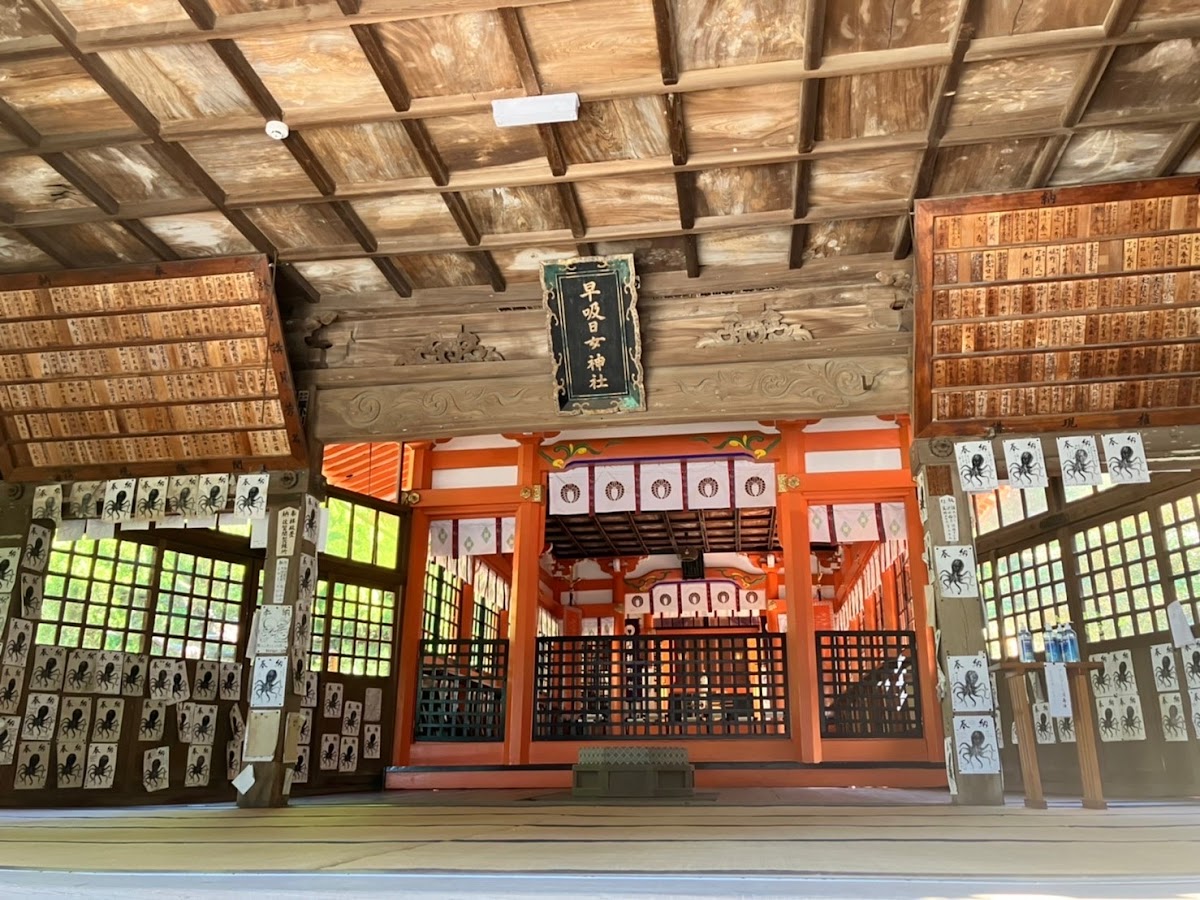
In the octopus abstinence prayer, instead of the usual ema (votive tablets), “octopus collages” are offered inside the shrine hall. These collages are drawings of octopuses on colored paper, and numerous collages are displayed inside the hall, creating a unique sight.
After the wish is granted, it is customary to visit again as a thank-you offering to express gratitude. There is a local saying that “if you abstain from octopus and pray, your wish will surely be granted,” and people constantly visit with various wishes, such as passing exams, finding a job, and recovering from illness.
The Practice of Octopus Abstinence Prayers in Modern Times
Even in modern times, octopus abstinence prayers are widely practiced. Especially during exam season, many students and their parents visit the shrine, making a vow to abstain from eating octopus in order to pray for success in their exams. Many also pray for business success and family safety.
While the duration of the prayer can be determined individually, it is common for people to set a period of several months to a year until their wish is fulfilled.
Cultural Value
Oita Prefecture Designated Tangible Cultural Property
Of the buildings at Hayasuhime Shrine, the following are designated as Oita Prefecture Designated Tangible Cultural Properties:
Main Hall (with Ridgepole Inscription)
The main hall, rebuilt in 1763 (Hōreki 13), retains many characteristics of shrine architecture from the mid-Edo period. The elaborate carvings and architectural techniques are valuable historical materials demonstrating the high level of craftsmanship at the time. The ridgepole inscription is also designated as an attached item and is an important historical document for understanding the history of the architecture.
Main Gate
Built in 1697 by the Hosokawa clan, the lords of the Kumamoto domain, the main gate possesses a unique atmosphere reminiscent of the Dragon Palace. Its design, befitting a shrine facing the sea, invites worshippers into the sacred precincts.
Architectural Style and Characteristics
Although the shrine buildings were rebuilt during the Edo period, they adhere to ancient architectural styles. The worship hall, a place for worshippers to offer prayers, is built in harmony with the main sanctuary. The overall layout of the shrine grounds takes advantage of its seaside location, expressing its character as a shrine of maritime worship from an architectural perspective.
Geographical Importance of Saganoseki
Characteristics of the Hayasui Strait (Bungo Channel)
Saganoseki, where the Hayasuihime Shrine is located, lies in the narrowest part of the Bungo Channel. This area is known as the “Hayasui Strait” or “Hayasui Gate,” a treacherous stretch of sea known for its strong currents.
Saganoseki is the point where Kyushu and Shikoku are closest, with a distance of only 14 kilometers from Cape Sata in Ehime Prefecture. Due to this geographical feature, it has historically played a vital role as a key point for maritime traffic.
As a production area for Seki mackerel and Seki horse mackerel
Fish raised in the strong currents of the Hayasui Strait are known for their firm flesh and rich fat content. In particular, “Seki mackerel” and “Seki horse mackerel” are nationally recognized brand fish, fetching high prices and spreading the name of Saganoseki throughout Japan.
As a shrine protecting this rich fishing ground, Hayasuihime Shrine remains a special place for those involved in the fishing industry. Many fishermen visit to pray for bountiful catches and safety at sea, making it a central place of faith for a region that lives in harmony with the sea.
Highlights of the Shrine Grounds
The Path from the Main Gate to the Main Hall
Visiting the shrine begins by passing through the main gate, built by the Hosokawa clan. The contrast between the vermilion of the main gate and the blue of the sea is beautiful, making it a popular spot for photography. Upon passing through the gate, stone steps lead to the main shrine.
The Worship Hall and Octopus Collages
Inside the worship hall, numerous collages of octopus-related prayers are dedicated, creating a unique sight not seen in other shrines. The array of octopus paintings in various colors and shapes visually demonstrates the unique form of faith at this shrine.
View from the Shrine Grounds
From the shrine grounds, you can see the Bungo Channel, and on clear days, the mountains of Shikoku are also visible. As a shrine facing the sea, visiting while feeling the sea breeze is a particularly special experience.
Annual Events and Festivals
Hayasuhime Shrine holds various festivals throughout the year. Particularly important is the annual grand festival, where local people gather for a procession of the portable shrine and dedication ceremonies.
Many worshippers visit for Hatsumode (first shrine visit of the year) to pray for safety and prosperity in the new year. Furthermore, traditional Japanese annual events such as the Setsubun Festival and the Summer Purification Ceremony are held here, and the shrine plays a central role in the religious life of the community.
Access and Visiting Information
Location and Basic Information
Address: 3329 Saganoseki, Oita City, Oita Prefecture
Telephone: Inquiries can be made through the Oita City Tourism Association (097-537-5635)
Visiting Hours: Grounds are freely accessible (please check the reception hours of the shrine office)
Parking: Available
Access by Public Transportation
From Oita Station:
- Take the Oita Bus bound for “Saganoseki”
- Get off at the “Sekinoe” bus stop and walk for about 5 minutes
- The journey takes about 1 hour
Since the number of buses is limited, it is recommended to check the timetable in advance.
Access by Car
Approximately 40 minutes from the center of Oita City via National Route 197. Once you enter the town of Saganoseki, there are signs directing you to the shrine. If using a car navigation system, please search for “Hayasuhime Shrine” or its address.
Nearby Tourist Attractions
Kozaki Beach
A beach located close to the shrine, boasting crystal-clear waters. It’s bustling with beachgoers during the summer.
Seki Town Historical Walking Tour
Hayasuhime Shrine is included in the “Seki Town Historical Walking Tour” course. Local guides are available, allowing you to learn more about the shrine’s history and the history of Saganoseki.
Seki Aji Seki Saba Museum
A facility where you can enjoy Seki Aji (horse mackerel) and Seki Saba (mackerel), specialties of Saganoseki. A popular course involves enjoying fresh seafood followed by a visit to the shrine.
Manners and Precautions for Visiting the Shrine
Basic Worship Etiquette
- Bow before passing through the main gate.
- Purify your body and mind at the water basin.
- Bow twice, clap twice, and bow once in front of the main hall.
- If you wish to make a prayer to abstain from octopus, receive a paper plaque at the shrine office.
Mindset When Making a Prayer to Abstain from Octopus
A prayer to abstain from octopus is a sincere prayer that involves imposing restrictions on oneself. It is important to approach it with a strong will to truly have your wish granted, not with a light heart. During the period, pay attention to the ingredient labels of foods containing octopus, and keeping your vow is considered the path to fulfilling your wish.
Regarding Photography
Photography is generally permitted on the shrine grounds, but consideration is necessary in sacred places such as inside the main hall and the inner sanctuary. Please observe proper etiquette when taking photos so as not to disturb other worshippers.
The Modern Significance of Hayasuhime Shrine
As a Center of the Local Community
Hayasuhime Shrine is not merely a tourist spot; it functions as a spiritual pillar for the community in the Saganoseki region. Through festivals and events, it serves as a place to strengthen community bonds and plays a crucial role in the transmission of traditional culture.
Preservation and Transmission of Maritime Culture
The unique forms of worship, such as the legend of Emperor Jimmu and the prayer for abstaining from octopus, are valuable cultural heritage that convey Japan’s maritime culture to the present day. The legend of the female divers preserves the memory of the female diver culture that once existed in Saganoseki, telling the story of the region’s history of coexisting with the sea.
Value as a Tourism Resource
In recent years, Hayasuhime Shrine has also attracted attention as an important tourism resource in Oita Prefecture. It is included in the “Onsen Prefecture Oita” tourist route, attracting many worshippers and tourists from both within and outside the prefecture. Tourist plans combining the shrine with gourmet sightseeing featuring Seki horse mackerel and Seki mackerel are also popular.
Summary: The Charm of Hayasuhime Shrine
Hayasuhime Shrine is a multifaceted shrine with a long history dating back to mythological times, a rare practice of abstaining from octopus, miraculous powers for maritime safety and protection from misfortune, and cultural value.
Located in the geographically important location of Saganoseki, this shrine has watched over the rough waves of the Bungo Channel for over 1,000 years, receiving the prayers of people who live in harmony with the sea. The beautiful Edo-period shrine architecture, the countless octopus collages displayed in the worship hall, and the magnificent view of the Bungo Channel from the shrine grounds leave a deep impression on visitors.
When visiting Oita City, be sure to visit Hayasuhime Shrine and experience its history, faith, and the charm of Saganoseki, a town by the sea. By encountering the unique custom of abstaining from octopus, you will gain a profound understanding of the depth of Japanese folk beliefs.
This shrine, affectionately known as “Seki no Gongen-sama” by the local people, is a special place where all who visit feel the warm protection of the sea god.


