Tsuruyama Hachimangu Shrine (Tsuyama City, Okayama Prefecture): A Thorough Explanation of its History and Nationally Designated Important Cultural Properties
Tsuruyama Hachimangu Shrine, located in Tsuyama City, Okayama Prefecture, is a venerable shrine deeply intertwined with the history of Tsuyama Castle. Affectionately known as “Yago no Hachiman-sama” by the local people, it boasts numerous valuable cultural assets, including its main hall, a nationally designated Important Cultural Property. This article provides detailed information about Tsuruyama Hachimangu Shrine, including its history, cultural properties, visiting information, and goshuin (shrine stamps), essential before your visit.
Overview of Tsuruyama Hachimangu Shrine
Tsuruyama Hachimangu Shrine is located at 159 Yamakita, Tsuyama City, Okayama Prefecture, in the northern part of Tsuyama city center, northwest of the Tsuyama Castle ruins. Formerly a village shrine, it is now widely revered as the great tutelary deity of northern Tsuyama.
Deities Enshrined
The following three deities are enshrined at Tsuruyama Hachimangu Shrine:
- Honda-wake no Mikoto: This refers to Emperor Ōjin, revered as Hachiman, the god of military fortune and national protection.
- Empress Jingū: The mother of Emperor Ōjin, worshipped as the goddess of safe childbirth and child-rearing.
- Tamayori-hime: The mother of Emperor Jimmu, known as the goddess of matchmaking and safe childbirth.
These enshrined deities are central to Hachiman worship and are believed to grant blessings for military success, family safety, and safe childbirth.
Shrine Rank and Regional Position
Tsuruyama Hachiman-gū, ranked as a village shrine under the modern shrine ranking system of the Meiji era, is one of the important shrines in the Tsuyama region. It is affectionately known locally as “Hachiman-sama of Yago,” and is deeply connected to the place name of its current location, Yamakita Yago.
History and Origins of Tsuruyama Hachimangu Shrine
Ancient Presence
The founding date of Tsuruyama Hachimangu Shrine is unknown, but it is said to have been enshrined on the summit of Tsuruyama (the mountain where the current Tsuyama Castle ruins are located) since ancient times. Tsuruyama is a strategically important location overlooking the Tsuyama Basin, and the fact that Hachiman-sama was enshrined here speaks to its importance as a guardian deity of the region.
Relocation Due to the Construction of Tsuyama Castle
The most important turning point in the history of Tsuruyama Hachimangu Shrine was the construction of Tsuyama Castle in the early Edo period.
In 1603 (Keicho 8), Mori Tadamasa, who was granted 186,500 koku in Mimasaka Province for his achievements in the Battle of Sekigahara, entered Tsuyama. Mori Tadamasa selected Tsuruyama as the site for his castle and began construction of Tsuyama Castle.
During the construction of the castle, the Tsuruyama Hachimangu Shrine, originally located on the summit of Tsuruyama Mountain, was temporarily relocated to Nozokiyama Mountain (near present-day Kume District) south of the castle. This was a measure taken to facilitate the castle construction.
In 1608 (Keicho 13), Mori Tadamasa, deeply revering Hachiman Daishin, consulted the oracle and determined that the current location northwest of Tsuyama Castle, Yamakita Yago Izayoiyama Mountain, was a sacred site. He then constructed a shrine building there and relocated the Hachimangu Shrine again. The northwest direction is considered a protective direction in feng shui, and it is believed that this also served to protect the castle’s unlucky direction (the “demon’s gate”).
Development during the Edo Period
In 1669 (Kanbun 9), during the reign of the second lord, Mori Nagatsugu, a large-scale repair of the main hall was carried out. The main hall, now a nationally designated important cultural property, is a valuable historical structure that preserves the architectural style of this period.
The Mori clan was dispossessed of their domain after four generations, and the Matsudaira clan subsequently became the lords of the Tsuyama Domain. However, the reverence for the shrine continued under successive lords, who provided maintenance and support for the shrine buildings and festivals.
Modern Era
With the Meiji-era separation of Shinto and Buddhism, Tsuruyama Hachimangu Shrine, which had previously practiced syncretism of Shinto and Buddhism, became an independent shrine. Under the Meiji-era shrine ranking system, it was designated a Gosha (village shrine), establishing its position as a central shrine in the region.
On April 1, 1956, the worship hall, fishing hall, and offering hall, along with the subsidiary Yakuso Shrine, were designated as Okayama Prefecture Important Cultural Properties. Furthermore, on May 31, 1980, the main hall was designated a National Important Cultural Property, officially recognizing its historical and architectural value.
Main Hall, a National Important Cultural Property
Architectural Style and Characteristics
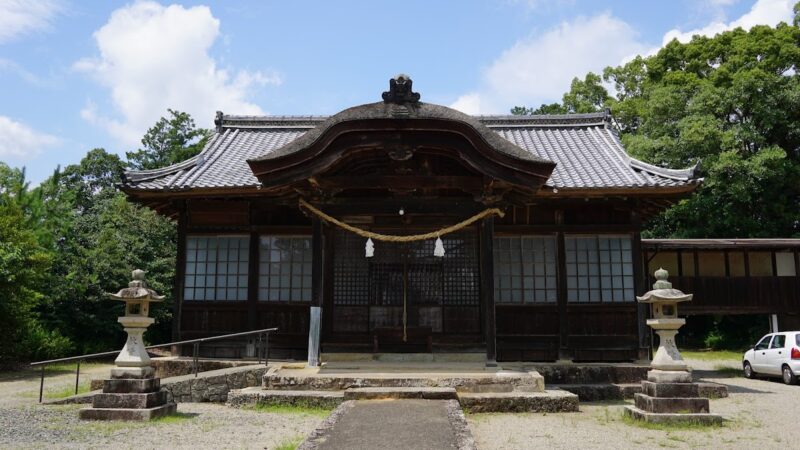
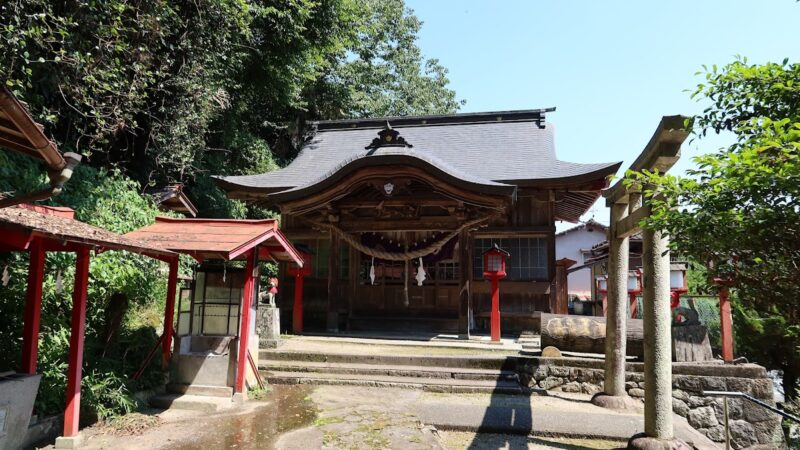
The main hall of Tsuruyama Hachimangu Shrine is highly regarded as a masterpiece of shrine architecture from the mid-Edo period.
Architectural Style:
- Three bays in length and three bays in width
- Single-story, hip-and-gable roof
- Gable-end entrance
- One-bay portico, curved gable roof
- Copper roofing (originally presumed to be cypress bark roofing)
The main hall is built in a unique architectural style also known as “Nakayama-zukuri.” Nakayama-zukuri is a regionally distinctive shrine architecture style found in northern Okayama Prefecture, characterized by its hip-and-gable roof and gable-end entrance.
Architectural Details
The main hall’s architecture showcases excellent woodworking techniques from the early to mid-Edo period. The curved gable roof of the portico features elegant curves, and the carvings and joinery demonstrate the high skill of the craftsmen of the time.
While its construction is thought to date back to the relocation in 1608 (Keicho 13), the existing building underwent significant renovations during a major repair in 1669 (Kanbun 9). This period saw the stability of the Edo Shogunate and a flourishing of shrine and temple construction throughout Japan.
Cultural Value
The main hall, designated a National Important Cultural Property on May 31, 1980, is highly regarded for the following reasons:
- Periodicity: It well preserves the style of shrine architecture from the mid-Edo period.
- Regional Characteristics: It is a representative example of the Nakayama style unique to northern Okayama Prefecture.
- Preservation Status: Despite its history of over 350 years, it retains much of its original appearance.
- Historical Background: It is closely related to the historical event of the construction of Tsuyama Castle.
Okayama Prefecture Designated Important Cultural Property
In addition to the main hall, Tsuruyama Hachimangu Shrine has several other Okayama Prefecture Designated Important Cultural Properties.
Worship Hall
This building, where worshippers perform their prayers, is thought to have been constructed around the same time as the main hall. It is a magnificent building with a hipped roof, creating a beautiful space in harmony with the main hall. ### Tsuridono (Fishing Hall)
This building connects the main shrine and the worship hall, playing an important role in Shinto rituals. The name Tsuridono comes from the fact that the buildings are positioned to “balance” each other.
Shinkusho (Offering Hall)
This building is where offerings to the gods are prepared. It is an indispensable facility in Shinto rituals and a valuable historical structure for understanding the actual state of shrine management during the Edo period.
Yakuso Shrine (Subsidiary Shrine)
Along with these buildings, the subsidiary shrine, Yakuso Shrine, is also designated as an Important Cultural Property of Okayama Prefecture. Yakuso Shrine enshrines the god of medicine and demonstrates the diversity of beliefs among people during the Edo period.
These buildings were collectively designated as an Important Cultural Property of Okayama Prefecture on April 1, 1956, and the entire shrine grounds are a valuable cultural property space that conveys Edo-period shrine architecture to the present day.
Annual Events and Festivals
Tsuruyama Hachimangu Shrine holds various festivals and Shinto rituals throughout the year.
Annual Festival
The annual festival of Tsuruyama Hachimangu Shrine is held grandly every October. This festival is the most important annual event for the shrine, a time to express gratitude to the enshrined deity and pray for peace and prosperity in the region.
During the festival, events such as a portable shrine procession and offering ceremonies take place, attracting many local people to worship. As the principal tutelary deity of northern Tsuyama, Tsuruyama Hachimangu Shrine is revered from a wide area, and its annual festival serves as an important opportunity to reaffirm the unity of the local community.
Other Annual Events
- New Year’s Day Festival: Prayers for happiness and peace in the new year
- Setsubun Festival: Prayers for protection from evil and good fortune
- Spring Grand Festival: Prayers for a bountiful harvest
- Summer Purification Ceremony: Purification of sins and impurities accumulated over the past six months
- Autumn Grand Festival: Gratitude for the harvest
- Year-End Purification Ceremony: Purification of sins and impurities accumulated over the past year
These Shinto rituals preserve traditional Japanese beliefs that have continued since ancient times.
Goshuin (Shrine Seal) Information
Tsuruyama Hachimangu Shrine offers Goshuin.
Features of the Goshuin
The Goshuin of Tsuruyama Hachimangu Shrine features the calligraphy of “Tsuruyama Hachimangu” and the shrine’s seal. The powerful calligraphy conveys the shrine’s prestige and historical significance.
Hours of Issuance
Goshuin (temple/shrine stamps) are issued at the shrine office. However, priests may not always be present, so if you want to be sure to receive a goshuin, it is recommended to call ahead to confirm.
Goshuincho (stamp book)
Please check with the shrine office during your visit regarding the availability of original goshuincho.
Highlights of the Shrine Grounds
Shrine Building Layout
The grounds of Tsuruyama Hachimangu Shrine feature a complex of buildings centered around the main hall, with the worship hall, fishing hall, and offering hall integrated into one structure. These buildings represent a typical layout of Edo period shrine architecture and are historically valuable.
Atmosphere of the Shrine Grounds
Despite being located in the city of Tsuyama, the shrine grounds are enveloped in a tranquil atmosphere. Surrounded by ancient trees, the grounds maintain a solemnity befitting a sacred place, even in an urban area.
Surrounding Environment
To the north of Tsuruyama Hachimangu Shrine is Jizoin Temple, which preserves the traditional Japanese religious space where Shinto and Buddhism coexist. Additionally, Tsuyama Castle Ruins (Tsuruyama Park) is nearby, making it a great addition to a historical walking tour.
Visiting Information
Location and Contact Information
- Address: 159 Yamakita, Tsuyama City, Okayama Prefecture 708-0004
- Phone: Please inquire at the shrine office.
Access
Public Transportation:
- Take the Chutetsu Bus bound for “Ichinomiya-kyoku-mae” from JR Tsuyama Station (approx. 10 minutes)
- Get off at the “Yago” bus stop and walk for approximately 3 minutes
- Take a taxi from JR Tsuyama Station (approx. 10 minutes)
Car:
- Approximately 20 minutes from the Chugoku Expressway “Tsuyama IC”
- Approximately 5 minutes from Tsuyama city center
- Parking: Parking is available on the shrine grounds or nearby (please check details on-site)
Visiting Hours
While visiting the shrine grounds is generally free, the shrine office may have limited opening hours. Those wishing to receive prayers or a Goshuin (temple/shrine stamp) are advised to check in advance.
Manners for Visiting the Shrine
- Bow when passing through the torii gate.
- Walk along the sides of the path, as the center is considered the path of the gods.
- Cleanse your hands and mouth at the water basin before praying.
- Pray in front of the main hall using the “two bows, two claps, one bow” method.
- The main hall, a nationally designated important cultural property, is a precious cultural asset. Please be careful not to damage the shrine when taking photographs.
Relationship with Tsuyama Castle
The relationship with Tsuyama Castle is inseparable from the history of Tsuruyama Hachimangu Shrine.
Overview of Tsuyama Castle
Tsuyama Castle is a flatland castle built by Mori Tadamasa over approximately 13 years, starting in 1603. It had three baileys (Honmaru, Ninomaru, and Sannomaru) and at its peak boasted 77 turrets, making it a magnificent fortress. Its scale is said to be second only to Himeji Castle and Matsuyama Castle.
A Shrine Protecting the Castle’s Demon’s Gate
One reason for the relocation of Tsuruyama Hachimangu Shrine to its current location was to protect the northwest direction of Tsuyama Castle, that is, the direction of the “demon’s gate.” Since ancient times, the northeast (demon’s gate) and southwest (back demon’s gate) have been considered directions where misfortune easily enters, and there was a custom of placing shrines and temples in the demon’s gate direction of important buildings.
The legend that Mori Tadamasa chose the current location “by divine revelation” is not merely superstition, but rather a calculated placement considering both castle defense and spiritual protection.
Reverence of the Feudal Lords
Successive lords of the Tsuyama domain deeply revered Tsuruyama Hachimangu Shrine, providing support for the construction and repair of the shrine buildings and for festivals. In particular, the major repair of the main hall by the second lord, Mori Nagatsugu, in 1669 (Kanbun 9) was an important project that resulted in the current nationally designated important cultural property.
Mori Tadamasa and Tsuruyama Hachimangu Shrine
The Life of Mori Tadamasa
Mori Tadamasa (1570-1634) was the younger brother of Mori Ranmaru, who served as a page to Oda Nobunaga. After losing his brothers in the Honnoji Incident, he served Toyotomi Hideyoshi and Tokugawa Ieyasu, and was granted 186,500 koku in Mimasaka Province for his achievements in the Battle of Sekigahara.
Construction of Tsuyama Castle and Urban Development
Mori Tadamasa not only built a castle, but also carried out comprehensive urban development, including the development of the castle town, the improvement of roads, and the promotion of industry. The relocation of Tsuruyama Hachimangu Shrine was also part of this urban plan.
Tadamasa had a deep faith in Hachiman, and it is said that when relocating Tsuruyama Hachimangu Shrine, he himself performed divination and selected the current location based on a spiritual dream. This demonstrates not only his faith, but also his insight as a ruler who valued shrines as a spiritual pillar for his people.
The Mori Family and Hachiman Worship
The Mori family revered Hachiman as their tutelary deity for generations. For samurai families, Hachiman was the god of military fortune and, as the tutelary deity of the Minamoto clan, was considered the guardian deity of samurai. Mori Tadamasa’s emphasis on Tsuruyama Hachimangu Shrine is related to this family tradition.
History and Culture of Tsuyama
The Center of Mimasaka Province
Tsuyama has flourished as the center of Mimasaka Province since ancient times. In the Middle Ages, it was known as Innosho, and in the late Kamakura period, it is known as the place where Kojima Takanori, a loyal retainer of Emperor Go-Daigo, was active.
A Castle Town in the Edo Period
Under the rule of the Mori clan, and later the Matsudaira clan, Tsuyama developed as the political, economic, and cultural center of Mimasaka Province. Samurai residences, merchant districts, and temples and shrines were systematically arranged in the castle town, and its basic structure is still inherited in the present-day Tsuyama city center.
Tsuyama in the Modern Era
After the Meiji Restoration, Tsuyama continued to develop as the central city of northern Okayama Prefecture. Even today, it remains the largest city in the prefecture, with a population of approximately 100,000, and serves as a center for medicine, education, and culture.
Nearby Tourist Attractions
When visiting Tsuruyama Hachimangu Shrine, we recommend also visiting the surrounding tourist attractions.
Tsuyama Castle (Tsuruyama Park)
The Tsuyama Castle ruins, located about a 15-minute walk away, are one of Japan’s 100 Famous Castles. It is also known as a cherry blossom viewing spot, with approximately 1,000 cherry trees blooming in spring. The Bitchu Turret has been restored, allowing visitors to imagine its former appearance.
Joto Townscape Preservation District
This is a traditional building preservation district lined with Edo-period townhouses. The white-walled storehouses and lattice-doored townhouses convey the atmosphere of that time.
Tsuyama Western Learning Museum
During the Edo period, Tsuyama was a thriving center for Western learning. This museum showcases the tradition of Western learning in Tsuyama, beginning with Genzo Udagawa, a physician of the Tsuyama Domain.
Shurakuen Garden
This is a daimyo garden of the Tsuyama Domain, designated as a National Place of Scenic Beauty. It’s a beautiful strolling garden with a pond, offering beautiful scenery throughout the seasons.
Summary
Tsuruyama Hachimangu Shrine is a historic shrine deeply connected to the historical event of the construction of Tsuyama Castle. Its valuable cultural assets, including the main hall (a National Important Cultural Property), preserve the essence of Edo period shrine architecture.
Affectionately known as “Hachiman-sama of Yako” by the local people, Tsuruyama Hachimangu Shrine is not merely a tourist spot, but a living place of faith that has functioned as a spiritual pillar of the community for over 350 years.
When visiting Tsuyama, be sure to visit Tsuruyama Hachimangu Shrine and experience its history and culture. We recommend spending time there, calming your mind in the tranquil grounds and feeling the weight of history.
By visiting Tsuruyama Hachimangu Shrine along with the ruins of Tsuyama Castle and the townscape of the castle town, you can gain a deeper understanding of Tsuyama’s history and culture, which has continued since the Edo period. Tsuruyama Hachimangu Shrine is a valuable spot where you can experience Tsuyama’s history firsthand.