Complete Guide to Ishiyama-dera Temple | A Thorough Explanation of its History, National Treasures, and Connections to Murasaki Shikibu
What is Ishiyama-dera Temple?
Ishiyama-dera Temple is the head temple of the Toji Shingon sect, located in Ishiyama-dera, Otsu City, Shiga Prefecture. Its mountain name is Ishikozan, and its principal image is Nyoirin Kannon Bodhisattva (Nyoirin Kannon). As the 13th temple on the Saigoku Thirty-Three Kannon Pilgrimage, it has attracted many worshippers since ancient times.
The temple’s name originates from the wollastonite (Keikaiseki) rock formation, a natural monument, that towers within its grounds. The main hall is built on top of this massive rock formation, and as the saying goes, “The temple is Ishiyama, the Buddha is Nyoirin,” it has been widely revered as a sacred site of Kannon worship with miraculous powers since the Nara period.
Located on the banks of the clear Setagawa River, near the waters flowing from Lake Biwa, and at the foot of Mount Garan (239m above sea level), the temple grounds create a landscape where the beauty of nature in each season harmonizes with historical buildings.
History of Ishiyama-dera Temple
Founding and the Nara Period
Ishiyama-dera Temple was founded in 747 AD (Tenpyo 19) by the monk Ryōben Sōjō at the behest of Emperor Shōmu. Ryōben Sōjō was a high-ranking priest who served as the first abbot of Tōdai-ji Temple. He was ordered by Emperor Shōmu to establish a sacred site for Kannon Bodhisattva, and he chose this location.
According to legend, while Ryōben Sōjō was practicing asceticism on the banks of the Setagawa River, he received a divine message from Nyoirin Kannon in a dream, and placed a statue of Kannon on this wollastonite rock, marking the beginning of Ishiyama-dera Temple. From the late Nara period to the Heian period, Ishiyama-dera Temple attracted the reverence of emperors and nobles, and developed into a sacred site dedicated to Kannon (Goddess of Mercy).
The Flourishing Ishiyama Temple in the Heian Period
During the Heian period, Ishiyama-dera Temple became extremely popular among the aristocracy as “Ishiyama-mode” (pilgrimage to Ishiyama Temple). Many women, in particular, visited the temple, bustling with people praying for safe childbirth and successful marriages. Numerous literary works, such as Sei Shonagon’s *The Pillow Book*, Sugawara no Takasue no Musume’s *Sarashina Nikki*, and Fujiwara no Michitsuna’s mother’s *Kagero Nikki*, describe pilgrimages to Ishiyama-dera Temple.
As a center of Kannon worship with profound spiritual efficacy, members of the imperial family and nobles, including the regent families, competed to visit the temple, supporting its prosperity. Many halls and pagodas were built during this period, forming the foundation of the present-day Ishiyama-dera Temple.
From the Medieval to the Early Modern Period
Even after the Kamakura period, Ishiyama-dera Temple welcomed many pilgrims as a pilgrimage site for the 33 Kannon temples of Saigoku. Although it was damaged by war during the Sengoku period, it was rebuilt under the patronage of the Tokugawa shogunate during the Edo period, and Kannon worship spread among the common people.
The current main hall was rebuilt after a fire in 1096 and is designated a National Treasure. The pagoda, built in 1194, is also a National Treasure as the oldest pagoda in Japan.
Ishiyama-dera Temple in the Modern Period
Despite the impact of the anti-Buddhist movement of the Meiji era, Ishiyama-dera Temple continued to exist as the head temple of the Toji Shingon sect, and remains so to this day. In 1950, with the enactment of the Cultural Properties Protection Law, many buildings and works of art were designated as National Treasures and Important Cultural Properties.
In recent years, Ishiyama-dera Temple has attracted attention as the temple where Murasaki Shikibu began writing “The Tale of Genji,” and its value as a literary historical site is highly regarded. Every spring and autumn, exhibitions related to “The Tale of Genji” are held, attracting many literature enthusiasts.
Murasaki Shikibu and The Tale of Genji
The Place Where The Tale of Genji Began
Ishiyama-dera Temple is widely known as the place where Murasaki Shikibu, a female writer of the Heian period, began writing “The Tale of Genji.” It is said that around 1004, Murasaki Shikibu stayed at Ishiyama-dera Temple, gazing at the full moon reflected on Lake Biwa, while formulating the story’s conception.
Within the temple grounds is a room called the “Genji Room,” preserved as the place where Murasaki Shikibu wrote. From this room, one can see the clear waters of the Seta River and the mountains on the opposite bank, creating a space that evokes the elegance of the Heian period.
Ishiyama-dera Temple in Literary Works
Ishiyama-dera Temple appears not only in *The Tale of Genji*, but also in many other classical literary works. In Sei Shonagon’s *The Pillow Book*, it is mentioned as “Ishiyama Temple,” praising it as a famous temple. *The Sarashina Diary* details the author’s visit to Ishiyama-dera, providing valuable information about the actual practices of pilgrimages to Ishiyama at that time.
*The Kagerō Diary* also mentions a visit to Ishiyama-dera, demonstrating its importance as a place of worship for Heian-period aristocratic women. These literary works give Ishiyama-dera a special place in literary history.
Highlights of the Temple Grounds
East Gate (Important Cultural Property)
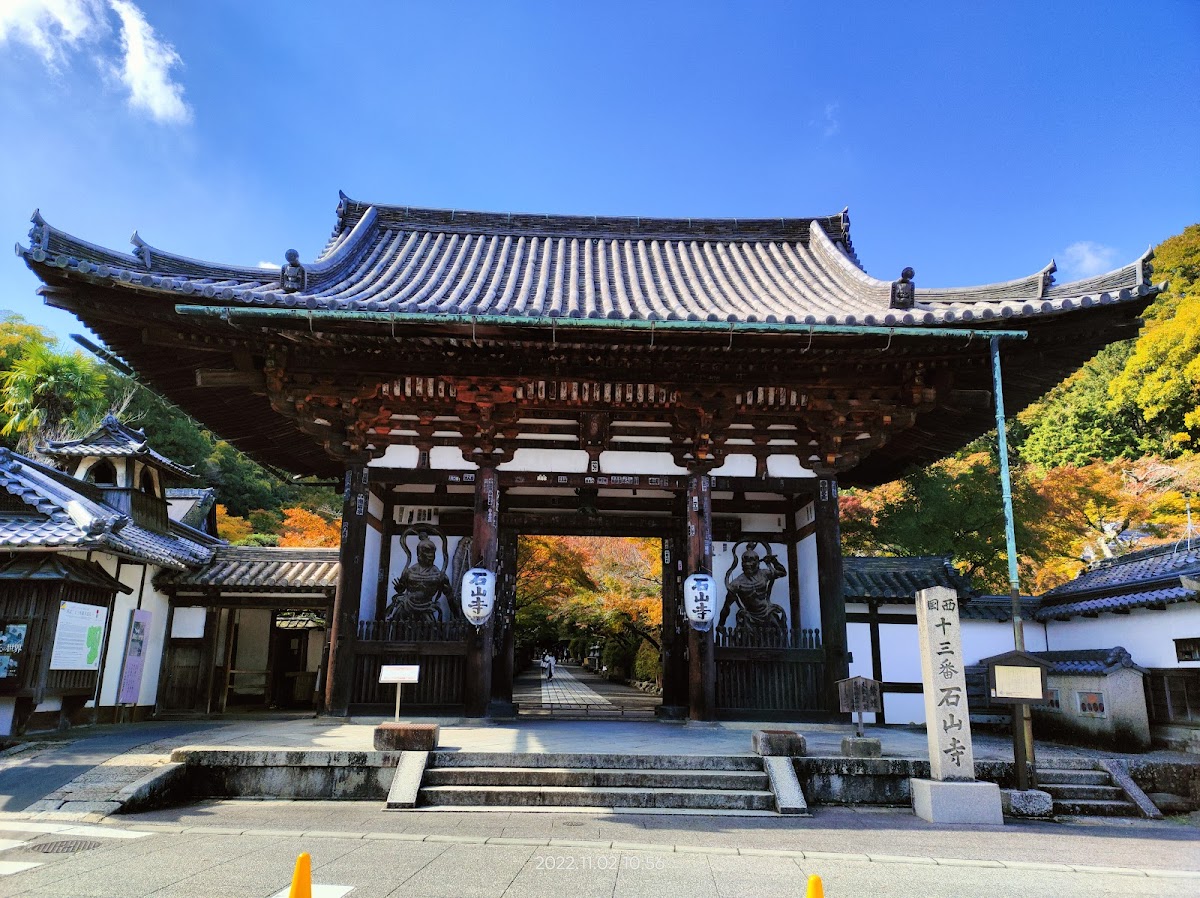
The East Gate, the main gate of Ishiyama-dera Temple, is an Important Cultural Property said to have been built in 1190. The imposing gate, with its hipped roof and tiled roof, is flanked by Nio statues. Passing through this gate marks the beginning of the sacred grounds of Ishiyama-dera Temple.
The “Pass-Through Rock” and Wollastonite
Immediately upon entering the temple grounds, one sees the wollastonite, a natural monument from which the temple derives its name. This massive rock formation is a geological heritage site of great importance, formed from limestone metamorphosed by geothermal heat. The “Pass-Through Rock,” a passage through which one passes, is a popular spot for worshippers to pass while making a wish.
The main hall stands atop the wollastonite, creating a unique landscape where the rock and architecture are integrated. This wollastonite has long been revered as a sacred stone and, combined with Kannon worship, has become a core element of Ishiyama-dera Temple’s faith.
Main Hall (National Treasure)
The main hall of Ishiyama-dera Temple was rebuilt after a fire in 1096 as a complex building connecting the main hall and the worship hall. The main hall is built in a cantilevered style, on wollastonite. The inner sanctuary houses the principal image, a seated statue of Nyoirin Kannon, but it is a hidden Buddha and is only unveiled once every 33 years.
The interior of the main hall is a precious space that conveys the elegant architectural style of the Heian period. The original colors remain on the ceiling and pillars, allowing visitors to imagine the view seen by Heian aristocrats. The worship hall section contains the “Genji Room,” where Murasaki Shikibu is said to have written, making it a pilgrimage site for literature fans.
Tahōtō Pagoda (National Treasure)
The Tahōtō Pagoda of Ishiyama-dera Temple was built in 1194 and is designated a National Treasure as the oldest Tahōtō pagoda in Japan. Standing approximately 16 meters tall, its elegant form is highly regarded as a masterpiece of Japanese pagoda architecture.
The pagoda features a unique multi-storied pagoda style, with a square base and a circular upper level, and a cypress bark roof. Inside, a seated statue of Dainichi Nyorai (Vairocana Buddha) is enshrined, embodying the beauty of esoteric Buddhist architecture. Surrounded by cherry blossoms in spring and autumn leaves in fall, it displays beautiful scenery throughout the seasons.
Tsukimi-tei (Moon-Viewing Pavilion)
Tsukimi-tei is said to be the place where Murasaki Shikibu conceived the idea for “The Tale of Genji” while gazing at the full moon of autumn. Located on a hill overlooking the Seta River and Lake Biwa, it remains a popular spot visited by many worshippers.
Especially on nights with a full moon in autumn, the beauty of the moon reflected on the lake is exceptional, allowing visitors to experience the same atmosphere as in the Heian period.
Other Buildings
Within the temple grounds, there are many other structures, including the Bishamondo Hall, the bell tower, and the Thirty-Eight Gongen Shrines. The Bishamondo Hall houses a standing statue of Bishamonten (an Important Cultural Property) dating from the Heian period, and the bell in the bell tower is also designated as an Important Cultural Property.
As you explore the grounds, you can appreciate the history and cultural value of each building, and a fulfilling visit is possible in about 1 to 1.5 hours.
Cultural Properties of Ishiyama-dera Temple
National Treasures
Ishiyama-dera Temple is a treasure trove of cultural properties, housing many National Treasures. Among the buildings, the main hall and the pagoda are designated as National Treasures.
Among the works of art and crafts, the wooden seated statue of Nyoirin Kannon (the principal image) is the most important. It is believed to be a work from the early Heian period and is a hidden Buddha that can only be viewed during the 33-year unveiling. Carved from a single piece of cypress wood, the imposing seated statue, approximately 5 meters tall, is considered one of the finest masterpieces of Nyoirin Kannon statues.
In addition, the “Ishiyama-dera Engi Emaki” (7 volumes) is also a National Treasure. This illustrated scroll was created between the Kamakura and Muromachi periods. It is a valuable historical document recording the founding and miraculous tales of Ishiyama-dera Temple in both pictures and text, and is an important work for understanding the customs of the time.
Important Cultural Properties
Numerous buildings are designated as Important Cultural Properties, including the East Gate, Bell Tower, Bishamondo Hall, and Sutra Repository. These are valuable relics that convey the architectural style from the Heian to Kamakura periods.
Among Buddhist statues, excellent Buddhist sculptures from the Heian to Kamakura periods are preserved, including a wooden standing statue of Bishamonten, a wooden standing statue of Fudo Myoo, and a wooden seated statue of Dainichi Nyorai.
In terms of calligraphy and texts, numerous ancient documents known as the “Ishiyama-dera Documents” are designated as Important Cultural Properties, providing valuable historical materials for understanding medieval temple management and social conditions.
Natural Monuments
The wollastonite within the temple grounds is designated as a national natural monument. This rock is academically rare and has played a central role in both the landscape and religious significance of Ishiyama-dera. It is protected as a geologically valuable site.
Seasonal Scenery and the Temple of Flowers
Ishiyama-dera in Spring
Ishiyama-dera is also known as the “Temple of Flowers,” and in spring, approximately 600 cherry trees adorn the temple grounds. A variety of varieties, mainly Somei Yoshino, but also mountain cherry and weeping cherry trees, are planted, reaching their peak bloom from late March to mid-April.
The cherry blossoms around the Tahoto pagoda are particularly beautiful, and the collaboration of the national treasure pagoda and cherry blossoms makes for an excellent photo opportunity. Additionally, approximately 200 plum trees are planted, and from late February to early March, the fragrance of plum blossoms fills the temple grounds.
Ishiyama-dera Temple in Summer
In early summer, the fresh greenery is beautiful, and the green maple leaves add a refreshing touch to the temple grounds. From late June to July, approximately 2,000 irises are in full bloom, their purple and white flowers beautifully decorating the waterside.
In summer, special nighttime viewings such as “Ishiyama-dera Atara Night Maple” are held, and the illuminated temple grounds are enveloped in a magical atmosphere.
Ishiyama-dera Temple in Autumn
Autumn is the most beautiful season for Ishiyama-dera Temple. Approximately 2,000 maple trees dye the temple grounds crimson, and the best time to see the autumn leaves is from mid-November to early December. The view of the autumn leaves from the main hall is particularly breathtaking, attracting many tourists.
The special autumn nighttime viewing, “Ishiyama-dera Temple’s Nightly Maple Leaves,” allows visitors to enjoy the interplay of illuminated autumn leaves and the national treasure architecture, offering a fantastical beauty different from that of the daytime.
Ishiyama-dera Temple in Winter
In winter, Ishiyama-dera Temple is enveloped in silence, allowing for a solemn visit in a crisp, serene atmosphere. The snow-covered grounds possess a special beauty, allowing visitors to enjoy the unique charm of winter.
In January, the temple is bustling with visitors for Hatsumode (first shrine visit of the year), with many coming to offer prayers for the new year. The view of Lake Biwa in the clear winter air is also exceptional.
13th Temple of the Saigoku Thirty-Three Kannon Pilgrimage
Saigoku Thirty-Three Kannon Pilgrimage
Ishiyama-dera Temple has long welcomed pilgrims as the 13th temple of the Saigoku Thirty-Three Kannon Pilgrimage. The Saigoku Thirty-Three Kannon Pilgrimage is Japan’s oldest pilgrimage route, visiting 33 temples dedicated to Kannon Bodhisattva, mainly in the Kinki region.
The principal image of Ishiyama-dera Temple, Nyoirin Kannon, is worshipped as a Kannon that grants wishes, and is especially believed to have miraculous powers for safe childbirth, good relationships, and good fortune. Goshuin (temple stamps) are given out at the main hall, and many pilgrims visit the temple.
Preceding and Following Temples
The 12th temple is Shōhō-ji Temple (Iwama-dera Temple) in Kyoto Prefecture, and the 14th temple is Mii-dera Temple (Onjō-ji Temple), also in Kyoto Prefecture. The distance from Ishiyama-dera Temple to Iwama-dera Temple is approximately 5 kilometers, and to Mii-dera Temple is approximately 8 kilometers, making walking pilgrimage possible.
While car and bus travel are currently the mainstream methods of pilgrimage, the number of people walking the ancient pilgrimage route is increasing, offering an experience of following a historical path.
Visiting Information
Visiting Hours and Admission Fees
Visiting Hours:
- 8:00 AM – 4:30 PM (Last entry at 4:00 PM)
Admission Fees:
- Adults (Junior High School Students and older): 600 yen
- Elementary School Students: 250 yen
- Group discounts available (30 or more people)
Special Visits:
Special nighttime visits and exhibitions may be held seasonally, and additional fees may apply. We recommend checking the official website for details.
Access Information
Access by Train and Bus:
- Get off at JR Biwako Line “Ishiyama Station,” take the Keihan Bus bound for “Ishiyama Danchi” or “Ishiyamadera Sanmon-mae” from the South Exit (approximately 10 minutes), and get off at “Ishiyamadera Sanmon-mae” bus stop.
- Get off at Keihan Electric Railway Ishiyama Sakamoto Line “Ishiyamadera Station,” approximately 10 minutes on foot.
Access by Car:
- Approximately 5 minutes from Meishin Expressway “Seta Nishi IC”
- Approximately 10 minutes from Meishin Expressway “Seta Higashi IC”
Parking:
- Parking available for visitors (fee applies)
- Passenger cars: 600 yen
- Buses: 2,000 yen
Location
1-1-1 Ishiyamadera, Otsu City, Shiga Prefecture 520-0861
Inquiries:
- Phone: 077-537-0013
- Official Website: https://www.ishiyamadera.or.jp/
Nearby Tourist Attractions
Seta no Karahashi Bridge
Located about a 15-minute walk from Ishiyamadera Temple, Seta no Karahashi Bridge has long been a vital transportation hub, with the saying “He who controls the Karahashi Bridge controls the world.” While the current bridge was rebuilt in modern times, it retains its historical charm and offers stunning views of Lake Biwa.
Lake Biwa
Lake Biwa, Japan’s largest lake, is about a 10-minute drive from Ishiyamadera Temple. The lakeside features a sightseeing boat dock, restaurants, and parks, allowing visitors to fully enjoy the magnificent scenery of Lake Biwa.
Mii-dera Temple (Onjo-ji Temple)
Mii-dera Temple, the 14th temple of the Saigoku Kannon Pilgrimage, is about a 15-minute drive from Ishiyamadera Temple. This is the head temple of the Tendai Jimon sect and a renowned temple housing many national treasures and important cultural properties. Visiting it in conjunction with Ishiyama-dera Temple will make for a more fulfilling sightseeing experience.
Enryaku-ji Temple on Mount Hiei
Enryaku-ji Temple on Mount Hiei, a World Cultural Heritage site, is approximately 30 minutes by car from Ishiyama-dera Temple. As the head temple of the Tendai sect, it is one of the most important temples in the history of Japanese Buddhism.
Experiences at Ishiyama-dera Temple
Sutra Copying and Buddha Image Copying Experience
At Ishiyama-dera Temple, you can experience copying the Heart Sutra and copying Buddhist images. It’s a valuable opportunity to calm your mind and connect with Buddhist teachings in a peaceful environment. Reservations may be required, so it’s recommended to check in advance.
Goshuin Stamp Pilgrimage
As a pilgrimage site for the 33 temples of the Saigoku Kannon Pilgrimage, Ishiyama-dera Temple offers Goshuin stamps. After visiting the main hall, you can have your Goshuin stamped in ink and red at the stamp office. Goshuin (temple/shrine stamps) are popular as proof of worship and as souvenirs of travel.
Seasonal Special Viewings
During the cherry blossom season in spring, the iris season in early summer, and the autumn foliage season, special events such as the “Ishiyama-dera Night Maple Leaf Viewing” are held. The illuminated temple grounds have a completely different, fantastical atmosphere from the daytime, offering a special experience.
The Tale of Genji Exhibition
Every spring and autumn, exhibitions related to Murasaki Shikibu and “The Tale of Genji” are held. Through valuable documents and works of art, you can experience the world of Heian literature.
Summary
Ishiyama-dera Temple is one of Japan’s leading Kannon pilgrimage sites, with a history of nearly 1300 years since its founding in the Nara period. Founded by the monk Ryōben at the request of Emperor Shōmu, this temple, built on a natural monument called wollastonite, boasts a unique landscape and has attracted the reverence of many nobles and commoners since the Heian period due to its deep devotion to Nyoirin Kannon.
Ishiyama-dera Temple holds a special place in literary history, particularly as the place where Murasaki Shikibu began writing “The Tale of Genji,” and as a temple that appears in many classical literary works such as “The Pillow Book,” “The Sarashina Diary,” and “The Kagerō Diary.” It is also the 13th temple on the Saigoku Kannon Pilgrimage, and remains a sacred site visited by many pilgrims.
Housing numerous important cultural properties, including the National Treasure main hall and pagoda, and offering the beauty of nature throughout the seasons—cherry blossoms in spring, irises in early summer, and autumn leaves—it attracts many tourists year-round as a “temple of flowers.”
When visiting Ōtsu City in Shiga Prefecture, be sure to visit Ishiyama-dera Temple and experience its long history, culture, and beautiful nature. This ancient temple, which conveys the elegance of the Heian period, is sure to provide a memorable experience.