Complete Guide to Asahi Inari Shrine (Chuo Ward, Tokyo) | The Mystery of the Rooftop and the Charm of the “Weathering with You” Sacred Site
Asahi Inari Shrine, located in the bustling Ginza district of Chuo Ward, Tokyo, is situated in an unusual location—on the rooftop of a building. This shrine, which has garnered attention as a sacred site for Makoto Shinkai’s film “Weathering with You,” is a guardian deity of Ginza with a turbulent history, having survived the Ansei Great Earthquake and the Great Kanto Earthquake. This article comprehensively covers everything you need to know before visiting Asahi Inari Shrine, from its detailed history and highlights to information on goshuin (shrine stamps) and how to worship.
Overview of Asahi Inari Shrine
Asahi Inari Shrine is an Inari shrine located in the “Daihiro Asahi Building” in Ginza 3-chome, Chuo Ward, Tokyo. With a worship hall on the first floor and the main shrine on the building’s rooftop, it has a unique structure and quietly attracts worshippers in the heart of the city.
Basic Information
- Location: 3-8-10 Ginza, Chuo-ku, Tokyo (Daihiro Asahi Building)
- Deity Enshrined: Ukanomitama-no-Mikoto / Inari Okami
- Shrine Rank: Shrine managed by Hie Shrine
- Annual Grand Festival: First Horse Day of February
- Benefits: Business prosperity, family safety, fire protection
- Nearest Station:
- Approximately 3 minutes on foot from Ginza Station (Tokyo Metro Ginza Line, Marunouchi Line, Hibiya Line)
- Approximately 2 minutes on foot from Higashi-Ginza Station (Tokyo Metro Hibiya Line, Toei Asakusa Line)
- Approximately 5 minutes on foot from Ginza-Itchome Station (Tokyo Metro Yurakucho Line)
- Approximately 7 minutes on foot from Yurakucho Station (JR Yamanote Line)
- Official Website: https://www.asahiinari.com/
- Phone Number: 03-3581-2471 (Hie Shrine)
Currently, it is a subsidiary shrine of Hie Shrine in Akasaka (Nagatacho), and Hie Shrine is responsible for the management and rituals of the shrine.
History of Asahi Inari Shrine
From Founding to the Ansei Great Earthquake
The founding date of Asahi Inari Shrine is unknown, but it has long been enshrined in this location in Ginza, and has been deeply revered as the guardian deity of the region, attracting worshippers from near and far. During the Edo period, it is believed to have received fervent faith from merchants and residents around Ginza, and functioned as a central presence in the local community.
However, the Ansei Great Earthquake of 1855 (Ansei 2) caused the shrine buildings to collapse. The shrine was buried in the Sanjikkenbori Canal. This disaster left the shrine grounds in ruins, and it remained unseen for a long time. The Sanjukkengori Canal was a canal constructed during the Edo period, flowing through what is now the Ginza area.
A Miraculous Discovery in the Taisho Era
Approximately 60 years after the shrine was buried in the Sanjukkengori Canal, in 1917 (Taisho 6), a great tsunami (high tide disaster) that struck Ginza caused the sacred object (spirit) to miraculously reappear from the bottom of the canal. Following this discovery, it is said that Mr. Tateoka, who ran a construction business, enshrined the sacred object at the site and rebuilt the shrine.
The reappearance of the sacred object after more than 60 years deeply moved the local people and became a catalyst for a renewed surge of faith in Asahi Inari Shrine.
The Great Kanto Earthquake and Post-War Reconstruction
The Great Kanto Earthquake of 1923 (Taisho 12) caused further damage to the newly rebuilt shrine, forcing it to relocate. At this time, the shrine came under the care of the Ginza 3-chome Neighborhood Association, establishing a system where the entire community protects and nurtures the shrine.
Although it suffered damage during World War II, it was rebuilt after the war. Later, in 1983 (Showa 58), the adjacent “Daihiro Building” was renovated, and a plan to construct a joint building was initiated. At this time, the current “Daihiro Asahi Building” was constructed, and the shrine came to be situated in a unique form, with the worship hall on the first floor and the main sanctuary on the rooftop.
This architectural form can be considered a solution unique to Tokyo, symbolizing the coexistence of urban development and traditional faith.
Weathering with You and Modern Popularity
In recent years, Asahi Inari Shrine has attracted significant attention as the model for the shrine featured in Makoto Shinkai’s animated film “Weathering with You” (released in 2019). In the film, the setting of a shrine on a building’s rooftop plays an important role, and the unique location and atmosphere of Asahi Inari Shrine are reflected in the work.
Since the film’s release, many fans have visited the site as a pilgrimage, attracting a new demographic of worshippers in addition to the traditional local faith. This is an interesting example of the fusion of modern pop culture and traditional shrine worship.
Highlights and Detailed Information on the Shrine Grounds
1st Floor Worship Hall Area
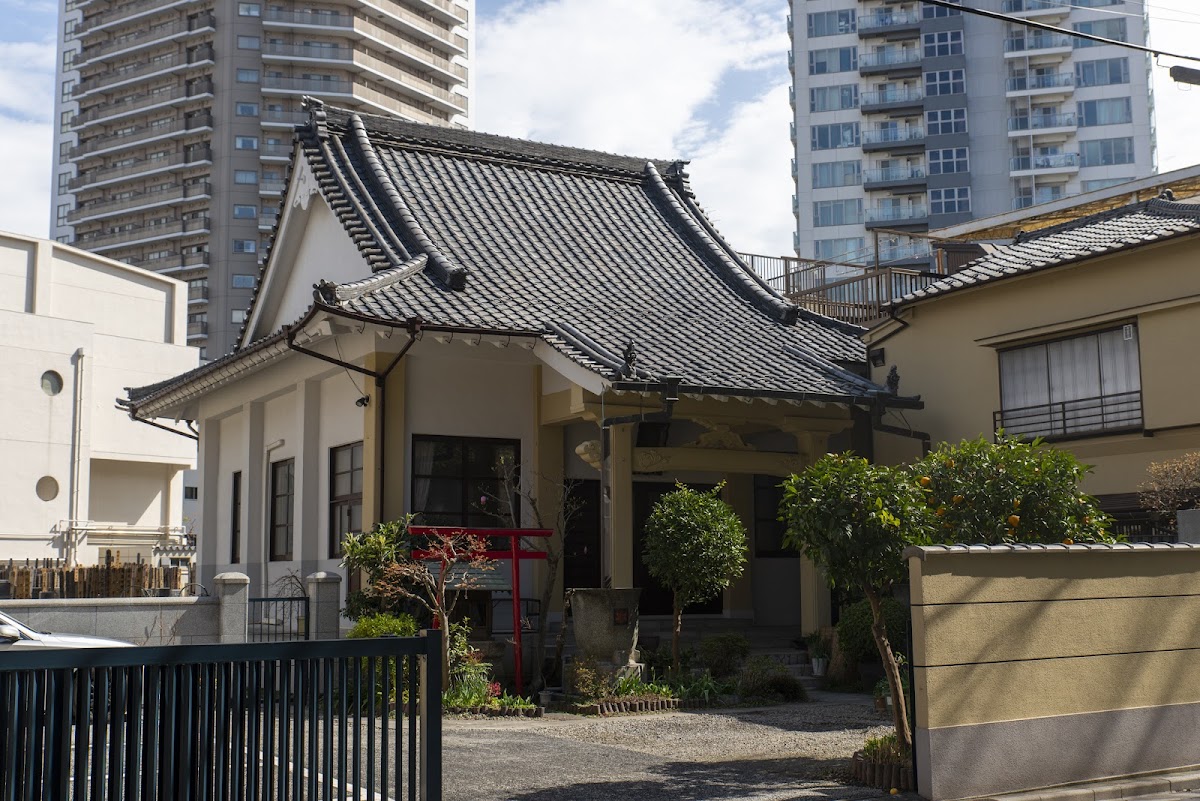
Worship at Asahi Inari Shrine begins at the worship hall located on the first floor of the Daihiro Asahi Building. Entering from the street-facing entrance, the worship hall is integrated into the building’s structure.
Features of the Worship Hall:
- A unique structure integrated into the building’s structure
- A compact yet carefully maintained worship space
- Acoustic design that allows the voices of worshippers in the worship hall to reach the main shrine on the rooftop
- Traditional decorations based on vermilion
A torii gate is also installed in the worship hall, creating a sacred atmosphere that makes you forget you’re in a city building. Worshippers can perform the two bows, two claps, and one bow ritual in the worship hall on the first floor.
Rooftop Main Shrine Area
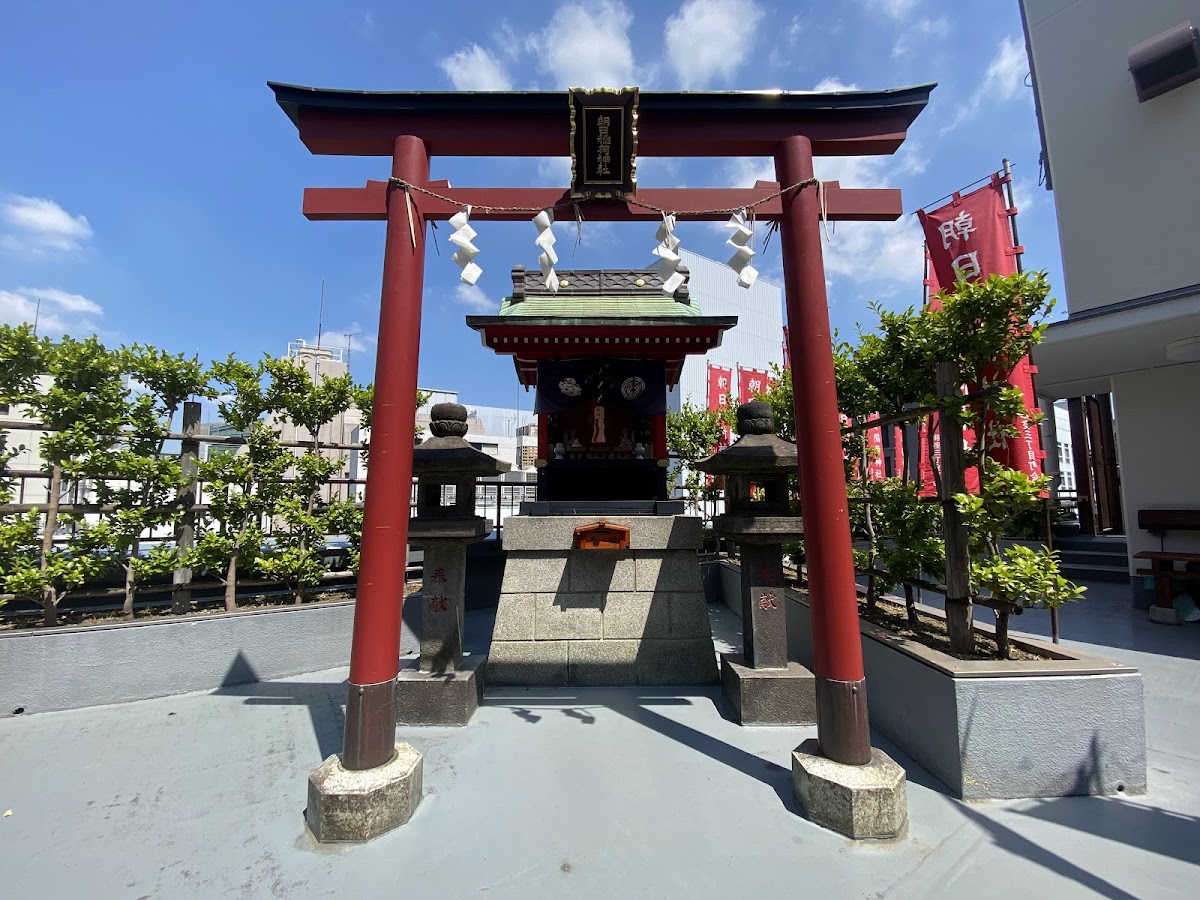
The most distinctive feature of Asahi Inari Shrine is its main shrine located on the rooftop of a building. While the rooftop is not usually open to the public, it may be accessible on special occasions or during annual festivals.
Features of the Rooftop Main Shrine:
- Views overlooking the Ginza district
- A tranquil space unlike anything you’d expect in the heart of the city
- Vermilion-painted shrine building and torii gate
- The landscape that inspired “Weathering with You”
From the rooftop, you can see the Ginza skyscrapers, a view symbolizing the coexistence of modern Tokyo and traditional shrine worship. It’s exactly the image of a “shrine close to the sky” depicted in the movie “Weathering with You.”
Shrine Office and Gift Shop
As Asahi Inari Shrine is a subsidiary shrine of Hie Shrine, there are no resident priests. For goshuin (shrine stamps) and other gifts, please refer to the following:
Reception for Offerings and Goshuin (Shrine Seals):
- Usually, pre-printed goshuin are available.
- For details, please contact Hie Shrine (03-3581-2471).
- On festival days and special occasions, goshuin may be given directly.
Atmosphere of the Shrine Grounds
The grounds of Asahi Inari Shrine are very compact, but this makes it a precious space for quiet prayer amidst the hustle and bustle of the city. Located in Ginza, one of Japan’s leading commercial districts, it attracts a diverse range of visitors, including business people praying for business prosperity and tourists stopping by between shopping.
Its embedded structure within a building demonstrates a unique approach to shrines in central Tokyo, where land constraints are severe, and is a very interesting example of the fusion of architecture and faith.
Goshuin Information
Characteristics of the Goshuin
Asahi Inari Shrine offers goshuin. As it is a shrine managed by Hie Shrine, the method of obtaining goshuin may vary depending on the time of year.
Basic Information on Goshuin (Shrine Seals):
- Offering Fee: Usually around 300-500 yen
- Format of Issuance: Primarily pre-printed (handwritten seals may only be available on special days)
- Design: Calligraphy and red seal of “Asahi Inari Shrine”
- Special Goshuin: Limited edition goshuin may be issued during festivals and special events.
Points to Note When Receiving a Goshuin
- Prior Confirmation: Since there is no resident priest, it is recommended to call Hie Shrine before visiting.
- Preparation of Goshuincho (Shrine Seal Book): Even if it is a pre-printed seal, bringing your goshuincho will allow you to paste it later.
- Worship Manners: Goshuin are proof of worship, so be sure to pray before receiving one.
- Time of Day: Worship is only permitted during the building’s business hours.
Ginza Hachicho Shrine Pilgrimage
Asahi Inari Shrine is one of the shrines included in the “Ginza Hachicho Shrine Pilgrimage.” The Ginza area is dotted with numerous shrines, and collecting Goshuin (shrine stamps) from these is a popular activity. When visiting Asahi Inari Shrine, visiting other Ginza shrines in conjunction will enhance your shrine pilgrimage.
Main Shrines on the Ginza Eight-Chome Shrine Pilgrimage:
- Asahi Inari Shrine
- Toyoiwa Inari Shrine
- Seikou Inari Shrine
- Kou Inari Shrine
- Ryukou Fudōson
- Azuma Inari Shrine
- Hōdō Inari Shrine
- Kotohira-gū
How to Visit and Access Details
Visiting Hours
Asahi Inari Shrine is located within the Daihiro Asahi Building, therefore, visiting hours are subject to the building’s operating hours.
- Visiting Hours: Generally weekdays 9:00 AM to 5:00 PM (depending on the building’s operating hours)
- Closed Days: None in particular (except for the building’s closing days)
- Note: The rooftop main hall is usually closed to the public.
We recommend checking the official website or calling ahead for the latest information before visiting.
Access Methods
Access by Train:
- Tokyo Metro Ginza Station (Ginza Line, Marunouchi Line, Hibiya Line)
- Approximately 3 minutes on foot from Exit A13
- Most convenient access method
- Tokyo Metro/Toei Subway Higashi-Ginza Station (Hibiya Line, Asakusa Line)
- Approximately 2 minutes on foot from Exit A7
- Convenient access from the Kabuki-za area
- Tokyo Metro Ginza-Itchome Station (Yurakucho Line)
- Approximately 5 minutes on foot
- JR Yurakucho Station (Yamanote Line, Keihin-Tohoku Line)
- Approximately 7 minutes on foot from the Ginza Exit
Walking Route:
If coming from Ginza Station, proceed along Harumi-dori towards Ginza 3-chome. The Daihiro Asahi Building is near Matsuya Ginza. The entrance to the shrine is visible on the first floor of the building.
Access by Car:
Parking is limited around Ginza, so we strongly recommend using public transportation. If you must come by car, please use a nearby paid parking lot.
Etiquette for Worship
Worship at Asahi Inari Shrine follows the general etiquette for visiting shrines.
- Bow at the entrance: Bow slightly at the building entrance before entering.
- Proceed to the main hall: Proceed to the main hall on the first floor.
- Offering: Place your offering in the offering box.
- Two bows, two claps, one bow:
- Bow deeply twice.
- Clap your hands twice.
- Pray with all your heart.
- Finally, bow deeply once.
- Bow upon leaving: Bow once when you leave after your visit.
Deity and Blessings
Ukanomitama-no-Mikoto
The deity enshrined at Asahi Inari Shrine is Ukanomitama-no-Mikoto, also known as Inari Okami. Ukanomitama-no-Mikoto is a god of grain appearing in Japanese mythology and is the principal deity enshrined at Inari shrines throughout Japan.
Divine Aspects of Ukanomitama-no-Mikoto:
- God of Abundant Harvests
- God of Business Prosperity
- God of Industrial Development
- Guardian Deity of Family Safety
Originally, Inari was a god of agriculture, but over time, it came to be worshipped as a guardian deity of commerce and industry in general. Especially since the Edo period, in Ginza, which developed as a merchant town, Asahi Inari Shrine has been deeply revered as a god of business prosperity.
Main Benefits
By visiting Asahi Inari Shrine, the following benefits are believed to be received:
- Business Prosperity: Located in the commercial district of Ginza, many visitors pray for business success.
- Family Safety: Protection of family health and peace.
- Fire Protection: A belief in fire protection that has continued since the Edo period.
- Good Fortune and Prosperity: Improved overall luck.
- Fulfillment of Wishes: Granting various wishes.
Business people working in Ginza and shop owners regularly visit the shrine to pray for business prosperity.
Annual Events and Grand Festival
Hatsuumasai (First Horse Day of February)
The grand festival of Asahi Inari Shrine is held on the first Horse Day of February. Hatsuumasai is the first Horse Day of February and is the most important festival day for Inari shrines.
Characteristics of the Hatsuumasai Festival:
- The day when Inari-sama (the Inari deity) is said to have descended upon Mount Inari
- Prayers for a bountiful harvest and business prosperity
- Attracts many worshippers every year
- Special offerings and Goshuin (temple/shrine stamps) are sometimes available
On Hatsuumasai, it is customary to offer Inari sushi and Inari age (fried tofu pouches), and it is believed that eating these after worship brings blessings.
Other Annual Events
In addition to the Hatsuumasai Festival, Asahi Inari Shrine may also hold the following events (please check with Hie Shrine for details):
- New Year’s Day Festival: Prayers for safety and prosperity in the new year
- Setsubun Festival: Prayers for warding off evil and inviting good fortune
- Autumn Festival: Prayers for gratitude for the harvest and business prosperity
Nearby Attractions and Tourist Spots
The Ginza area, where Asahi Inari Shrine is located, has many tourist attractions and commercial facilities. Visiting them in conjunction with your shrine visit will allow you to enjoy a fulfilling Ginza sightseeing experience.
Major Spots in Ginza
Commercial Facilities:
- Matsuya Ginza: A long-established department store
- Ginza Mitsukoshi: A traditional department store
- GINZA SIX: A modern commercial facility
- Ginza Place: Fashion and gourmet food
Cultural Facilities:
- Kabuki-za Theatre: A hallowed hall of traditional performing arts
- Former Sony Building Site (Ginza Sony Park): Event space
- Ginza Graphic Gallery: Design gallery
Other Shrines and Temples:
- Toyoiwa Inari Shrine: 5-minute walk
- Seikou Inari Shrine: 7-minute walk
- Tsukiji Honganji Temple: 10-minute walk
Recommended Pilgrimage Route
Ginza Shrine Pilgrimage Course (Estimated time: approx. 2-3 hours)
- Asahi Inari Shrine (Start)
- Toyoiwa Inari Shrine (5-minute walk)
- Seikou Inari Shrine (5-minute walk)
- Kou Inari Shrine (10-minute walk)
- Lunch and Shopping in Ginza
As a Sacred Site for “Weathering with You”
Connection to the Film
Makoto Shinkai’s “Weathering with You” (released in 2019) is a story set in Tokyo about a girl with the power to control the weather and a runaway boy. It is said that Asahi Inari Shrine served as the model for the “shrine on the rooftop of an abandoned building” that appears in the film.
Similarities with the Film:
- Location on the rooftop of a building
- Mysterious space in the middle of the city
- Setting as a place close to the sky
- Vermilion torii gate and shrine building
While the film depicts an abandoned building, the actual Asahi Inari Shrine is incorporated into an active office building and is kept clean.
Precautions for Pilgrimage
When visiting Asahi Inari Shrine as a fan of “Weathering with You,” please note the following points.
- Photography Etiquette: Remember to be considerate of your surroundings.
- Noise: Be mindful that you are inside a building and pray quietly.
- Praying First: Even if your purpose is sightseeing, pray first.
- Rooftop Not Open to the Public: The view from the rooftop, as seen in the movie, is not usually visible.
- Consideration for Neighbors: The surrounding area is a commercial district; please do not obstruct pedestrian traffic.
Pilgrimages to sacred sites should be undertaken with both love for the work and respect for the site.
The Charm and Value of Asahi Inari Shrine
Coexistence of City and Tradition
The greatest charm of Asahi Inari Shrine lies in the masterful fusion of modern buildings and traditional shrine. The ingenuity in preserving this place of worship within the limited space of Tokyo is evident throughout.
Architectural Value:
- A model for the coexistence of urban development and religious facilities
- Effective use of limited space
- Harmony between traditional shrine architecture and modern buildings
A History of Overcoming Disasters
The history of Asahi Inari Shrine, which has overcome numerous disasters such as the Ansei Great Earthquake, the Great Kanto Earthquake, and World War II, is itself a history of Tokyo’s reconstruction. The miraculous episode of the sacred object being discovered 60 years after being buried in the Sanjukkengori moat speaks to the shrine’s divine power and the depth of faith of the local people.
Community Bonds
The history of the Ginza 3-chome Neighborhood Association taking the lead in protecting the shrine demonstrates the strength of the local community bonds. Even today, it continues to attract the faith of many people as a guardian deity of the region and a god of business prosperity.
Connection with Modern Culture
Having gained new attention as a pilgrimage site for the movie “Weathering with You,” Asahi Inari Shrine has become a bridge connecting traditional faith with modern pop culture. It has become a catalyst for younger generations to take an interest in shrines and is contributing to the preservation of traditional Japanese culture.
Visitor Voices and Experiences
The following are some comments from people who have visited Asahi Inari Shrine:
Business Person’s Voice:
“I work in Ginza, so I visit before important business meetings. It’s compact but has a sacred atmosphere, and it calms my mind.”
Tourist’s Voice:
“I was surprised to find a shrine inside a building. It’s a place where you can feel the fusion of urban life and tradition, typical of Ginza.”
Weathering with You Fan’s Voice:
“I visited while recalling scenes from the movie. The actual shrine is different from the movie, but it was still moving.”
Local Resident’s Voice:
“My family and I have been visiting since I was a child. Even though Ginza has changed, this shrine allows us to feel the old Ginza.”
Checklist of Items to Bring When Visiting
Here’s a list of items that are useful to bring when visiting Asahi Inari Shrine.
Essential Items:
- Offering money (small change)
- Goshuincho (stamp book) (if you wish to receive a stamp)
- Camera/Smartphone (for taking photos)
Helpful Items:
- Map or app of the Ginza area
- Eco-bag (if shopping in Ginza)
- Comfortable walking shoes (if visiting shrines)
Manners:
- Modest attire
- A mindset of quiet worship
- Consideration for those around you
Frequently Asked Questions (FAQ)
Q1: Can anyone visit Asahi Inari Shrine?
A1: Yes, anyone is welcome to visit. However, visits are limited to the building’s business hours.
Q2: Can I visit the main hall on the rooftop?
A2: It is not usually open to the public. It may be open during special events, so we recommend checking with Hie Shrine in advance.
Q3: Can I get a Goshuin (temple/shrine stamp) every day?
A3: While pre-printed Goshuin are often available, please check with Hie Shrine (03-3581-2471) in advance if you want to be sure to receive one.
Q4: Is there parking available?
A4: There is no dedicated parking lot. We recommend using public transportation.
Q5: Is photography allowed?
A5: Photography for personal records of your visit is permitted, but please be considerate of other visitors and building users. Commercial photography requires prior permission.
Q6: Are there amulets or other items available?
A6: The availability of items varies depending on the season. Please check with Hie Shrine for details.
Q7: Can anyone participate in the Hatsuumasai (First Horse Day Festival)?
A7: Yes, the Hatsuumasai is open to the public. It is usually crowded with many visitors, so we recommend visiting with plenty of time to spare.
Q8: Can foreign tourists visit the shrine?
A8: Of course. Anyone is welcome as long as they follow the basic etiquette of visiting a shrine.
Summary: Experience the Charm of Asahi Inari Shrine
Asahi Inari Shrine is a unique shrine located on the rooftop of a building in Ginza, Chuo Ward, Tokyo, one of Japan’s leading commercial areas. It has a turbulent history, having been buried in the Sanjukkengori moat during the Ansei Great Earthquake and miraculously rediscovered 60 years later. It has survived the Great Kanto Earthquake and wartime destruction to reach its present state.
The unique structure, with a worship hall on the first floor and a main shrine on the rooftop, symbolizes the coexistence of urban development and traditional faith, showcasing Tokyo’s ingenuity in preserving a place of worship within limited land. It is believed to offer blessings for business prosperity, family safety, and fire protection, attracting devout followers from Ginza workers and tourists alike.
In recent years, it has gained attention as a pilgrimage site for fans of Makoto Shinkai’s film “Weathering with You,” attracting many young fans in addition to traditional worshippers. Its convenient location, just a 3-minute walk from Ginza Station, is a major draw, making it easy to visit in conjunction with shopping and dining in Ginza.
It’s also known as one of the shrines on the Ginza Eight Shrines Pilgrimage, and visiting it along with other nearby shrines will enhance your Ginza sightseeing experience. Asahi Inari Shrine is a precious space where you can quietly offer prayers in the heart of the city. We encourage you to visit and experience its history and charm for yourself.
When visiting, please remember to show respect to the shrine and be considerate of those around you. We hope your visit to Asahi Inari Shrine will be a memorable one.