Complete Guide to Kasama Inari Shrine | The Charm and Blessings of One of Japan’s Three Great Inari Shrines with a 1360-Year History
Kasama Inari Shrine, located in Kasama City, Ibaraki Prefecture, is a venerable shrine counted among Japan’s three great Inari shrines. Founded in 651 AD (Hakuchi 2), it boasts a history of over 1360 years and is known as one of the most sacred and auspicious shrines in the Kanto region, attracting over 3.5 million visitors annually. This article comprehensively introduces information you should know before visiting Kasama Inari Shrine, including its history, blessings, highlights within the grounds, festivals and events, and access methods.
What is Kasama Inari Shrine?
Status as One of Japan’s Three Great Inari Shrines
Kasama Inari Shrine is widely recognized as one of Japan’s three great Inari shrines, alongside Fushimi Inari Taisha in Kyoto and Yutoku Inari Shrine in Saga (or Toyokawa Inari in Aichi). Also known as “Kurumigashita Inari” and “Monzaburo Inari,” this shrine has long been revered as a deity of the common people.
Located at 1 Kasama, Kasama City, Ibaraki Prefecture, it was formerly a village shrine but is now designated as a special shrine by the Association of Shinto Shrines. Over 800,000 people visit during the first three days of the New Year alone, making it the most visited shrine in Ibaraki Prefecture.
Deity and Divine Virtues
The deity enshrined at Kasama Inari Shrine is Ukanomitama-no-Kami. This deity is revered as the guardian deity of all kinds of industries and businesses, including abundant harvests, and is believed to bestow the following wide-ranging blessings:
- Abundant Harvest and Business Prosperity: Protection for the development of agriculture and commerce
- Good Fortune and Happiness: Improvement of luck and the arrival of happiness
- Fire Prevention: Protection from fire
- Safety in Home and Workplace: Peace and safety in home and workplace
- Exorcism and Protection from Misfortune: Protection from disasters
- Traffic Safety: Safe travel and accident prevention
The benefit of business prosperity is particularly well-known, and business owners and people involved in commerce come to worship from all over Japan, not just the Kanto region.
History of Kasama Inari Shrine
From Founding to the Present
Kasama Inari Shrine is said to have been founded in the second year of the Hakuchi era (651 AD) during the reign of Emperor Kotoku, the 36th emperor. This period was immediately after the Taika Reforms, a time when Japan’s Ritsuryo system was being established. With a long history spanning over 1360 years since its founding, it has attracted the faith of people across generations.
Prosperity during the Edo Period
During the Edo period, it received deep reverence from successive feudal lords, including the Makino clan, the lords of the Kasama Domain. These lords made significant contributions to the shrine’s development by donating land and buildings. In particular, in 1681 (Enpo 9), Makino Narisada, the lord of the Kasama Domain, invited an Inari shrine to his Edo residence, which became the origin of the current Tokyo branch shrine (Nihonbashi Hamacho).
During this period, it became popular among common people under the names “Kurumishita Inari” and “Monzaburo Inari,” attracting many worshippers from all over the Kanto region.
Development since the Modern Era
Even after the separation of Shinto and Buddhism in the Meiji era, it has continued to attract unwavering faith since the Meiji period. In 1967, the wisteria tree on the shrine grounds was designated a natural monument of Ibaraki Prefecture, and in 2008, the main hall was designated a national important cultural property, demonstrating its high cultural value.
Even today, it continues to develop as a representative shrine of Ibaraki Prefecture, attracting over 3.5 million visitors annually, and drawing large crowds from both within and outside the prefecture for New Year’s visits and various festivals.
Shrine Grounds Guide
Tower Gate (Nio-mon Gate)
Upon entering the grounds of Kasama Inari Shrine, the first thing that catches the eye is the magnificent tower gate. This gate houses statues of “Kushiiwamado-no-kami” and “Toyoiwamado-no-kami” on the outside, and two “sacred horses” on the inside, protecting the sacred area.
Passing through the main gate, the solemn atmosphere welcoming worshippers intensifies, leading you into a sacred space.
Worship Hall and Main Sanctuary
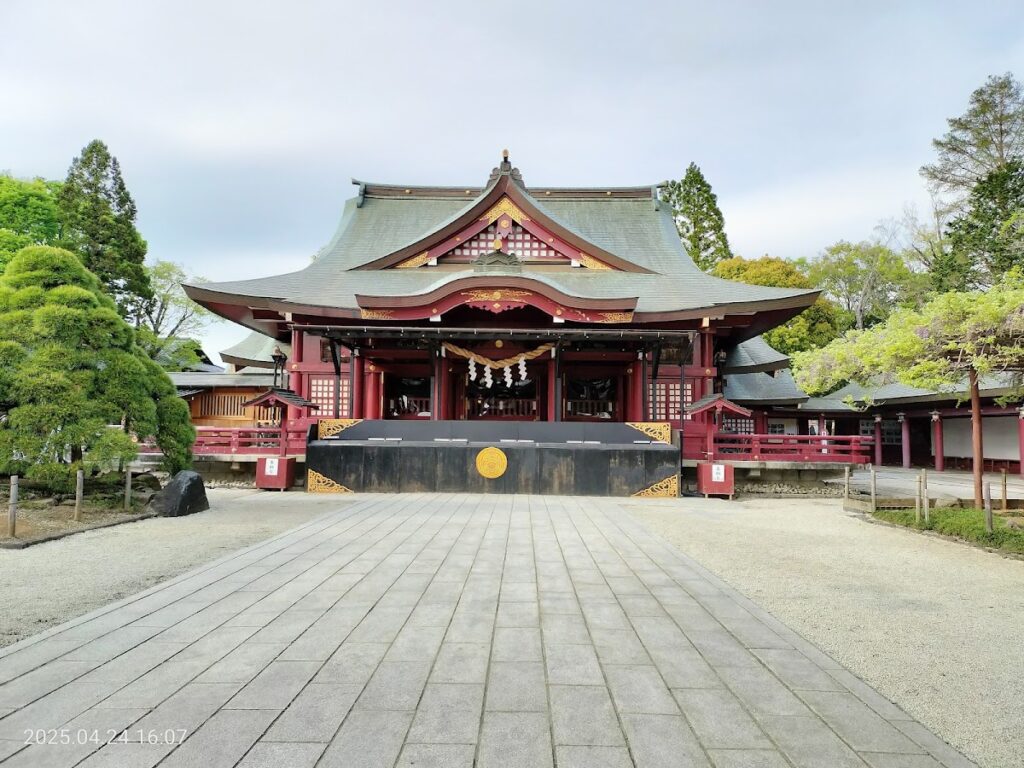
The worship hall is where worshippers offer their prayers and is bustling with many visitors. Located behind it is the main sanctuary, a building constructed between 1859 (Ansei 6) and 1860 (Man’en 1), designated a National Important Cultural Property in 2008 (Heisei 20).
The main sanctuary is a complex building consisting of an outer sanctuary (the former worship hall) and an inner sanctuary (the main sanctuary), and has the following characteristics:
Outer Sanctuary (Former Worship Hall)
- Three bays wide, two bays deep, single-story, hip-and-gable roof
- One-bay portico with curved gable roof
- Copper plate roofing in the style of traditional roof tiles
Inner Sanctuary (Main Hall)
- Three bays wide, three bays deep, single-story
- Hip-and-gable roof at the rear, connected to the outer sanctuary at the front
- The inner sanctuary’s ridge extends beyond the outer sanctuary’s ridge, creating a gable at the front
- Copper plate roofing in the style of traditional roof tiles
This exquisite architectural style is highly regarded as the pinnacle of shrine architecture from the late Edo period.
Prefectural Designated Natural Monument: “Yae-no-Fuji” (Double-flowered Wisteria)
To the right of the worship hall within the shrine grounds are two wisteria trees over 400 years old. These wisteria, known as “Yae-no-Fuji” (Double-flowered Wisteria) and “Dai-Fuji” (Great Wisteria), were designated as natural monuments of Ibaraki Prefecture in November 1967.
In particular, the “Yaeno Fuji” (double-flowered wisteria) is a rare variety whose flowers bloom in clusters resembling grapes, and it typically reaches its peak bloom in early May. When in full bloom, the shrine grounds are dyed a pale purple, making it a springtime spectacle that attracts many worshippers and tourists to Kasama Inari Shrine.
Subsidiary Shrines and Shrines within the Grounds
Besides the main shrine, Kasama Inari Shrine has several subsidiary shrines. Each subsidiary shrine enshrines a different deity, and worshippers can visit these shrines according to their wishes. Visiting each subsidiary shrine while exploring the grounds will provide a deeper religious experience.
Kasama Inari Art Museum
The Kasama Inari Art Museum is also located within the shrine grounds, where visitors can appreciate artworks and historical materials donated to the shrine. Visiting the museum in conjunction with worship will allow for a deeper understanding of the history and culture of Kasama Inari Shrine.
Festivals and Events
Kasama Inari Shrine holds various festivals and events throughout the year. These rituals convey traditions that have been passed down through a long history.
Annual Grand Festival
The most important festival at Kasama Inari Shrine is the Annual Grand Festival, held every year on April 9th. This is the most prestigious festival at the shrine, and it is conducted solemnly from 11:00 AM. On the day of the Annual Grand Festival, the times for prayers are different from usual, and are only available at 8:00 AM, 1:00 PM, 2:00 PM, 3:00 PM, and 4:00 PM. Please take note of this if you plan to visit.
New Year’s Visit
During the first three days of the New Year, over 800,000 people visit the shrine for their first visit of the year, the highest number in Ibaraki Prefecture. The shrine grounds are bustling with people praying for good fortune and business prosperity in the new year. This is a representative New Year’s pilgrimage spot in Ibaraki Prefecture, attracting many visitors who come with the wish for a good year.
Kasama Chrysanthemum Festival
Every autumn, the “Kasama Chrysanthemum Festival” is held, mainly along the street in front of the shrine. This event is a popular autumn event in Kasama City, with magnificent chrysanthemums displayed on the shrine grounds and along the street, attracting many tourists. It’s a Kasama tradition where visitors can enjoy chrysanthemum viewing in addition to visiting the shrine.
Other Annual Events
Besides the annual festival and New Year’s pilgrimage, Kasama Inari Shrine holds various festivals and religious ceremonies throughout the year, including monthly festivals, Setsubun festivals, and Shichi-Go-San (children’s festival). It is recommended to check the official website for the dates and details of each festival.
About Prayers
Types of Prayers
At Kasama Inari Shrine, you can receive prayers tailored to various wishes of worshippers. The main types of prayers are as follows:
- Business Prosperity and Success
- Family Safety and Good Health
- Protection from Evil and Misfortune
- Traffic Safety
- Prayers for Success in Exams and Academic Achievement
- Prayers for Safe Childbirth
- First Shrine Visit for a Newborn
- Shichi-Go-San Ceremony
Prayer Reception Hours
Prayers are usually accepted daily, but times may change on special days such as festival days. On major festival days such as the Grand Festival (April 9th), prayer times are limited, so it is recommended to check the official website or contact the shrine directly in advance.
Shinto Wedding Ceremony
Kasama Inari Shrine offers traditional Shinto wedding ceremonies. This historic shrine, with over 1360 years of history, is a popular choice for couples seeking a solemn and dignified wedding ceremony. If you wish to have a Shinto wedding ceremony, you must consult and make a reservation with the shrine in advance.
Items Offered
Amulets and Talismans
Kasama Inari Shrine offers a variety of amulets and talismans. You can receive amulets tailored to your specific wishes, such as business prosperity, family safety, traffic safety, and academic success.
Umbrella Fortune Slips
One of the popular items offered at Kasama Inari Shrine is the adorable “Umbrella Fortune Slip.” These colorful umbrella-shaped fortune slips are popular not only for fortune-telling but also as Instagrammable items, especially among young visitors. You can tie them to designated spots on the shrine grounds before leaving.
Other Items Offered
A variety of items are available, including Goshuin (shrine stamps), Ema (votive tablets), and lucky charms. These can be received as mementos of your visit or as proof of your faith.
Kasama Inari Shrine Tokyo Branch
History of the Tokyo Branch
The Kasama Inari Shrine Tokyo Branch, currently located in Nihonbashi Hamacho 2-chome, Chuo-ku, Tokyo, is also known as Monzaburo Inari and was originally a shrine within the residence of the former Kasama Domain lord, the Makino family.
It was founded over 325 years ago, in Enpo 9 (1681), on land granted to Makino Narisada, the lord of the Kasama Domain, as a secondary residence by the 5th Shogun, Tokugawa Tsunayoshi. The original site was a vast 21,269 tsubo (approximately 70,000 square meters), stretching from the area around the current Ogawa Bridge and Kakihama Bridge in front of the Hisamatsu Police Station to the Sumida River. The residence included a large mansion, gardens, and a pond, and the artificial hill housed shrines to Inari, Sanno, and Hachiman.
Visiting in Tokyo
The Tokyo branch shrine is a valuable place for believers living in Tokyo who cannot travel to Kasama, and for people working in the city center, to receive the divine blessings of Kasama Inari Shrine. Like the main shrine, it is believed to bring good fortune and prosperity in business, and attracts many visitors.
Access Information
Location
Address: 1 Kasama, Kasama City, Ibaraki Prefecture
*If the above address cannot be found using car navigation, please aim for “Kasama Nichido Museum of Art” (it is located next to the east side of the Kasama Nichido Museum of Art).
Access by Train
From JR Mito Line “Kasama Station”
- Walking: Approximately 20 minutes (just go straight down the road)
- Bus: Take the bus bound for Kasama Inari Shrine (approximately 5 minutes)
The route from Kasama Station is easy to follow, and it is easily accessible on foot. Strolling along the street in front of the shrine is also recommended.
Access by Car
From the Joban Expressway
- Approximately 15 minutes from Tomobe IC via National Route 355
- Approximately 15 minutes from Iwama IC via National Route 355
From the Kita-Kanto Expressway
- Approximately 15 minutes from Tomobe IC via National Route 355
- Approximately 20 minutes from Kasama-Nishi IC via National Route 50
Parking Information
The following parking lots are available at Kasama Inari Shrine:
Public Kasama Inari Parking Lot
- Address: 1014 Kasama, Kasama City, Ibaraki Prefecture
- The closest public parking lot to the shrine
Jizo-mae Parking Lot
- Located near the temple gate
- Convenient for strolling around the temple gate area in conjunction with visiting the shrine
There are also several other parking lots in the surrounding area. The shrine gets very crowded during New Year’s and festival seasons, so it is recommended to allow ample time for your visit. Also, consider using public transportation during peak times.
Toilet and Accessibility Information
Toilets are available on the shrine grounds for visitors. While accessibility features are in place, it is recommended to inquire with the shrine in advance for details.
Nearby Tourist Attractions
Kasama Monzen-dori Street
Monzen-dori Street, the approach to Kasama Inari Shrine, is lined with traditional shops, restaurants, and souvenir shops. There are plenty of places to enjoy alongside your visit, including shops selling Kasama ware pottery and restaurants offering local delicacies such as Inari sushi.
Kasama Nichido Museum of Art
Located next to the shrine to the east, the Kasama Nichido Museum of Art houses and exhibits modern and contemporary art from Japan and abroad. A visit before or after your shrine visit will make for a culturally enriching day.
Kasama Pottery Village
Kasama City is also famous as a production area for Kasama ware pottery. There are numerous facilities such as Kasama Craft Hill and pottery-making workshops, allowing you to experience the charm of Kasama ware alongside your shrine visit.
Manners and Points for Visiting a Shrine
Etiquette for Visiting a Shrine
When visiting Kasama Inari Shrine, please observe the following basic etiquette:
- Bow before passing through the torii gate: A courtesy before entering the sacred area.
- Purify your body and mind at the water basin: Purify your left hand, right hand, and mouth in that order.
- Avoid walking in the center of the path: The center is the path of the gods.
- Worship at the main hall: Two bows, two claps, and one bow is the basic procedure.
Regarding Photography
Photography is generally permitted on the shrine grounds, but there may be restrictions inside the main hall or during Shinto rituals. Please observe photography etiquette and be considerate of other visitors.
Tips for Avoiding Crowds
The shrine is especially crowded during the first three days of the New Year (Hatsumode), the annual festival (April 9th), and the chrysanthemum festival. If you want to visit at a leisurely pace, weekday mornings or times when festivals are not taking place are recommended. However, if you want to experience festivals and events, choosing a time when it’s crowded might be a good idea.
Summary
Kasama Inari Shrine is one of Japan’s three major Inari shrines, boasting a history of over 1360 years since its founding in 651. Dedicated to Ukanomitama-no-kami, it is believed to offer a wide range of blessings, including business prosperity, abundant harvests, good fortune, and fire prevention, attracting over 3.5 million visitors annually.
With its main hall designated as a National Important Cultural Property, a 400-year-old wisteria tree designated as a prefectural natural monument, solemn festivals and rituals, and the charming atmosphere of the street in front of the shrine, there are plenty of sights to see. When visiting Ibaraki Prefecture, be sure to visit Kasama Inari Shrine and experience its history and sacred atmosphere.
With excellent access, Kasama Inari Shrine is within walking distance of JR Kasama Station and can be reached quickly by car from the Joban Expressway and Kita-Kanto Expressway. Combining your visit with a stroll through the Kasama ware pottery village and the street in front of the shrine will make for a fulfilling day.
We recommend visiting Kasama Inari Shrine to all business owners praying for prosperity, those seeking good fortune and happiness, those wanting to experience traditional Japanese culture, and anyone who wishes to visit a historic shrine.