
Complete Guide to Shusshakaji Temple | The Legend of Kobo Daishi’s Self-Sacrifice and Everything About the 73rd Temple of the Shikoku 88 Temple Pilgrimage
What is Shusshakaji Temple?
Shusshakaji Temple is a Shingon sect Omuro school temple located in Yoshihara-cho, Zentsuji City, Kagawa Prefecture. Its mountain name is Gahaishizan, and its temple name is Gumonjiin. As the 73rd temple of the Shikoku 88 Temple Pilgrimage, it is visited by many pilgrims.
The principal image is a statue of Shakyamuni Buddha, said to have been carved by Kobo Daishi Kukai himself. The temple’s name, “Shusshaka,” is a special name derived from the legend that Kobo Daishi encountered Shakyamuni Buddha in this place when he was seven years old.
The temple grounds are located at the foot of Mt. Gahaishi, and on the summit of the mountain behind it lies the inner sanctuary, Shashingadake Zenjo. This place is a sacred site that can be considered the origin of Kobo Daishi, and it continues to attract worshippers as an important holy site for the practice of Shingon Esoteric Buddhism.
The Legend of Kobo Daishi’s Self-Sacrifice at Age 7
The Resolve of Young Mao
The most distinctive feature of Shusshakaji Temple is its deep connection to the legend of Kobo Daishi Kukai’s childhood. When Kukai was seven years old and still known by his childhood name, Mao, he harbored a great vow to enter the Buddhist path and save many people.
It is said that young Mano climbed to the summit of Mount Gahaishi (then called Mount Yamatozan) and made a vow: “I wish to enter the Buddhist order and save all sentient beings. If this wish is granted, O Shakyamuni Buddha, please reveal yourself. If this wish is not granted, I will dedicate myself to all Buddhas.” He then threw himself from the cliff.
The Appearance of Shakyamuni Buddha and the Celestial Maiden
At that moment, Shakyamuni Buddha and the Celestial Maiden appeared on clouds and gently embraced young Mano. This miraculous event allowed the boy to safely descend to earth. This legend is the origin of the temple’s name, “Shusshaka” (出釈賀).
The place where he threw himself is now known as Shusshingatake, and it is considered one of the most important sacred sites in the life story of Kobo Daishi. This event, demonstrating the unwavering faith and determination of the young Kukai, continues to touch the hearts of many visitors.
History of Shusshakaji Temple
Founding and Founder
Shusshakaji Temple is said to have been founded in 807 AD (Daido 2), after Kobo Daishi Kukai returned from Tang China. Kukai visited the site of the legend of his self-sacrifice in his childhood and decided to build a temple in this place, his starting point.
Kukai himself carved a statue of Shakyamuni Buddha, making it the principal image, and also enshrined a statue of Kokuzo Bodhisattva. Kokuzo Bodhisattva was the principal image when Kukai practiced the Kokuzo Gumonji ritual in his youth, indicating the deep connection between this temple and Kukai’s training. The temple’s name, “Gumonji-in,” also derives from this Kokuzo Gumonji ritual.
From the Medieval to the Early Modern Period
During the medieval period, despite the effects of war, the temple maintained its faith as a sacred site associated with Kobo Daishi. During the Edo period, the Shikoku Pilgrimage became popular among the common people, and Shusshakaji Temple, as the 73rd temple on the pilgrimage route, attracted many pilgrims.
Although affected by the anti-Buddhist movement of the Meiji era, the temple was preserved thanks to the fervent faith of the local people. Currently, it belongs to the Omuro branch of the Shingon sect and is positioned as a branch temple of Ninna-ji Temple, the head temple in Kyoto.
Shusshakaji Temple in Modern Times
From the Showa to the Heisei era, improvements were made to the temple grounds and the temple buildings. In particular, the improvement of the pilgrimage route to the inner sanctuary has made it possible for more people to visit Shusshakaji.
In 2017, the “Shikoku Pilgrimage” was designated a Japan Heritage site, and Shusshakaji Temple was registered as one of its constituent cultural properties. Its value as an important place that conveys the origins of the Kobo Daishi faith has been reaffirmed.
Temple Grounds
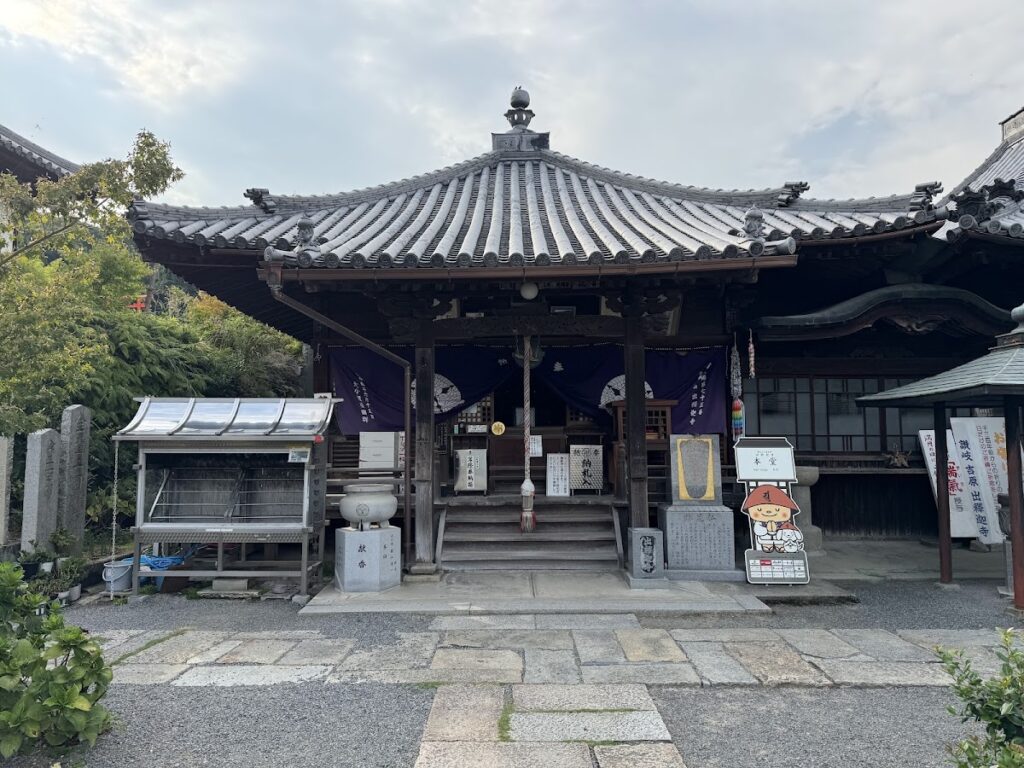
Main Hall
The main hall houses the principal image, a statue of Shakyamuni Buddha, said to have been created by Kobo Daishi himself. Visitors offer prayers here, reflecting on Kobo Daishi’s childhood resolutions. The main hall also enshrines Kokuzo Bosatsu, attracting many visitors seeking improvement in wisdom and memory.
While maintaining the traditional Shingon Buddhist temple style, the building has also undergone modern restorations, creating a solemn atmosphere.
Daishi Hall
The Daishi Hall houses a statue of Kobo Daishi and serves as a place for visitors to chant sutras according to the customs of the Shikoku Pilgrimage. Chanting “Namu Daishi Henjo Kongo” here deepens one’s connection with Kobo Daishi.
Sutra Copying Office
The sutra copying office offers Goshuin (temple stamps) and Omie (images of Kobo Daishi). The temple’s official seal bears the mountain name “Gahaishi-san,” indicating its connection to Kobo Daishi (Kukai).
Other Facilities
The temple grounds include a bell tower, a water basin, and a pilgrim’s rest area. Taking advantage of its location at the foot of Mount Gahaishi, a tranquil space harmonizes with nature.
Inner Sanctuary/Shushin-ga-take Zenjo
Path to Shushin-ga-take
The main attraction of Shusshakaji Temple is the inner sanctuary, Shushin-ga-take Zenjo, located at the summit of Mount Gahaishi, approximately 2 kilometers from the main hall. The climb to the 481-meter-high summit takes about 45 minutes to an hour on foot.
While the path is well-maintained, there are steep stone steps and mountain trails, so comfortable shoes and clothing are recommended. Along the way, historical sites and stone Buddha statues associated with Kobo Daishi are scattered, and many pilgrims challenge this path as a form of spiritual training.
The Scenery of Sutemi-ga-take
At the summit of Sutemi-ga-take, there is a sheer cliff from which Kobo Daishi is said to have thrown himself. While safety railings are now in place, its height and steepness speak to the strength of young Mao’s resolve at the time.
From the summit, you can enjoy a panoramic view of the Sanuki Plain, including the city of Zentsuji and the Seto Inland Sea. On a clear day, you can even see the Seto Ohashi Bridge, and the magnificent view will make you forget the fatigue of the climb.
The Temple of the Inner Sanctuary
A small temple has been built on Sutemi-ga-take, enshrining statues of Shakyamuni Buddha and Kobo Daishi. By visiting here, you can connect with the origins of Kobo Daishi and deepen your own faith.
Many pilgrims visit the inner sanctuary after visiting the main hall, but even if you are unable to climb due to physical limitations or time constraints, you can complete your pilgrimage by visiting the main hall.
Cultural Properties and Temple Treasures
Principal Image: Shakyamuni Buddha Statue
The principal image, a statue of Shakyamuni Buddha said to have been created by Kobo Daishi himself, is the greatest treasure of Shusshakaji Temple. It is usually kept in a shrine as a hidden Buddha, but is occasionally unveiled during special religious ceremonies.
Kokuzo Bodhisattva Statue
The Kokuzo Bodhisattva statue enshrined in the main hall is also an important temple treasure. As the principal image used by Kobo Daishi when he practiced the Kokuzo Gumonji ritual, it attracts the faith of practitioners and those aspiring to learning.
Other Cultural Properties
The temple grounds also house stone structures from the Edo period and calligraphy and paintings by successive chief priests. These are important historical materials that convey the history of the region, designated as cultural properties of Zentsuji City.
Annual Events
New Year’s Events
At the start of the new year, the temple is bustling with visitors for their first shrine visit of the year, who come to pray for good health and safety for their families throughout the year.
Spring and Autumn Grand Festivals
Grand festivals are held in spring and autumn, with memorial services and Goma fire rituals performed for the main deity. Local parishioners and pilgrims participate, praising the virtues of Kobo Daishi.
Kobo Daishi’s Birthday Celebration
A special memorial service is held on June 15th, Kobo Daishi’s birthday (according to the lunar calendar). This day holds particular significance as Shusshakaji Temple is a sacred site that represents the origin of Kobo Daishi’s teachings.
Positioning as one of the 88 Sacred Sites of Shikoku
Significance of Temple No. 73
Shusshakaji Temple is the 73rd temple of the 88 Sacred Sites of Shikoku, and one of the important sacred sites in Sanuki Province (Kagawa Prefecture). It is located approximately 3 kilometers from Mandaraji Temple (Temple No. 72) and approximately 7 kilometers from Kozanji Temple (Temple No. 74).
Characteristics of the Pilgrimage Route
The pilgrimage route around Shusshakaji Temple is relatively flat, but visiting the inner sanctuary adds an element of mountain asceticism. Many pilgrims visit this temple feeling a special significance, as they are visiting the origin of Kobo Daishi.
Relationship with Preceding and Following Temples
Together with Mandaraji Temple (Temple No. 72), it forms an important sacred site within Zentsuji City. Zentsuji City is the birthplace of Kobo Daishi and, centered around Zentsuji Temple (the 75th temple on the Shikoku Pilgrimage), is known as “Daishi no Sato” (the Village of the Great Master) and is one of the highlights of the pilgrimage route.
Transportation Access
Access by Public Transportation
Access by Train
- Approximately 40 minutes on foot from JR Dosan Line “Zentsuji Station”
- Approximately 10 minutes by taxi
Access by Bus
- Community buses operate, but the number of services is limited, so it is necessary to check the timetable in advance.
Access by Car
From the Expressway
- Approximately 10 minutes from Takamatsu Expressway “Zentsuji Interchange”
- Parking is available on the temple grounds for approximately 20 regular cars (free of charge)
Car Navigation Settings
- Address: 1091 Yoshihara-cho, Zentsuji City, Kagawa Prefecture
- You can also search by phone number
For Pilgrimage on Foot
Approximately 3 kilometers from Temple No. 72, Mandara-ji Temple, about 45 minutes on foot. The pilgrimage route is relatively easy to follow, and the signposts are well-maintained.
Etiquette and Manners for Visiting the Temple
Basic Order of Visiting the Temple
- Bow at the main gate and enter the temple grounds.
- Purify your body and mind at the water basin.
- Ring the bell at the bell tower (only before praying).
- Offer a votive slip, make an offering, and chant sutras at the main hall.
- Offer a votive slip, make an offering, and chant sutras at the Daishi Hall.
- Receive your temple stamp at the sutra office.
Precautions for Visiting the Inner Sanctuary
If you are planning to climb Mt. Sutemigatake, please note the following:
- Prepare comfortable shoes and clothing.
- Bring drinking water.
- Check the weather and do not force yourself to go in rainy weather.
- Allow ample time for your visit (approximately 2 hours round trip).
- Do not force yourself if you have a fear of heights.
Photography Manners
Photography is permitted on the temple grounds and in the inner sanctuary, but please be considerate of the interior of the main hall and other visitors. Please take extra care to ensure your safety when taking photos, especially at Sutemigatake.
Nearby Tourist Attractions
Zentsuji Temple
The head temple of the Shingon sect, Zentsuji branch, built on the birthplace of Kobo Daishi. Located approximately 3 kilometers from Shusshakaji Temple, it is the 75th temple on the Shikoku 88 Temple Pilgrimage.
Mandaraji Temple
The 72nd temple on the pilgrimage, preceding Shusshakaji Temple. The temple’s name originates from the fact that it houses a mandala brought back from Tang China by Kobo Daishi.
Kozanji Temple
The 74th temple on the pilgrimage, following Shusshakaji Temple. A unique temple with Bishamonten as its principal deity.
Gogakusan Mountains
Five mountains that are symbols of Zentsuji City. Gahaishiyama Mountain is one of them, characterizing the landscape of the Sanuki Plain.
Temple Lodgings and Rest Facilities
Temple Lodging Information
While Shusshakaji Temple does not offer temple lodgings, there are several pilgrim lodgings and guesthouses around Zentsuji Temple. Advance reservations are recommended.
Rest Facilities
A pilgrim rest area is provided on the temple grounds, where you can rest free of charge. Vending machines and restrooms are also available.
Summary of Highlights of Shusshakaji Temple
The greatest attraction of Shusshakaji Temple is the opportunity to experience the origins of Kobo Daishi Kukai. Shusshakaji, where the 7-year-old boy Mao risked his life to demonstrate his resolve to pursue Buddhism, is not merely a legendary site, but a sacred place that still moves the hearts of many.
From quiet worship in the main hall to the training path to the inner sanctuary, and the breathtaking views from the mountaintop, you can experience faith and nature in various ways. Not only is it a temple on the Shikoku Pilgrimage, but as a special temple where you can touch the core of Kobo Daishi faith, it continues to inspire many visitors.
When visiting Zentsuji City, be sure to visit Shusshakaji Temple and its inner sanctuary, Sutemigatake, to experience the unwavering faith of Kobo Daishi and the spiritual energy of the place that was its origin.
Visitor Voices and Experiences
Many pilgrims say, “The climb to the inner sanctuary was difficult, but the feeling of awe when I stood on the summit is unforgettable.” The view of the Sanuki Plain from Sutemigatake is particularly highly regarded as a precious opportunity to relive the landscape that Kobo Daishi saw.
Many also express sentiments such as, “Thinking about a 7-year-old child who decided to throw himself from this cliff, I truly feel the greatness of the power of faith.” Shusshakaji Temple is not merely a tourist destination; it leaves a deep impression on visitors as a place to reflect on their own faith and life.
Practical Information
Temple Name: Gahaishizan Gumonjiin Shusshakaji
Sect: Shingon Omuro School
Principal Image: Shakyamuni Buddha
Pilgrimage Site: Shikoku 88 Temple Pilgrimage, No. 73
Address: 1091 Yoshihara-cho, Zentsuji City, Kagawa Prefecture 765-0061
Phone: 0877-63-0073
Visiting Hours: 7:00~17:00 (Temple Office)
Admission Fee: Free
Parking: Free (Approximately 20 regular cars)
Official Website: https://shusshakaji.com/
Shusshakaji is the starting point of Kobo Daishi Kukai’s teachings and one of the most important sacred sites on the Shikoku Pilgrimage. In this sacred place where history, faith, and nature blend together, take some time to quietly offer your prayers and reflect on the teachings of Kobo Daishi.

