
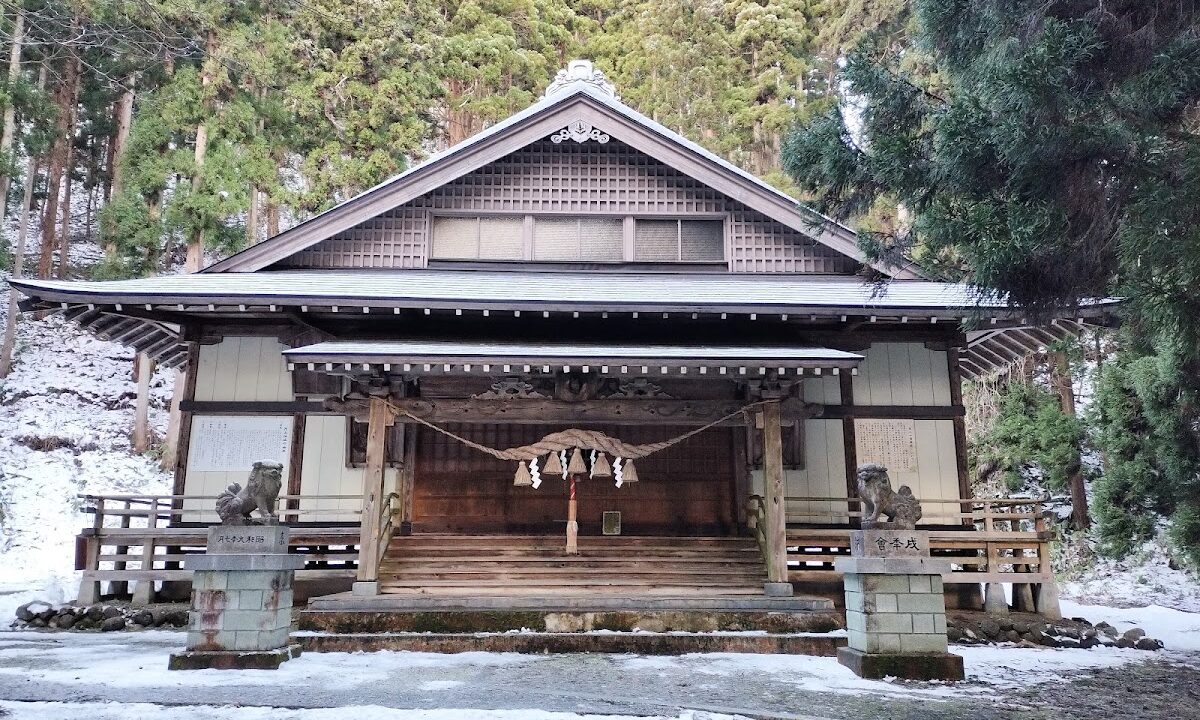
Gassan Shrine (Kazuno City, Akita Prefecture) Complete Guide | 1200 Years of History and the Legend of Sakanoue no Tamuramaro
Gassan Shrine, located in Towada Kemanai, Kazuno City, Akita Prefecture, is a historical shrine said to have been founded in the early Heian period by Sakanoue no Tamuramaro, the Shogun. For over 1200 years, it has attracted the faith of the local people and holds a high status as the only prefectural shrine in the Kazuno region. This article provides a detailed explanation of Gassan Shrine’s history, cultural value, visiting information, and its deep connection to the local community.
Overview and Basic Information of Gassan Shrine
Location and Access
Gassan Shrine is located at 32 Kemanai-zawa, Towada Kemanai, Kazuno City, Akita Prefecture. The postal code is 〒018-5334. It is situated in a lush green environment, slightly removed from the center of the Kemanai district.
Transportation Access:
- Approximately 10 minutes by car from JR Hanawa Line “Towada-Minami Station”
- Approximately 20 minutes by car from Tohoku Expressway “Kazuno-Hachimantai IC”
- Also accessible from Akita Inland Railway “Takanosu Station”
Deity and Shrine Characteristics
The deity enshrined at Gassan Shrine is Tsukuyomi-no-Mikoto. Tsukuyomi-no-Mikoto is one of the Three Noble Children, along with Amaterasu-Omikami and Susanoo-no-Mikoto, and is revered as the moon god who rules the night world.
The shrine was founded as a guardian deity for the nation and the people, and has functioned as a place to pray for the peace and prosperity of the region. It also has an aspect as an agricultural deity, and given the relationship between the phases of the moon and agriculture, it is thought that there was also a strong belief in praying for a bountiful harvest.
The History of Gassan Shrine and the Legend of Sakanoue no Tamuramaro
Founding Legend of 807 AD
According to the shrine’s traditions, Gassan Shrine was founded in 807 AD. In that year, when Sakanoue no Tamuramaro, the Shogun, led an expedition to Oshu to pacify the Emishi people, he prayed for the peaceful resolution of the conflict between Oshu and the central government.
It is said that Sakanoue no Tamuramaro vowed to build seven Gassan shrines in Oshu upon his success, and that he enshrined Tsukuyomi-no-Mikoto at this location as one of them. This is considered the origin of Gassan Shrine, which has continued to exist as a spiritual pillar of the region for over 1200 years.
Sakanoue no Tamuramaro and the Pacification of the Emishi
Sakanoue no Tamuramaro (758-811) was a military commander in the early Heian period. He enjoyed the deep trust of Emperor Kanmu and, as Seii Taishogun (Commander-in-Chief of the Expeditionary Force against the Barbarians), dedicated himself to pacifying the Tohoku region. His Tohoku expedition was not merely a military action, but is believed to have had strong political implications, aiming for reconciliation with the local people.
The founding legend of Gassan Shrine can be interpreted as reflecting Sakanoue no Tamuramaro’s peaceful governing stance. It is thought that he intended to win the hearts of the local people by building the shrine, thus creating a bridge between the central government and the local areas.
Prosperity During the Feudal Period
In the Edo period, Gassan Shrine received the patronage of the Morioka Nanbu Domain. The lord and local residents held the shrine in extremely deep faith, providing support for the repair of the shrine buildings and for festivals. The Kemanai district, in particular, was one of the important bases of the Nanbu Domain, and Gassan Shrine functioned as its spiritual center.
The feudal lord himself sometimes visited the shrine, and it was highly valued as a place to pray for peace within the domain and the happiness of its people. This deep faith during this period led to its later designation as a prefectural shrine.
Promotion to Prefectural Shrine
In 1925 (Taisho 14), Gassan Shrine was designated as the only prefectural shrine in the Kazuno region. A prefectural shrine is a ranking system for shrines under the modern shrine ranking system, given to representative shrines of each prefecture.
This designation signifies the official recognition of Gassan Shrine’s long history and importance in the region. While many shrines exist in Kazuno City, Gassan Shrine is the only one designated as a prefectural shrine, demonstrating its high status.
Gassan Shrine Main Hall | Akita Prefecture Designated Cultural Property
History of Cultural Property Designation
The Gassan Shrine Main Hall is designated as an Akita Prefecture Designated Cultural Property due to its architectural value and historical importance. It well preserves the characteristics of late Edo period shrine architecture and is a valuable resource for understanding the architectural history of the region. ### Architectural Style and Characteristics
The main shrine building is constructed in the Ikkensha Nagare-zukuri style, a typical style of Shinto shrine architecture. The roof is covered with cypress bark, employing a traditional technique of layering finely split wooden planks.
The building features intricate carvings in its details, showcasing the high skill of Edo-period craftsmen. In particular, decorative elements such as the rainbow beams (koryo) and wooden brackets (kibana) are carved with motifs of dragons, lions, and flowers and birds.
Preservation and Restoration
Despite its long history, the main shrine remains in relatively good condition. This is a result of careful maintenance by local residents and restoration work carried out at appropriate times.
To avoid compromising its value as a cultural property, traditional construction methods and materials were used in the restoration, and efforts were made to preserve its original appearance as much as possible.
The Relationship Between the Kemanai Festival and Gassan Shrine
Overview of the Kemanai Festival
The Kemanai Festival is a traditional festival held annually in late August in the Kemanai district of Kazuno City. With a history of approximately 400 years, it is known for its magnificent Tanabata decorations and elegant Bon Odori (Bon dance).
This festival has a deep connection with Gassan Shrine, forming a unique culture that blends shrine rituals and folk customs.
Connection to Shrine Rituals
The origin of the Kemanai Festival is believed to be a combination of the Gassan Shrine rituals, the Tanabata festival on the 7th day of the 7th month of the lunar calendar, and Bon rituals. During the festival, special Shinto rituals are performed at Gassan Shrine, praying for the safety and prosperity of the community.
When the floats (yamaguruma) and Tanabata decorations parade through the town, visiting Gassan Shrine is also an important element, forming a regional culture where the festival and the shrine are integrated.
Role as a Center of the Local Community
Gassan Shrine plays a vital role in strengthening community ties through the Kemanai Festival. Many residents are involved in the preparation and operation of the festival, making it a place for intergenerational exchange.
This continuation of festival culture demonstrates that Gassan Shrine is more than just a place of worship; it supports the identity of the region.
Annual Events and Festivals of Gassan Shrine
Major Festivals
Gassan Shrine holds various festivals throughout the year.
Annual Festival: The most important festival, held annually in late August, in conjunction with the Kemanai Festival. Prayers are offered for a bountiful harvest, family safety, and regional prosperity.
New Year’s Day Festival: A festival celebrating the start of the new year and praying for peace throughout the year. Many worshippers visit for their first shrine visit of the year.
Monthly Festival: A festival held regularly each month, offering daily gratitude and prayers.
The Local People and the Shrine
Gassan Shrine is closely intertwined with the lives of the local people. Life rites such as Shichi-Go-San (a traditional rite of passage for children), coming-of-age ceremonies, and weddings are held at the shrine, making it a spiritual anchor for the local residents.
Furthermore, many people visit the shrine at key points in the agricultural season and at seasonal changes to pray for bountiful harvests and good health. This everyday faith has supported the shrine’s history of over 1200 years.
Gassan Shrine Grounds and Highlights
Approach and Torii Gate
The approach to Gassan Shrine exudes a tranquil atmosphere, surrounded by lush greenery. Passing through the torii gate evokes a refreshing feeling of entering a sacred realm from the secular world.
Ancient trees line both sides of the approach, creating a landscape that evokes a long history. The nature within the shrine grounds, which changes with the seasons, soothes the hearts of visitors.
Worship Hall and Main Shrine
The worship hall is where worshippers offer their prayers and is located in front of the main shrine. Its simple yet robust construction exudes the unique beauty of shrine architecture.
The main shrine is located behind the worship hall and possesses the dignity befitting a prefectural designated cultural property. While not open to the public, its presence enhances the overall atmosphere of the shrine grounds.
Subsidiary Shrines and Stone Monuments
Besides the main shrine, several subsidiary shrines and stone monuments are located within the grounds. These represent the accumulated history of Gassan Shrine, each with its own origin and story of faith.
Older stone monuments bear inscriptions of dedications from the Edo and Meiji periods, revealing the depth of faith of the people at that time.
History of Kazuno City and Gassan Shrine
Historical Background of the Kazuno Region
Kazuno City is located in the northeastern part of Akita Prefecture and has flourished as a transportation hub since ancient times. Many Jomon period ruins have been discovered, indicating that people have lived in this area since antiquity.
During the Heian period, this area was considered important as a border region with the Emishi people, and it is believed that Sakanoue no Tamuramaro’s expedition to the Tohoku region also passed through this area. The founding of Gassan Shrine must be understood within this historical context.
The Nanbu Domain and the Kemanai District
During the Edo period, the Kazuno region became part of the Morioka Nanbu Domain, and Kemanai was one of the domain’s important bases. A magistrate’s office was established there, and it developed as an administrative and economic center.
Gassan Shrine played a crucial role throughout the domain’s rule as the spiritual center of Kemanai. Under the patronage of the domain lord, it continued to attract the faith of the local residents.
Development in the Modern Era
After the Meiji Restoration, the Shinto-Buddhist Separation Order clearly distinguished shrines and temples. Gassan Shrine was also affected by this, but the local faith continued unchanged.
After being designated a prefectural shrine during the Taisho era, and then a cultural property after the war, Gassan Shrine became an entity whose historical and cultural value was officially recognized, and it remains so to this day.
Relationship with Gassan Shrines Nationwide
Spread of Gassan Faith
There are 42 shrines named “Gassan Shrine” throughout Japan. Many of these shrines originate from Mount Gassan, one of the Dewa Sanzan mountains in Yamagata Prefecture.
Mount Gassan has long been an object of mountain worship and is known as a sacred site for Shugendo (mountain asceticism). Shrines dedicated to Tsukuyomi-no-Mikoto were established in various locations.
Uniqueness of Kazuno City Gassan Shrine
The Gassan Shrine in Kazuno City has a unique history, with a founding legend attributed to Sakanoue no Tamuramaro. It has a different origin story than the Gassan faith of the Dewa Sanzan mountains and is deeply connected to the history of the Tohoku region.
The legend of “establishing seven Gassan shrines in Oshu” also highlights the uniqueness of this shrine. It is thought that its founding had political and historical significance, rather than simply being a consolidation of Gassan faith.
Manners and Etiquette for Visiting a Shrine
Basic Etiquette for Visiting a Shrine
There are basic etiquette rules for visiting a shrine. When visiting Gassan Shrine, following the steps below will allow for a more heartfelt visit.
- Bow before the Torii Gate: Before entering the sacred area, bow to show respect.
- Purify yourself at the Water Basin: Purify your left hand, then your right hand, then your mouth, and finally your left hand.
- Walk along the edge of the path: The center is considered the path of the gods, so walk along the edge.
- Etiquette at the Main Hall: The basic procedure is two bows, two claps, and one bow.
Amulets and Goshuin (Shrine Seals)
Gassan Shrine offers various amulets and talismans. There are amulets for various wishes, such as traffic safety, family safety, and academic success.
Those wishing to receive a Goshuin (shrine seal) can do so at the shrine office. Many people receive a Goshuin (temple/shrine stamp) as a memento of their visit and as proof of their faith.
Tourist Attractions Around Gassan Shrine
Highlights of Kazuno City
When visiting Gassan Shrine, we recommend also visiting other tourist attractions in Kazuno City.
Oyu Stone Circle: A large-scale stone circle from the late Jomon period, designated as a National Special Historic Site. It is one of the constituent assets of the World Heritage Site “Jomon Prehistoric Sites in Hokkaido and Northern Tohoku.”
Hanawa Bayashi: A traditional festival held every August, known for its magnificent floats and music. It is sometimes counted as one of Japan’s three greatest festival music traditions.
Korakukan: The oldest active theater, built during the Meiji era, and designated as a National Important Cultural Property.
Hot Springs and Nature
Kazuno City is also known as a hot spring resort. There are famous hot springs such as Oyu Onsen and Yuse Onsen, where you can relax and enjoy the hot springs after visiting the shrine.
Furthermore, the area is blessed with magnificent natural scenery, including Lake Towada and Hachimantai, allowing visitors to enjoy the beauty of each season.
Detailed Access Information to Gassan Shrine
Access by Public Transportation
By JR Train:
- Get off at Towada-Minami Station on the JR Hanawa Line, then take a taxi for approximately 10 minutes.
- Get off at Kazuno-Hanawa Station, then take a taxi for approximately 15 minutes.
By Highway Bus:
- Highway buses from Tokyo and Sendai stop in Kazuno City. Please walk or take a taxi from the nearest bus stop.
Access by Car
By Tohoku Expressway:
- Approximately 20 minutes from Kazuno-Hachimantai IC via National Route 282.
- Approximately 25 minutes from Towada IC via National Route 103.
Parking:
Parking is available on the shrine grounds or nearby, but congestion is expected during festivals. Please consider using public transportation.
Searching with Car Navigation/Map Apps
Searching for the address “32 Kemanai-zawa, Towada Kemanai, Kazuno City, Akita Prefecture” or “Gassan Shrine, Kazuno City” will display the location. Please confirm the exact location before you go.
The Future of Gassan Shrine and Cultural Property Protection
Preservation Activities as a Cultural Property
The main hall of Gassan Shrine is a prefecturally designated cultural property, requiring appropriate preservation and management. The Kazuno City Board of Education and local residents cooperate to conduct regular inspections and necessary repairs.
While there is the challenge of the aging of craftsmen who inherit traditional architectural techniques, efforts are underway to pass on these skills to the next generation.
Collaboration with the Local Community
The cooperation of the local community is essential for maintaining Gassan Shrine. Local residents are involved in various ways, including cleaning activities and managing festivals, primarily through the parishioner organization.
Amidst the declining birthrate and aging population, efforts to convey the history and cultural value of the shrine to younger generations are also important. Collaboration with schools and information dissemination at local events are being carried out.
Utilization as a Tourism Resource
Gassan Shrine is a valuable tourism resource for Kazuno City. Efforts are underway to promote its historical value and cultural appeal, attracting many visitors and contributing to regional revitalization.
However, maintaining a balance between tourism development and the tranquility of a place of worship is also a crucial challenge.
Summary
Gassan Shrine (Kazuno City, Akita Prefecture) is an ancient shrine boasting a history of over 1200 years, with a founding legend attributed to Sakanoue no Tamuramaro. It possesses many attractions, including its main hall, a prefecturally designated cultural property, its status as the only prefectural shrine in the Kazuno region, and its deep connection to the Kemanai Festival.
More than just a tourist spot, Gassan Shrine remains a spiritual haven for the local people, embodying the region’s history and culture. When visiting Kazuno City, be sure to visit this historic shrine and experience its timeless history and tranquil atmosphere.
A visit to Gassan Shrine will be a journey of discovery, revealing the history of Tohoku, the beauty of shrine architecture, and the richness of local culture.


