Junmyoji Temple (Kashihara City, Nara Prefecture) Complete Guide | A Jodo Shinshu Buddhist Temple in Imai-cho with 800 Years of History
Junmyoji Temple, located in Imai-cho, Kashihara City, Nara Prefecture, is a Jodo Shinshu Honganji sect temple founded in 1217 (Kenpo 5) during the Kamakura period. Also known as “Kita no Mido” (Northern Temple), it is an important temple that forms part of the historical landscape of Imai-cho, which is designated as an Important Preservation District for Groups of Traditional Buildings, and attracts many worshippers and tourists.
Junmyoji Temple (Kita no Mido) Complete Guide | A Jodo Shinshu Buddhist Temple in Imai-cho with 800 Years of History
Junmyoji Temple (Kumahara City, Nara Prefecture) is a Jodo Shinshu Buddhist temple located in Imai-cho, Kashihara City, Nara Prefecture. ## Basic Information about Junmyoji Temple
Official Name: Tentozan Shiunkaku Junmyoji Temple
Sect: Jodo Shinshu Honganji School
Principal Image: Amida Buddha
Address: 4-11-4 Imaicho, Kashihara City, Nara Prefecture 634-0812
Phone Number: 0744-22-3393
Mountain Name: Tentozan
Founded: 1217 (Kenpo 5)
Founder: Shoibou Junmyō
Junmyoji Temple is a Jodo Shinshu temple located at the western end of Kitasonbō Street in the former Kitamachi area of Imaicho, characterized by its lush green grounds. Based on the teachings of Jodo Shinshu Buddhism, founded by Shinran Shonin, it has continued to exist as a center of faith for the local people for over 800 years.
How to access Junmyoji Temple
Access by train
The most convenient way to reach Junmyoji Temple is by Kintetsu Railway.
Nearest Station: Kintetsu Kashihara Line “Yagi-Nishiguchi Station”
- Approximately 7-8 minutes on foot from the station (approx. 611m)
- Proceed northwest from the station exit, passing through the streets of Imai-cho to arrive.
Other Accessible Stations:
- Approximately 12 minutes on foot from Kintetsu Kashihara Line “Yamato-Yagi Station”
- Approximately 20 minutes on foot from Kintetsu Kashihara Line “Kashihara-Jingu-mae Station”
Access by Car
- Approximately 30 minutes from Nishi-Meihan Expressway “Koriyama IC”
- Approximately 20 minutes from Minami-Hanna Expressway “Katsuragi IC”
Parking: There is a town-operated parking lot in Imai-cho, but it is recommended to check in advance for parking exclusively for the temple. Imai-cho is a traditional building preservation district, so some roads are narrow; please drive carefully.
Combining with a Stroll Through Imai-cho
Junmyoji Temple is located in the northwestern part of Imai-cho, making it efficient to incorporate into a walking route that covers the entire town. It’s approximately a 5-minute walk from the Imai-machi Townscape Exchange Center “Hana-Iraka,” a base for Imai-cho sightseeing.
History of Junmyoji Temple
From Founding to Relocation
Junmyoji Temple was founded in 1217 (Kenpo 5) by Shōi-bō Junmyō. Shōi-bō Junmyō, whose common name was Tada Hachirō Nakasada, was from a prestigious samurai family, being the grandson of Nakakane, the fourth-generation descendant of Yorimitsu, the son of Minamoto no Mitsunaka, the ancestor of the Tada Minamoto clan.
Initially located in Shinga-shō, Tōichi-gun (present-day Kashihara City area), it relocated to its current location in Imai-cho in 1626 (Kan’ei 3). This relocation coincided with the period when Imai-cho was developing as a moated settlement and flourishing as a commercial city.
Connection to Imai-cho
Imai-cho was a thriving commercial city from the Sengoku period to the Edo period, so much so that it was said, “Seven-tenths of Yamato’s wealth is in Imai.” It developed as a temple town of the Jodo Shinshu sect, possessing the characteristics of an autonomous city surrounded by a moat and earthen ramparts.
Junmyoji Temple is located in the northwestern part of Imai-cho and became one of the town’s spiritual pillars, known as the “Northern Temple.” Situated north of Shonenji Temple (Imai Gobo), the central temple of the town, it has functioned as an important temple that shaped the religious landscape of Imai-cho.
Connection to the Imperial Family during the Meiji Era
A noteworthy aspect of Junmyoji Temple’s history is the record of Empress Dowager Shoken staying there during the Meiji era. This is an important historical fact demonstrating the high status of Junmyoji Temple as a prominent temple in the region. Its selection as accommodation for the imperial family and high-ranking officials accompanying Emperor Meiji during his visit speaks to the temple’s prestige and the quality of its facilities.
Highlights of Junmyoji Temple
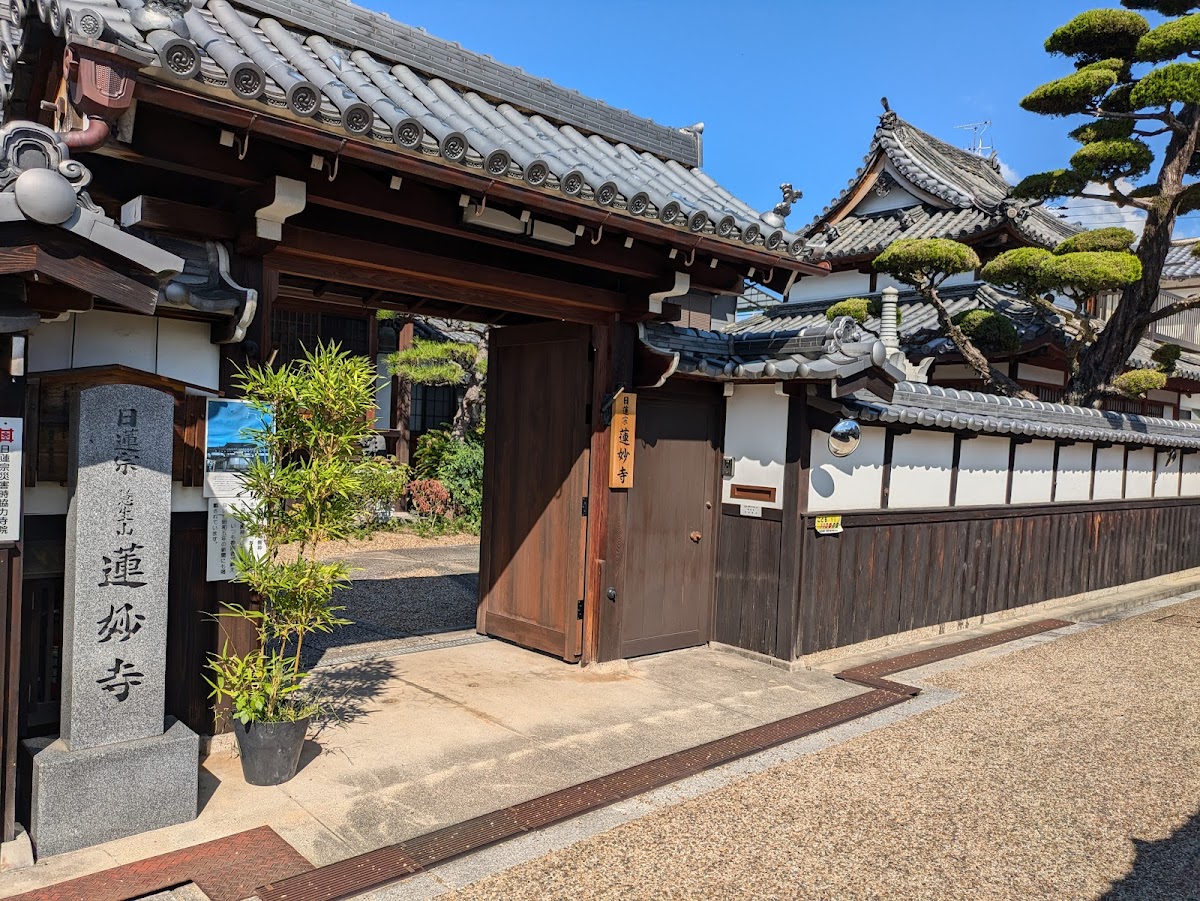
Junmyoji Temple Main Gate (Important Cultural Property)
The greatest highlight of Junmyoji Temple is its main gate, which is also designated as a cultural property of Kashihara City.
Architectural Style:
- Roof: Gable roof
- With a descending ridge
- Chidorihafu (gable with a curved roof) with Inome-kegyo (boar’s eye ornament)
- The wooden doors are adorned with Irihasso-kanagu (double-leaf metal fittings) and have a double-leaf structure
The main gate retains many characteristics of Edo period temple architecture and occupies an important position among the traditional buildings of Imai-cho. The Inome-kegyo on the Chidorihafu is a decorative element with the meaning of warding off evil, showcasing meticulous craftsmanship.
Lush Green Grounds
Imai-cho is a town densely packed with traditional townhouses, and while it generally lacks greenery, the grounds of Junmyoji Temple are an exception, boasting abundant greenery and cherished as an “oasis.”
Passing through the main gate, a meticulously maintained garden unfolds, beyond which lies the main hall, resembling a palace with a ceremonial platform. This spatial configuration reflects the prestige of the temple’s founder, who was of samurai lineage.
Features of the Grounds:
- Plantings lining both sides of the path leading from the main gate
- Trees that change their appearance with the seasons
- A space where one can find peace of mind in a tranquil atmosphere
- Also functions as a place of relaxation for local residents (parents and children can be seen playing catch)
Main Hall and Ceremonial Platform
The main hall has a palace-like style and features a ceremonial platform (a type of entrance, found in buildings of high status). This architecture reflects the history of the temple’s founder, who was of samurai lineage, and the fact that the Empress Dowager stayed there during the Meiji era.
The principal image, Amida Buddha, is the central Buddha of Jodo Shinshu Buddhism, embodying the philosophy of salvation through the power of others, where all people are saved by chanting “Namu Amida Butsu.”
The Position of Junmyoji Temple in Imai-cho
Part of the Important Preservation District for Groups of Traditional Buildings
Imai-cho was designated a National Important Preservation District for Groups of Traditional Buildings in 1993 (Heisei 5). Within the townscape, which retains approximately 500 traditional buildings, Junmyoji Temple plays an important role as a religious facility.
Characteristics of Imai-cho:
- The town layout from the Edo period remains almost unchanged
- A treasure trove of townhouse architecture (including 9 Important Cultural Properties)
- Remnants of a moated settlement
- A history as a commercial city, once said to have “seven-tenths of Yamato’s wealth in Imai”
Role as the “Northern Temple”
Junmyoji Temple was known as the “Northern Temple” and was the center of faith in the northwestern part of Imai-cho. While Shonenji Temple (Imai Gobo), located in the town center, was commonly referred to as “Gobo,” Junmyoji Temple has been a familiar and beloved temple for the residents of the northern region.
Teachings of the Jodo Shinshu Honganji School
The Jodo Shinshu Honganji School, to which Junmyoji Temple belongs, is a branch of Japanese Buddhism founded by Shinran Shonin.
Basic Teachings of Jodo Shinshu
Salvation by Other Power: The teaching that salvation is achieved not by one’s own power (self-power), but by the power of Amida Buddha’s vow (other power).
Nembutsu: Believing in the salvation of Amida Buddha by chanting “Namu Amida Butsu.”
Salvation for the Wicked: The idea that ordinary people with worldly desires are the very objects of Amida Buddha’s salvation.
Characteristics of the Honganji School
The Honganji School has Nishi Honganji Temple as its head temple and is one of the largest Buddhist organizations in Japan, with over 10,000 temples nationwide. Junmyoji Temple has been passing on these teachings to the community for over 800 years.
Junmyoji Temple’s Annual Events
As a Jodo Shinshu Buddhist temple, Junmyoji Temple holds various religious services and events throughout the year.
Main Annual Events
Shushōe: New Year’s service (January)
Spring Equinox Service: Spring equinox service (March)
Gotan-e: Celebration of Shinran Shonin’s birth (May)
Obon: Ancestor memorial service (August)
Autumn Equinox Service: Autumn equinox service (September)
Hōonkō: Most important memorial service commemorating Shinran Shonin’s death anniversary (November)
Joya-e: Year-end service (December)
For specific dates and details, please contact the temple directly.
Nearby Spots to Visit in conjunction with a Stroll through Imai-cho
When visiting Junmyōji Temple, combining it with a stroll through the entire Imai-cho area will make for a more fulfilling sightseeing experience.
Major Spots in Imai-cho
Shonenji Temple (Imai Gobo): The central temple of Imai-cho, a Jodo Shinshu Buddhist temple deeply involved in the town’s founding.
Imai Townscape Exchange Center “Ka-Iraka”: A tourist hub where you can learn about the history and culture of Imai-cho.
Former Yoneya Residence: A townhouse designated as an Important Cultural Property.
Imanishi Residence: The home of the town’s chief elder, a nationally designated Important Cultural Property.
Toyoda Residence: An early Edo period building, an Important Cultural Property.
Otomura Residence: A townhouse that operated a hardware store, an Important Cultural Property.
Tourist Spots Around Imai-cho
Kashihara Shrine: A shrine dedicated to Emperor Jimmu, the first emperor of Japan (approximately 20 minutes on foot).
Imai-cho Tourist Information Center: Ideal for gathering information on exploring Imai-cho.
Yagi-Fuda-no-Tsuji: A former transportation hub, where historical streetscapes remain.
Points to Note and Manners When Visiting Junmyoji Temple
Temple Visit Manners
Attire: Please dress appropriately for visiting a temple.
Photography: Photography is generally permitted within the temple grounds, but please refrain from taking photos inside the main hall or during religious ceremonies.
Quietness: Remember that the temple grounds are a place of worship, and pray quietly.
Greetings: When you encounter temple staff or other visitors, it is polite to give a slight bow.
Points to Note When Exploring Imai-cho
Residential Area: Imai-cho is still a residential area where people live. Please be considerate of the residents’ privacy.
Street Width: Due to the traditional townscape, some roads are narrow. Please be careful when driving.
Opening Hours: Many townhouses are not open to the public or require reservations. Please check in advance which facilities are open for viewing.
Summary of Junmyoji Temple’s Charms
Junmyoji Temple is a temple whose charm lies in its history of over 800 years dating back to the Kamakura period, its beautiful main gate, its lush grounds, and its harmony with the townscape of Imai-cho.
Reasons to Visit:
- Historical Value: An ancient temple founded in 1217, with a history rooted in the Tada Minamoto clan.
- Architectural Beauty: Edo period architecture, including the main gate, a designated cultural property of Kashihara City.
- Cultural Landscape: Blends seamlessly into the townscape as part of an Important Preservation District for Groups of Traditional Buildings.
- Green Oasis: A precious, lush green space within Imai-cho.
- Tranquil Atmosphere: An environment where you can escape the hustle and bustle of the city and find peace of mind.
- Connection to the Imperial Family: A temple of high status, having hosted the Empress Dowager during the Meiji era.
- Jodo Shinshu Teachings: A place of faith that has continued to transmit the teachings of Shinran Shonin for over 800 years.
Best Season to Visit Junmyoji Temple
Junmyoji Temple is open year-round, but each season offers a different charm.
Spring (March-May): Beautiful fresh greenery, the trees in the temple grounds are budding. The weather is mild, making it ideal for a stroll.
Summer (June-August): Lush greenery, cool shade. The time of the Imai-cho summer festival.
Autumn (September-November): Beautiful autumn foliage, and important Buddhist services such as the Hoonko are held.
Winter (December-February): Fewer tourists, allowing for peaceful worship. Snowfall creates a magical atmosphere in the temple grounds.
The Future of Junmyoji Temple and Imai-cho
Junmyoji Temple, as an important component of the Imai-cho Traditional Buildings Preservation District, contributes to the preservation of the historical landscape. At the same time, it continues to function as a place of worship and relaxation for local residents in modern times.
As Imai-cho as a whole enhances its value as a tourist destination, Junmyoji Temple is expected to continue existing as a temple open to many people while preserving its history and traditions.
Based on the Jodo Shinshu Buddhist principle that “all people are equally saved,” as taught by Shinran Shonin, Junmyoji Temple will continue to walk hand in hand with the local community, providing peace of mind to those who visit.
Summary
Junmyoji Temple, located in Imai-cho, Kashihara City, Nara Prefecture, is a Jodo Shinshu Honganji-ha temple with a history of over 800 years. Its beautiful architecture, lush grounds, and its presence within the historical landscape of Imai-cho, a designated Important Preservation District for Groups of Traditional Buildings, are its main attractions.
Its convenient location, approximately an 8-minute walk from Yagi-Nishiguchi Station, makes it a must-visit spot when exploring Imai-cho. Why not calm your mind in the tranquil grounds and reflect on the history that has continued since the Kamakura period?
Through a visit to Junmyoji Temple, you can experience traditional Japanese temple architecture, the teachings of Jodo Shinshu Buddhism, and the history and culture of Imai-cho. It is a hidden gem that you should definitely visit when sightseeing in Nara.