Complete Guide to Naritasan Sapporo Betsuin Shin’eiji Temple | History, Goshuin (Temple Seal), Visiting Hours, and Access Information
Just a few minutes’ walk from Susukino, the bustling downtown area of Sapporo, Hokkaido, lies a temple with surprisingly vast grounds. This is Naritasan Sapporo Betsuin Shin’eiji. As a branch temple of the head temple Naritasan Shinshoji in Narita City, Chiba Prefecture, this temple has served as a spiritual haven for Hokkaido’s pioneers since the Meiji era. This guide provides a detailed introduction to its history and visiting information.
About Naritasan Sapporo Betsuin Shin’eiji Temple
Naritasan Sapporo Betsuin Shin’eiji Temple is a Shingon-shu Chizan-ha temple located at 2-3-2 Minami 7-jo Nishi, Chuo-ku, Sapporo City, Hokkaido. As the Sapporo branch temple of the head temple Naritasan Shinshoji in Narita City, Chiba Prefecture, it is an important center of Shingon Buddhism in Hokkaido.
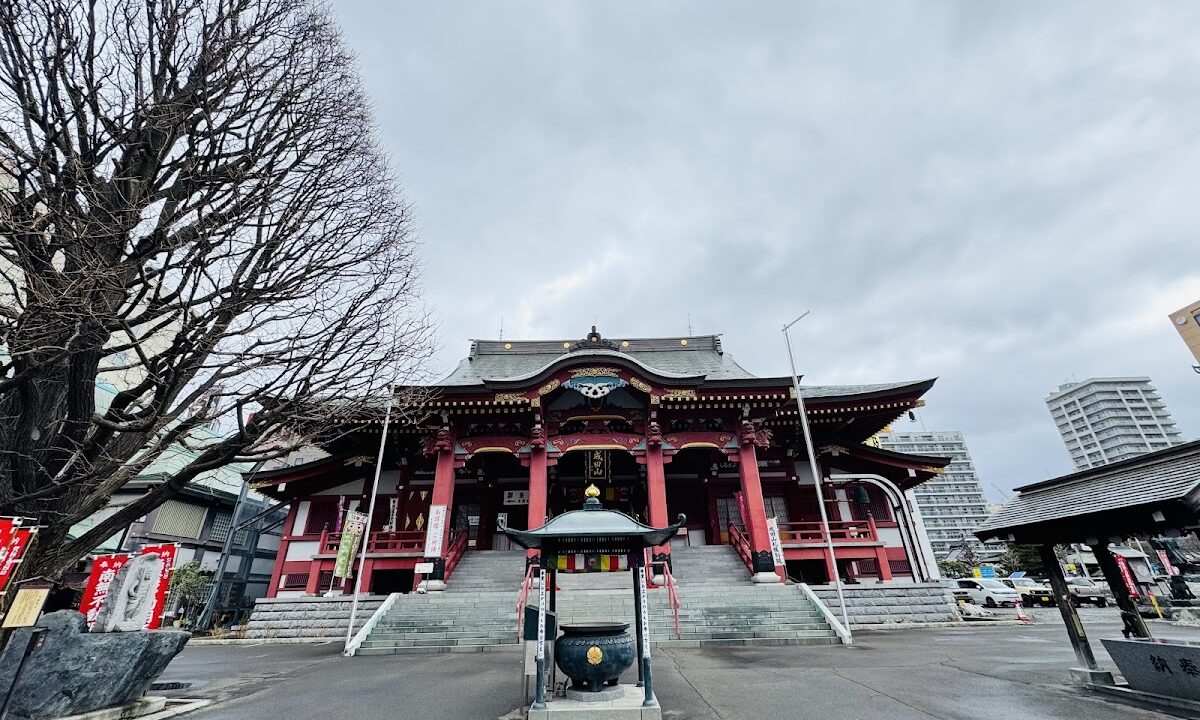
Located in the heart of Sapporo’s Susukino district, this temple boasts a vast site, and the sheer size of its main hall astonishes visitors. Its distinctive feature—three staves perched atop the roof—makes its presence felt even from afar.
Principal Deity and Beliefs
The principal deity is Fudo Myoo. A manifestation of Fudo Myoo, invited from the head temple Naritasan Shinshoji, is enshrined here, attracting worshippers with various wishes, including traffic safety, family safety, and business prosperity. Fudo Myoo is believed to possess the power to sever worldly desires and subdue evil, and is particularly known for its blessings of protection against misfortune and good fortune.
History: 138 Years of Progress with the Development of Hokkaido
Founded in the Meiji Era
The history of Naritasan Sapporo Betsuin Shin’eiji Temple is closely intertwined with the history of Hokkaido’s development. Since the establishment of the Hokkaido Development Commission in 1869 (Meiji 2), many people migrated to Hokkaido from Honshu, Shikoku, and Kyushu in search of a new life.
In 1885 (Meiji 18), a temporary hall was constructed on the current site, and the temple was founded by inviting a replica of the principal deity, Fudo Myoo, from the head temple Naritasan Shinshoji. For those undertaking the difficult task of development, the existence of a temple that provided spiritual support was extremely important.
Development and Current State
Since its founding, Shin’eiji Temple has grown alongside the development of Sapporo. It has been renovated from its initial temporary hall into the magnificent main hall it has today, and various other halls, including the Daishido (Great Master Hall), have also been built. Within the temple grounds, a large ginkgo tree over 150 years old is enshrined as a sacred tree and has been designated as a “Scenic Resource for Promotion of Utilization” by Sapporo City.
Currently, it is known as the ninth temple of the Hokkaido Thirty-Three Kannon Pilgrimage and the thirty-six Fudo Myoo Pilgrimage, attracting many pilgrims.
Highlights of the Temple Grounds
Main Hall
The main hall of Naritasan Sapporo Betsuin Shin’ei-ji Temple overwhelms visitors with its immense size. Its scale is unbelievable for a temple located in the heart of Sapporo, and three distinctive staves are placed atop the roof. These staves serve as a landmark visible from afar and are a symbol of Shin’ei-ji Temple.
Inside the main hall, the principal image, Fudo Myoo, is enshrined, and visitors can enter the inner sanctuary. You can quietly offer your prayers in a solemn atmosphere.
Daishi Hall
The temple grounds also include a Daishi Hall, where Kobo Daishi (Kukai) is enshrined. There is deep devotion to Kobo Daishi, the founder of the Shingon sect, and memorial services such as the “Kobo Daishi Sho-Miei-ku” are held annually.
Sacred Ginkgo Tree
The magnificent ginkgo tree, over 150 years old, stands tall within the temple grounds and has been a sacred tree watching over the temple since its founding. Reaching a height of approximately 10 meters, this ginkgo tree boasts a distinctive and beautiful shape thanks to its carefully pruned branches and leaves, and has been designated as Sapporo City’s “Promoted Landscape Resource No. 8.”
In autumn, it turns a golden color, beautifully adorning the temple grounds. Many visitors take photographs in front of this ginkgo tree, drawing strength from its vitality.
Visiting Hours and Goma Prayer Ceremony Hours
Opening Hours
The opening hours of Naritasan Sapporo Betsuin Shin’eiji Temple vary depending on the season.
- Summer Hours: The temple is open for longer hours, but please check the official website for the latest information.
- Normal Season: Opening hours are similar to those of other temples.
Reception Hours
There are also set hours for various prayers and Goshuin (temple stamp) applications. Those wishing to participate in the Goma prayer ceremony are advised to check the reception hours in advance.
Goma Prayer Ceremony Times
Naritasan Sapporo Betsuin Shin’eiji Temple regularly holds Goma prayer ceremonies. Goma is an important Shingon Esoteric Buddhism ritual in which prayers are offered while burning sacred wood in front of Fudo Myoo (Acala). You can receive Goma prayers for various wishes, such as traffic safety, family safety, business prosperity, and protection from evil.
The times for the Goma ceremony may vary depending on the day of the week and season, so it is recommended to check the official website or call (011-511-0927) before visiting.
Annual Events and Ceremonies
Naritasan Sapporo Betsuin Shin’eiji Temple holds various Buddhist services and ceremonies throughout the year.
Kobo Daishi Sho-Miei-ku (Kobo Daishi Memorial Service)
This is an important Buddhist service held to coincide with the anniversary of the death of Kobo Daishi (March 21st in the old lunar calendar), the founder of the Shingon sect. Many devotees attend this memorial service to express gratitude to Kobo Daishi.
Hana Matsuri (Buddha’s Birthday Celebration)
The Hana Matsuri, celebrating the Buddha’s birthday on April 8th, is also held with great fanfare. This traditional event involves pouring sweet tea over the baby Buddha enshrined in the flower-decorated hall, attracting many visitors of all ages.
Temple Fair
Temple fairs are held on specific days each month, creating a special atmosphere within the temple grounds. These fairs are believed to bring special blessings, attracting many worshippers.
Other Annual Events
- Hatsumode: Many worshippers visit for Hatsumode (first shrine visit of the New Year).
- Setsubun-e: Bean-throwing and other events are held during Setsubun in February.
- Obon Memorial Service: Memorial services are held to honor ancestors.
For detailed event information and the latest updates, please check the official website before your visit.
For more information on events and the latest updates, please check the official website before your visit. ## Goshuin (Temple Seal) Information
At Naritasan Sapporo Betsuin Shin’eiji Temple, you can receive a Goshuin as proof of your visit.
Types of Goshuin
Shin’eiji Temple offers several types of Goshuin:
- Goshuin of the Principal Image, Fudo Myoo: The basic Goshuin
- Goshuin of the 9th Temple of the Hokkaido Thirty-Three Kannon Pilgrimage
- Goshuin of the Hokkaido Thirty-Six Fudo Myoo Pilgrimage
Those undertaking the pilgrimage can have the seals recorded in their respective Goshuin notebooks.
Goshuin Reception
Goshuin can be obtained at the reception desk during reception hours. Many people cherish the carefully handwritten Goshuin as a memento of their visit.
Access and Transportation Information
Location
〒064-0807 2-3-2 Minami 7-jo Nishi, Chuo-ku, Sapporo City, Hokkaido
Access by Subway
The most convenient way to access the temple is by subway.
- Approximately 4 minutes on foot from Toyosui-Susukino Station on the Sapporo Municipal Subway Toho Line (using Exit 6)
- Approximately 6 minutes on foot from Susukino Station on the Sapporo Municipal Subway Namboku Line
The temple is within walking distance of the Susukino area, located 3-4 minutes south of the entertainment district.
Access by Car
Access from central Sapporo is also good. However, as it is located in the city center, it is recommended to check parking availability in advance.
If using a car navigation system, please search by phone number “011-511-0927” or address.
Surrounding Environment
Despite its proximity to the Susukino entertainment district, stepping onto the temple grounds envelops you in tranquility. Its convenient location makes it easy to stop by between sightseeing and shopping.
Shin’ei-ji Temple as a Power Spot
Naritasan Sapporo Betsuin Shin’ei-ji Temple is also known as a “power spot in Sapporo.”
The Benefits of Fudo Myoo
The principal deity, Fudo Myoo, is believed to possess the power to sever worldly desires, ward off misfortune, and grant wishes. In particular, the following benefits are believed to be offered:
- Protection from evil and misfortune
- Traffic safety
- Family safety
- Business prosperity
- Good fortune and happiness
- Healing from illness
The Power of the Sacred Tree
The sacred ginkgo tree, over 150 years old, is a symbol of vitality and is cherished by many worshippers. It is said that quietly praying before this great tree calms the mind and brings renewed energy.
A Sanctuary in the City
Despite its location in the heart of Sapporo, the vast temple grounds maintain a tranquility reminiscent of another world. This special environment, a “sanctuary in the city,” provides healing and strength to visitors.
Reviews and Visitor Feedback
Many visitors have shared their impressions of Naritasan Sapporo Betsuin Shin’eiji Temple.
“I was surprised to find such a magnificent temple so close to Susukino. I was overwhelmed by the size of the main hall.” Other comments include, “Visiting a Shingon Buddhist temple is very calming. The temple grounds were bustling with preparations for tomorrow’s grand festival.”**
The sacred ginkgo tree, in particular, is highly praised, with comments such as, “The autumn foliage is beautiful, and it’s a fantastic photo spot.”**
Those who received a Goshuin (temple stamp) have commented, “It was written so carefully, it’s a wonderful memento.” “I visited as part of a pilgrimage, and I was deeply moved by this magnificent temple.”
Hokkaido Pilgrimage
Hokkaido Thirty-Three Kannon Pilgrimage Site No. 9
Naritasan Sapporo Betsuin Shin’eiji Temple is designated as the ninth temple of the Hokkaido Thirty-Three Kannon Pilgrimage Site. As an important pilgrimage site based on Kannon worship, it attracts many pilgrims from both within and outside Hokkaido.
Hokkaido Thirty-Six Fudo Myoo Pilgrimage Sites
Shin’ei-ji Temple, whose principal deity is Fudo Myoo, is also a pilgrimage site of the Hokkaido Thirty-Six Fudo Myoo Pilgrimage. As a center of Fudo worship, rituals such as Goma prayer are performed daily.
Significance of Pilgrimage
Pilgrimage is a traditional form of faith in which one visits each pilgrimage site, pays homage, receives Goshuin (temple stamps), and engages in spiritual training. By visiting the pilgrimage sites of Hokkaido, including Shin’ei-ji Temple, one can experience Hokkaido’s history, culture, and natural beauty.
Manners and Points for Visiting a Temple
Basic Visiting Etiquette
- Bow at the Temple Gate: Bow before entering the temple grounds.
- Purify at the Water Basin: Purify your hands and mouth before proceeding to the main hall.
- Pray at the Main Hall: Place your offering, clasp your hands together, and pray quietly.
- Bow Upon Exit: Bow again when leaving the temple grounds.
Recommendation for Visiting the Inner Sanctuary
At Naritasan Sapporo Betsuin Shin’eiji Temple, visiting the inner sanctuary is recommended. The inner sanctuary is the interior of the main hall, the closest place to the principal image of Buddha. By worshipping Fudo Myoo from closer proximity, you can offer a deeper prayer.
Regarding Photography
Photography of the temple grounds and sacred trees is permitted, but please refrain from taking photos inside the main hall or during prayers. It is important to observe proper etiquette during your visit.
Nearby Tourist Attractions
Naritasan Sapporo Betsuin Shin’eiji Temple is surrounded by many of Sapporo’s major tourist attractions.
Susukino
Hokkaido’s largest entertainment district is just a few minutes’ walk away. It’s a hub of restaurants and shops, making it convenient for dining and shopping after visiting the temple.
Odori Park
Odori Park, which runs east-west through the heart of Sapporo, is within walking distance. Various events are held there throughout the seasons.
Nakajima Park
Nakajima Park is located south of Shin’eiji Temple. It’s a beautiful park where rich nature and cultural facilities harmonize.
Sapporo Clock Tower/Former Hokkaido Government Office
Sapporo’s representative historical buildings are also nearby and can be incorporated into your sightseeing route.
Summary: Add Shin’eiji Temple to your Sapporo sightseeing
Naritasan Sapporo Betsuin Shin’eiji Temple is a historic temple that has walked hand in hand with the history of Hokkaido’s development since its founding in 1885 (Meiji 18). As a branch temple of Naritasan Shinshoji Temple, the head temple of the Fudo Myoo faith in Narita City, Chiba Prefecture, it serves as a central sanctuary for Fudo Myoo worship.
Despite its convenient location just a few minutes’ walk from Susukino in downtown Sapporo, it boasts vast grounds and a magnificent main hall, offering a sanctuary that allows you to forget the hustle and bustle of the city. There are many points of interest, including a sacred ginkgo tree over 150 years old and three monk’s staffs placed on the roof.
Visitors can enjoy a variety of experiences, including Goma prayer ceremonies, various events, and the issuance of Goshuin (temple stamps). It is also known as a pilgrimage site for the 33 Kannon pilgrimage sites and the 36 Fudo Myoo pilgrimage sites of Hokkaido, playing an important role as a base for pilgrimage.
When sightseeing in Sapporo, be sure to visit Naritasan Sapporo Betsuin Shin’eiji Temple and experience its history and grandeur. It’s a power spot in the heart of the city where you can refresh both mind and body.
For the latest event information and visiting hours, please check the official website (https://sapporo-naritasan.jp/).