Complete Guide to Suiten-gu Shrine (Sapporo) | History, Blessings, Goshuin (Shrine Seal), and Access Information
Suiten-gu Shrine, located next to Nakajima Park in Chuo Ward, Sapporo City, has been a beloved local shrine for over 140 years since the Meiji era. Known for its blessings for safe childbirth, child-rearing, and protection from water-related disasters, it is the 32nd branch shrine nationwide, established from the main Suiten-gu Shrine in Kurume City, Fukuoka Prefecture, and is a central figure in Suiten-gu worship in Hokkaido.
This article provides a comprehensive overview of the charm of Sapporo Suiten-gu Shrine, including its detailed history, enshrined deities and blessings, highlights of the grounds, goshuin information, annual events such as the Grand Festival, and useful access information for visitors.
History and Origins of Suiten-gu Shrine (Sapporo)
Founding Circumstances and the Former Kurume Domain Samurai, Genshiro Mizuno
The history of Sapporo Suiten-gu Shrine begins in 1884 (Meiji 17). Mr. Genshiro Mizuno, a former samurai of the Kurume Domain, brought a divided spirit from the main Suiten-gu Shrine in Kurume, Kyushu, and traveled to Hokkaido for the purpose of developing the region. Initially, the shrine was enshrined at Minami 2-jo Nishi 4-chome in Sapporo (near present-day Tanukikoji 4-chome), which is the origin of its founding.
Mr. Genshiro Mizuno was one of many who migrated to Hokkaido in search of a new land during the turbulent times following the Meiji Restoration. His deep faith in the Suiten-gu Shrine of his hometown, Kurume, fueled his desire to receive the same divine protection in his new land, and his wish for the safety and prosperity of those engaged in development became the driving force behind the founding of Sapporo Suiten-gu Shrine.
Relocation to the Kamo-Kamagawa River and subsequent relocation to the current site
In 1885 (Meiji 18), Suiten-gu Shrine was relocated to the residence of Genhachiro Sato on the banks of the Kamo-Kamagawa River. The Kamokamo River is part of the Toyohira River system, flowing through the urban area of Sapporo, making it a suitable location for Suiten-gu Shrine, which enshrines the water god.
Later, in 1888 (Meiji 21), the shrine was built at its current location, Minami 9-jo Nishi 4-chome, Chuo-ku, Sapporo City, and has continued to be revered as the guardian shrine of the region to this day. Its current location, adjacent to Nakajima Park and on the banks of the Kamokamo River, can be considered an ideal environment for a shrine dedicated to the water god.
Relationship with Kurume Suiten-gu Shrine and its Position as a Branch Shrine
Sapporo Suiten-gu Shrine is the 32nd branch shrine of the main Suiten-gu Shrine (Kurume Suiten-gu Shrine) located in Kurume City, Fukuoka Prefecture. Kurume Suiten-gu Shrine is a historically significant shrine founded in 1818 (Bunsei 1), and has many branch shrines throughout Japan.
A branch shrine refers to the act of dividing the divine spirit of the main shrine and enshrining it in another location. In Shinto, it is believed that divine spirits do not diminish even when divided, and that shrines where a divided spirit is enshrined possess the same divine power as the main shrine. Sapporo Suiten-gu Shrine, as the only officially designated branch shrine of Kurume Suiten-gu Shrine in Hokkaido, has maintained its faith unchanged since the Meiji era.
Deities and Benefits
Main Deity: Amenominakanushi-no-kami and the Gods of Suiten-gu Shrine
The following deities are enshrined at Sapporo Suiten-gu Shrine:
Main Deity:
- Amenominakanushi-no-kami
- Emperor Antoku
- Takakura Taira no Chūgū
- Nii no Ama Tokiko
Amenominakanushi-no-kami is the first god in Japanese mythology and is considered the supreme god who governs the center of the universe. Emperor Antoku was the 81st emperor at the end of the Heian period and drowned at the Battle of Dan-no-ura at the young age of 8. Takakura Taira no Chūgū refers to Kenreimon-in Tokuko, the mother of Emperor Antoku, and Ni’i no Ama Tokiko refers to Taira no Tokiko, the grandmother of Emperor Antoku.
These enshrined deities form the core of the Suiten-gū faith, which enshrines Emperor Antoku and the Taira clan, who drowned themselves in the Battle of Dan-no-ura, as water deities.
Enshrined Deities: Ōkunitama no Mikoto, Ōnamuchi no Mikoto, Sukunahikona no Mikoto
Along with the main deity, the following deities are enshrined in the auxiliary shrines:
- Ōkunitama no Mikoto: Guardian deity of the land
- Ōnamuchi no Mikoto: Another name for Ōkuninushi no Mikoto, god of matchmaking and medicine
- Sukunahikona no Mikoto: God of medicine, hot springs, and sake brewing
These deities held particular significance in Hokkaido during the pioneering era. Ōkunitama-no-Mikoto was revered as the guardian of the land, while Ōnamuchi-no-Mikoto and Sukunahikona-no-Mikoto were worshipped as deities presiding over nation-building, medicine, and health, protecting life in new lands.
Benefits for safe childbirth, child-rearing, and protection from water-related disasters
Suiten-gū Shrine is known nationwide for the following benefits:
Main Benefits:
- Prayer for Safe Childbirth: Prayers for the safety of pregnant women and a safe delivery.
- Prayer for Conception and Fertility: Prayers for the blessing of children.
- Protection for Child-Rearing: Prayers for the healthy growth of children.
- Protection from Water-Related Disasters: Protection from water-related accidents and disasters.
- Protection from Fire and Disaster Prevention, and Bringing Good Fortune: Protection from fires and disasters.
- Business Prosperity: Especially for businesses related to water.
- Protection from Fisheries, Shipping, and Agriculture: Prosperity for water-related industries.
- Traffic Safety: Prayers for safe travel.
The benefits for safe childbirth and child-rearing are particularly well-known, attracting many worshippers from Sapporo and throughout Hokkaido. There is a custom of praying for safe childbirth on the Day of the Dog in the fifth month of pregnancy, and Suiten-gu Shrine is especially crowded with worshippers on this day.
Highlights and Facilities within the Shrine Grounds
Features of the Shrine Building and Main Hall
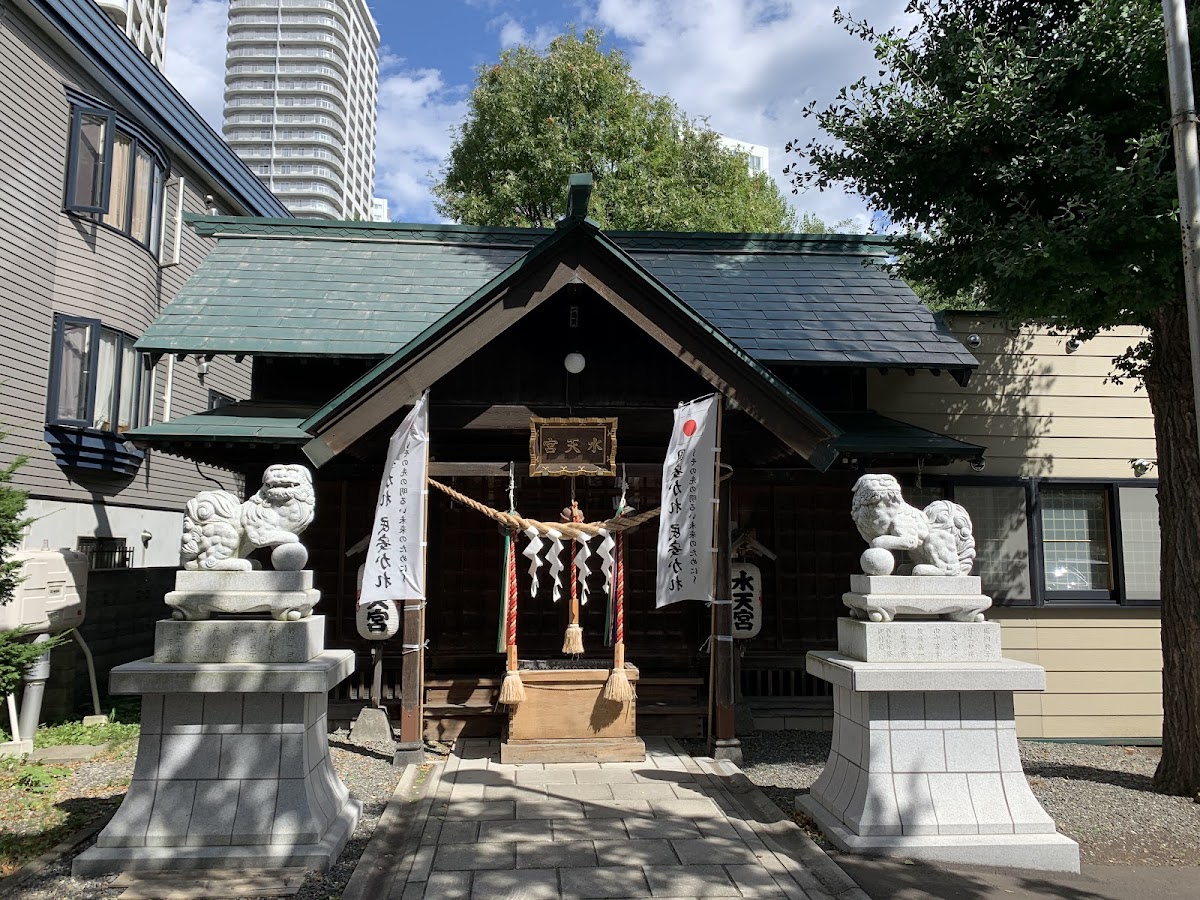
The Sapporo Suiten-gu Shrine building was constructed in its current location in 1888 (Meiji 21), and has been maintained as the center of worship to this day, undergoing several repairs along the way. The shrine building follows traditional shrine architectural styles, with the vermilion torii gate and the unpainted wooden shrine building creating a beautiful contrast.
The main hall, while relatively compact, is carefully crafted and possesses a warmth befitting a shrine deeply rooted in the community. A donation box and bell rope are placed in front of the worship hall, and worshippers perform the ritual of two bows, two claps, and one bow.
Komainu (Guardian Dogs) and Torii Gate
Several komainu (guardian dogs) are placed within the shrine grounds. These komainu were donated over different eras, each possessing a unique expression and form. In particular, the komainu in front of the main hall are magnificent stone sculptures combining strength and elegance, delighting the eyes of worshippers.
The torii gate is a vermilion-lacquered Myojin-style torii standing at the entrance to the shrine grounds, welcoming visitors approaching from Nakajima Park. Its positioning, coming into view after crossing the Suiten-gu Bridge over the Kamo-Kamo River, creates a serene atmosphere befitting a shrine approach.
Suiten-gu Bridge and Kamo-Kamo River
The small bridge crossed when accessing Suiten-gu from Nakajima Park is named “Suiten-gu Bridge” and serves as the official approach to Suiten-gu. The Kamo-Kamo River, flowing beneath this bridge, was once an important waterway supplying Sapporo’s urban area and is symbolic of Suiten-gu, which enshrines the god of water.
The walking path along the Kamo-Kamo River, where you can enjoy the scenery of each season—cherry blossoms in spring, fresh greenery in summer, autumn leaves in fall, and snowscapes in winter—is a hidden gem of Sapporo that should be visited in conjunction with a visit to Suiten-gu.
Atmosphere and Visiting Environment of the Shrine Grounds
Despite its urban location, Sapporo Suiten-gu Shrine maintains a tranquil atmosphere. Adjacent to Nakajima Park, it is surrounded by lush greenery, offering a peaceful space away from the hustle and bustle of the city.
The grounds are not particularly large, but are kept clean and equipped with facilities such as a purification fountain, shrine office, and amulet shop. A small parking space for visitors is also available, making it accessible by car.
Goshuin (Shrine Seals) and Amulets
Characteristics and Design of Goshuin (Shrine Seals)
Sapporo Suiten-gu Shrine offers goshuin to visitors. Goshuin are available at the shrine office, and the offering fee is usually 300 yen.
The Suiten-gu shrine’s goshuin features a simple yet powerful design with “Suiten-gu” written in large calligraphy in the center, accompanied by the shrine’s seal. The date is also written in calligraphy, making it a popular souvenir for goshuin collectors.
Goshuincho (Stamp Book) and Issuance Hours
Suitengu Shrine offers its own original goshuincho (stamp book). The design of the goshuincho may vary depending on the season, featuring water motifs characteristic of Suitengu Shrine, or traditional Japanese patterns.
Goshuin (stamps) are issued during the shrine office’s opening hours. Generally, this is from 9:00 AM to around 5:00 PM, but this may not be possible during Shinto rituals or events. Therefore, it is recommended to check in advance if you wish to be sure to receive a goshuin.
Amulets and Offerings
At Suitengu Shrine, amulets for safe childbirth and child-rearing are particularly popular. The main offerings include the following:
- Safe Childbirth Amulet: An amulet worn by pregnant women to pray for a safe delivery.
- Childbearing Amulet: An amulet for those who wish to have children.
- Child-Rearing Amulet: An amulet to pray for the healthy growth of children.
- Water Disaster Prevention Amulet: An amulet to protect against water accidents.
- Traffic Safety Amulet: An amulet to pray for safety in cars and during travel.
- Exorcism Amulet: An amulet to ward off misfortune.
Each of these amulets has been carefully blessed, and can be chosen according to the wishes of the worshipper.
Annual Festival and Annual Events
Annual Festival Date and Ceremony Details
The annual festival at Sapporo Suiten-gu Shrine is held on a fixed date each year. The annual festival is the most important ceremony for the shrine, the day when the gods are worshipped most grandly throughout the year.
During the annual festival, a solemn ceremony is held by Shinto priests, and parishioners and devotees attend. Shinto rituals such as the recitation of prayers and the offering of sacred branches are performed, expressing gratitude to the gods and praying for peace in the community.
Annual Events Calendar
Suitengu Shrine holds various annual events in addition to its annual grand festival.
Main Annual Events:
- January 1st: Saitansai (New Year’s Festival)
- Mid-January: Hatsumode (First Shrine Visit of the Year)
- February (Setsubun): Setsubun Festival
- Spring: Spring Grand Festival
- Summer: Summer Purification Ceremony
- Autumn: Autumn Grand Festival
- November: Shichi-Go-San Festival
- December 31st: Year-End Purification Ceremony, New Year’s Eve Festival
These events are conducted according to traditional Japanese annual customs and are deeply intertwined with the lives of the local people.
Prayer for Safe Childbirth on the Day of the Dog
At Suitengu Shrine, the prayer for safe childbirth on the Day of the Dog is particularly important. Dogs are considered symbols of safe childbirth because they are prolific and have easy deliveries. It is customary for pregnant women to wear a maternity belt and pray for a safe delivery on the Day of the Dog in their fifth month of pregnancy, and many pregnant women and their families visit Suitengu Shrine on this day.
The Day of the Dog occurs every 12 days, so there are 2-3 such days each month. Especially on the Day of the Dog that falls on a lucky day (Taian), it is expected to be crowded, so it is recommended to allow ample time for your visit.
Access and Visiting Information
Location and Basic Information
Location: 4-chome, Minami 9-jo Nishi, Chuo-ku, Sapporo City, Hokkaido
Affiliation: Sapporo Branch of the Hokkaido Shrine Association
Shrine Office Hours: 9:00 AM to approximately 5:00 PM (may vary depending on the season)
Parking: Limited spaces available (use of public transportation is recommended due to limited space)
Access by Subway
The most convenient way to reach Sapporo Suiten-gu Shrine is by using the Sapporo Subway Namboku Line.
From Nakajima-Koen Station on the Sapporo Subway Namboku Line:
- Approximately 2-3 minutes on foot from Exit 1 or Exit 3
- Proceed north through Nakajima Park and cross the Suiten-gu Bridge over the Kamokamo River.
Nakajima-Koen Station is only about 5 minutes from Sapporo Station, making access very convenient. The route from the station to the shrine is flat and easy to follow, so even first-time visitors can arrive without getting lost.
Access by Streetcar
If using the Sapporo Streetcar, the nearest stop is as follows:
From the “Nakajima Park-dori” Streetcar Stop:
- Approximately 5-7 minutes on foot
- Head towards Nakajima Park, pass through the park, and reach Suiten-gu Shrine.
The streetcar is a charming mode of transportation in Sapporo and popular with tourists, offering enjoyable city views from the windows.
Access by Car and Parking Information
If visiting by car, it takes approximately 5-10 minutes from central Sapporo.
Access from Major Roads:
- From National Route 36, head towards Minami 9-jo
- From Sapporo Station, head south for approximately 10 minutes
There is a limited number of parking spaces on the shrine grounds, but due to limited availability, especially on days when crowds are expected, such as the Day of the Dog or the annual festival, we recommend using nearby coin-operated parking lots or public transportation.
There are several coin-operated parking lots around Nakajima Park, making it relatively easy to find parking.
Nearby Tourist Attractions
Here are some nearby tourist attractions you might want to visit in conjunction with your visit to Suiten-gu Shrine.
Nakajima Park:
A representative urban park of Sapporo, adjacent to Suiten-gu Shrine. The vast grounds include a Japanese garden, an iris pond, and the Sapporo Concert Hall Kitara, allowing visitors to enjoy nature throughout the seasons. The cherry blossoms in spring and the autumn foliage are particularly spectacular.
Toyohirakan:
A Western-style building designated as a National Important Cultural Property, located within Nakajima Park. Built by the Hokkaido Development Commission in 1880, it is characterized by its beautiful light blue exterior.
Kamo-Kamo River Promenade:
A promenade is maintained along the Kamo-Kamo River, which flows in front of Suiten-gu Shrine, allowing for a peaceful stroll. It is a beloved oasis in the city, cherished by locals.
Susukino:
A 10-minute walk north will take you to Susukino, Hokkaido’s largest entertainment district. A wide variety of restaurants line the streets, allowing you to enjoy Hokkaido’s gourmet cuisine.
Manners and Etiquette for Visiting Shrines
Basic Etiquette for Visiting Shrines
When visiting Suiten-gu Shrine, please observe the following basic etiquette.
When passing through the torii gate:
- Bow before passing through the torii gate.
- Walk along the edge of the path, as the center is the path for the gods.
How to purify yourself at the water basin:
- Hold the ladle in your right hand and purify your left hand.
- Switch the ladle to your left hand and purify your right hand.
- Switch the ladle back to your right hand, receive water in your left hand, and rinse your mouth.
- Purify your left hand once more.
- Hold the ladle upright, purify the handle, and return it to its original position.
How to pray at the main hall:
- Place your offering in the offering box.
- Ring the bell if there is one.
- Bow twice (bowing deeply twice).
- Clap your hands twice.
- Join your hands and pray.
- Bow once (bowing deeply once).
How to receive a prayer for safe childbirth
To formally receive a prayer for safe childbirth, follow the steps below.
- Advance Reservation: If possible, contact the shrine office in advance to make a reservation for the prayer.
- On-the-Day Registration: Fill out the application form at the shrine office and pay the offering fee.
- Prayer: Receive a prayer from a Shinto priest (approximately 20-30 minutes).
- Gifts: After the prayer, you will receive amulets, a maternity belt, etc.
The offering fee varies depending on the shrine, but is generally around 5,000 to 10,000 yen. It is recommended to check the details in advance.
Attire and Items to Bring When Visiting
While casual attire is acceptable, please note the following points if you are receiving a formal prayer.
Attire:
- Please dress neatly and cleanly.
- For formal prayers, men should wear a suit or jacket, and women should wear formal attire such as a dress or suit.
- Avoid revealing or overly flashy clothing.
Items to Bring:
- Offering (new bills are considered polite).
- Goshuincho (stamp book) (if you wish to receive a Goshuin stamp).
- Maternity belt (if praying for a safe delivery, the maternity belt you bring can be blessed).
Suiten-gu Faith and Hokkaido Development
Hokkaido Development and Shrines in the Meiji Era
During the Meiji era, as Hokkaido development intensified, many settlers from Honshu moved to this new land with hopes for a better future. They relied on the deities of their hometown shrines for spiritual support and sought spiritual stability by worshipping the same deities in their new land.
Sapporo Suiten-gu Shrine was founded against this historical backdrop. The fact that Mr. Genshiro Mizuno, a former samurai of the Kurume Domain, enshrined a divided spirit of the Suiten-gu Shrine in his hometown of Kurume in Sapporo was not merely an act of personal faith, but also had social significance, creating a spiritual anchor for his fellow villagers and the many people involved in pioneering.
The Water God and the Pioneer City of Sapporo
The fact that Suiten-gu Shrine is dedicated to the water god held special significance in the pioneering city of Sapporo. Water was one of the most important resources in pioneering, used for agriculture, fishing, and daily life. At the same time, protection from water-related disasters such as floods and water-related accidents was a desperate wish.
Suiten-gu Shrine, situated on the banks of the Kamokamo River, has truly understood both the blessings and threats of water, and has functioned as a guardian deity for people who live in harmony with water.
Connections with the Local Community
Since its relocation to its current location in 1888 (Meiji 21), Suiten-gu Shrine has been deeply connected to the local community as the guardian shrine of the surrounding area. The annual festival and other yearly events have served as opportunities for local people to gather, strengthening community ties.
Even today, Suiten-gu Shrine remains an integral part of Sapporo’s life, a place visited at significant life events such as children’s Shichi-Go-San (a traditional rite of passage for children) and expectant mothers praying for safe childbirth.
The Role of Suiten-gu Shrine in Modern Times
A Sanctuary in the City
Even in modern times, as Sapporo has grown into a metropolis with a population of nearly 2 million, Suiten-gu Shrine functions as a precious sanctuary within the city. Located adjacent to the lush green environment of Nakajima Park and situated on the banks of the clear Kamogawa River, it is a place of tranquility away from the hustle and bustle of the city, cherished by many citizens.
A Hub for Safe Childbirth and Child-Rearing Support
In today’s society with its declining birthrate, Suiten-gu Shrine’s role as a deity of safe childbirth and child-rearing has become more important than ever. Prayers at the shrine during the crucial periods of pregnancy, childbirth, and child-rearing provide spiritual support and opportunities to deepen family bonds. The prayer for safe childbirth at Suiten-gu Shrine is not merely a religious ceremony; it holds cultural significance as a celebration and watchful presence of the birth of a new life by the entire family and society.
Value as a Tourist Resource
For tourists visiting Sapporo, Suiten-gu Shrine is a valuable spot to experience traditional Japanese culture and Shinto beliefs. Its convenient location, easily accessible in conjunction with Nakajima Park, attracts many visitors.
With the current popularity of collecting Goshuin (shrine stamps), Sapporo Suiten-gu Shrine has become an important destination for Goshuin collectors visiting shrines nationwide.
Frequently Asked Questions
Is a reservation necessary to visit Suiten-gu Shrine?
Reservations are not required for regular visits. You can freely enter the shrine grounds. However, if you wish to receive formal prayers such as prayers for safe childbirth, it is recommended to contact the shrine office in advance to make a reservation. Especially on the Day of the Dog and auspicious days, crowds are expected, so a reservation will ensure a smoother experience.
Can I get a Goshuin every day?
Goshuin (temple/shrine stamps) are available during the shrine office’s opening hours (usually 9:00 AM to 5:00 PM). However, they may not be available during religious ceremonies or events. If you want to be sure to receive a goshuin, it is recommended to call ahead to confirm.
Is there parking?
There are a limited number of parking spaces on the shrine grounds. Especially during busy periods such as the Day of the Dog or the annual festival, the parking lot is likely to be full, so using public transportation is recommended. If you are visiting by car, please consider using nearby coin-operated parking lots.
How much is the offering for a prayer for safe childbirth?
The offering varies depending on the shrine, but is generally around 5,000 to 10,000 yen. It is recommended to check with the shrine office in advance for the exact amount.
Is Suiten-gu Shrine open all year round?
Visiting the shrine grounds is generally possible all year round. However, the shrine office’s reception hours are limited, and there may be special hours during the New Year period. If you wish to receive a formal prayer or a Goshuin (temple/shrine stamp), it is recommended to check the opening hours in advance.
How to get to Suiten-gu Shrine from Nakajima Park?
Exit from the north exit of Nakajima Park and cross the Suiten-gu Bridge over the Kamokamo River. You will immediately arrive at the grounds of Suiten-gu Shrine. It is about a 2-3 minute walk. The bridge is named “Suiten-gu Bridge” and is the official approach to Suiten-gu Shrine.
Summary: Visiting Sapporo Suiten-gu Shrine
Located in Chuo-ku, Sapporo, Suiten-gu Shrine is a historic shrine that has been cherished by the local community for over 140 years since its founding in 1884 (Meiji 17). As the only official branch shrine in Hokkaido, having received a divided spirit from Kurume Suiten-gu Shrine, it is widely known for its blessings of safe childbirth, child-rearing, and protection from water-related disasters.
Its excellent accessibility, being adjacent to Nakajima Park and just a 2-3 minute walk from Nakajima Park Subway Station, is also a major attraction. Despite being in the heart of the city, Suiten-gu Shrine offers a peaceful and tranquil environment on the banks of the Kamogawa River, perfect for a calm and peaceful visit.
If you are considering praying for a safe delivery, for the success of your child-rearing, or are simply collecting Goshuin (shrine stamps), please consider visiting Suiten-gu Shrine during your Sapporo sightseeing trip. This shrine, steeped in history and tradition, will allow you to offer heartfelt prayers.
As a member of the Sapporo branch of the Hokkaido Association of Shrines, Suiten-gu Shrine will continue to serve as a guardian shrine for the region and a central hub of Suiten-gu worship in Hokkaido, receiving the prayers of many.