Katsushika Shrine (Funabashi City, Chiba Prefecture) Complete Guide | History, Deities, Highlights, and Access Information
Located in Nishifuna, Funabashi City, Chiba Prefecture, Katsushika Shrine is a historic shrine that once served as the guardian shrine of Higashi-Katsushika County, known as “Ichigun Sōsha Katsushika Daimyōjin.” Despite its convenient location just a 2-3 minute walk from Nishi-Funabashi Station, it stands quietly on a small hill and is deeply revered by local residents. This article provides a detailed explanation of Katsushika Shrine’s history, enshrined deities, highlights within the grounds, cultural assets, and access methods.
History and Origins of Katsushika Shrine
Origin as Katsushika Daimyōjin
The exact founding date of Katsushika Shrine is unclear, but during the Edo period, it was known as “Sōsha Myōjin,” “Katsushika Myōjin,” and “Moto Sōsha Myōjin,” and was widely revered as the principal shrine of Higashi-Katsushika County. A Sōsha is a shrine that enshrines the deities of multiple shrines located in a region, playing an important role in protecting the entire area.
Katsushika Shrine was originally located at 141 Hongō, Katsushika Village, Higashi-Katsushika District, Chiba Prefecture (near present-day Ichikawa City). This area has been known as “Katsushika” since ancient times and was a historically important place, even being mentioned in the Manyōshū (Collection of Ten Thousand Leaves). Near the shrine is a well called “Katsura no I,” which was believed to be the purification well of the original Katsushika Shrine.
Relocation and Merger with Kumano Gongen Shrine in the Taisho Era
The current form of Katsushika Shrine was established on January 13, 1916 (Taisho 5). On this day, the Ichigun Sōsha Katsushika Daimyōjin was relocated from its original site to its current location in Nishifuna, Funabashi City, and merged with the Kumano Gongen Shrine located there. As a result, the shrine’s name was changed to “Katsushika Shrine,” marking a new beginning as a village shrine.
The Kumano Gongen Shrine, to which the shrine was relocated, was situated on a hill overlooking Katsumada Pond (present-day Katsumada Park), a scenic spot known for its beauty. It was a beloved local shrine dedicated to Kumano Okami and a historical site of worship in the area.
To the Present
More than 100 years have passed since the relocation and merger in 1916 (Taisho 5), and Katsushika Shrine continues to be revered by local residents as the guardian shrine of Nishifuna, Funabashi City. Despite its location facing National Route 14, the shrine grounds maintain a tranquil atmosphere, providing a space where visitors can offer prayers in peace.
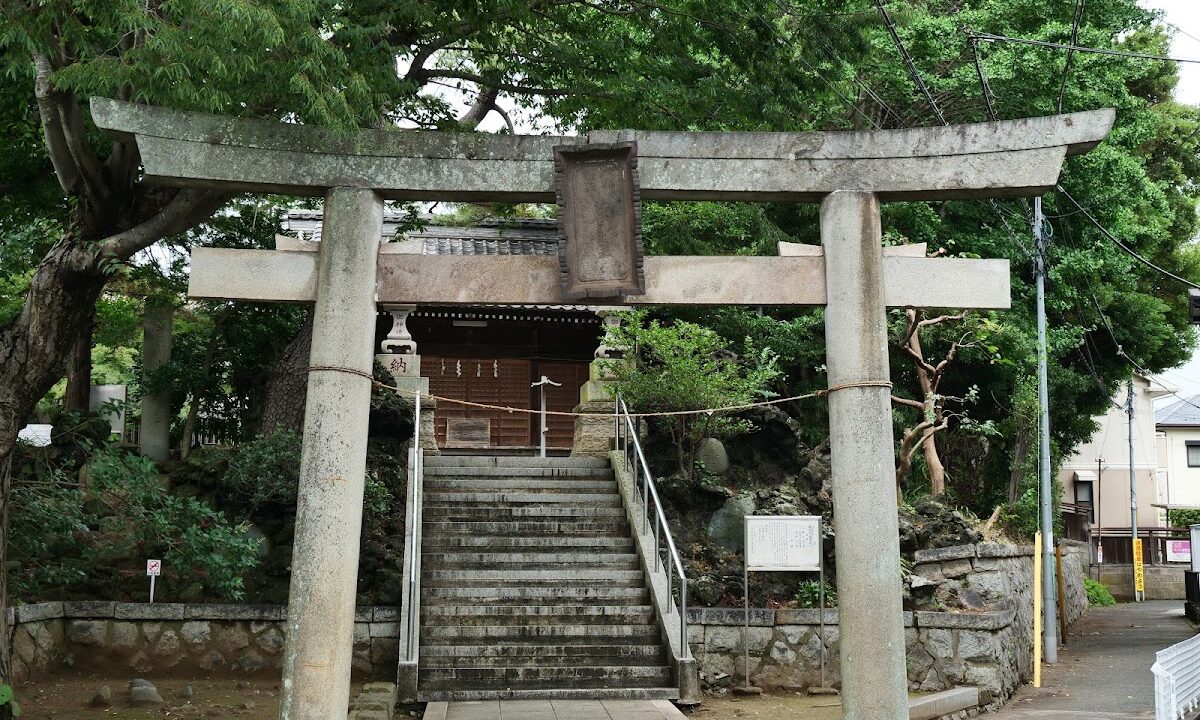
The plaque on the large torii gate bears the inscription “Ichigun Sōsha Katsushika-gū,” conveying its former status as a principal shrine.
Deities and Divine Virtues
Katsushika Shrine enshrines the following three deities:
Ninigi-no-Mikoto
The grandson of Amaterasu-Omikami, and known as the main character in the descent of the heavenly grandchild. He is said to have descended from Takamagahara to earth and laid the foundation for the creation of Japan. He is believed to bestow divine virtues such as the development of agriculture and industry, national peace and security, and the prosperity of descendants.
Hikohodemi-no-Mikoto
The son of Ninigi-no-Mikoto, known as “Yamasachihiko.” Famous for the myth of visiting the palace of the sea god, he is considered a god who brings blessings from the sea and mountains, and is believed to bestow blessings of abundant harvests and business prosperity.
Kumano-no-Okami
Originally the deity enshrined at the Kumano Gongen Shrine located in this area. The deities of the Kumano Sanzan shrines are collectively called Kumano Okami, and are believed to bestow divine blessings such as purification, regeneration, healing from illness, and family safety. Kumano faith has been widely practiced among ordinary people since ancient times and continues to be revered by many today.
Due to these enshrined deities, Katsushika Shrine is worshipped as a shrine that bestows a wide range of divine blessings, including abundant harvests, business prosperity, family safety, healing from illness, and the prosperity of descendants.
Highlights of the Shrine Grounds
The Japanese Black Pine, a Funabashi City Designated Cultural Property
The greatest highlight of Katsushika Shrine is the Japanese black pine that stands tall within the stone fence surrounding the main hall. This black pine is designated as a Funabashi City cultural property and is a magnificent ancient tree estimated to be several hundred years old.
Its distinctive feature is its unique tree shape. The trunk splits into two near the ground, and the sight of the two trees standing side by side, almost like twins, is breathtaking. This bifurcated Japanese black pine is also known as the “Married Couple Pine” and is cherished by visitors as a symbol of matchmaking and marital harmony.
Stretching its branches powerfully in the sunny grounds, this black pine can be considered a living witness to the long history of Katsushika Shrine. When you visit, please take the time to admire this magnificent black pine.
Stone Torii Gate and Shrine Plaque
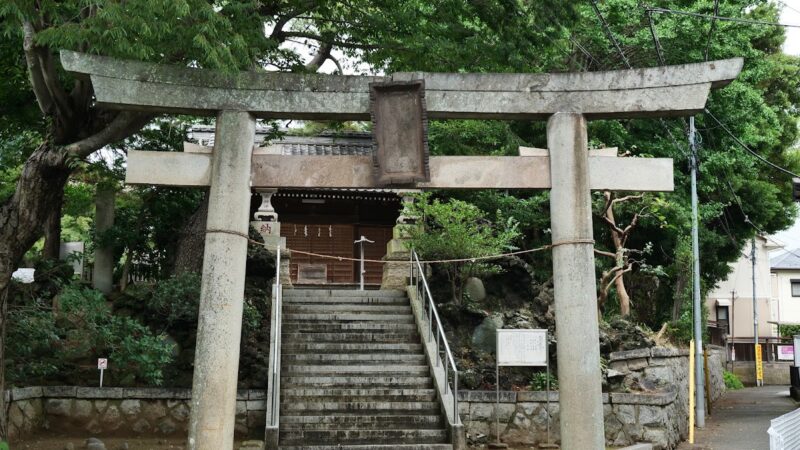
The large torii gate, facing National Route 14, is a majestic stone structure. The shrine plaque on this gate bears the inscription “Ichigun Sōsha Katsushika-gū,” telling the story of its history as the principal shrine of Higashi-Katsushika County, which was once revered.
The stone torii gate has withstood the wind and snow, continuing to mark the entrance to the sacred grounds across time. It is customary to bow before entering the shrine grounds after passing through the torii gate.
The Appearance of the Shrine
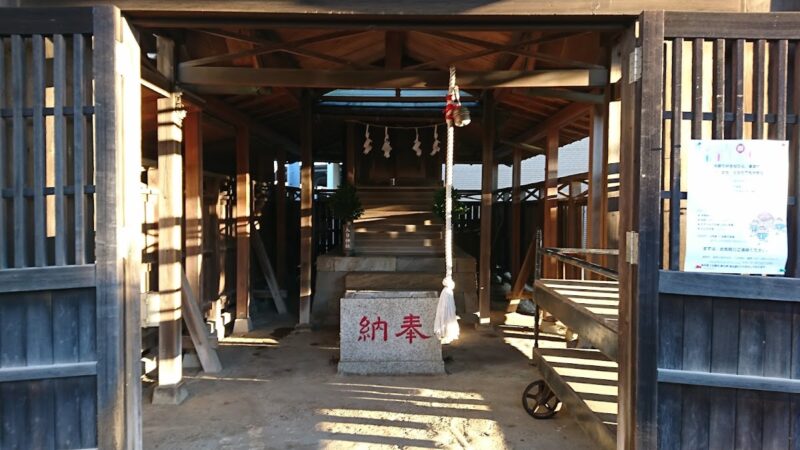
The shrine, situated on a small hill, is nestled in a tranquil space surrounded by trees. The main hall is usually closed, a consideration to protect the sacred space. This is a common practice among shrines in the Nishifunabashi area, where worship takes place in front of the worship hall.
The shrine, though simple, exudes a sense of dignity, possessing the character of a central religious center in the region. The grounds are sunny, well-maintained, and provide a pleasant environment for worship.
The Atmosphere of the Shrine Grounds
Despite facing National Route 14, a major thoroughfare, the grounds of Katsushika Shrine are surprisingly quiet. Its location on a small hill and the surrounding trees create a natural barrier, creating a sacred space isolated from the hustle and bustle of the city.
The shrine is not overcrowded, making it a pleasant place to worship. It has a friendly atmosphere, as it is a shrine regularly visited by locals.
Basic Information and Access to Katsushika Shrine
Address and Contact Information
Address: 4-13-30 Nishifuna, Funabashi City, Chiba Prefecture 273-0031
Access Methods
Access by Train
- Approximately 2-3 minutes on foot from JR Sobu Main Line “Nishifunabashi Station”
- Approximately 2-3 minutes on foot from Tokyo Metro Tozai Line “Nishifunabashi Station”
- Approximately 2-3 minutes on foot from Toyo Rapid Railway “Nishifunabashi Station”
Nishifunabashi Station is a major station served by multiple lines, offering excellent access from central Tokyo. Upon exiting the station, proceed along National Route 14, and you will soon see the torii gate of Katsushika Shrine.
Access by Car
Located along National Route 14, access by car is also convenient. However, it is recommended to check in advance regarding dedicated parking. There are also coin-operated parking lots nearby.
Visiting Hours
The shrine grounds are generally open for free visits. However, it is recommended to check the office hours and the hours for receiving Goshuin (shrine stamps) before your visit.
Nearby Spots and Tourist Information
Katsumata Park
Located right next to Katsushika Shrine, Katsumata Park was once a scenic spot known as “Katsumata Pond.” It is now a well-maintained park and a popular place for local residents to relax. A stroll before or after visiting the shrine is recommended.
Gourmet Spots Around Nishi-Funabashi Station
The area around Nishi-Funabashi Station boasts a wide variety of restaurants. After visiting the shrine, you can enjoy a meal at one of the restaurants or cafes near the station. The shopping street is also lively, offering a local atmosphere.
Other Shrines and Temples in Funabashi City
Besides Katsushika Shrine, Funabashi City has many other historical shrines and temples. If you have time, it would be a good idea to visit other shrines such as Funabashi Grand Shrine (Ofuhi Shrine) and Ninomiya Shrine.
Etiquette and Manners for Worship
Basic Worship Etiquette
- Bow before the Torii Gate – Bow before the torii gate before entering the sacred area.
- Purify yourself at the water basin – If there is a water basin, purify your hands and mouth.
- Walk along the edge of the path – The center of the path is considered the path of the gods.
- Etiquette in front of the main hall – The basic etiquette is “two bows, two claps, one bow.”
- Bow deeply twice.
- Clap your hands twice.
- Bow deeply once.
- Bow when leaving the Torii Gate – When leaving the sacred area, turn around and bow.
Points to Note When Worshiping
- The shrine grounds are a sacred place. Please refrain from speaking loudly or running around.
- Photography is generally permitted, but there are areas where photography is prohibited, such as inside the main hall.
- Please take all your trash with you.
- Please note that regulations regarding bringing pets to shrines vary by shrine.
Annual Events at Katsushika Shrine
Various festivals are held at the shrine throughout the year. Major annual events include:
- New Year’s Day Festival – A festival celebrating the New Year
- Setsubun Festival – A festival to ward off evil spirits held on Setsubun in February
- Annual Grand Festival – The most important festival of the shrine (please check with the shrine for dates)
- Shichi-Go-San – Many families visit in November to pray for the healthy growth of their children
- Great Purification Ceremony – A Shinto ritual held in June and December to purify sins and impurities
For specific dates and details, it is recommended to check with the shrine before visiting.
Goshuin Information
Goshuin (shrine stamps) are available at Katsushika Shrine. A Goshuin (temple/shrine stamp) is proof of your visit and a tangible record of your connection with the shrine.
Etiquette for Receiving a Goshuin
- Always pray first – A Goshuin is proof of your visit. Always pray first.
- Prepare a Goshuincho (stamp book) – It is desirable to have a dedicated Goshuincho.
- Prepare the offering – Generally around 300-500 yen. Prepare the exact amount to avoid needing change.
- Be polite – Don’t forget to show gratitude to the shrine priest.
It is recommended to check the Goshuin issuance hours and offering fees in advance.
Summary of the Charms of Katsushika Shrine
Katsushika Shrine is a historical shrine located in Nishifuna, Funabashi City, Chiba Prefecture. While it once held the status of the principal shrine of Higashi-Katsushika County, it is now a beloved local guardian shrine.
Main Attractions:
- Excellent Access – Conveniently located just a 2-3 minute walk from Nishi-Funabashi Station
- Historical Value – A prestigious and historically significant shrine as the main shrine of the county
- Cultural Property: Japanese Black Pine – A magnificent bifurcated Japanese black pine designated as a cultural property by Funabashi City
- Quiet Grounds – A tranquil space away from the hustle and bustle of the city
- Community-Oriented – A friendly atmosphere loved by local residents
When visiting Nishi-Funabashi, be sure to stop by Katsushika Shrine and experience its history and serenity. Its proximity to the station makes it easy to visit even for a short time.
Recommended Season for Visiting Katsushika Shrine
Katsushika Shrine can be visited year-round, but each season offers its own unique charm.
Spring (March-May)
This is the season of fresh greenery, with the trees on the shrine grounds adorned in beautiful green. The weather is mild, making it an ideal time for a visit.
Summer (June-August)
The temple grounds receive plenty of sunlight, and the strong summer sun pours down. Early morning or evening visits are recommended.
Autumn (September-November)
This is the season of autumn leaves, a time when the contrast between the green of the Japanese black pines and the vibrant red foliage is beautiful. The temple is bustling with families during the Shichi-Go-San (7-5-3) festival.
Winter (December-February)
The temple is crowded with many visitors during the New Year’s visit season. Visiting the temple in the crisp winter air is a solemn and austere experience.
Origin of the Place Name Katsushika
The place name “Katsushika” has been used to refer to this region since ancient times. It is mentioned in the Manyoshu (an ancient collection of Japanese poetry) as “Katsushika no Mama,” referring to a wide area encompassing present-day Katsushika Ward in Tokyo and Ichikawa and Funabashi cities in Chiba Prefecture.
There are several theories about the origin of the place name, but the most likely one is that it was named after the abundance of kudzu (kudzu) plants that grew there. Kudzu has been used for clothing and food since ancient times, making it an important resource in this region.
Katsushika Shrine, bearing the name of this historic “Katsushika,” is an important presence that conveys the history and culture of the region to the present day.
Voices and Reputation of Local Residents
Katsushika Shrine is a shrine beloved by local residents. Visitors have shared comments such as:
- “It’s conveniently located near the station. I can easily stop by on my way home from work.”
- “I like the quiet and peaceful atmosphere. It’s refreshing.”
- “The Japanese black pine trees are magnificent and impressive.”
- “A shrine I want to cherish as the guardian deity of my hometown.”
- “The grounds are well-maintained and pleasant.”
On the other hand, some have commented that “the main hall is often closed,” but this is a consideration to protect the sacred space and is common practice at shrines in the Nishifunabashi area. You can still connect with the deities by praying from in front of the worship hall.
Nearby Historical Spots
Katsura-no-i Well
Near the site of the original Katsushika Shrine, there was a well called “Katsura-no-i.” This is believed to be the well used for purification at the original Katsushika Shrine, and it has been revered as a sacred water source since ancient times. It is thought to have been located near present-day Ichikawa City.
The Legend of Tekona of Mama
The Katsushika region is home to the legend of Tekona, which is also mentioned in the *Manyoshu* (Collection of Ten Thousand Leaves). In Mama, Ichikawa City, there is the Tekona Reijindo (Tekona Shrine), an important site that tells the story of Katsushika’s ancient history.
Summary: The Value of Visiting Katsushika Shrine
Katsushika Shrine, located in Nishifuna, Funabashi City, Chiba Prefecture, boasts a dignified history as the main shrine of a county, yet it is a familiar shrine beloved by local residents. It has many attractions, including its excellent accessibility (2-3 minutes walk from Nishifunabashi Station), a Japanese black pine tree designated as a Funabashi City cultural property, and a tranquil atmosphere within the shrine grounds.
Amidst the hustle and bustle of the city, this is a precious space where you can offer prayers in peace. When you visit Nishi-Funabashi, be sure to stop by Katsushika Shrine and experience its history and tranquility. It’s sure to be a refreshing and soul-cleansing experience.
Understanding the local history and the shrine’s origins will give your visit a deeper meaning. We hope your visit to Katsushika Shrine will be a memorable one.