Complete Guide to Nihonji Temple: History, Highlights, and Visiting Information for Kanto’s Oldest Imperial Temple on Mount Nokogiri
Nihonji Temple, located on the southern slope of Mount Nokogiri in Kyonan-machi, Awa-gun, Chiba Prefecture, is the oldest imperial temple in the Kanto region, founded approximately 1300 years ago by Gyoki Bodhisattva at the behest of Emperor Shomu. Its vast grounds, covering approximately 100,000 tsubo (about 7 times the size of Tokyo Dome), are dotted with historically and culturally valuable stone structures, including Japan’s largest stone Buddha statue, a 100-foot Kannon statue, and a group of 1500 Arhat stone statues. This article comprehensively explains all the information necessary for visiting Nihonji Temple, from its history and main highlights to visiting routes and access methods.
History of Nihonji Temple
Founding and Early History
The official name of Nihonji Temple is “Kenkonzan Nihonji,” and it is said to have been founded in 725 AD (Shinki 2) by the high-ranking monk Gyoki at the behest of Emperor Shomu. Originally belonging to the Hossō sect, Nihonji Temple later converted to the Tendai sect.
As the oldest imperial prayer temple in the Kanto region, Nihonji played a crucial role in praying for national peace and the well-being of the people. From the Nara period to the Heian period, it was a central figure in the spread of Buddhist culture to eastern Japan.
Transition from the Medieval to the Early Modern Period
In 1181 (Yōwa 1), Minamoto no Yoritomo, and in 1345 (Jōwa 1), Ashikaga Takauji, were involved in its reconstruction, demonstrating its history of receiving patronage from the samurai government. These reconstruction projects established Nihonji Temple’s position as a powerful temple in the Kanto region.
During the Edo period, it converted to the Sōtō sect, maintaining that sect to this day. Many stone structures were erected during this period, forming the foundation of the Nihonji Temple landscape we see today.
Preservation and Development in the Modern Era
Although it temporarily declined due to the anti-Buddhist movement of the Meiji era, since the Showa era, restoration of stone structures and improvement of the temple grounds have progressed, and today it welcomes many visitors as a representative tourist temple of Chiba Prefecture. Mount Nokogiri is a prefecturally designated scenic spot, and the grounds of Nihonji Temple, spread across its southern slope, form a unique landscape where nature and culture are fused.
Main Highlights of Nihonji Temple
Nihonji Great Buddha (Yakushi Rurikō Nyorai)
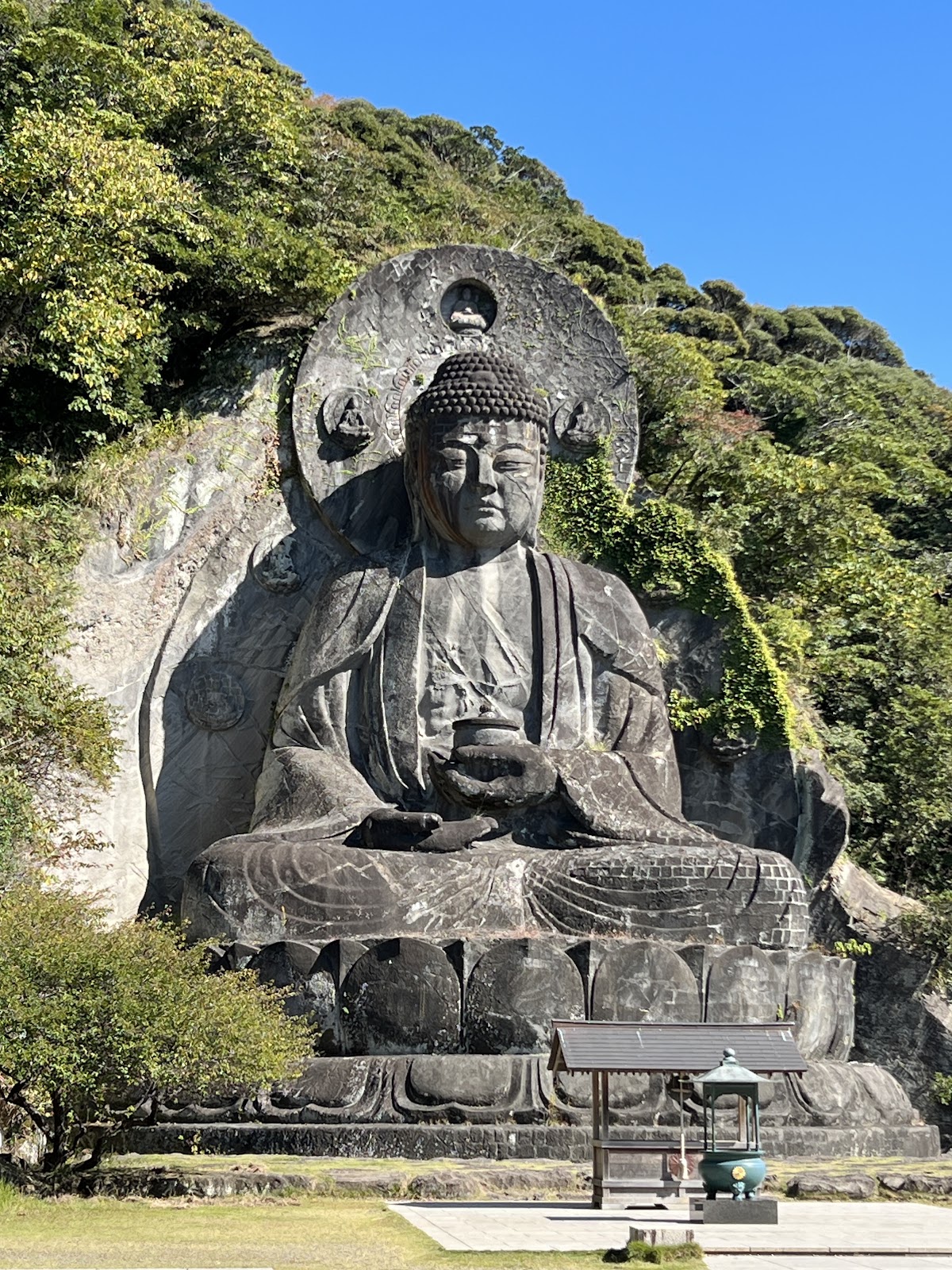
The principal image of Nihonji Temple, Yakushi Rurikō Nyorai, is the largest stone Buddha statue in Japan, boasting a height of 31.05 meters. The Great Buddha was constructed between 1783 (Tenmei 3) and 1789 (Kansei 1) by Ōno Jingorō Hideyoshi and 27 stonemasons.
The original form was completed in the Edo period, but it fell into disrepair due to weathering during the Meiji era. Restoration work was carried out over four years starting in 1969 (Showa 44), resulting in its current appearance. The Great Buddha, crafted from granite, captivates visitors not only with its immense size but also with its serene expression and exquisite carving techniques.
Hyakushaku Kannon Statue
The Hyakushaku Kannon is a statue of Kannon Bodhisattva carved directly into the rock face of Mount Nokogiri over a period of six years, starting in 1960. Standing approximately 30 meters tall, it was erected to pray for the safety of air and sea transport and for world peace.
It boasts the largest scale of any Kannon statue carved into a rock face in East Asia, and its compassionate expression watches over worshippers. Its form, integrated with the natural rock surface, can be considered a work of art symbolizing the harmony between artificial and natural elements.
1500 Arhat Stone Statues
The 1500 Arhat statues are a group of stone statues carved over approximately 50 years, starting in 1783, by Ono Jingoro Hideyoshi and his disciples. In reality, 1553 statues have been identified, each with a different expression and posture.
Arhat statues are placed throughout the temple grounds, allowing visitors to encounter various expressions as they walk along the approach. There’s a saying that “wherever three people gather, there’s always someone who resembles an acquaintance,” giving visitors the pleasure of searching for an Arhat that resembles a deceased loved one or someone they know.
Jigoku-no-zoki (Hell’s Gaze)
Located near the summit of Mount Nokogiri, “Jigoku-no-zoki” is a spectacular viewpoint overlooking the landscape from a rock jutting out from a sheer cliff face. You can gaze down approximately 100 meters, offering a thrilling experience.
On clear days, the view extends to Tokyo Bay, the Boso Peninsula, and even Mount Fuji, making it a popular tourist spot. However, those with a fear of heights should exercise caution.
Niomon Gate and Kongo Rikishi Statues
The Niomon Gate, standing at the entrance to the main approach, houses imposing Kongo Rikishi statues. These statues welcome worshippers and protect Buddhist teachings.
Passing through the Niomon Gate, you’ll begin the approach to the temple, which features 2,639 stone steps. Climbing these steps offers a physical and spiritual experience.
Temple Grounds Pilgrimage Route and Estimated Time
Omotesando Route (Mountain Trail)
The Omotesando is the official pilgrimage route to Nihonji Temple, a stone staircase leading from the Niomon Gate at the foot of the mountain to the summit area. Visiting all the sights takes approximately 2-3 hours, offering a truly authentic experience of walking through nature and paying respects to the stone structures.
Main Sights Route:
- Niomon Gate (Entrance)
- 1500 Arhat Stone Statues
- Nihonji Great Buddha
- Hyakushaku Kannon
- Jigoku-no-zoki (Summit Area)
The stone steps are steep in places, so comfortable shoes and clothing are essential. Particular caution is needed during rainy weather, as the steps can become slippery.
Ropeway Route
Using the Nokogiriyama Ropeway, you can reach the summit station from the base station in approximately 4 minutes. From the summit station, it’s a few minutes’ walk to Jigoku-no-zoki (Hell’s Gaze), and from there, the usual route involves descending to the grounds of Nihonji Temple.
This route is recommended for those who are not confident in their physical strength or have limited time, as it involves descending, reducing the strain on your legs and back.
Road Route
There is also a toll road (Nokogiriyama Mountain Climbing Road) that allows you to access the area near the summit of Nokogiriyama by car. From the summit parking lot, you can walk to various parts of the temple grounds, making it a suitable route for families and the elderly.
Practical Information Needed for Visiting the Temple
Visiting Hours and Admission Fees
Visiting Hours:
- Regular Season: 8:00 AM – 5:00 PM
- Winter Season (November – February): 8:00 AM – 4:00 PM
Admission Fees:
- Adults: 700 yen
- Children (4-12 years old): 400 yen
The admission fee is used for the maintenance of the temple grounds and the preservation of cultural properties. Considering the vast grounds, the price is reasonable for what you see.
Access Information
By Train/Bus:
- Approximately 8 minutes on foot from JR Uchibo Line “Hamakanaya Station” to the Nokogiriyama Ropeway base station
- Approximately 15 minutes on foot from the same station to the Nihonji Omotesando entrance
By Car:
- Approximately 5 minutes from Futtsu-Kanaya IC on the Futtsu-Tateyama Expressway
- Free parking available (near the Omotesando entrance)
- Paid parking available near the summit if using the toll road
Nokogiriyama Ropeway:
- Operating Hours: 9:00 AM – 5:00 PM (Varies by season)
- Fare: Adult round trip 930 yen, one way 500 yen
Precautions and Preparations for Visiting
Clothing and Items to Bring:
- Comfortable walking shoes (sneakers or hiking boots recommended)
- Comfortable clothing
- Drinking water (especially essential in summer)
- Hat and sunscreen (some areas have little shade)
- Towel
Seasonal Precautions:
- Spring/Autumn: Clothing that can adapt to temperature changes
- Summer: Heatstroke prevention is essential; early morning visits are recommended.
- Winter: Warm clothing is necessary; allow ample time as the sun sets early.
Physical Requirements:
The temple grounds are vast and have significant elevation changes, requiring considerable stamina to explore everything. It’s important to visit at your own pace without overexerting yourself.
Nearby Tourist Attractions
Highlights of Mount Nokogiri
Besides the grounds of Nihonji Temple, Mount Nokogiri offers many other sights. From the mountaintop observation deck, you can enjoy a panoramic view of Tokyo Bay, and on clear days, you can even see Mount Fuji and the Izu Peninsula. The sharp, rocky ridgeline, which gives Mount Nokogiri its name, also creates a unique landscape when viewed from afar.
Around Kanaya Port
Around Kanaya Port at the foot of Mount Nokogiri, there are numerous restaurants serving fresh seafood. Dishes using locally caught seafood are particularly exquisite and highly recommended for a meal after your visit.
Hota/Kyonan Area
Kyonan Town has facilities where you can purchase local specialties, such as the “Hota Elementary School” roadside station. Agricultural and marine products grown in the warm climate of the Boso Peninsula are popular souvenirs.
Cultural Properties and Preservation Activities of Nihonji Temple
Important Cultural Properties and Prefecturally Designated Cultural Properties
Nihonji Temple preserves many cultural properties. The stone structures, including the 1500 Arhat stone statues, are valuable cultural heritage representing the pinnacle of Edo period stonemasonry techniques.
Mount Nokogiri itself is a Chiba Prefecture-designated scenic spot, possessing a unique value where natural landscapes and cultural properties are integrated.
Preservation and Restoration Efforts
Nihonji Temple continuously engages in preservation and restoration activities to prevent weathering and damage to its stone structures. A portion of the admission fee is used for these preservation activities, and valuable cultural properties are passed on to future generations through the cooperation of visitors.
Another Temple with the Same Name as Nihonji
Nihonji in Tako-machi, Chiba Prefecture
There is also a Nichiren Buddhist temple called “Shotozan Nihonji” in Tako-machi, Katori-gun, Chiba Prefecture. This is an ancient temple founded in 1319 by the third head priest of Nakayama Hokkeji Temple, Nichiyu Shonin, and has a history as a Danrin (Buddhist school) where scholars from all over Japan gathered.
While it is a different temple from the Nihonji on Mount Nokogiri, with a different sect and history, it shares the same name “Nihonji,” so caution is advised when visiting.
Nihonji in Bodh Gaya, India
There is also an “Indo-san Nihonji” in Bodh Gaya, a Buddhist holy site in India. This temple was established in 1968 through the cooperation of various Japanese Buddhist sects, with the purpose of repaying gratitude to Shakyamuni Buddha and praying for world peace.
It is operated by the International Buddhist Promotion Association, a public interest incorporated foundation, and serves as a base for disseminating Japanese Buddhist culture overseas.
Guidelines and Enjoyment of Visiting the Temple
Spiritual Preparation
Nihonji Temple is not merely a tourist attraction, but a place of faith with a 1300-year history. When visiting, it is important to enter the temple grounds with a reverent heart. Before the Great Buddha and Kannon statues, quietly clasp your hands together and offer your prayers.
Photography Etiquette
Photography is generally permitted on the temple grounds, but consideration for other visitors is necessary. Especially if someone is praying, be careful not to disturb them.
Enjoying Harmony with Nature
One of the charms of Nihonji Temple is that cultural assets are scattered within a rich natural environment. Walking along the approach to the temple, you can listen to the seasonal plants and birdsong, and experience Buddhist culture integrated with nature.
With cherry blossoms in spring, fresh greenery in summer, autumn leaves in fall, and the crisp winter air, Nihonji Temple shows a different face with each season, offering new discoveries with every visit.
Summary: The Value of Visiting Nihonji Temple
Nihonji Temple, located on Mount Nokogiri in Chiba Prefecture, is a unique temple where 1,300 years of history, Japan’s largest stone Buddha statue, 1,500 arhats and other precious cultural assets, and magnificent natural scenery are fused together. As the oldest imperial prayer temple in the Kanto region, it has received the faith and prayers of people from the time of Emperor Shomu to the present day.
While traversing the vast grounds requires some physical effort, the spiritual fulfillment and profound emotions gained are immeasurable. Despite its relatively accessible location from Tokyo, it offers a tranquil space away from the hustle and bustle of the city, where you can connect with history and nature.
As you ascend the main approach or descend from the mountaintop, encountering the diverse expressions of the 1,500 arhats, offering prayers before Japan’s largest Buddha statue, and gazing at the breathtaking view from the “Hell’s Gaze” viewpoint will leave a deep impression on the hearts of visitors.
Nihonji Temple is not merely a tourist spot; it is a precious place where you can experience Japanese Buddhist culture and history. If you visit with proper preparation and a reverent heart, it will surely be an unforgettable experience.