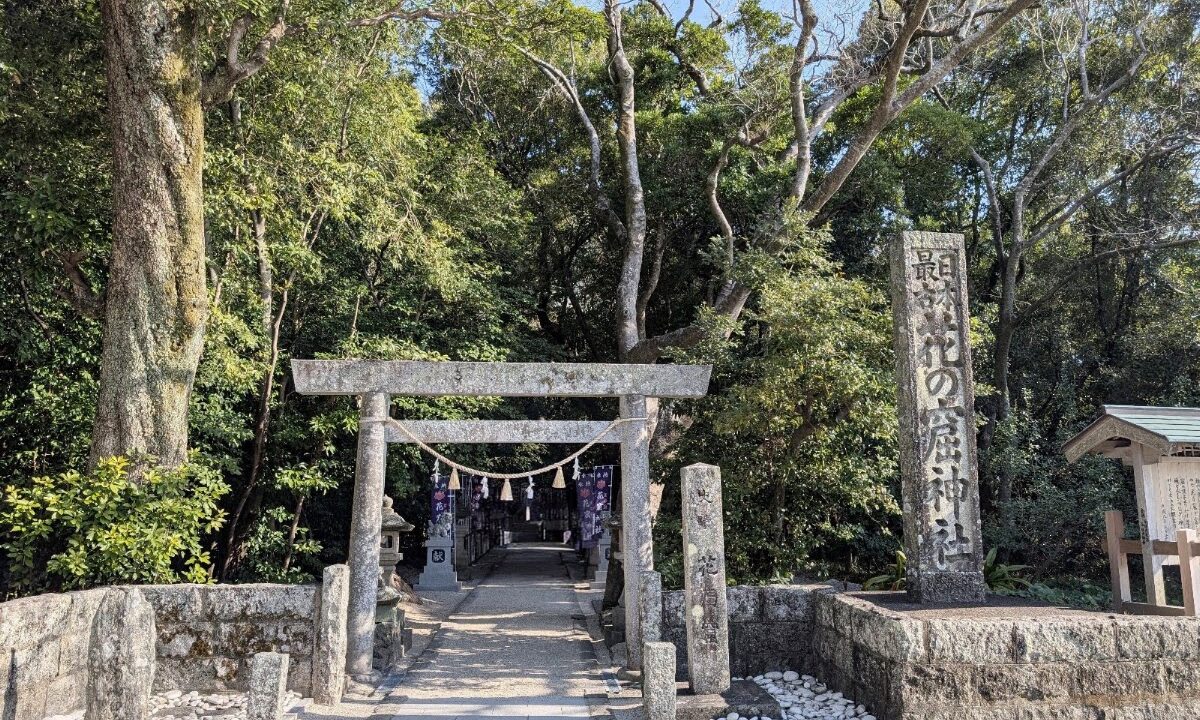
Complete Guide to Hananoiwaya Shrine (Mie Prefecture) | A Thorough Explanation of the Charms of Japan’s Oldest Shrine and World Heritage Site
Located in Arima-cho, Kumano City, Mie Prefecture, Hananoiwaya Shrine is known as Japan’s oldest shrine and is a special sacred site registered as a component of the World Heritage Site “Sacred Sites and Pilgrimage Routes in the Kii Mountain Range.” Without a shrine building, it preserves a primitive form of worship where the massive rock face, approximately 45 meters high, itself serves as the deity, a place that can be considered the root of Japanese spiritual culture.
This article comprehensively explains everything you need to know before visiting Hananoiwaya Shrine, from its historical background and highlights to its unique festivals, access methods, and surrounding tourist information.
About Hananoiwaya Shrine | The Setting of Myths Recorded in the Nihon Shoki
History as Japan’s Oldest Shrine
Hananoiwaya Shrine is a sacred site that dates back to the age of mythology, appearing in the first volume of the “Age of the Gods” section of the Nihon Shoki, Japan’s first official history compiled in 720 (Nara period). The Nihon Shoki records that Izanami-no-Mikoto died when her genitals were burned while giving birth to Kagutsuchi-no-Mikoto, the god of fire, and was buried in “Arima Village in Kumano, Kii Province.”
This “Arima Village” is the present-day Arima-cho, Kumano City, Mie Prefecture, and Hananoiwaya Shrine is considered to be her burial place. Because local residents have offered seasonal flowers to Izanami-no-Mikoto since ancient times, the shrine came to be called “Hana-no-Iwaya” (Flower Cave).
Deities and Mythological Significance
The main deities enshrined at Hanaiwaya Shrine are the following two:
- Izanami-no-Mikoto: A goddess who, along with Izanagi-no-Mikoto, created the Japanese archipelago and many other gods in the creation myth. After her death, she became the ruler of the underworld.
- Kagutsuchi-no-Mikoto: The god of fire. While he is the god who caused the death of his mother, Izanami-no-Mikoto, he is also enshrined alongside her.
This arrangement of enshrining mother and son deities symbolizes the duality of life and death, creation and destruction, embodying a fundamental theme in Japanese mythology.
Value as a World Heritage Site
In July 2004, Hanaiwaya Shrine was registered as a World Heritage Site as part of the “Sacred Sites and Pilgrimage Routes in the Kii Mountain Range.” As “Kumano of the Cave,” which existed even before the establishment of the Kumano Sanzan (Kumano Hongu Taisha, Kumano Hayatama Taisha, and Kumano Nachi Taisha), it is internationally recognized as a valuable cultural heritage site that conveys the prototype of ancient nature worship.
It is highly valued as an important component demonstrating the multifaceted nature of Kumano faith, preserving a more primitive form of worship distinct from Ise Grand Shrine and the Kumano Sanzan.
Highlights of Hanaiwaya Shrine | The Charm of a Mysterious Sacred Site
The Giant Rock of the Sacred Object, Exuding an Overwhelming Presence
The most distinctive feature of Hanaiwaya Shrine is the absence of a shrine building. The massive rock face itself, approximately 45 meters high and 91 meters in circumference, towering over the Kumano Sea, serves as the sacred object. This iwakura (sacred rock) is a natural masterpiece, welcoming worshippers in its unchanged form since ancient times.
The rock surface displays complex textures due to weathering, showing different appearances depending on the time of day and weather. The giant rock, especially when bathed in the morning sun, emits a divine glow, and at dusk, it creates a fantastical landscape that blends seamlessly with the Kumano Sea.
A Sacred Space Surrounded by White Stones
In front of the giant rock, the sacred object of worship, there is a worship area paved with white pebbles. These white stones symbolize purity and serve as a boundary separating the secular world from the sacred realm. Standing on the white stones, one can feel the overwhelming presence of the giant rock even more strongly, and a sense of awe towards nature naturally arises.
The worship area, surrounded by a stone fence, is neatly maintained, providing a space where worshippers can offer their prayers in peace.
The Mausoleum of Izanami-no-Mikoto, “Hotoana”
Midside on the giant rock is a small cave called “Hotoana,” which is considered the mausoleum of Izanami-no-Mikoto. It is associated with the myth in the Nihon Shoki (Chronicles of Japan) that “her genitals were burned when she gave birth to the fire god,” and has become an object of worship as a symbol of femininity.
Even today, many worshippers offer prayers towards this cave, and the belief in safe childbirth and women’s health continues.
A Stunning Location Overlooking the Kumano Sea
Hanaiwaya Shrine is located facing the Kumano Sea, offering a magnificent panoramic view of the Pacific Ocean. The scenery, a tapestry of sea, giant rocks, and sky, is a breathtaking sight that evokes the origins of nature worship.
Especially on sunny days, the contrast between the blue sea and sky, white pebbles, and giant rocks is beautiful, making it a popular spot for photography. Visiting the shrine while listening to the sound of the waves will provide a healing time that allows you to forget the hustle and bustle of city life.
Twice-Yearly Grand Festivals and the Rope-Hanging Ritual | Japan’s Longest Ritual
Spring and Autumn Grand Festivals
Hanaiwaya Shrine holds its annual grand festivals twice a year, on February 2nd and October 2nd. This festival is a traditional Shinto ritual that has continued since ancient times and has been passed down as an important annual event in the region.
The centerpiece of the annual festival is the “Otsunakake Ritual.” This ritual involves stretching a massive rope, approximately 170 meters long, from the top of the sacred rock to a pillar standing at “Shichiri-Mihama” at the southern end of the shrine grounds. It is also known as “Japan’s longest sacred rope.”
Meaning and Procedure of the Otsunakake Ritual
The Otsunakake Ritual is based on a passage in the Nihon Shoki (Chronicles of Japan) stating that Izanami-no-Mikoto requested that seasonal flowers be offered. Three flag ropes hang from the large rope, and seasonal flowers and fans are used to decorate them.
The Shinto ritual proceeds as follows:
- Recitation of prayers and ritual by Shinto priests
- Transport of the large rope by parishioners and worshippers
- Securing the rope to the top of the giant rock
- Stretching the rope to the pillars at Shichiri-Mihama beach
- Decorating the flag rope with seasonal flowers
The process of passing the large rope is carried out with the cooperation of many parishioners and worshippers, and is an event that symbolizes the unity of the local community. The sight of the flowers swaying in the wind and the large rope is a visual representation of the form of faith that has continued since ancient times.
Regarding viewing the Grand Festival
The Grand Festival is open to the public. The ritual and rope-hanging ceremony, which begin around 10:00 AM, are particularly impressive and attract many tourists and photography enthusiasts. However, as it is a sacred ritual, please be quiet and considerate so as not to disturb the ceremony.
Photography is generally permitted, but please be considerate of the Shinto priests and participants, and observe proper etiquette such as refraining from using flash photography.
Goshuin (Shrine Seals) and Amulets | Items Offered at Hanakutsu Shrine
About Goshuin
Hanakutsu Shrine offers Goshuin (shrine seals). Goshuin are proof of worship and are cherished by many visitors as a tangible representation of their connection to the shrine.
Goshuin at Hanakutsu Shrine can be obtained at the shrine office next to the main hall. However, since the shrine priest may not always be present, it is recommended to call ahead or visit on a day with special events such as the annual festival if you wish to be sure to receive a Goshuin.
The offering fee is usually around 300 to 500 yen. If you forget your Goshuincho (stamp book), you may be able to receive a pre-printed Goshuin.
Amulets and Items Offered
Hanakutsu Shrine offers various items, including amulets for safe childbirth and good health. Because the shrine enshrines Izanami-no-Mikoto, the guardian deity of women, amulets related to women’s blessings are particularly popular.
Within the shrine grounds, there is a rest area called “Otsuna Chaya,” where you can purchase local specialties and related goods. It’s a space where you can relax and enjoy the nature of Kumano.
How to Access Hanaiwaya Shrine | Public Transportation and Driving
Access by Train and Bus
If using JR:
- Get off at Kumano-shi Station on the JR Kisei Main Line
- Take the Mie Kotsu bus bound for Shingu Station
- Get off at the Hanaiwaya bus stop (approximately 4-7 minutes)
- A short walk from the bus stop
Since bus services are limited, it is recommended to check the timetable in advance. Walking from Kumano-shi Station takes approximately 25-30 minutes.
Access by Car
If using the expressway:
- Approximately 5 minutes (approx. 5 km) from Kumano-Owase Expressway “Kumano-Otomari IC” via National Route 42
- Approximately 3 hours 30 minutes from Nagoya
- Approximately 4 hours from Osaka
Parking Information:
Hanaiwaya Shrine has a free parking lot (approx. 20 spaces for regular cars). It can get crowded during peak tourist seasons and on the day of the annual festival, so early arrival is recommended.
The shrine is located along National Route 42, making it easily accessible by road. However, the Kumano area is mountainous, so road conditions may be icy in winter. Please check the weather and road conditions in advance.
Address and Basic Information
- Address: 130 Arima-cho, Kumano City, Mie Prefecture 519-4325
- Phone: 0597-89-2881
- Visiting Hours: Open 24 hours (Shrine office hours are irregular)
- Admission Fee: Free
Nearby Tourist Attractions | Places to Visit Along with Hanaiwaya Shrine
Ubuta Shrine
Located about a 10-minute walk from Hanaiwaya Shrine, Ubuta Shrine is said to be the place where Izanami-no-Mikoto gave birth to Kagutsuchi-no-Mikoto. It is revered as a deity of safe childbirth, and many people visit it along with Hanaiwaya Shrine.
Every year on January 10th, the Ubuta Shrine Grand Festival is held, featuring a unique ritual called “Ubuta no Sanma.” Due to its deep connection with Hanaiwaya Shrine, visiting both shrines will allow you to understand the world of mythology more deeply.
Shichiri Mihama
Shichiri Mihama, stretching out in front of Hanakurai Shrine, is Japan’s longest sandy-gravel beach, extending approximately 22 kilometers from Kumano City to Kiho Town. It is also registered as part of the World Heritage Site “Sacred Sites and Pilgrimage Routes in the Kii Mountain Range.”
Characterized by its beautiful pebbles, even a stroll along the shoreline offers a refreshing experience. The scenery at sunset is particularly spectacular and perfect for photography.
Onigajo
Located about 15 minutes by car from Hanakurai Shrine, Onigajo is a scenic spot designated as a National Place of Scenic Beauty and Natural Monument, and also registered as a World Heritage Site. Enjoy the dynamic natural landscape of strangely shaped rocks and caves created by the rough waves of the Kumano Sea, stretching for approximately 1 kilometer.
A walking path is maintained, allowing you to see the impressive rock faces up close while walking along the coastline. The walk takes approximately 1 hour.
Shishiiwa (Lion Rock)
Located very close to Onigajo Castle, Shishiiwa is a massive rock formation resembling a lion roaring towards the sea. Standing approximately 25 meters tall, this natural masterpiece attracts many tourists.
It can be seen from National Route 42 and is a popular photo spot.
Kumano City and Hot Springs
Kumano City offers several day-trip hot spring facilities, including Yunokuchi Onsen and Kinari no Yu in Asuka-cho. Relaxing in a hot spring after visiting Hanaiwaya Shrine is highly recommended.
Kumano City also boasts a wealth of local cuisine, such as Kumano Jidori (local chicken) and Mehari Sushi. Enjoy local dishes while experiencing Kumano’s culture.
The Power Spot Appeal of Hanaiwaya Shrine
A Sacred Site Bordering the Underworld
Hanaiwaya Shrine has long been believed to be a place bordering the underworld, as it is the burial site of Izanami-no-Mikoto. As a sacred site situated at the boundary between life and death, it has been considered a place of special spiritual power since ancient times.
While the entire Kumano region is known as a “sacred site of resurrection,” Hanaiwaya Shrine, in particular, is a powerful spiritual spot attracting people seeking spiritual experiences.
The Origin of Nature Worship
The form of worship, which involves the deification of nature itself without a shrine building, represents the origin of Japanese faith. It is believed that a purer spiritual experience can be obtained by directly confronting nature without the mediation of artificial objects.
Standing before the giant rock, one can feel a sacred atmosphere that cannot be expressed in words. This is said to be the unchanging power of nature since ancient times, and it is believed to have a purifying effect on the hearts of visitors.
Worship as a Guardian Deity of Women
Izanami-no-Mikoto is the goddess of creation and a symbol of the power to give birth to life. Therefore, she is believed to grant blessings related to women, such as safe childbirth, fertility, and women’s health.
She is particularly popular with pregnant women and women expecting to become mothers, and is cherished as a place where one can feel a gentle, enveloping maternal energy.
Precautions and Manners for Visiting
Clothing and Items to Bring
Hanaiwaya Shrine is located along the coast, so it can be windy on some days. Especially in winter, be sure to take adequate precautions against the cold. Also, the white stone worship area can be difficult to walk on, so comfortable shoes are recommended.
In summer, the sun is strong, so sun protection such as a hat and sunscreen is necessary.
Photography
Photography is generally permitted on the shrine grounds, but please remember that it is a sacred place and be considerate of other visitors. Especially during festivals, be careful not to disrupt the religious ceremony.
When photographing the sacred rock, please do so with respect.
Etiquette for Worship
As with most shrines, please worship using the following etiquette:
- Bow before passing through the torii gate
- Cleanse your hands and mouth at the water basin
- Bow twice, clap twice, and bow once at the worship area
- Bow once again at the torii gate when leaving
Since there is no shrine building, you will worship towards the giant rock. Offer your prayers quietly and sincerely.
Seasons of Hanakutsu Shrine | Seasonal Charms
Spring (March-May)
Spring is the perfect season for worship, with its beautiful fresh greenery and mild climate. During the Spring Grand Festival on February 2nd, spring flowers adorn the large rope, creating a vibrant atmosphere. In cherry blossom season, the surrounding mountains are dyed a delicate pink.
Summer (June-August)
Summer is a beautiful season with the contrast between the blue sea and sky of the Kumano Sea. However, the sun is very strong, so precautions against heatstroke are necessary. Visiting in the early morning or evening is recommended. Local beaches are also bustling from July to August.
Autumn (September-November)
Autumn offers pleasant weather and is an ideal season for sightseeing. At the Autumn Grand Festival on October 2nd, autumn flowers adorn the large rope. During the autumn foliage season, the surrounding mountains change color, allowing visitors to enjoy the beautiful contrast between the sea and mountains.
Winter (December-February)
Winter is a quiet season for visiting the shrine with fewer tourists. The majestic presence of the giant rocks is even more striking in the crisp winter air. At midnight on January 1st, a New Year’s fireworks display is held at the Hanaiwaya beach, a spectacular event celebrating the new year.
Summary | A Special Experience Touching the Roots of the Japanese People
Hanaiwaya Shrine is the setting for myths recorded in the Nihon Shoki (Chronicles of Japan) and a sacred site with a history of over 1300 years as Japan’s oldest shrine. Its primitive form of worship, which involves the massive rock face itself as the object of worship without a shrine building, conveys the origins of Japanese spiritual culture.
Its value as a World Heritage Site is recognized internationally not merely as a tourist destination, but as a cultural heritage shared by all humanity. The twice-yearly Otsunagake Shinto ritual offers a valuable opportunity to visually experience this ancient form of worship.
When visiting Kumano City in Mie Prefecture, be sure to visit Hanaiwaya Shrine and experience the world of ancient nature worship. Standing before the giant rock while listening to the sound of the waves of the Kumano Sea, you will surely feel something sacred that cannot be expressed in words.
Different from Ise Grand Shrine and Kumano Sanzan, Hanaiwaya Shrine, filled with a more primitive and powerful energy, is sure to be an important destination on a journey to explore the roots of the Japanese people.