Complete Guide to Eigenji Temple: History and Highlights of the Rinzai Zen Head Temple, Known for its Autumn Foliage
About Eigenji Temple
Eigenji Temple is the head temple of the Eigenji branch of the Rinzai Zen sect, located in Eigenji Takano-cho, Higashiomi City, Shiga Prefecture. Its mountain name is Zuisekizan, and its principal image is Kannon Bodhisattva. This ancient temple, nestled in a rich natural environment within the gorge of the Echigawa River (which originates in the Suzuka Mountains), is nationally renowned for the beauty of its autumn foliage and is affectionately known as “Momiji-dera” (Maple Temple).
As the head temple of the Eigenji branch of the Rinzai Zen sect, it boasts 127 branch temples throughout Japan and continues to fulfill its role as an ancient training ground for Zen meditation and prayers for peace and security throughout the land. With a long history and prestige dating back to the Nanboku-cho period, Eigenji Temple has held an important position as a center of Zen Buddhist culture in the Omi region.
History of Eigenji Temple
Founding and First Abbot
The history of Eigenji Temple begins in the first year of the Koan era (1361) during the Nanboku-cho period. Sasaki Rokkaku Ujiyori, the governor of Omi Province at the time, was deeply devoted to Jakushitsu Genko Zenji (Shoto Kokushi), a high-ranking monk who had traveled to China to seek Buddhist teachings. He donated land within his territory to construct the temple, which became the impetus for its founding.
Jakushitsu Genko Zenji was a high-ranking monk who studied Zen in China (Yuan Dynasty), and after returning to Japan, he made significant contributions to the development of Rinzai Zen in Japan. Sasaki Ujiyori was impressed by the Zen master’s virtue and earnestly requested that a Zen training hall be established in Omi, and the Zen master was welcomed as the founding abbot. From its founding, Eigenji Temple played a crucial role as the central training ground for Zen Buddhism in Omi Province.
Development and Patronage in the Medieval Period
After its founding, Eigenji Temple developed under the patronage of influential figures in Omi Province, including the Sasaki Rokkaku clan. Even during the turbulent period of the Northern and Southern Courts, it flourished as a training ground for Zen, attracting many monks and serving as a place to learn the teachings of Rinzai Zen. The lineage of Zen Master Jakushitsu Genko was continuously passed down, and the Eigenji school developed uniquely.
During the Muromachi period, it gained the reverence of the shogunate and court nobles, further expanding its influence. Many sub-temples were built, and it grew into a large temple boasting a vast temple grounds.
Warfare and Reconstruction in the Sengoku Period
During the Sengoku period, Eigenji Temple suffered numerous fires caused by war. In particular, during Oda Nobunaga’s invasion of Omi Province, many temple buildings were destroyed, jeopardizing the temple’s survival. Many valuable cultural artifacts and records are believed to have been lost during this period.
In the early Edo period, after the turmoil of war subsided, Eigenji Temple experienced a time of reconstruction. In particular, it received fervent support from Emperor Go-Mizunoo and Tofukumonin (Tokugawa Kazuko), and the reconstruction of the temple complex progressed. With support from the Imperial family, the main hall and other major buildings were rebuilt, laying the foundation for the Eigenji Temple we see today.
Developments since the Modern Era
Despite the impact of the anti-Buddhist movement after the Meiji Restoration, Eigenji Temple maintained its status as the head temple of the Eigenji branch of the Rinzai school of Zen Buddhism. During the Showa era, it became widely known as a famous spot for autumn foliage and developed into a tourist destination attracting many visitors.
Currently, while preserving its tradition as a Zen training ground, it plays a central role in local culture as a temple open to the general public.
Highlights of the Temple Grounds
Main Gate
As you proceed along the path to Eigenji Temple, the first thing you see is the main gate. Crossing the bridge over the clear waters of the Aichigawa River and walking along the lush, green approach, you’ll find the main gate, inviting visitors into a world of tranquility. In autumn, the surrounding autumn leaves color the main gate, making it a perfect photo spot.
Temple Gate
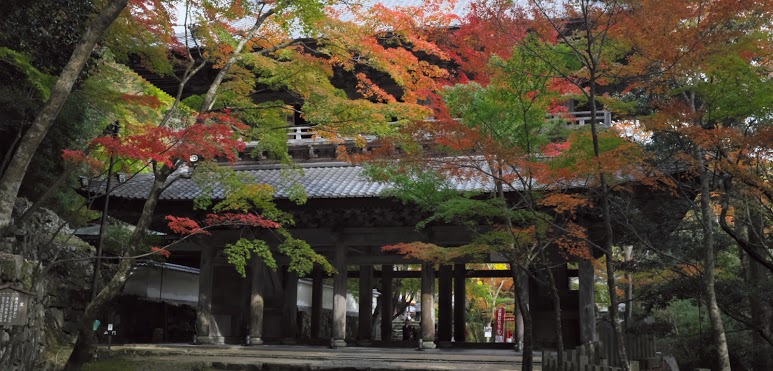
After passing through the main gate and climbing the stone steps, a magnificent temple gate appears. This gate was rebuilt during the Edo period and is characterized by the imposing construction typical of Zen Buddhist temples. Passing through the temple gate symbolizes entering the Buddhist world from the secular world, marking the beginning of the temple grounds.
On either side of the temple gate are Kongo Rikishi statues, watching over worshippers. During the autumn foliage season, the contrast between the temple gate and the autumn leaves creates a magnificent landscape.
Main Hall (Hojo)
Located in the center of the temple grounds, the main hall is a building rebuilt in the early Edo period with the support of Emperor Go-Mizunoo. Inside, the principal image, Kannon Bodhisattva, is enshrined. This Kannon statue, also known as “Yotsugi Kannon,” has attracted worshippers seeking blessings for conception and safe childbirth.
The interior of the main hall is filled with a simple yet solemn atmosphere, typical of a Zen Buddhist temple. The dragon painting on the ceiling and the sliding screen paintings are among its highlights. While normally a hidden Buddha and not open to the public, it is sometimes unveiled during special religious ceremonies.
Founder’s Hall
The Founder’s Hall, dedicated to the temple’s founder, Zen Master Jakushitsu Genko, is a particularly important building at Eigenji Temple. A wooden statue of the Zen Master is enshrined there, making it the spiritual center of Eigenji. Surrounded by autumn foliage, the Founder’s Hall offers a tranquil atmosphere for reflecting on the Zen Master’s virtues.
Gardens and Autumn Leaves
The greatest charm of Eigenji Temple is undoubtedly the beauty of its autumn leaves. Approximately 200 maple trees are planted throughout the temple grounds, and they all change color simultaneously in autumn. Combined with the flowing Aichigawa River, it creates a truly picturesque landscape. The autumn foliage, especially around the main hall and along the approach to the temple, is magnificent, and is typically at its best from mid- to late November. Visiting in the quiet early morning hours allows you to enjoy the beauty of the leaves illuminated by the morning sun all to yourself.
The temple grounds also feature a pond garden, where you can enjoy the beauty of nature throughout the seasons. It’s beautiful in the fresh green season, the deep green of summer, and the snowy landscape of winter, making it worth visiting year-round.
Cultural Properties
Important Cultural Properties
Eigenji Temple houses several valuable cultural properties designated as Important Cultural Properties of Japan.
The Portrait of Jakushitsu Genko (painted on silk)** is a portrait of the temple’s founder, Zen Master Jakushitsu Genko, and is highly regarded as an excellent portrait from the Nanboku-cho period. It beautifully captures the appearance and spirituality of the Zen master.
The Eigenji Documents** are a valuable collection of historical materials that convey the history of the temple from the medieval to the early modern period. They include documents showing the temple’s relationship with the Sasaki clan and Emperor Go-Mizunoo, making them important materials for historical research. ### Other Temple Treasures
In addition to its Important Cultural Properties, Eigenji Temple possesses many other treasures. As befits a Zen Buddhist temple, it houses numerous cultural artifacts of high spiritual significance, including calligraphy, tea ceremony utensils, and Buddhist art.
These cultural artifacts are usually stored in the temple’s treasure hall, but they can sometimes be viewed during special public viewings.
Main Events
Regular Events
Eigenji Temple holds various Buddhist events throughout the year.
Zen meditation sessions are held regularly and are open to the public. Many participants attend, seeking a valuable opportunity to experience Rinzai Zen meditation. Beginner-friendly instruction is available, so even those new to Zen meditation can participate with confidence.
Buddhist memorial services are held throughout the year, including important services such as the founder’s memorial service. The founder’s memorial service, held on the anniversary of the death of Zen Master Jakushitsu Genko, is one of the most important events at Eigenji Temple.
Seasonal Events
During the autumn foliage season, special viewings are sometimes held. Areas normally closed to the public may be opened, and nighttime illuminations may be implemented, allowing visitors to enjoy the autumn leaves in a different, more magical way than during the daytime.
About the Eigenji School
The Eigenji School of Rinzai Zen Buddhism is one of the 15 head temples of the Rinzai and Obaku schools, and continues to uphold its own unique lineage. With Eigenji Temple as its head temple, it is a branch school with 127 branch temples throughout Japan.
The characteristic of the Eigenji School lies in its strict Zen style inherited from Zen Master Jakushitsu Genko. It emphasizes training centered on seated meditation and continues to uphold its tradition as an ancient training ground praying for peace and security throughout the land.
While its branch temples are mainly distributed in the Kinki region, they are also spread throughout Japan, and the teachings of the Eigenji School are widely disseminated.
Access Information
Location
41 Takano-cho, Eigenji, Higashiomi City, Shiga Prefecture 527-0212
Access by Train and Bus
From JR Tokaido Main Line “Omihachiman Station” or “Notogawa Station”
Take the Omi Railway Bus bound for “Eigenji Bus Depot,” get off at the last stop “Eigenji Bus Depot,” and walk for approximately 15 minutes.
From Omi Railway “Yokaichi Station”
Take the Omi Railway Bus bound for “Eigenji Bus Depot,” get off at the last stop, and walk for approximately 15 minutes.
During the autumn foliage season, extra buses may be added, but congestion is expected, so we recommend allowing ample time for your journey.
Access by Car
From Meishin Expressway “Yokaichi IC”
Approximately 20 minutes via National Route 421
From Shin-Meishin Expressway “Koga-Tsuchiyama IC”
Approximately 30 minutes via National Route 421
There are several paid parking lots near the temple. It gets very crowded during the autumn foliage season, so we recommend visiting early in the morning. The surrounding roads can also be congested, so please allow ample time for your journey.
Visiting Hours and Admission Fees
Visiting Hours
9:00 AM – 4:00 PM (may vary depending on the season)
Admission Fees
Adults: 500 yen
Junior and Senior High School Students: 300 yen
Elementary School Students and younger: Free
(Fees may change during the autumn foliage season)
Nearby Attractions
Mountain Village Landscape of Okueigenji
Behind Eigenji Temple lies a beautiful mountain village landscape that can be described as a quintessential Japanese scene. This region, designated as a Japan Heritage site as “The Mountain Village Landscape of Eigenji and Okueigenji,” still thrives with its traditional lifestyle and culture.
It is also known as a production area for Mandokoro tea, producing high-quality Japanese tea. The mountainous landscape of tea plantations soothes the souls of visitors.
Aichigawa Valley
The valley of the Aichigawa River, which flows around Eigenji Temple, is a spot where you can enjoy the beauty of nature in every season. The scenery, woven from clear streams, rocks, and abundant vegetation, is perfect for hiking and driving.
Guidelines for Visiting
Clothing and Items to Bring
Because Eigenji Temple is located in a mountainous area, the temperature is lower than in urban areas. It can get particularly chilly during the autumn foliage season, so it is recommended to bring a jacket.
There are many stone steps and slopes within the temple grounds, so comfortable walking shoes are recommended. Particular caution is needed during rainy weather and the autumn foliage season, as the ground can be slippery.
Regarding Photography
Photography is generally permitted within the temple grounds, but there are some areas where photography is prohibited, such as inside the main hall. Also, please refrain from using tripods during crowded times, as this may inconvenience other visitors.
Tips for Avoiding Crowds
The temple is extremely crowded during the peak of the autumn foliage season (mid-to-late November weekends). For those who wish to visit in peace, we recommend visiting on weekdays or early in the morning. Arriving around 8 AM, in particular, allows for a relatively leisurely stroll through the grounds.
To Fully Enjoy the Charm of Eigenji Temple
The true charm of Eigenji Temple lies not merely in its status as a tourist destination, but in its spirituality as a Zen training ground. While being captivated by the beauty of the autumn leaves is wonderful, a deeper experience can be gained by quietly practicing Zen meditation or calming your mind while walking through the temple grounds.
We recommend spending your time slowly, listening to the sounds of nature: the clear waters of the Aichigawa River, the rustling of trees in the wind, the chirping of birds. Eigenji Temple offers an ideal space to escape the hustle and bustle of modern society and regain inner peace.
Eigenji Temple displays a different face in each of the four seasons. It’s a temple worth visiting throughout the year, not only in autumn with its vibrant foliage, but also in spring with its fresh green leaves, summer with its deep green foliage, and winter with its snowy landscapes. Each visit will offer new discoveries and unforgettable experiences.
With a history spanning over 660 years since the Nanboku-cho period, Eigenji Temple offers a space where its long history, tradition, and natural beauty blend seamlessly, allowing you to experience the depth of Japanese spiritual culture.