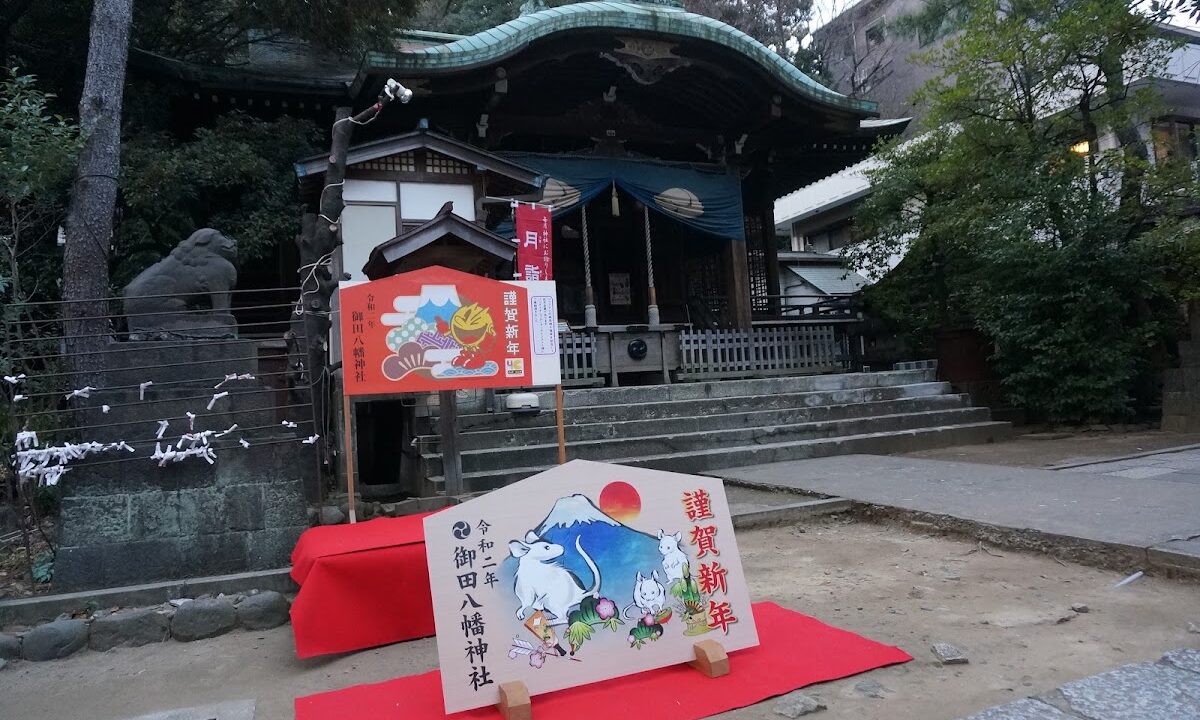
Complete Guide to Mita Hachiman Shrine (Minato Ward, Tokyo) | 1300 Years of History, Goshuin (Shrine Seal), and Access Information
Mita Hachiman Shrine, located in Mita, Minato Ward, Tokyo, is a venerable shrine with a history of over 1300 years, said to have been founded in 709 AD. Known as a candidate for the Engishiki-listed Hieda Shrine, it has long been revered as a guardian deity of eastern Japan. Situated between Shinagawa and Tamachi stations, this shrine, nestled in a modern business district, attracts many worshippers seeking good fortune and career advancement.
History of Mita Hachiman Shrine
Founding and Origin
The founding of Mita Hachiman Shrine dates back to 709 AD. Initially, it was enshrined as a guardian deity of eastern Japan in Makioka, Musashi Province (believed to be near the present-day Hieda Shrine). This period corresponds to the early Nara period, a time when the Ritsuryo state was strengthening its control over eastern Japan.
Originally called “Hieda Shrine,” it is considered a candidate for the “Hieda Shrine in Toshima District, Musashi Province” listed in the Engishiki Jinmyocho (compiled in 927). The Engishiki-listed shrines are highly prestigious, with 2,861 listed nationwide, reflecting the long history and status of Mita Hachiman Shrine.
Relocation to Mita and the Clan Deity of the Watanabe Clan
In 1011 (Kankō 8), the shrine was relocated to Mita in Musashi Province. This relocation led to it being revered as the clan deity of the Watanabe clan of the Saga Minamoto clan. The Watanabe clan was a samurai group descended from Watanabe Tsuna, known as one of Minamoto no Yorimitsu’s Four Heavenly Kings. While based in Watanabe, Settsu Province (present-day Osaka City), they also extended their influence into Musashi Province.
From this period onward, the shrine also came to be popularly known as “Tsuna Hachiman,” and its character as a shrine that attracted the faith of samurai warriors strengthened. Watanabe no Tsuna is a figure known for numerous heroic deeds, such as slaying demons at Mt. Oe and severing a demon’s arm at Rashomon Gate, and the shrine’s prestige increased as the tutelary deity of his descendants.
Changes in the Edo Period
Mita Hachiman Shrine underwent several relocations during the Edo period. In 1628 (Kanei 5), it was established at its current location. This period marked a time of stability for the Edo shogunate and the full-scale development of Edo’s urban area. The Mita area, located south of Edo Castle, developed as a key transportation hub near the Tokaido road.
Throughout the Edo period, the shrine attracted the faith of local residents as the guardian shrine of the Mita, Shiba, and Shibaura areas. It was managed as a temple and maintained a form of syncretism between Shinto and Buddhism.
Development Since the Modern Era
With the arrival of the Meiji era, the Shinto-Buddhist Separation Order led to the abolition of the temple that managed the shrine, and a system of management by Shinto priests was established. In 1869 (Meiji 2), it was named “Hieda Shrine,” and in 1872 (Meiji 5), it was ranked as a local shrine. In 1874 (Meiji 7), it was renamed “Mita Hachiman Shrine,” and then in 1897 (Meiji 30), the name was changed back to “Mita Hachiman Shrine,” reverting “Mita” to its former name, “Mita,” resulting in its current name.
In May 1945 (Showa 20), the shrine suffered significant damage during the Tokyo air raids, with the shrine buildings being completely destroyed. However, the shrine buildings were rebuilt in 1954 (Showa 29), and it remains so to this day. Even through the Heisei and Reiwa eras, it continues to be an important shrine in Minato Ward, serving as a spiritual pillar for the community.
Deities and Divine Virtues
Main Deity: Hondawake-no-Mikoto
The main deity of Mita Hachiman Shrine is Hondawake-no-Mikoto, also known as Hachiman-sama. This deity is a deification of Emperor Ojin, the 15th emperor, and is widely worshipped as the god of military fortune and victory. Hachiman worship has spread throughout Japan, and Hachiman shrines and Hachiman-gu are one of the most numerous types of shrines in Japan.
Enshrined Deities
Along with the main deity, the following two deities are enshrined:
Amenokoyane-no-Mikoto
This deity appears in the Amano-Iwato myth and is known as the god of prayers and learning. He is also the main deity of Kasuga Taisha Shrine and has been revered as the tutelary deity of the Fujiwara clan.
Takenouchi no Sukune no Mikoto
A legendary loyal retainer said to have served five emperors, from Emperor Keiko to Emperor Nintoku, he is worshipped as a god of longevity, success, and good fortune.
Divine Virtues
Based on these enshrined deities, the following divine virtues are believed to be associated with the Mita Hachiman Shrine:
- Victory and Long-Lasting Military Fortune: As a divine virtue of Hachiman, the power to overcome challenges and difficulties in competitions.
- Career Advancement and Good Fortune: As a divine virtue of Takenouchi no Sukune no Mikoto, success in work and advancement in life.
- Academic Achievement: As a divine virtue of Amenokoyane no Mikoto, improvement in academics.
- Protection from Misfortune and Good Fortune: The protective power as a god of protection for the eastern provinces.
- Family Safety and Business Prosperity: Divine virtue as the guardian shrine of the region.
Located in the business district of Shinagawa and Tamachi, this shrine is frequently visited by business people praying for improved career prospects and successful business negotiations.
Highlights of the Shrine Grounds
Shrine Buildings
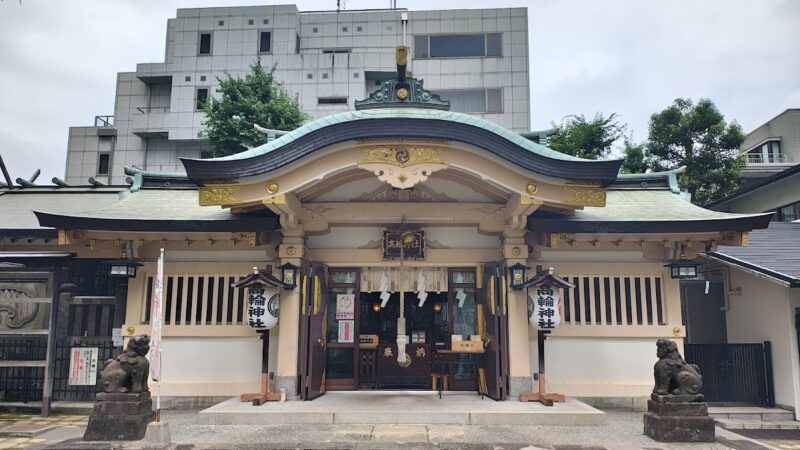
The current shrine buildings were rebuilt in 1954. They were a reconstruction of the shrine lost in the war, and while made of reinforced concrete, they follow the traditional style of shrine architecture. The worship hall has a hipped roof, and the main sanctuary is in the nagare-zukuri style.
Torii Gate and Approach
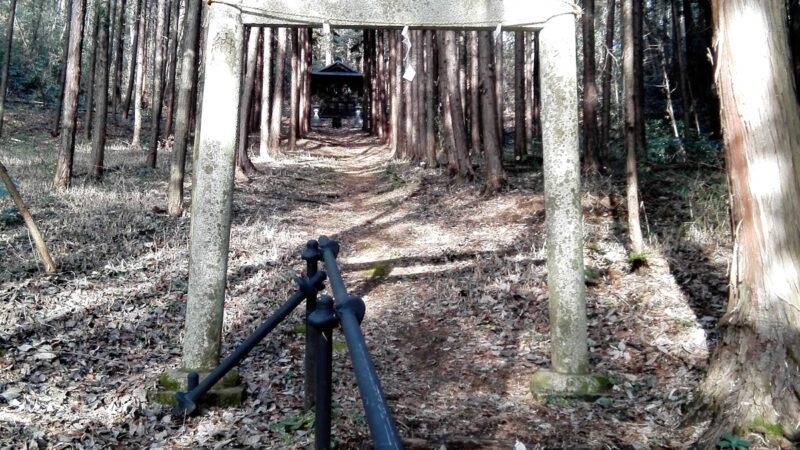
The shrine is located on a hillside slightly off the Tokaido (Dai-ichi Keihin). Its unique location is characterized by its elevation from the former coastline of the Tokaido to the hilly area. Upon entering the grounds after climbing the stone steps, one is enveloped in a tranquil atmosphere.
Subsidiary Shrines
Several subsidiary shrines are enshrined within the grounds, attracting worship of various deities. Each of these subsidiary shrines also attracts the faith of local people.
Sacred Trees and Nature
Despite being a shrine in the heart of the city, the grounds retain abundant greenery. The sacred trees and other trees welcome visitors, creating a space that allows them to forget the hustle and bustle of the city.
Goshuin (Shrine Seal) Information
Features of the Goshuin
At Mita Hachiman Shrine, you can receive a standard goshuin. The goshuin will have the words “Mita Hachiman Shrine” written in ink and stamped with the shrine’s seal. In some cases, it may be written directly into your goshuin book instead of being a pre-printed one (this depends on the crowd).
The offering fee for a goshuin is usually around 300 to 500 yen.
Goshuin Book
Mita Hachiman Shrine also offers its own original goshuin book. The design reflects the history and characteristics of the shrine, making it a popular souvenir of your visit.
Reception Hours
The reception hours for goshuin are generally from 9:00 AM to 5:00 PM, but these may change due to religious ceremonies or events. If you want to be sure to receive a goshuin, it is recommended to check with the shrine in advance.
Annual Events and Festivals
Grand Festival
The Grand Festival of Mita Hachiman Shrine is held annually around August 15th. This festival is an important local event, celebrated grandly by the entire parish community. Traditional festival rituals, such as the portable shrine procession and offering ceremonies, are preserved.
New Year’s Visit
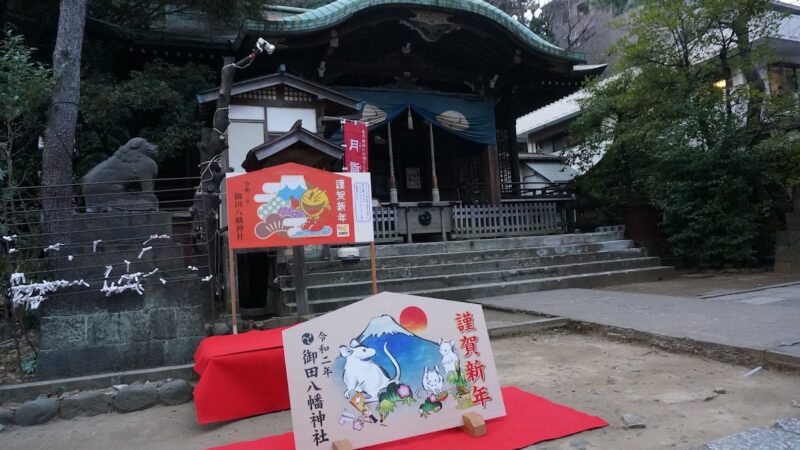
Many worshippers visit the shrine for their first shrine visit of the new year. As a major shrine in Minato Ward, it attracts not only local residents but also people working in nearby offices who come to pray for the new year.
Other Annual Events
- Saitansai (January 1st): A festival celebrating the New Year
- Setsubunsai (around February 3rd): Events such as bean-throwing
- Natsukoshi no Oharae (June 30th): A Shinto ritual to purify oneself of sins and impurities accumulated over the past six months
- Shichi-Go-San (November): An event celebrating the growth of children
- Toshikoshi no Oharae (December 31st): A Shinto ritual to purify oneself of sins and impurities accumulated over the past year
These events also serve as opportunities to deepen the bonds of the local community.
Relationship between the Parishioner Area and the Community
Vast Parishioner Area
The parishioner area of Mita Hachiman Shrine is extremely vast, encompassing Mita, Shiba, Shibaura, Konan, and Takanawa. These areas include historical areas dating back to the Edo period and reclaimed land from the Meiji era onward, resulting in a community where long-time residents and new residents coexist.
Connection to Modern Minato Ward
Located midway between JR Shinagawa Station and JR Tamachi Station, the area surrounding Mita Hachiman Shrine has become a modern business district lined with high-rise office buildings and condominiums. Large-scale developments such as Shinagawa Season Terrace have also progressed, significantly changing the local landscape.
However, even amidst these changes, Mita Hachiman Shrine has continued to protect the Shinagawa area for over 1300 years, remaining a valuable presence that conveys the history and traditions of the region to the present day.
Center of the Local Community
Shrines serve not only as places of worship but also as centers of the local community. Through festivals and annual events, they become places for interaction among local residents, playing a role in deepening community bonds.
Access and Visiting Information
Location
Address: 3-7-16 Mita, Minato-ku, Tokyo
Access by Train
Mita Hachiman Shrine is accessible from multiple train lines.
Nearest Stations:
- Mita Station (Toei Mita Line/Asakusa Line): Approximately 7 minutes on foot (Exit A9)
- Sengakuji Station (Toei Asakusa Line): Approximately 8 minutes on foot (Exit A2)
- Tamachi Station (JR Yamanote Line/Keihin Tohoku Line): Approximately 10 minutes on foot (West Exit)
- Shinagawa Station (JR Yamanote Line/Keihin Tohoku Line): Approximately 15 minutes on foot (Takanawa Exit)
Mita Station or Sengakuji Station on the Toei Mita Line/Asakusa Line are the closest and most convenient. Tamachi Station is also within walking distance, and Shinagawa Station is also within walking distance.
Access by Car
Located along Dai-ichi Keihin (National Route 15), access by car is possible, but dedicated parking is limited. There are coin-operated parking lots nearby, which you will need to use. Due to its central location, we recommend using public transportation.
Visiting Hours
While you can generally visit the shrine grounds freely, the shrine office is open from approximately 9:00 AM to 5:00 PM. If you wish to receive a Goshuin (shrine stamp) or other items, it is recommended to visit within these hours.
Estimated Time Required for Visiting
The shrine grounds are not very large, so a visit itself can be completed in about 15 minutes. If you wish to leisurely explore the grounds and receive a Goshuin, it is advisable to allow about 30 minutes.
Nearby Attractions
Kamezuka Park
Kamezuka Park is located near Mita Hachiman Shrine. The hilly area where this park is situated is a valuable location that preserves the former topography, forming a historical landscape together with the shrine.
Keio University
The Mita Campus is nearby, and many students can be seen in this area. The historical buildings of Keio University are also a point of interest.
Shinagawa Season Terrace
This large-scale office and commercial complex, recently developed, offers a modern urban experience. You can feel the unique characteristics of Minato Ward, where old shrines and new developments coexist.
Sengaku-ji Temple
This temple, accessible from Sengaku-ji Station, is associated with the Ako Forty-Seven Ronin. Many people visit it along with Mita Hachiman Shrine.
Manners and Points for Visiting a Shrine
Basic Worship Etiquette
- Bow before passing through the torii gate: This is a courtesy before entering the sacred area.
- Purify yourself at the water basin: Purify your left hand, right hand, and mouth in that order.
- Worship at the main hall: The basic method is two bows, two claps, one bow (two bows, two claps, one bow).
- Visit the subsidiary shrines: If you have time, visit the subsidiary shrines as well.
- Bow upon leaving: Turn around and bow before leaving the torii gate.
Regarding Photography
Photography is generally permitted on the shrine grounds, but you should refrain from taking pictures inside the shrine buildings or during Shinto rituals. Please be considerate of other worshippers. ### Attire
While casual attire is acceptable for visiting, it is preferable to dress appropriately, as it is a sacred place. Especially when formally visiting or receiving prayers, please dress appropriately.
The Charm of Mita Hachiman Shrine
A Witness to History Remaining in the Heart of the City
The greatest charm of Mita Hachiman Shrine is that, despite its long history of over 1300 years, it continues to stand in the heart of modern Tokyo. While the surrounding area has transformed into a business district lined with skyscrapers, the shrine remains unchanged, watching over the community.
Status as an Engishiki-Listed Shrine
As a candidate for the “Hieda Shrine” listed in the Engishiki Jinmyocho (a list of shrines compiled in the Heian period), it is a shrine with ancient status. Among the many shrines throughout Japan, Engishiki-listed shrines hold a special position, and their historical value is extremely high.
Guardian Deity of Business Professionals
As a god of victory and career advancement, it is a reassuring presence for modern business professionals. Many people working in the Shinagawa and Tamachi areas visit this shrine to pray for success in their work and the successful completion of business negotiations. As an oasis in the heart of the city, it serves as a place to calm the mind amidst the hustle and bustle of daily life.
Bonds of the Local Community
With a vast parish area, the shrine plays a vital role in deepening community bonds through annual events, including the annual festival. In Minato Ward, where new and old residents coexist, the shrine is an important presence that conveys the history and traditions of the region.
Summary
Mita Hachiman Shrine is a historic shrine that has protected the Mita area of Minato Ward, Tokyo, for over 1300 years since its founding in 709 AD. It has long been revered as a candidate for the Engishiki-listed Hieda Shrine and as a guardian deity of eastern Japan.
After several relocations, the shrine was established in its current location in 1628 (Kanei 5). As the tutelary deity of the Watanabe clan of the Saga Minamoto family and the guardian deity of the region, it has attracted the faith of people across generations. Having overcome the hardship of being destroyed by fire during wartime, the shrine building, rebuilt in 1954 (Showa 29), continues to welcome many worshippers.
The Mita Hachiman Shrine, with Hachiman-no-Mikoto (Homudawake-no-Mikoto) as its main deity, and Amenokoyane-no-Mikoto and Takeuchi-no-Sukune-no-Mikoto as secondary deities, is known for its divine blessings of victory, career advancement, and academic success, and is particularly popular among business people working in the Shinagawa and Tamachi areas.
Conveniently located within walking distance of Mita Station and Sengakuji Station on the Toei Mita and Asakusa subway lines, it is also accessible from JR Tamachi and Shinagawa Stations. Shrine seals (Goshuin) are available, and annual events, including the annual festival, are held.
In the modern Minato Ward, lined with skyscrapers, Mita Hachiman Shrine is a precious place that conveys history and tradition to the present day. Why not visit this shrine, which has protected the Shinagawa area for over 1300 years, and feel the weight of its history and tranquil atmosphere? Whether you visit during a break from work or for a leisurely visit on your day off, you are sure to have a peaceful moment.