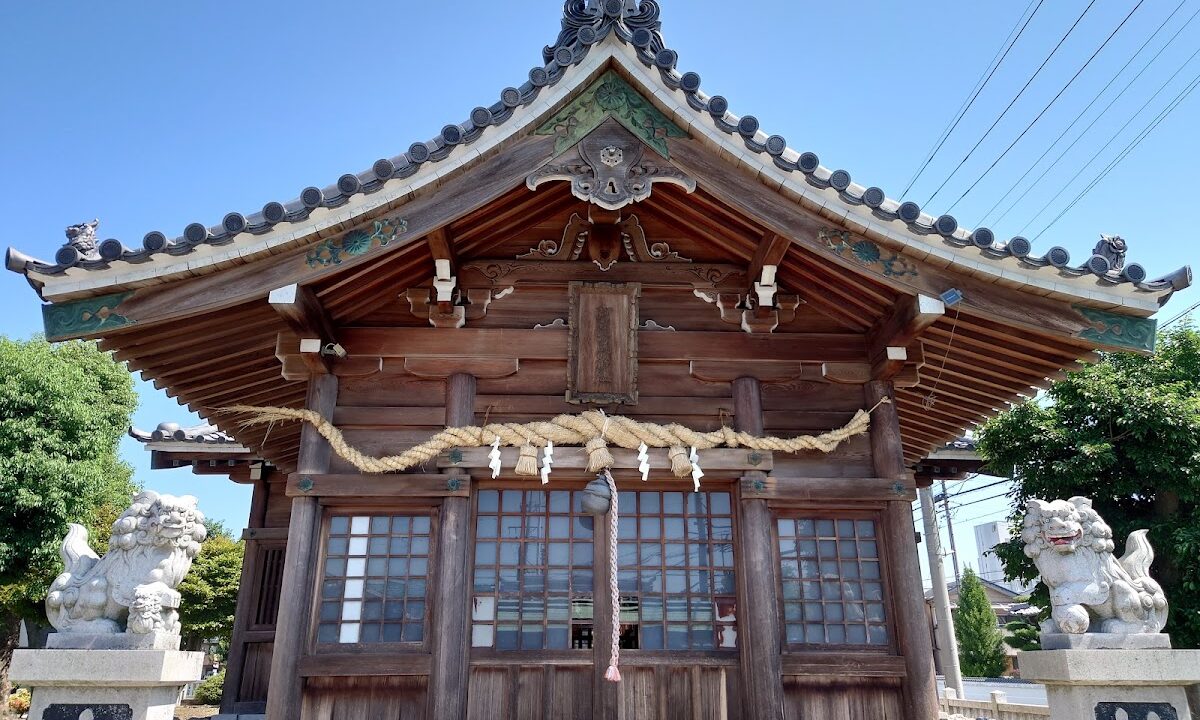
Azura Shrine (Ichinomiya City, Aichi Prefecture) Complete Guide | History, Benefits, and Access Information for this Shikinaisha Shrine
Azura Shrine, located in Azura, Ichinomiya City, Aichi Prefecture, is a venerable ancient shrine with a history of approximately 2000 years, listed in the Engishiki Jinmyocho (a list of shrines compiled in the Heian period). It is said to be the second oldest shrine in Aichi Prefecture after Masumida Shrine, and has continued to attract the faith of the local community. This article comprehensively introduces information you should know before visiting Azura Shrine, including its detailed history, the origin of its enshrined deities, its benefits, highlights within the grounds, and access methods.
Basic Information about Azura Shrine
Azura Shrine is located at 1-7-19 Azura, Ichinomiya City, Aichi Prefecture, and is a prestigious shrine that was ranked as a Gosha (village shrine) under the modern shrine ranking system.
Basic Data
- Location: 1-7-19 Azura, Ichinomiya City, Aichi Prefecture
- Former Shrine Rank: Gosha (Village Shrine)
- Shikinaisha (Shrine listed in the Engishiki): Azura Shrine (minor shrine) in Niwa District, Owari Province
- Main Deity: Amenomikatsuhime-no-Mikoto
- Founding: Said to be in the 57th year of Emperor Suinin’s reign (28 AD)
- Annual Festival Day: September 7th
The nearest station is Myokoji Station on the Meitetsu Nagoya Main Line, about a 30-minute walk away. It is about 4 kilometers southeast of Owari-Ichinomiya Station on the JR Tokaido Main Line.
History
Ancient Founding and Records in the Owari Province Fudoki
According to shrine tradition, Azura Shrine was founded in the 57th year of Emperor Suinin’s reign (28 AD). This shrine dates back to the late Yayoi period, before the Kofun period, and is considered one of the oldest shrines in Aichi Prefecture. It is also said to have the second oldest history in the prefecture, after Masumida Shrine.
The *Owari no Kuni Fudoki*, compiled during the Nara period, contains descriptions of Azura-ri in Niwa District, suggesting that this area was an important site of worship from ancient times. Approximately 1 kilometer north of the current location lies the Mamizuka site, a ritual site dating from the Jomon to Kofun periods, and some theories suggest this may be the former site of Azura Shrine.
Status as a Shikinaisha (Shrine Listed in the Engishiki)
The *Engishiki Jinmyocho*, compiled in the 5th year of the Enchō era (927 AD) during the Heian period, clearly lists “Azura Shrine” as a shrine in Niwa District, Owari Province. This is important evidence that it is a historically significant shrine officially recognized by the imperial court.
Furthermore, the “Owari Province Shrine Register,” believed to have been compiled in the mid-Heian period, lists the shrine as “Junior First Rank Azura Myojin,” indicating that it was granted the extremely high rank of Junior First Rank. This suggests that Azura Shrine was a central place of worship in the region and was highly valued by the imperial court.
Transition from the Medieval to the Early Modern Period
While records from the medieval period are fragmentary, there are records indicating that the shrine buildings were rebuilt during the Tensho era (1573-1592), after the turbulent Sengoku period. This was a turbulent time, with Oda Nobunaga unifying Owari and the era of Toyotomi Hideyoshi beginning, but local faith continued uninterrupted.
During the Edo period, the shrine was revered as the tutelary deity of the region, attracting many worshippers from surrounding villages. Around this time, its relationship with Hanachoue Shrine and Hanachoshimo Shrine deepened, and a custom was established where the two shrines alternately held festivals on September 7th each year. A tradition arose that the deities of the two shrines were a married couple, and this was deeply rooted in the local religious life.
Developments since the Modern Era
In the Meiji era, under the modern shrine ranking system established by the Meiji government, it was ranked as a Gosha (village shrine). This was a higher rank than a Sonsha (village shrine), signifying recognition as a central shrine in a region spanning multiple villages.
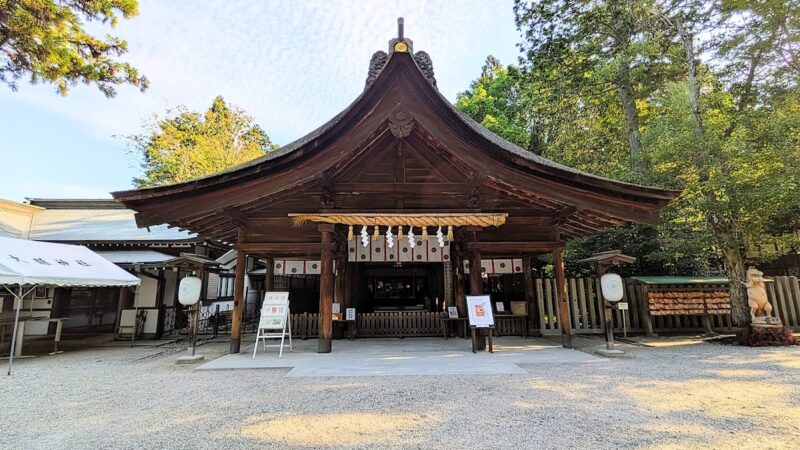
Even after the Meiji era, it continued to attract worshippers as the local tutelary deity, and its history and traditions have been carefully preserved through the Showa, Heisei, and Reiwa eras. The current shrine building has an open atmosphere bathed in bright sunlight, and many tree stumps remain, indicating the once lush shrine forest.
About the Deity, Amenomikatsuhime-no-Mikoto
About Amenomikatsuhime-no-Mikoto
The main deity of Azura Shrine is Amenomikatsuhime-no-Mikoto, also known as Amamikatsuhime. This deity is a goddess appearing in the *Izumo Fudoki* (ancient record of Izumo Province), and her worship in the Owari region is relatively rare.
Ame-no-Mikatsuhime-no-Mikoto’s name, “Mikatsu,” is believed to be related to sacred jars and vessels. In ancient times, jars and vessels were important containers for storing water, sake, and other liquids, and were deeply associated with fertility and vitality.
A Unique Deity Among Shikinaisha Shrines
While many Shikinaisha shrines in Owari Province enshrine deities related to Amaterasu-Omikami or the Owari clan, the fact that Azura Shrine enshrines a goddess of Izumo origin is noteworthy. This provides an important clue suggesting cultural and religious exchange between Izumo and Owari in ancient times.
One theory suggests that Izumo clans who migrated to this region may have enshrined the gods of their homeland. Alternatively, it’s possible that beliefs related to water and agriculture were transmitted from Izumo and became established as worship of Ame-no-Mikatsuhime-no-Mikoto.
Origin of the Shrine Name “Azura”
The most likely explanation for the shrine name “Azura” is that it originated from “Azura.” Azura refers to a plant-based headdress worn during Shinto rituals in ancient times—a flower crown or an ornament woven from vines.
This name indicates a sacred place of worship, making it a valuable place name and shrine name that conveys ancient forms of worship. The place name “Azura” also derives from the shrine’s name, indicating that this region has been a center of faith since ancient times.
Benefits and Faith
Miraculous Healing of Deafness
Azura Shrine has been known since ancient times for its miraculous healing of deafness. It was widely believed that people suffering from hearing loss or speech impairment would be cured after praying at this shrine.
The origin of this belief is said to be related to the divine nature of Ame-no-Mikatsuhime-no-Mikoto. The “tsu” in “Mikatsu” means port or waterside, and can also be interpreted as the flow of sound or words, thus it is thought to be associated with blessings related to hearing and language.
Other Blessings
Besides healing from deafness, Azura Shrine is said to offer the following blessings:
- Health and Longevity: As an ancient shrine with a long history, it is believed to bring blessings of vitality and health.
- Abundant Harvest: As a guardian deity of agricultural areas, it is believed to bring prayers for a bountiful harvest.
- Family Safety: As a local tutelary deity, it is believed to bring safety and prosperity to families.
- Protection from Evil: Located in the northeast direction (the “demon’s gate”), it is also believed to offer protection against evil.
Highlights of the Shrine Grounds
Atmosphere of the Shrine and Grounds
The grounds of Azura Shrine were once covered with a lush forest, but now there are almost no trees, creating an open space bathed in bright sunlight. Numerous tree stumps remain on the shrine grounds, hinting at the former scale of the shrine’s grove.
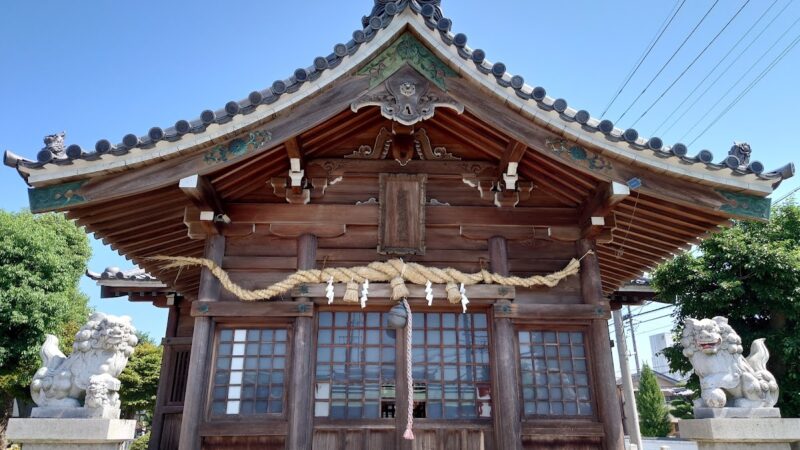
The shrine building, though simple, possesses a dignified presence, conveying the weight of its history as a Shikinaisha (a shrine listed in the Engishiki, an ancient Japanese legal code). The architectural style of the main hall exhibits characteristics of shrine architecture in the Owari region, making it valuable as a regional cultural asset.
Banpei (District Wall)
Azura Shrine features a banpei, a type of fence characteristic of shrines in the Owari region. A banpei is a screen wall built along the approach to a shrine, serving as a boundary separating the sacred area from the secular world.
This banpei, seen in many Owari shrines including Masumida Shrine, is an important element demonstrating the unique shrine architectural culture of this region. The banpei at Azura Shrine is also a symbolic presence, guiding worshippers into a sacred space.
Parking and Worship Facilities
Parking for worshippers is located across the road from the shrine. The shrine grounds are well-maintained and equipped with basic facilities such as a purification fountain and a shrine office.
The grounds are relatively compact, but this contributes to a quiet and peaceful environment for worship. In the midst of the increasingly urbanized city of Ichinomiya, it is a valuable space where one can feel a sense of history.
Related Shrines in the Surrounding Area
Relationship with Hanachoue Shrine and Hanachoshimo Shrine
Hanachoue Shrine and Hanachoshimo Shrine have a deep connection with Azura Shrine. There is a tradition that these two shrines alternately hold festivals on September 7th each year.
There is also a belief that the deities of the two shrines are a married couple, and the relationship between these three shrines, including Azura Shrine, is an important clue to understanding the form of faith in this region. Currently, the detailed history of Hanachoue Shrine and Hanachoshimo Shrine is not clear, but it is certain that they formed a long-standing network of local faith.
Location in relation to Masumida Shrine
Masumida Shrine, the main guardian shrine of Ichinomiya City, is located approximately 4 kilometers northwest of Azura Shrine. Masumida Shrine, as the Ichinomiya (first-ranked shrine) of Owari Province, is even more prestigious than Azura Shrine, but Azura Shrine, as a Shikinaisha (a shrine listed in the Engishiki), also had its own unique sphere of influence.
Directional Relationship with Kuta Shrine and Owari Okunitama Shrine
Interestingly, Azura Shrine is located in the northeast direction (kimon) from the perspective of Kuta Shrine and Owari Okunitama Shrine (Konomiya). The kimon is the northeast direction, considered in Onmyodo (Japanese esoteric cosmology) to be a direction where evil spirits easily enter, and important shrines were sometimes located there.
This location is not a coincidence, suggesting that Azura Shrine may have played a role in warding off evil and providing protection within the ancient urban planning and religious system.
Relationship between the Mamizuka Site and Azura Shrine
Mamizuka as a Ritual Site
Approximately 1 kilometer north of the current Azura Shrine lies an important archaeological site called the Mamizuka Site. This site is known as a ritual site dating from the Jomon period to the Kofun period, indicating that this region was a religious center for a long period. The archaeological site has yielded pottery and stone tools believed to have been used in rituals, confirming evidence that ancient people worshipped deities in this area.
The Theory of the Former Site of Azura Shrine
There is a theory that the Mamizuka site is the former site of Azura Shrine. According to shrine tradition, the original location of Azura Shrine is approximately 200 meters north of its current location, but including the Mamizuka site further north brings the total distance to about 1 kilometer.
If the Mamizuka site was indeed the original site of Azura Shrine’s rituals, it reveals a historical progression: a belief system dating back to the Jomon period was organized into a shrine during the late Yayoi period under Emperor Suinin, and then relocated to its current location.
Access and Visiting Information
Access by Train
Using the Meitetsu Nagoya Main Line
- Get off at Myokoji Station, approximately 30 minutes on foot (approx. 2.4 km)
- Get off at Shima-Ujinaga Station, approximately 32 minutes on foot (approx. 2.6 km)
Using the JR Tokaido Main Line
- Get off at Owari-Ichinomiya Station, approximately 38 minutes on foot (approx. 3.1 km)
- Approximately 10 minutes by taxi from Owari-Ichinomiya Station
Since the temple is a considerable distance from the station, it is recommended to allow ample time if planning to visit on foot.
Access by Car
From Nagoya
- Approximately 15 minutes from the Meishin Expressway “Ichinomiya IC”
- Approximately 20 minutes from the Tokai-Hokuriku Expressway “Ichinomiya-Kisogawa IC”
Parking
- There is a parking lot for visitors on the opposite side of the road from the shrine.
- Spaces are limited, so caution is advised during busy periods such as New Year’s Day.
Visiting Hours and Precautions
- Visiting Hours: Generally open all day (Shrine office hours are irregular)
- Goshuin (Shrine Seal): Available during the hours the shrine office is open, but prior confirmation is recommended.
- Annual Festival: September 7th (Related events with Hanachoue Shrine and Hanachoshimo Shrine)
The shrine grounds are bright and open, but please visit with respect as it is a historical shrine.
Other Shikinaisha and Ancient Shrines in Ichinomiya City
If you visit Azura Shrine, we recommend visiting other Shikinaisha and ancient shrines in Ichinomiya City.
Masumida Shrine
A shrine of the highest status as the Ichinomiya (first-ranked shrine) of Owari Province. It enshrines Ame-no-Hoakari-no-Mikoto and has been revered since ancient times as the tutelary deity of the Owari clan. It is located approximately 4 km northwest of Azura Shrine.
Omiwa Shrine
One of the Shikinaisha (shrines listed in the Engishiki), this ancient shrine enshrines Omononushi-no-Kami. It is also said to have connections to Omiwa Shrine in Nara.
Asai Shrine
An ancient shrine located in Asai Town, it is revered as the local tutelary deity.
Visiting these shrines will allow you to gain a deeper understanding of the overall picture of ancient beliefs in the Owari region.
Cultural Value of Azura Shrine
Historical Importance as a Shikinaisha
Of the approximately 3,000 Shikinaisha nationwide, 121 (2 major shrines and 119 minor shrines) are listed in Owari Province. Azura Shrine is one of them, with a history of being officially recognized since the Heian period.
Being a Shikinaisha (a shrine listed in the Engishiki, an ancient Japanese legal code) is not simply a sign of age, but also evidence of its recognized status by the imperial court and its importance to the local community. Even today, this historical value is cherished as part of the region’s identity.
Significance of Worshipping Izumo-related Deities
Shrines that worship Izumo-related deities are a minority in the Owari region. The worship of Azuma-no-Mikoto at Azuma-no-Shrine is a valuable case study for researching ancient cultural exchange, clan migration, and the spread of beliefs.
In ancient Japanese history, Izumo and Owari were connected by sea routes, and it is known that there was technological exchange, such as ironworking and jade making. The existence of Azuma-no-Shrine can be considered a cultural heritage that conveys traces of such exchanges to the present day.
Inheritance of Local Beliefs
Azuma-no-Shrine, which has been protected by the local people for approximately 2000 years, is a fine example of how traditional Japanese forms of belief have been passed down to the present day. Its relationship with Hanacho-kami Shrine and Hanacho-shimo Shrine, and the festival on September 7th, demonstrate the unique local belief culture that still thrives today. ## Summary
Azura Shrine in Ichinomiya City, Aichi Prefecture, is a Shikinaisha (a shrine listed in the Engishiki) said to have been founded in the 57th year of Emperor Suinin’s reign, and is a venerable ancient shrine with a history of approximately 2000 years. It enshrines Ame-no-Mikatsuhime-no-Mikoto, a goddess of Izumo lineage, and has been known for its blessings of healing deafness and muteness.
Azura Shrine, which holds the status of being listed in the Engishiki Jinmyocho (a list of shrines compiled in the Heian period), is said to be the second oldest shrine in Aichi Prefecture after Masumida Shrine. Its connection to the Mamizuka ruins and its religious network with Hanachoue Shrine and Hanachoshimo Shrine provide important clues to understanding the ancient beliefs of Owari.
The bright and open grounds offer a valuable space to feel the historical atmosphere amidst the increasingly urbanized city of Ichinomiya. It is a recommended shrine not only for those interested in visiting Shikinaisha shrines and the ancient history of Owari, but also for those who wish to quietly experience history while worshipping.
When you visit Ichinomiya City, be sure to stop by Azura Shrine and reflect on this place of worship that has been passed down for over 2000 years.
Frequently Asked Questions (FAQ)
Q1: How do you pronounce Azura Shrine?
A1: It is pronounced “Azura Jinja.” The place name “Azura” is pronounced the same way, and is believed to have originated from the ancient plant ring called “azura.”
Q2: When was Azura Shrine founded?
A2: According to shrine tradition, it was founded in the 57th year of Emperor Suinin’s reign (28 AD). This falls in the late Yayoi period, making it one of the oldest shrines in Aichi Prefecture. It is also said to be the second oldest in the prefecture, after Masumida Shrine.
Q3: What kind of blessings can I expect?
A3: It has been known since ancient times for its miraculous power to cure deafness (inability to hear or speak). It is also believed to bring blessings for health and longevity, abundant harvests, family safety, and protection from evil.
Q4: What is a Shikinaisha?
A4: A Shikinaisha is a shrine listed in the Engishiki Jinmyocho (a list of shrines compiled in the Heian period), and refers to a historically significant shrine officially recognized by the imperial court. Azura Shrine is listed as a Shikinaisha in Niwa District, Owari Province, and has long been recognized as a shrine of high status.
Q5: Is there parking?
A5: Yes, there is a parking lot for visitors across the road from the shrine. However, there is a limited number of spaces, so caution is advised during busy periods such as New Year’s Day.
Q6: How is it accessible from the nearest station?
A6: It is approximately a 30-minute walk (about 2.4 km) from Myokoji Station on the Meitetsu Nagoya Main Line. It takes about 38 minutes (approximately 3.1 km) to walk from JR Owari-Ichinomiya Station, so we recommend considering using a car or taxi.
Q7: Can I get a Goshuin (temple/shrine stamp)?
A7: You can get one during the hours the shrine office is open, but since the hours are irregular, we recommend checking in advance.
Q8: What is the relationship between Hanachoue Shrine and Hanachoshimo Shrine?
A8: There is a tradition that the two shrines alternately hold festivals on September 7th every year, indicating a deep relationship. There is also a belief that the deities of the two shrines are a married couple, forming a regional faith network.
Q9: What is the relationship with the Mamizuka Ruins?
A9: The Mamizuka Ruins, located about 1 km north of the shrine, are a ritual site dating from the Jomon to Kofun periods, and there is a theory that it may be the former site of Azura Shrine. It is an important site that shows that this area was a center of faith from ancient times.
Q10: How long does it take to visit the shrine?
A10: The temple grounds are compact, so a typical visit takes about 15-20 minutes. If you want to take your time to look around the grounds and appreciate the history, you should allow about 30 minutes.